
A well-cured head of garlic is one of the best keepers in the kitchen garden, and also one of the easiest to ruin. Put it in the fridge and it sprouts, seal it in a damp bag and it molds, leave it on a sunny counter and it shrivels. Knowing how to store garlic comes down to three things: curing it properly after harvest, keeping whole bulbs cool, dry and airy, and treating peeled garlic (especially garlic in oil) as a perishable food with firm safety rules.
This page covers curing, whole-bulb storage and the temperature debate among extension specialists, hardneck versus softneck keeping times, peeled cloves, freezing, drying your own garlic powder, the botulism rules for garlic in oil, and how to tell when garlic has gone bad.
Quick answer: Cure freshly dug garlic in a shaded, airy spot for about 2 to 3 weeks, then store whole bulbs in mesh bags somewhere cool, dark and dry (about 60°F keeps them 3 to 5 months; commercial storage near 32°F keeps softnecks up to 9 months). Do not refrigerate whole heads, which sprouts them. Peeled cloves keep about a week in the fridge, and freeze or dry well. Fresh garlic in oil must be refrigerated and used within 4 days, or frozen; never keep it at room temperature.
In this guide
- How to store garlic: 6 methods compared
- How to cure garlic after harvest
- Storing whole bulbs: temperature, humidity and air
- How long does garlic last, by type
- What you’ll need to cure and store garlic
- Peeled and chopped garlic
- Can you freeze garlic? Three ways
- Drying garlic and making garlic powder
- Garlic in oil, wine or vinegar: the safety rules
- Signs garlic has gone bad
- Garlic storage FAQ
How to store garlic: 6 methods compared
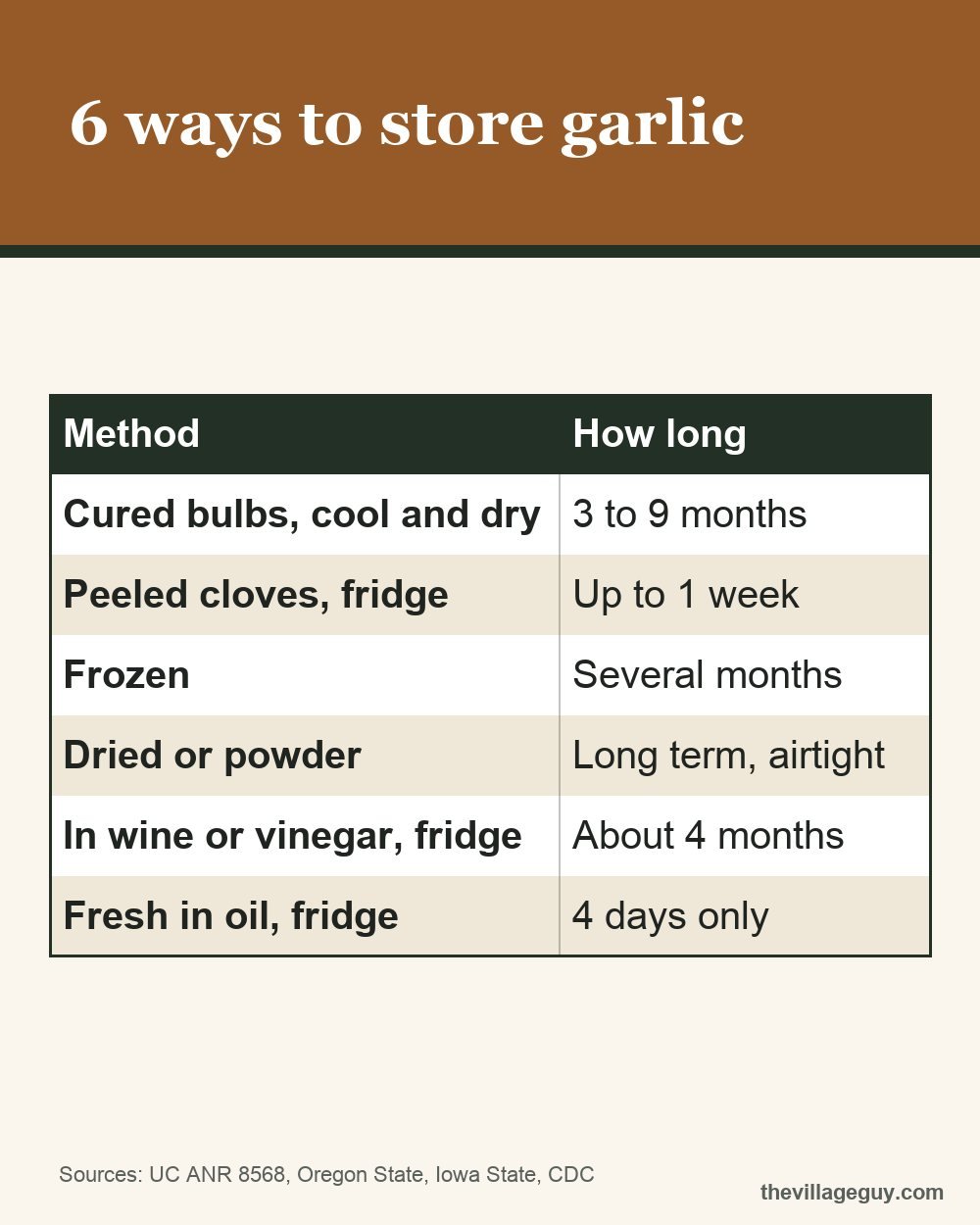
The right method depends on what form the garlic is in and how soon you will use it. This table pulls together the guidance from University of California, Oregon State, Iowa State and Washington State extension publications, plus the CDC on oil.
| Method | Best for | How long | Key rule |
|---|---|---|---|
| Whole cured bulbs, cool and dry | Your own harvest, bulk buys | 3 to 5 months at about 60°F; up to 6 (hardneck) or 9 (softneck) months near 32°F | Mesh bags, dark, airy, not the fridge |
| Peeled cloves in the fridge | This week’s cooking | Up to about 1 week | Covered container |
| Frozen (whole, chopped or pureed) | Surplus, damaged bulbs | Several months | Wrap tightly; freeze oil puree immediately |
| Dried slices or powder | Pantry seasoning | Long term in an airtight jar | Dry until crisp and snaps |
| Cloves in wine or vinegar | Flavored vinegar, quick use cloves | About 4 months refrigerated | Fridge only; discard if moldy |
| Fresh garlic in oil | Garlic oil, confit, puree | 4 days in the fridge, or freeze | Never at room temperature |
Canning is missing from the list on purpose. UC Agriculture and Natural Resources says canning garlic is not recommended: it is a low-acid vegetable that would need a pressure canner, it loses most of its flavor that way, and no tested processing times exist.
How to cure garlic after harvest
Curing is the slow drying that seals each bulb in papery wrappers so it does not rot in storage. If you grow your own, our guide to planting garlic covers timing the harvest; this section picks up the day the bulbs come out of the ground.
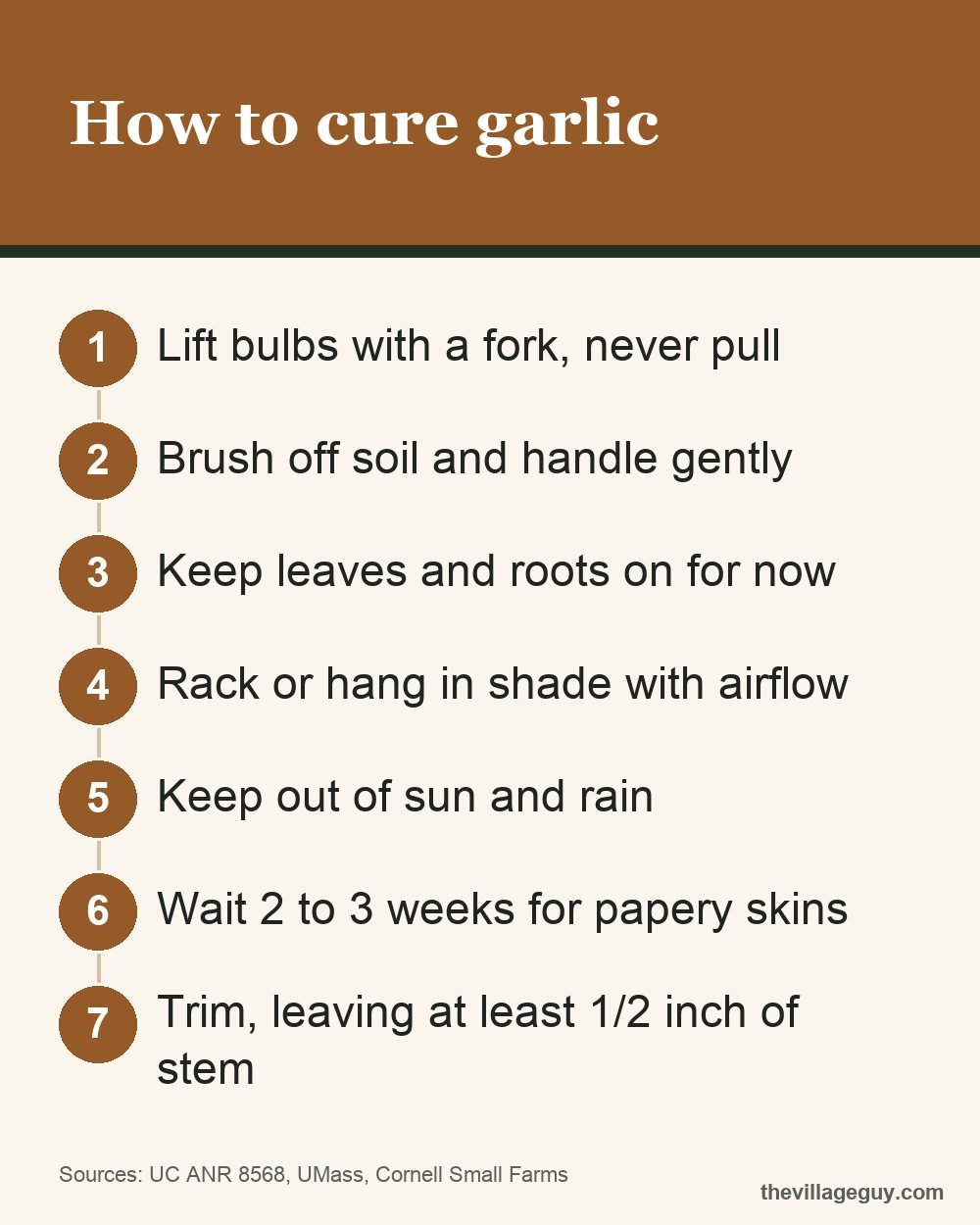
- Lift bulbs with a fork or spade instead of pulling on the stems
- Brush off loose soil and handle bulbs gently, since garlic bruises easily
- Leave the leaves and roots on for now, which helps the bulbs dry evenly
- Spread bulbs on wire racks or screens, or tie about 10 plants per bunch and hang them
- Pick a dry, well-ventilated spot out of direct sun and rain
- Run a fan if the air is still or humid
- Check after 2 weeks for papery outer skins and a tight, dry neck
- Trim roots and cut stems after curing, leaving at least 1/2 inch of stem
Timing varies with the weather. UC ANR says outer skins turn papery in about 2 to 3 weeks, and UMass Extension puts curing at 10 to 14 days, finished when the outer skins are dry and the neck is tight. Elephant garlic, which is a leek relative rather than true garlic, needs longer: UC ANR suggests 4 to 6 weeks. Cornell’s Small Farms Program adds a trimming detail that matters: stems cut closer than half an inch to the bulb tend to store for a shorter time, because more air reaches the wrappers.
Tip: Sort as you trim. Bulbs with split wrappers, exposed cloves or nicks from the fork will not keep, so use those first or freeze them. Cornell notes that small and medium bulbs generally store longer than large ones.
Storing whole bulbs: temperature, humidity and air
Extension sources agree on the danger zone, and differ on the target. Garlic breaks dormancy and sprouts fastest in the cool range: UMass puts it at 40 to 50°F, Oregon State at 40 to 60°F, and Cornell says bulbs below 50°F are likely to sprout. A home refrigerator sits right in that zone, which is why UC ANR says the fridge (typically about 40°F) is not suitable for long-term garlic storage because it stimulates sprouting.
Above and below that zone, garlic keeps. The cold option is what commercial storage uses: UMass recommends 30 to 32°F at 60 to 70 percent relative humidity, and Oregon State 32 to 38°F at under 70 percent. Few homes can hold that steady. The practical option is cool room storage: UC ANR gives 3 to 5 months at about 60°F in dry, dark conditions, and Cornell’s Small Farms Program puts the optimum at 56 to 58°F and 45 to 50 percent humidity, noting that bulbs above 66°F shrivel quickly.
| Where | Typical temperature | What happens |
|---|---|---|
| Cold storage room | About 30 to 38°F, steady | Longest life, if humidity stays under about 70% |
| Kitchen fridge | About 40°F | Sprouting speeds up; not for whole heads |
| Cool basement, closet or unheated room | About 55 to 60°F | Good home option: 3 to 5 months |
| Warm kitchen counter | 68 to 86°F | Softnecks last about 1 to 2 months; bulbs dry out |
Humidity and air matter as much as temperature. UMass warns that relative humidity above 85 percent for long periods encourages disease, and Cornell credits good air circulation with preventing mold. That is why mesh bags, braids, slatted crates and open baskets beat plastic bags and closed bins. Cornell suggests paper bags for short-term storage and mesh for the long haul.
Seed garlic for fall planting can sit a little warmer than eating garlic, around 50°F at 65 to 70 percent humidity in UMass’s guidance. Pick your biggest, cleanest bulbs for seed at curing time and keep them apart so they do not end up in the soup pot; the garlic planting guide has the rest.
How long does garlic last, by type
How long garlic lasts depends on the type more than most people expect. UC ANR says softneck garlic stores longer than hardneck: up to 9 months for softneck near 32°F, against up to 6 months for hardneck, with Oregon State giving the same figures. Among hardnecks, Cornell’s Small Farms Program says rocambole types store only about 3 to 4 months, while silverskin softnecks often store over 12 months.
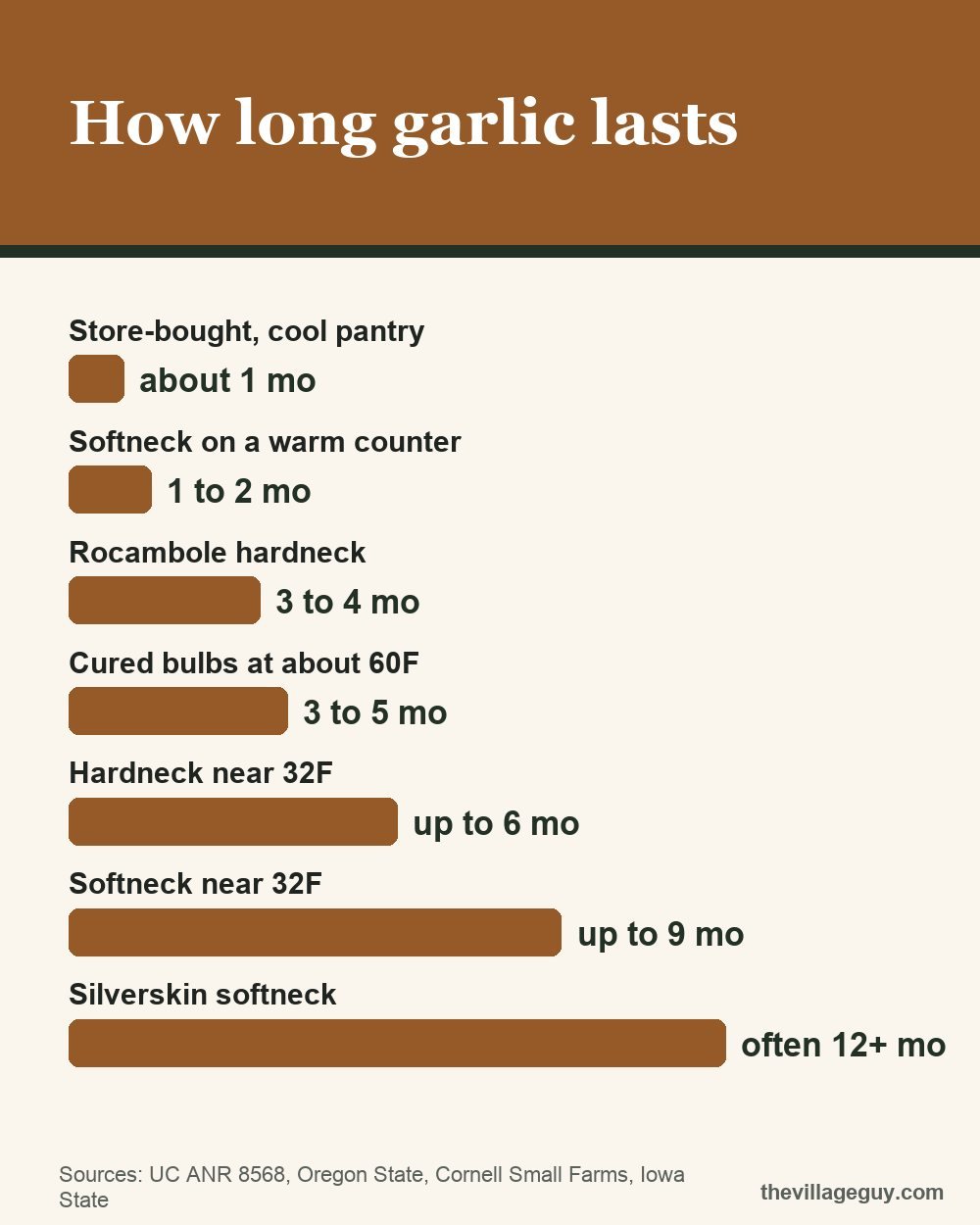
Store-bought garlic is a different story, because you do not know how long it sat before you bought it. Iowa State’s Spend Smart Eat Smart program says whole bulbs kept in a cool, dark place (not the refrigerator) keep for about a month. Buy bulbs that are firm with tight, unbroken skins and heavy for their size; UC ANR notes that light bulbs may hide shriveled or decayed cloves.
Plan your eating order around those numbers. Use rocamboles and other hardnecks through fall and early winter, and save softnecks and silverskins for late winter and spring, when hardnecks start to sprout. The University of Vermont Extension points out that midwinter sprouting is simply the nature of garlic cloves, and the sprouts draw down the clove until it is little more than husk by spring.
A monthly check for stored garlic
- Squeeze a few bulbs from each bag and pull out any that feel soft or hollow
- Look for green tips at the top of cloves and move sprouting bulbs to the front of the line
- Remove any bulb with mold or a musty smell before it spreads
- Check that the storage spot is still dark, dry and below about 66°F
- Freeze or dry the last hardnecks before they sprout in late winter
What you’ll need to cure and store garlic
Most of this is probably already in the shed or the kitchen.
- Drying racks or window screens: an open mesh surface so air reaches every side of the bulbs during curing.
- Box or oscillating fan: keeps air moving in a humid barn or garage while bulbs cure.
- Mesh storage bags or slatted crates: breathable containers for long storage; avoid sealed plastic.
- Digital thermometer and hygrometer: a small combined unit shows whether your storage spot really holds near 60°F and under about 70 percent humidity.
- Sharp pruners or scissors: for clean cuts on roots and stems after curing.
- Food dehydrator with a thermostat: one that holds 130 to 140°F for drying slices.
- Freezer bags and airtight containers: heavy enough to keep garlic odor from spreading through the freezer.
- Glass jars with tight lids: for dried garlic, powder and refrigerated garlic in vinegar.
- Waterproof labels and a marker: for prep dates and discard-by dates on anything in oil.
Peeled and chopped garlic
Once a clove is peeled, it is on a short clock. Iowa State says to store peeled cloves in covered containers in the refrigerator for up to a week. If you chop more than you need, freeze the extra rather than leaving it in the fridge. A sprouted clove is not harmful; UC ANR suggests cutting it in half and discarding the green sprout, which can taste bitter.
Jarred minced garlic from the store is made under regulated commercial processes, so follow the label’s storage directions and use-by date. Do not try to make shelf-stable minced garlic at home by covering it with oil; that is the riskiest combination on this page, covered below.
Can you freeze garlic? Three ways
Freezing is the easiest way to save bulbs that will not last, so yes, you can freeze garlic. UC ANR and Oregon State describe three methods:
- Whole bulbs or cloves: put bulbs or cloves, peeled or unpeeled, in a freezer bag and pull out cloves as needed.
- Chopped: chop the garlic, wrap it tightly in a freezer bag or plastic wrap, then grate or break off what you need.
- Pureed in oil: blend peeled cloves with oil at 2 parts oil to 1 part garlic, pack it in an airtight container and freeze it immediately. It stays soft enough to scrape out a spoonful for sauteing.
The third method comes with a hard rule: freeze the puree at once and never hold it at room temperature, because low-acid garlic sealed off from air by oil can support Clostridium botulinum. Oregon State also recommends wrapping all frozen garlic tightly so its smell does not move into the ice cream.
Drying garlic and making garlic powder
Drying turns a basket of aging bulbs into a pantry seasoning. UC ANR’s method: use only fresh, firm cloves with no bruises, peel and halve them lengthwise, then dry in a dehydrator at 140°F for 2 hours and 130°F for another 4 to 6 hours, until brittle. Oregon State slices large cloves 1/4 inch thick and dries at 140°F for 2 to 3 hours or until crisp. Either way, the test is the same: a dry piece snaps when bent instead of flexing.
- Peel firm, unbruised cloves and cut them in halves or 1/4-inch slices
- Dry at 140°F, then lower to 130°F until every piece snaps
- Cool completely before grinding so no steam gets into the jar
- Grind to powder and store in an airtight jar in a dark, dry cupboard
To make garlic salt, UC ANR blends 4 parts salt with 1 part garlic powder for just 1 to 2 seconds; blend longer and the salt gets too fine and cakes. Store dried garlic at room temperature or in the freezer. In humid areas (UC ANR says above about 60 percent relative humidity), dried garlic can pull moisture from the air, so keep the lid tight.
Garlic in oil, wine or vinegar: the safety rules
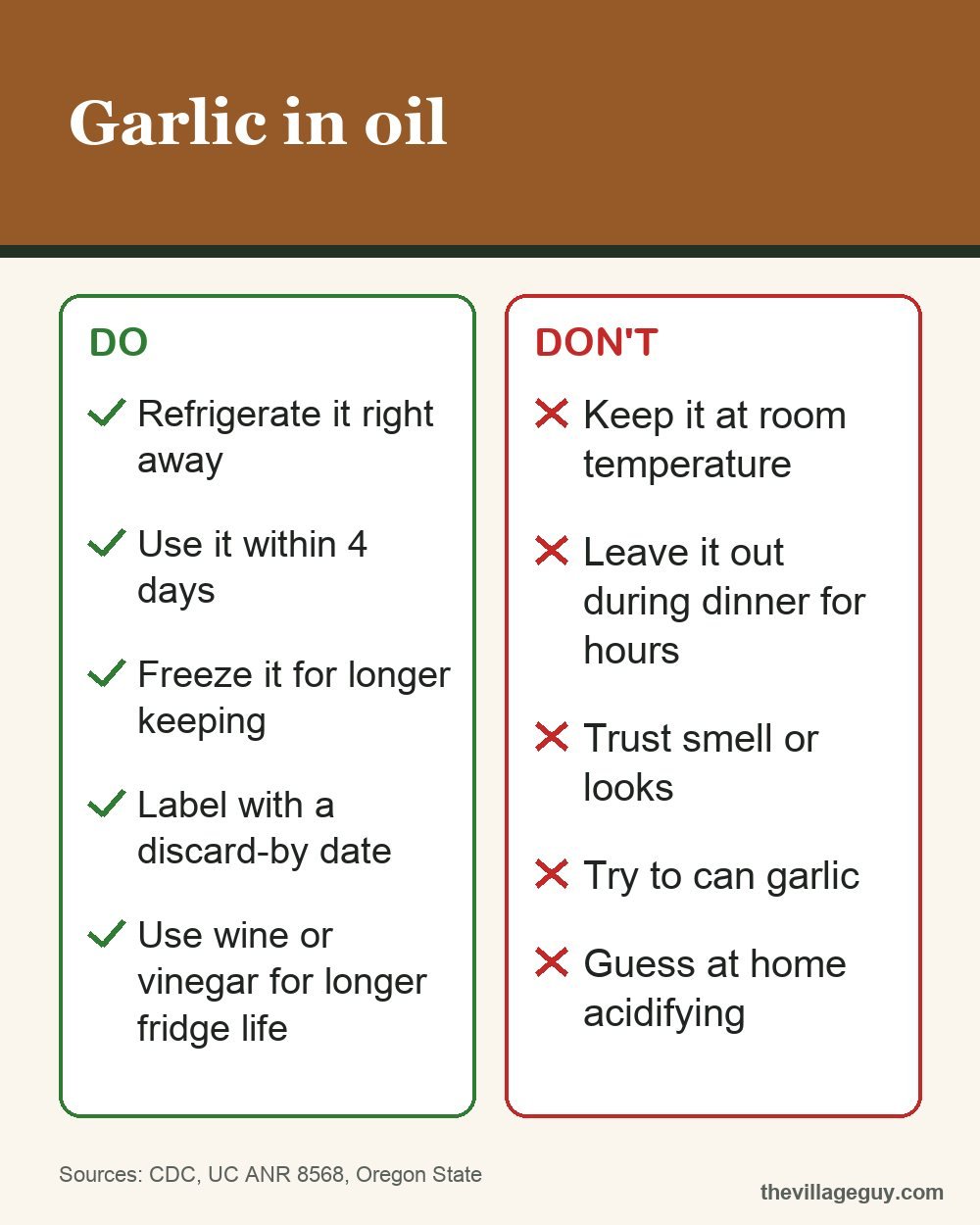
Safety: Fresh garlic covered in oil can grow Clostridium botulinum and produce botulism toxin, which you cannot see, smell or taste. Never store homemade garlic in oil, garlic oil, roasted garlic in oil or garlic confit at room temperature. The CDC says to refrigerate homemade oils made with garlic or herbs and throw away any unused oil after 4 days. For longer storage, freeze it. Botulism is a medical emergency: if anyone falls ill after eating garlic in oil, get emergency care right away.
The reason is chemistry, not cleanliness. UC ANR explains that garlic is low in acid, oil shuts out oxygen, and room temperature lets the bacteria grow, which is exactly the set of conditions C. botulinum needs. The same hazard applies to roasted garlic in oil. UC ANR records at least four botulism outbreaks tied to garlic-in-oil mixtures in North America in the late 1980s and 1990s, including home-prepared garlic in oil in California in 1991 and Florida in 1999.
- GARLIC IN OIL: made ______. Refrigerate. Discard after ______ (4 days).
- GARLIC OIL PUREE: frozen ______. Keep frozen. Use from frozen.
- GARLIC IN VINEGAR: made ______. Refrigerate. Best before ______ (about 4 months).
Commercial garlic-in-oil products are a different case: UC ANR notes they are made under strict rules that require citric or phosphoric acid. A home acidification method tested by the University of Idaho exists, and UC ANR publication 8568 gives it in full with exact weights; follow that publication to the letter or not at all, because no home method has been tested for acidifying whole cloves. Fully dried, brittle garlic can be used to flavor oil, UC ANR says, as long as it is not rehydrated and no moisture gets in.
Wine and vinegar
Wine and vinegar are the safer liquids, because they make the mixture acidic (below pH 4.6) so C. botulinum cannot grow. UC ANR says peeled cloves covered in full-strength wine or vinegar keep about 4 months in the refrigerator. Never leave them at room temperature, where mold develops quickly, and throw out both cloves and liquid if mold or yeast appears on the surface.
Signs garlic has gone bad
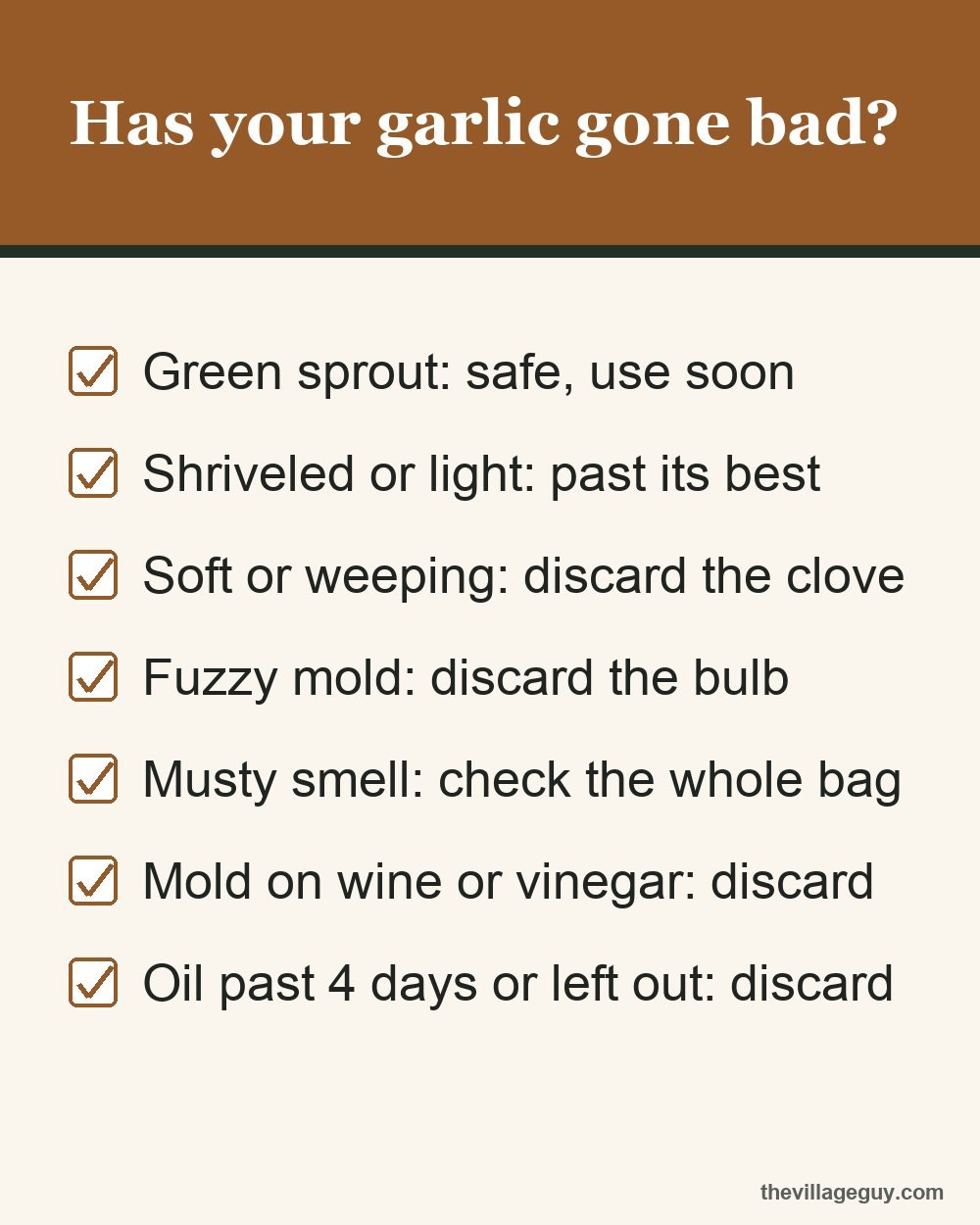
Whole garlic usually tells you when it is past its best. Some signs mean lower quality, and some mean the bulb goes in the compost.
| What you see | What it means | What to do |
|---|---|---|
| Green shoot in the clove | Sprouting; not harmful (UC ANR) | Use soon; cut out the green center if bitter |
| Shriveled, light or hollow cloves | Drying out with age or warmth | Use what is firm; compost the rest |
| Soft, mushy or weeping cloves | Decay | Discard the clove |
| Fuzzy mold or a musty smell | Mold growth | Discard the bulb and check its neighbors |
| Mold or yeast on garlic in wine or vinegar | Spoilage (UC ANR) | Discard cloves and liquid |
| Garlic in oil older than 4 days in the fridge, or left out | Botulism risk you cannot detect | Discard without tasting |
The last row is the one that matters most. Botulism toxin gives no warning smell or look, so a jar of garlic oil that seems perfect is not proof of anything. Go by the date and how it was stored.
A stored crop is the payoff of the whole garden year. If you are planning beds for next season, our guide to starting a vegetable garden covers the first steps.
Garlic storage FAQ
Should you store garlic in the fridge?
Not whole heads. UC ANR says fridge temperatures around 40°F stimulate sprouting, so whole bulbs keep better somewhere cool, dark and dry. The fridge is the right place for peeled cloves (about a week), garlic in wine or vinegar, and any homemade garlic in oil (4 days at most).
Can you store garlic in a paper bag?
Yes, for a few weeks to a couple of months. Cornell’s Small Farms Program suggests paper bags for short-term storage and mesh bags for long-term storage, because mesh lets more air move around the bulbs. Fold the paper bag loosely rather than sealing it.
How do you keep garlic from sprouting?
Keep it out of the 40 to 60°F range where Oregon State and UMass say sprouting runs fastest, which rules out the fridge. Hold bulbs at a steady cool room temperature (Cornell suggests 56 to 58°F) or, if you have true cold storage, near 32°F. Eat hardnecks first, since they sprout sooner than softnecks.
Is sprouted garlic safe to eat?
Yes. UC ANR says sprouting and shriveling are not harmful, only signs the garlic is past peak quality. Cut the clove in half and remove the green sprout if it tastes harsh, and use sprouting bulbs soon, since the sprout keeps drawing down the clove.
Sources
- UC Agriculture and Natural Resources, Publication 8568: Garlic: Safe Methods to Store, Preserve, and Enjoy (curing, fridge sprouting, storage life, freezing, drying, wine and vinegar, garlic in oil, outbreaks, no canning)
- Oregon State University Extension: Preserving Garlic (SP 50-645, 2024) (32-38°F storage, 40-60°F sprouting, storage life by type, freezing, drying, oil limit)
- UMass Extension: Garlic Harvest, Curing and Storage (10-14 day cure, 40-50°F sprouting, 30-32°F and seed storage, humidity and disease)
- Cornell Small Farms Program: Secrets of Storing Garlic (2020) (56-58°F optimum, sprouting below 50°F, stem length, rocambole and silverskin storage, bag types)
- Iowa State University Spend Smart Eat Smart: Garlic (whole bulbs about a month, peeled cloves up to a week)
- Washington State University Extension: Garlic Storage and Preservation (curing 2-3 weeks, freezing and drying methods)
- University of Vermont Extension: Prevent Late Winter Loss of Stored Garlic (2022) (midwinter sprouting, snap test for dried garlic)
- CDC: Botulism Prevention (refrigerate homemade garlic oils, discard after 4 days; toxin cannot be seen, smelled or tasted)
Browse more kitchen garden and food storage guides on our guides page.