Garlic is the easiest crop in the kitchen garden to get right and the easiest to get slightly wrong. Learning how to plant garlic takes about ten minutes: push a clove into loose soil, pointed end up, a couple of inches deep, in fall. The parts that decide whether you dig up golf balls or marbles next summer are timing, clove size, mulch and knowing when to pull it.
This page covers when to plant garlic in your USDA zone, which type suits your winters, the planting steps, and how to grow garlic through spring to a harvest that keeps for months. Every number comes from extension services or the USDA, and where they disagree, you will see both answers.
Quick answer: Plant individual garlic cloves in fall, pointed end up, about 2 inches deep (deeper in cold zones) and 4 to 6 inches apart, a few weeks before the ground freezes. In zones 3 to 6 that usually means late September through October; in zones 8 to 10 it runs from October into December or January. Mulch with 3 to 4 inches of straw and harvest the next summer when the lower leaves turn brown.
In this guide
When to plant garlic by USDA zone
Garlic goes in during fall so the cloves can grow roots before the soil freezes, then sit through winter and race upward in spring. The University of Maine says to plant early enough for roots to establish but not so early that the tops push up and get damaged before winter. Each extension service phrases the trigger a little differently:
- University of Minnesota Extension: about one to two weeks after the first killing frost.
- University of Illinois Extension: 6 to 8 weeks before the ground is expected to freeze.
- Texas A&M AgriLife Extension: 4 to 6 weeks before the first freeze date.
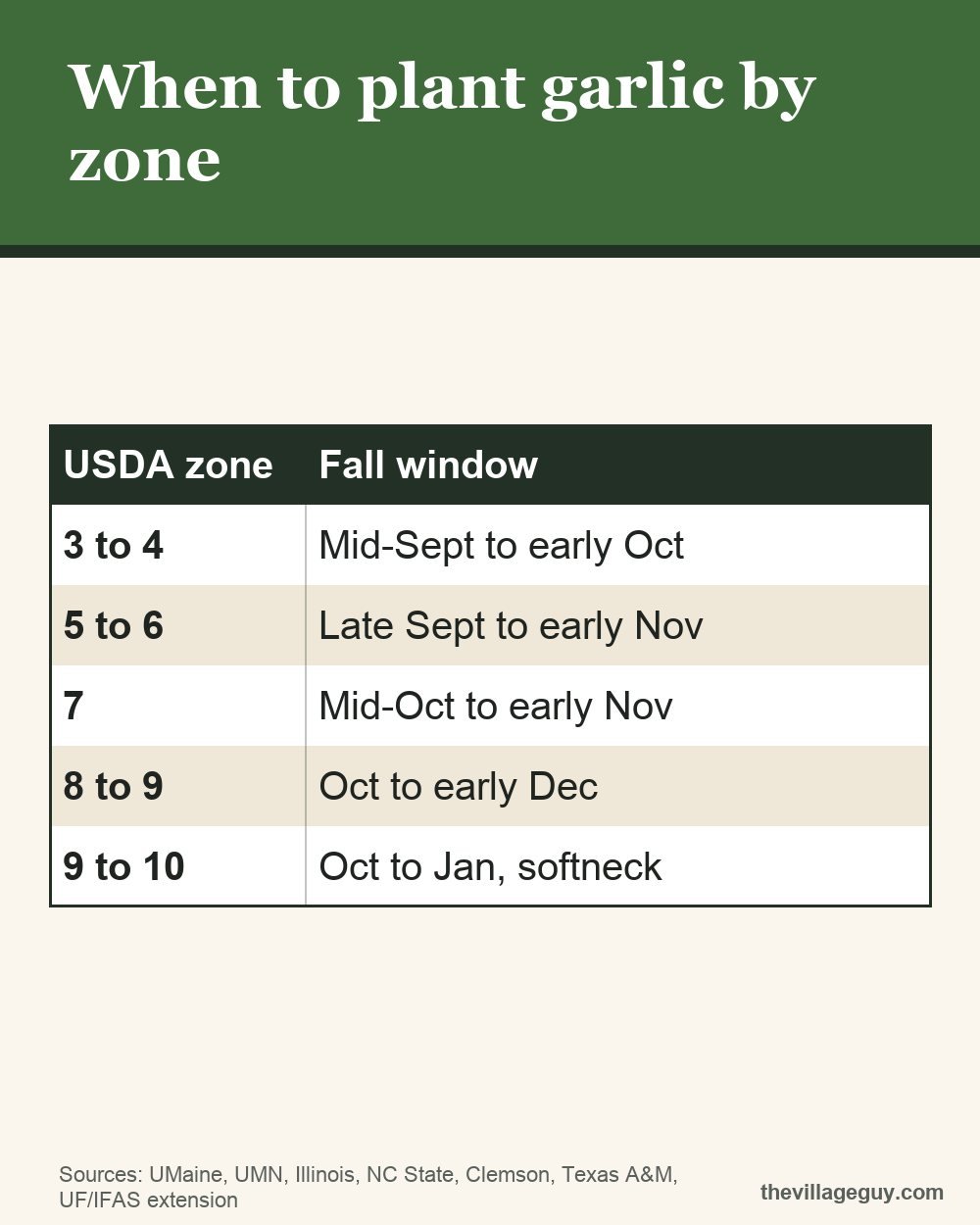
Your hardiness zone gives a rough starting point. The 2023 USDA Plant Hardiness Zone Map sorts places by their average coldest winter night (1991 to 2020 data) in 10°F zones and 5°F half zones, so it describes winter cold rather than frost dates. Use the table to find your window, then fine-tune it with your local first-frost date or county extension office.
| USDA zone | Typical fall window | Extension example |
|---|---|---|
| 3 to 4 | Mid-September to early October | Northern Maine: by October 1 (UMaine); Minnesota: 1 to 2 weeks after first killing frost (UMN) |
| 5 to 6 | Late September to early November | Central Illinois: late September to early October (Illinois Extension); southern Maine: by November 1 (UMaine) |
| 7 | Mid-October to early November | Zone 7 North Carolina: mid-October to early November (NC State Extension) |
| 8 to 9 | October to early December | Coastal South Carolina: October 1 to November 30 (Clemson); Austin area: mid-October to early December (AgriLife) |
| 9 to 10 | October to January | Florida: October through January, softneck types recommended (UF/IFAS) |
Mild-winter gardeners have one extra trick. Garlic needs a cold spell to form a proper bulb, and a University of Florida Extension office in Sarasota County suggests chilling cloves in the refrigerator for about two months before planting in November or December. Find your exact zone by ZIP code on the USDA map before you guess.
Hardneck or softneck: pick garlic for your winters
There are two main types, and the right one depends mostly on how cold your winters get. University of Maine Extension recommends hardneck for Maine because softneck is not reliably hardy there, while Clemson and UF/IFAS recommend softneck for the mild South.
| Trait | Hardneck | Softneck |
|---|---|---|
| Usual fit | Cold-winter areas, roughly zones 3 to 6 | Mild-winter areas, roughly zones 7 to 10 |
| Flower stalk (scape) | Yes, and it is edible | Rarely |
| Peeling | Easier | Harder |
| Storage life | Shorter | Longer; can be braided |
| Found in grocery stores | Seldom | Usually |
Elephant garlic is a different plant: Utah State University Extension notes it is more closely related to leeks, mild in flavor and poor in storage. Zone 7 sits on the line, so many gardeners there grow some of each and keep the type that does best.
Buy seed garlic from a garden center, farmers market or seed supplier. Illinois Extension warns that grocery store garlic is usually treated to prevent sprouting, and UMaine adds that you want disease-free stock because the two worst garlic problems, white rot and the garlic bloat nematode, travel in infected bulbs.
Prepare the bed before planting day
UMaine recommends full sun, well-drained soil, a pH around 6.5 and plenty of organic matter. Garlic hates competition, so the bed needs to start weed-free; you cannot easily hoe around cloves under mulch.
- Pick a spot with full sun and soil that does not puddle after rain
- Use a bed that has not grown garlic, onions or leeks lately; Minnesota Extension suggests a four-year rotation
- Run a soil test and add lime or fertilizer only if the results call for it
- Work an inch of finished compost into the top 6 inches
- Pull every perennial weed root you can find
- Line up weed-free straw or shredded leaves for mulch
Utah State caps compost at about 1 inch of well-composted material per 100 square feet for garlic beds, which is plenty. Raised beds are a good fit in heavy clay or wet ground, since standing water rots cloves over winter.
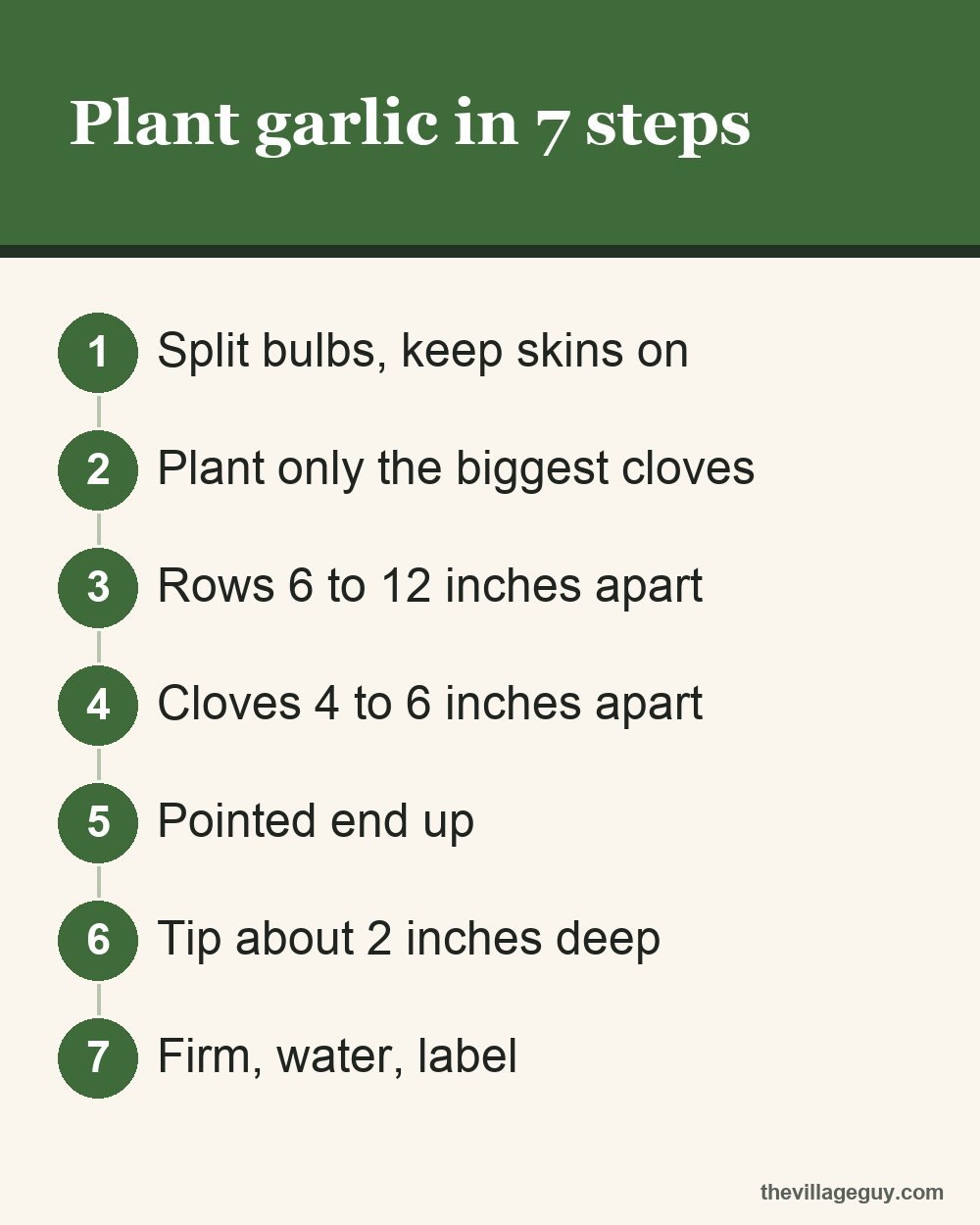
How to plant garlic in the fall: 7 steps
Garlic planting is a quick job once the bed is ready. Each clove becomes one whole bulb, so the clove you choose today sets the bulb you get next summer.
- Split the bulbs into cloves shortly before planting, and leave the papery skin on each clove.
- Sort the cloves and plant the biggest; UMaine notes that large cloves make large bulbs. Use the small ones in the kitchen.
- Mark rows 6 to 12 inches apart (wider if you will weed with a hoe).
- Make holes 4 to 6 inches apart along each row.
- Set each clove pointed end up, flat root end down.
- Cover so the tip sits about 2 inches below the surface: 2 to 4 inches deep in cold northern gardens, 1 to 2 inches in the South.
- Firm the soil, water once if it is dry, and label the row with the variety and date.
Depth and spacing by region
Extension advice on depth tracks the climate. UMaine puts the clove tip 2 to 4 inches below the surface for Maine winters, Utah State says 2 to 3 inches, Illinois says 1 to 2 inches, and Texas A&M says 1 to 2 inches. Deeper planting gives more protection from heaving in hard-freezing soil. For spacing, UMaine notes that closer cloves make smaller bulbs and wider spacing makes bigger ones.
Worked example: how much seed garlic to buy
Take a 4 by 8 foot raised bed and plant on a 6-inch grid: that is 8 rows of 16 cloves, or 128 cloves. Break open one of your seed bulbs and count the plump cloves. If it has 6, you need about 22 bulbs (128 divided by 6, rounded up). Tighter spacing fits more: a NC State Extension article reports 152 plants in a 4 by 8 bed.
- Order seed garlic by late summer, before popular varieties sell out
- Store seed bulbs whole in a cool, airy spot until planting day
- Bring a bucket for cloves, a ruler or marked stick, row labels and a trowel
- Note the variety, source and planting date in a garden notebook
Mulch and winter care
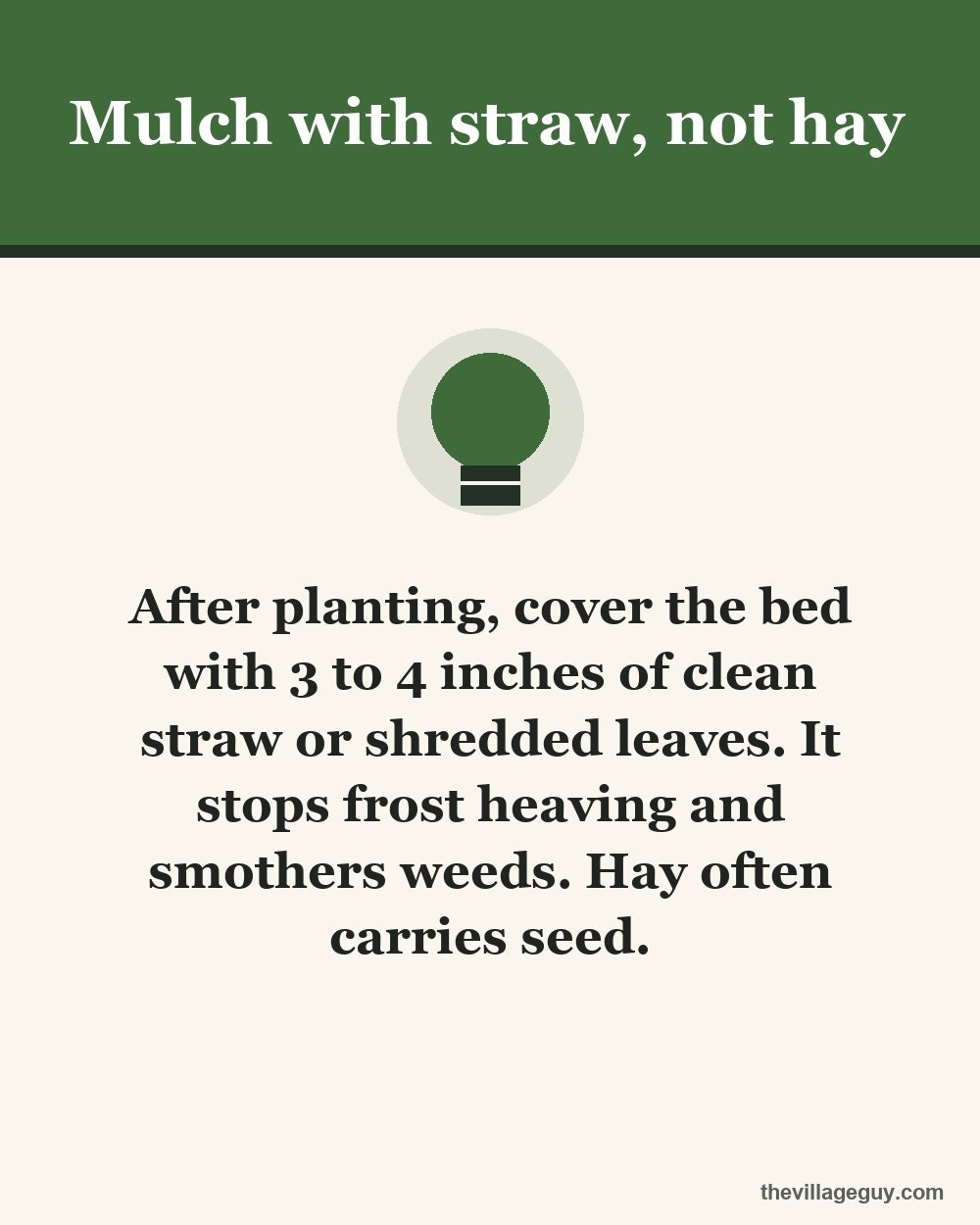
Mulch evens out freeze and thaw cycles, keeps cloves from heaving out of the ground, smothers weeds and holds moisture, according to UMaine. Recommended depths vary: UMaine says about 3 inches, the University of Minnesota 3 to 4 inches of weed-seed-free straw, and Illinois and NC State 4 to 6 inches. In the coldest zones, the deeper end makes sense; in the South, mulch is mainly for weeds and moisture.
Straw is the favorite because it is light and, when bought clean, nearly weed-free. Hay is a different product and often carries grass and weed seed, which is the opposite of what you want. Shredded leaves work too.
A few green shoots poking through before winter are normal in many gardens and usually survive; Minnesota Extension notes most shoots stay below the soil until spring. Once the bed is mulched, that is it until spring. While you are out there, it is a good moment to drain hoses and shut off outdoor taps before the first hard freeze; this guide to the temperature at which pipes freeze covers the rest of that job.
How to grow garlic through spring and summer
Most of the bulb forms in late spring and early summer, so this is when water, food and weeding pay off. Utah State notes that roots are shallow and that drought stress cuts yield and bulb size.
- Pull mulch back from the shoots once hard freezes are over, and leave it on the bed between rows
- Side-dress with nitrogen when shoots emerge and again 2 to 3 weeks later
- Stop fertilizing by late May; late nitrogen can shorten storage life
- Water about 1 inch a week in dry spells, soaking the root zone
- Pull weeds while they are small so you do not disturb the bulbs
- Snap or cut hardneck scapes as soon as they appear
- Stop watering when the leaves start to yellow
Minnesota Extension times mulch removal for after the threat of hard freezes, generally around the second week of April there; NC State’s zone 7 article uses daffodil bloom as the cue. UMaine’s spring feeding plan is nitrogen only, at emergence and 2 to 3 weeks later, with no extra phosphorus or potassium.
Why scapes come off
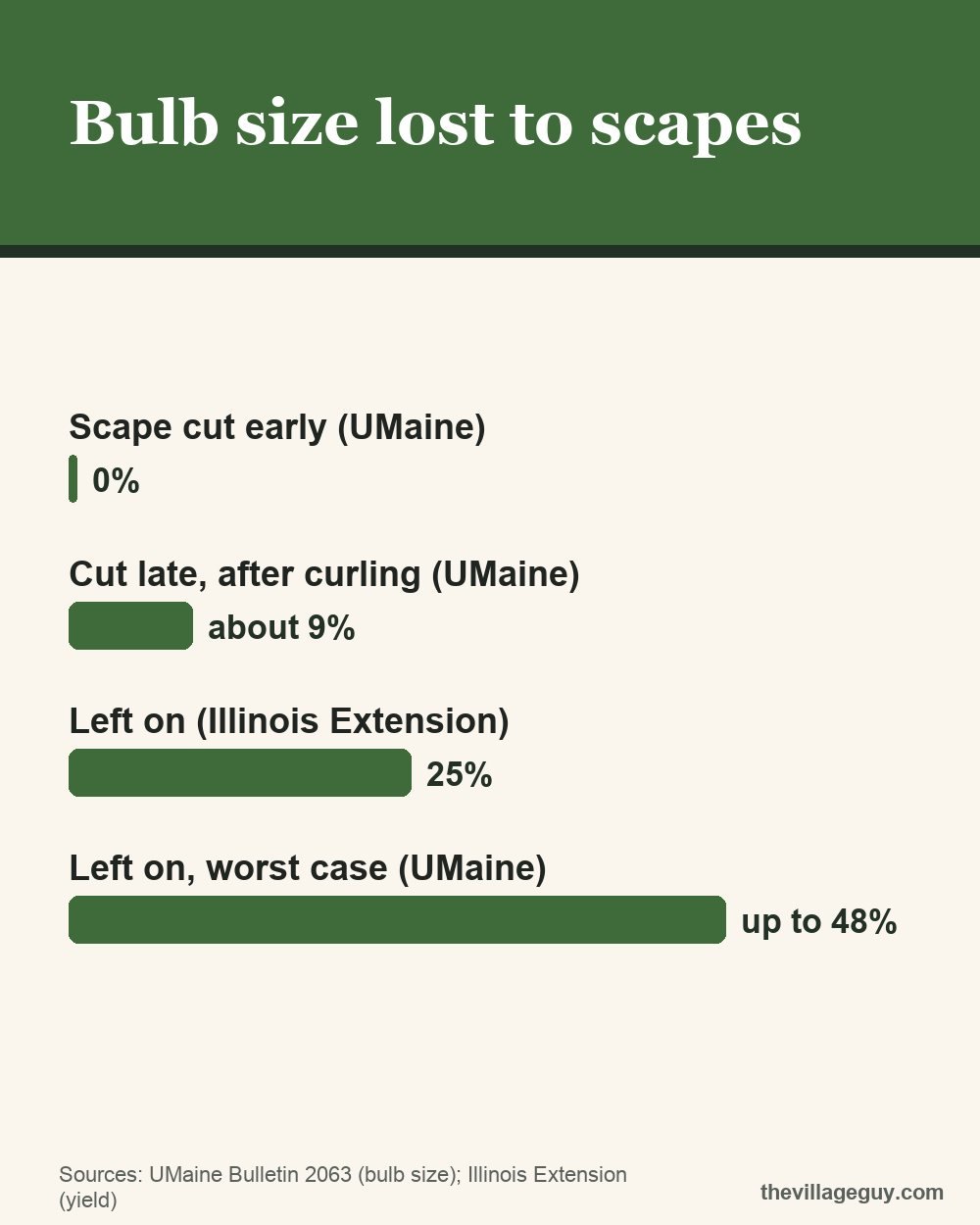
Hardneck garlic sends up a curly flower stalk called a scape, usually in June in the North. Removing it sends energy to the bulb, and the numbers are striking. UMaine reports that leaving scapes on can cut bulb size by as much as 48 percent, while removing them late, after they curl, costs about 9 percent. Illinois Extension puts the yield loss from leaving them at 25 percent. Either way, cut them early, and cook them: young scapes are good in stir-fries and pesto.
Harvest, cure and store garlic
Harvest timing is a judgment call, and extension services describe the signal differently. UMaine says to dig when the lowest three leaves have turned brown, and warns that you have about two weeks before the bulb wrappers start to break down. Illinois says half the leaves yellowed, usually late June to early July there. Utah State says when tops begin to yellow or fall over, before they dry completely, because overmature bulbs split and store poorly. Digging one test bulb first settles the argument.
- Loosen the soil beside the row with a spading fork before pulling
- Lift plants by hand; never yank them by the stalk from hard soil
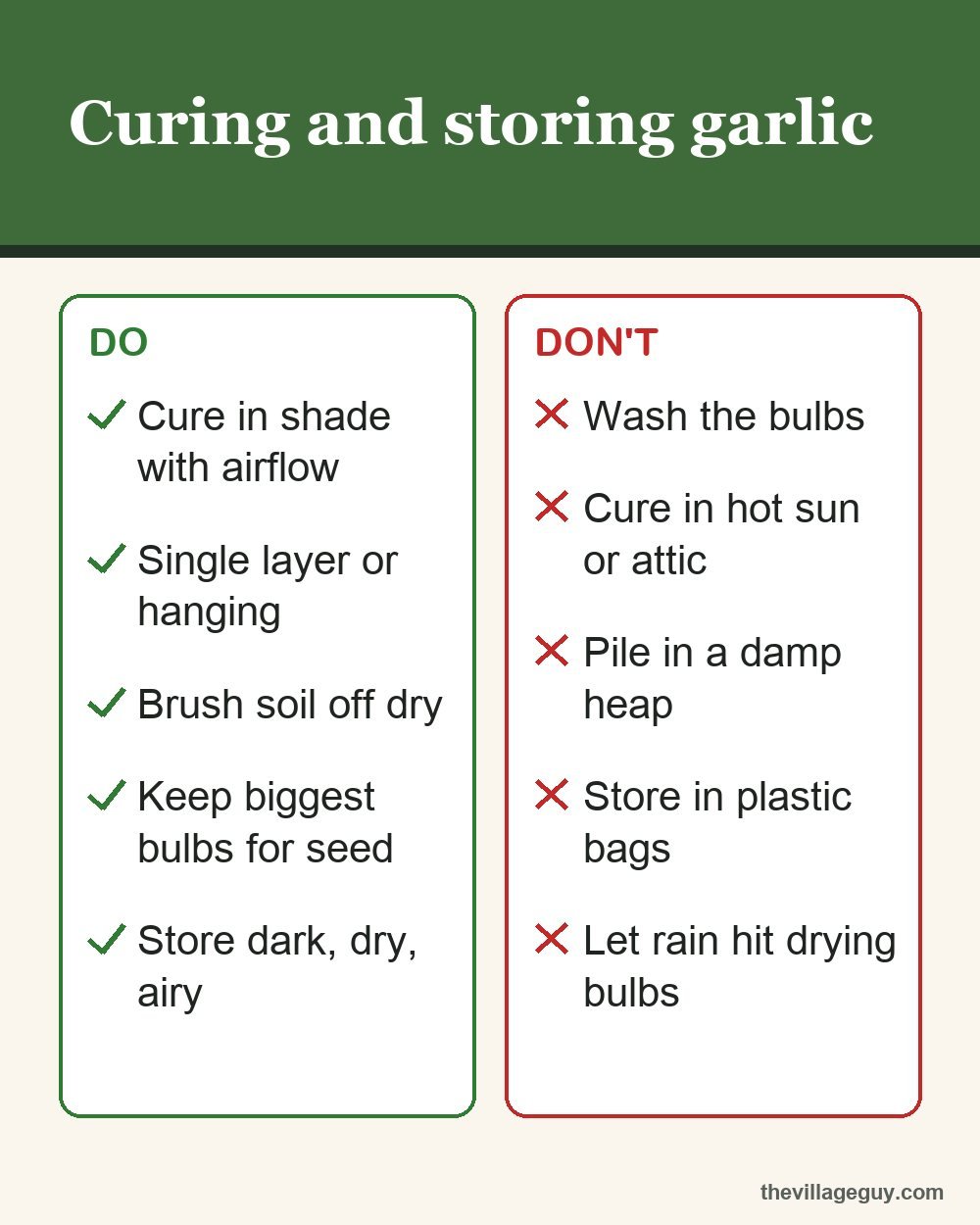
- Shake off loose soil, but do not wash the bulbs
- Cure whole plants in a single layer somewhere shady, warm, dry and breezy
- Trim tops to about 1.5 inches and roots short once the skins are papery
- Set aside the biggest, healthiest bulbs as next fall’s seed
UMaine says curing takes about 3 to 4 weeks and warns against very hot spots such as attics, closed greenhouses or direct sun; Utah State gives 1 to 2 weeks. A covered porch or open barn with a fan works well.
Storage advice is where sources really split. UMaine recommends a dark place at about 60°F and 50 percent humidity, warns that cooler, moister conditions cause sprouting, and says never to refrigerate garlic or keep it in plastic. Utah State recommends 32 to 40°F and dry. Both agree on dry, airy and dark; softnecks braid well and hardnecks store best in mesh bags or open baskets.
Garlic troubleshooting: small bulbs, rot and sprouting
| Problem | Likely cause | Fix for next time |
|---|---|---|
| Small bulbs | Small cloves, crowding, weeds, drought, scapes left on, or spring planting | Plant big cloves 4 to 6 inches apart, weed early, water in spring, cut scapes |
| Bulbs split open, few wrappers | Dug too late | Dig within about two weeks of the lower leaves browning |
| Cloves heaved out of the ground | Freeze and thaw cycles on bare soil | Mulch after planting; plant deeper in cold zones |
| Plants yellow early, white fluffy growth at the base | Possibly white rot | Remove plants, do not replant onion-family crops there, have it confirmed by your extension office |
| Bulbs sprouting in storage | Storage too cool and damp | Keep storage dry and airy, away from cool, damp corners |
| Soft, moldy bulbs after curing | Washed, bruised or cured in damp air | Brush soil off dry and cure with airflow |
White rot is the one problem worth taking seriously, because UMaine names it one of the two most serious garlic pests and says it spreads through infected planting stock. If you suspect it, bag the plants and take a sample to your county extension office rather than guessing. For other kitchen garden and homestead jobs, browse the full set of Village Guy guides, or read about how we research them.
Garlic planting FAQ
Can you plant garlic in the spring?
You can, but expect smaller bulbs. Utah State says spring-planted garlic generally makes small bulbs, and Illinois Extension says cloves should be refrigerated for at least 8 weeks first so they get the cold they need. Plant as soon as the soil can be worked.
Can I plant garlic from the grocery store?
It is a gamble. Illinois Extension says store garlic is usually treated to prevent sprouting, and it is usually a softneck grown for a different climate. Seed garlic costs more per bulb, but it is grown and sold for planting, and UMaine stresses starting with disease-free stock.
How deep do you plant garlic?
About 2 inches to the tip is a good middle answer. Cold northern gardens go deeper (UMaine says 2 to 4 inches), and warm southern gardens go shallower (Texas A&M says 1 to 2 inches).
Is it too late to plant garlic in November?
Not in much of the country. Zone 7 to 9 gardens plant through November, and Florida plants into January. In zones 3 to 5, you can still plant if the ground is workable, but roots will have little time to grow, so mulch well and accept a smaller harvest.
Sources
- University of Maine Cooperative Extension: Bulletin 2063, Growing Garlic in Maine (planting dates, pH, depth, spacing, mulch, scape trials, harvest, curing, storage, white rot)
- University of Minnesota Extension: Growing garlic in home gardens (plant 1 to 2 weeks after first killing frost, 3 to 4 inches of straw, four-year rotation)
- University of Illinois Extension: How to grow garlic (6 to 8 weeks before freeze, grocery garlic, 25 percent scape loss, spring chilling)
- Utah State University Extension: How to Grow Garlic in Your Garden (depth, compost limit, watering, elephant garlic, harvest, 32 to 40°F storage)
- Texas A&M AgriLife Extension: Texas Home Vegetable Gardening Guide (4 to 6 weeks before first freeze, 1 to 2 inches deep)
- Texas A&M AgriLife Extension, Travis County: In Austin’s October Vegetable Garden (mid-October to early December)
- NC State Extension, Henderson County: It’s Time for Garlic! (zone 7 timing, 152 plants in a 4 by 8 bed)
- Clemson Cooperative Extension HGIC: Onion, Leek, Shallot and Garlic (South Carolina planting windows)
- UF/IFAS Gardening Solutions: Garlic (Florida timing, softneck types)
- UF/IFAS Extension Sarasota County: Edible Gardening Series, Garlic (chilling cloves about two months)
- USDA ARS: USDA Unveils Updated Plant Hardiness Zone Map (2023 map basis and zone structure)