
Water freezes at 32°F, but a pipe in a country house rarely freezes the moment the thermometer touches 32. So at what temperature do pipes freeze in real life? For pipes in unheated or poorly insulated spots, insurers and plumbers treat an outdoor temperature of about 20°F as the danger line, and a long, windy night below that is when the calls start. Pipes inside heated rooms almost never freeze at all.
Out here the risk list is longer than in town: a pressure tank in a shed, water lines under a mobile home, a vented crawl space, a cabin nobody visits from November to April. Below are the temperatures that matter, how to protect each of those spots, and how to thaw a pipe without starting a fire.
Quick answer: Water freezes at 32°F (0°C), but pipes in unheated attics, crawl spaces, exterior walls and pump houses are most at risk once the outdoor temperature drops to about 20°F (-7°C) or below. Keep indoor heat at 55°F or higher, insulate exposed pipes, let a faucet drip on the coldest nights, and never thaw a pipe with an open flame.
In this guide
At what temperature do pipes freeze: the 3 numbers that matter
Three temperatures do most of the work in frozen-pipe advice, and they measure different things. One is the water, one is the weather and one is your thermostat.
32°F (0°C): water turns to ice
This is the freezing point of water. The water in a pipe has to lose its heat before ice forms, so an hour of 30°F air does little, while two days of it can freeze a hose bib on a north wall.
20°F (about -7°C): the outdoor danger line
State Farm’s winter guidance says pipes in uninsulated attics, crawl spaces and exterior walls are most at risk when temperatures drop below 20°F. The figure is usually credited to 1990s freeze research at the University of Illinois. Treat it as a planning number, not a promise: wind through a gap in the siding can freeze a pipe on a milder night, and a well-insulated pipe can ride out a colder one.
55°F (13°C): the lowest indoor setting most guidance accepts
The American Red Cross, Travelers and NC State Extension all say to keep the heat set no lower than 55°F, including when you are away. The Insurance Information Institute (Triple-I) goes further for severe cold and suggests 65°F, because the air inside a wall that holds pipes is colder than the room. If your pipes run in outside walls, the higher number is the safer one on bitter nights.
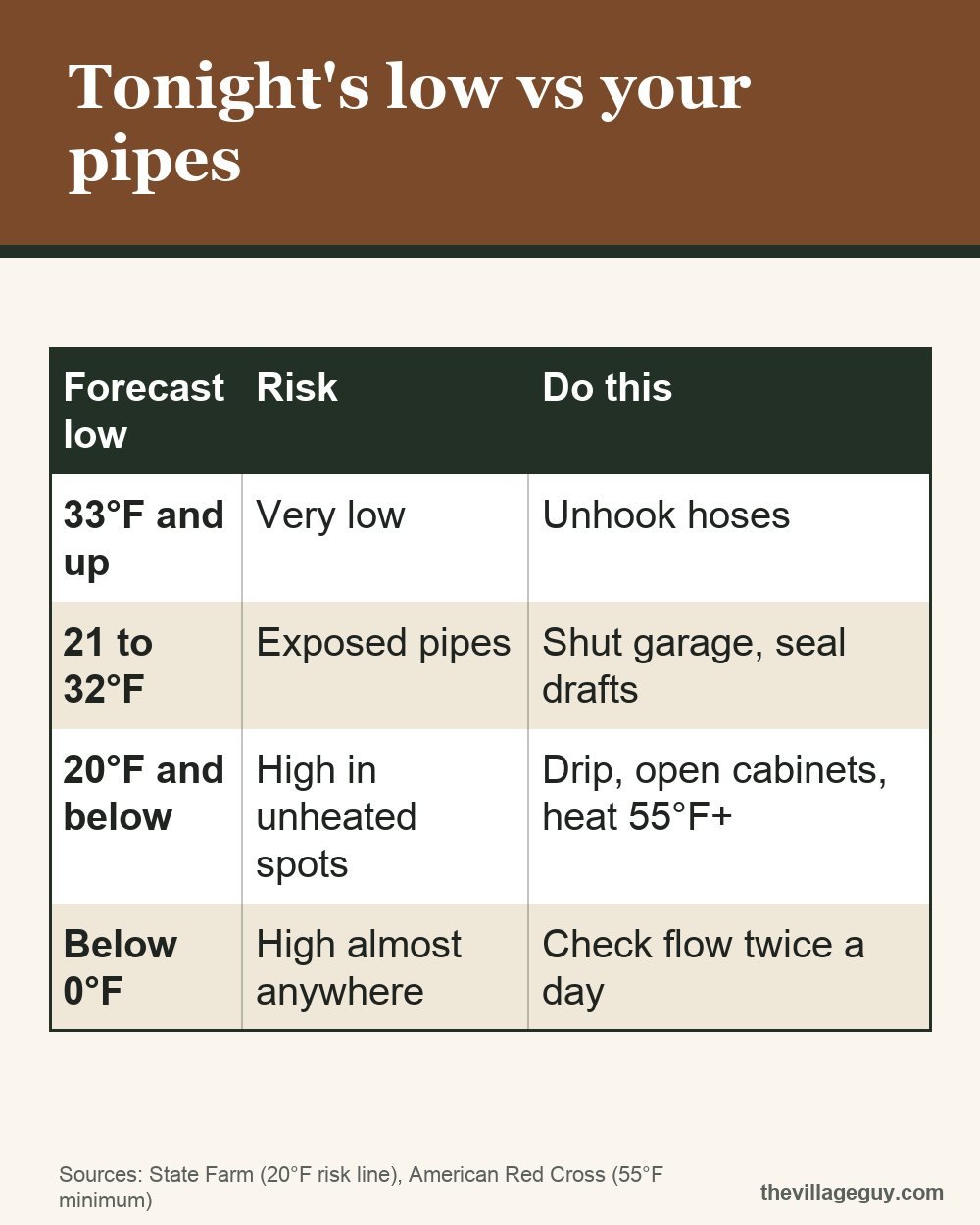
| Forecast low | Risk to pipes in unheated spots | What to do tonight |
|---|---|---|
| 33°F and above | Very low | Disconnect hoses if you have not already |
| 21°F to 32°F | Possible for exposed pipes, hose bibs and pipes in drafts | Close garage doors, check pump house heat, seal drafts |
| 20°F and below | High for pipes in attics, crawl spaces, exterior walls and sheds | Drip the faucet on risky lines, open sink cabinets, keep heat at 55°F or more |
| Below 0°F, or a multi-day cold snap | High even for pipes that usually cope | All of the above, check water flow morning and night, have a plan for a power cut |
Why frozen pipes burst, and why the split is rarely where the ice is
Ice takes up more room than water: the U.S. Geological Survey notes that ice is about 9 percent less dense than liquid water. That expansion is why people assume the pipe cracks right where it froze. Research tells a slightly different story.
A 1996 University of Illinois report on freezing and bursting water pipes in homes describes a two-step process. First, ice forms a solid plug in the pipe. Then, as more ice grows, it squeezes the water trapped between the plug and a closed faucet, and that pressure, not the ice itself, splits the pipe. Because the pressure builds in the water-filled stretch between the plug and the faucet, the split can appear away from the obvious cold spot, sometimes behind drywall or under a floor.
That is why a dripping faucet helps: it gives the trapped water somewhere to go. The report still names heated space as the main defense, and University of Illinois Extension warns that a 1/8-inch crack can release up to 250 gallons of water a day once it thaws.
Where pipes freeze first in a country house
The Red Cross and Travelers list the usual suspects: hose bibs, sprinkler and pool lines, pipes in unheated basements, crawl spaces, attics, garages and cabinets, and pipes in thinly insulated exterior walls. Rural homes add a few more. Walk the property with this table and a flashlight in October, not January.
| Location | Why it freezes | First fix |
|---|---|---|
| Outdoor hose bibs and yard hydrant risers | Fully exposed; a connected hose traps water in the valve | Disconnect hoses, shut the inside valve, drain the bib |
| Pump house or well shed | Small, rarely heated, often drafty | Insulate the walls and fittings; add thermostat-controlled heat made for the space |
| Crawl space | Cold air through foundation vents and gaps | Insulate pipes, seal gaps, close vents during long freezes |
| Under a mobile or manufactured home | Pipes sit in open air if skirting or belly insulation is damaged | Repair skirting and belly wrap; use heat tape listed for manufactured homes |
| Exterior walls and sink cabinets | Thin insulation; cabinet doors block room heat | Open cabinet doors on cold nights; seal air leaks |
| Where the water line enters the house | Foundation is cold; gaps let in drafts | Seal and insulate around the entry point |
How to keep pipes from freezing: before winter and during a cold snap
Most of the work happens once, in fall. The rest is a ten-minute routine when the forecast turns ugly.
Before the first hard freeze
- Find the main water shutoff (and, on a well, the pump’s breaker) and tag both so anyone in the house can find them in the dark
- Disconnect, drain and store garden hoses
- Close the inside valve to each outdoor faucet, then open the outdoor faucet so leftover water can drain and expand safely
- Drain sprinkler and pool supply lines following the installer’s or manufacturer’s directions
- Wrap pipes in crawl spaces, attics, garages and outside walls with foam or fiberglass pipe sleeves
- Seal gaps around pipes, dryer vents and wiring where cold air leaks in
- Inspect any existing heat tape: unplug it and check its full length for cracked or charred insulation and bare wire
- Check that crawl space doors, foundation vents and mobile home skirting can be closed or repaired before January
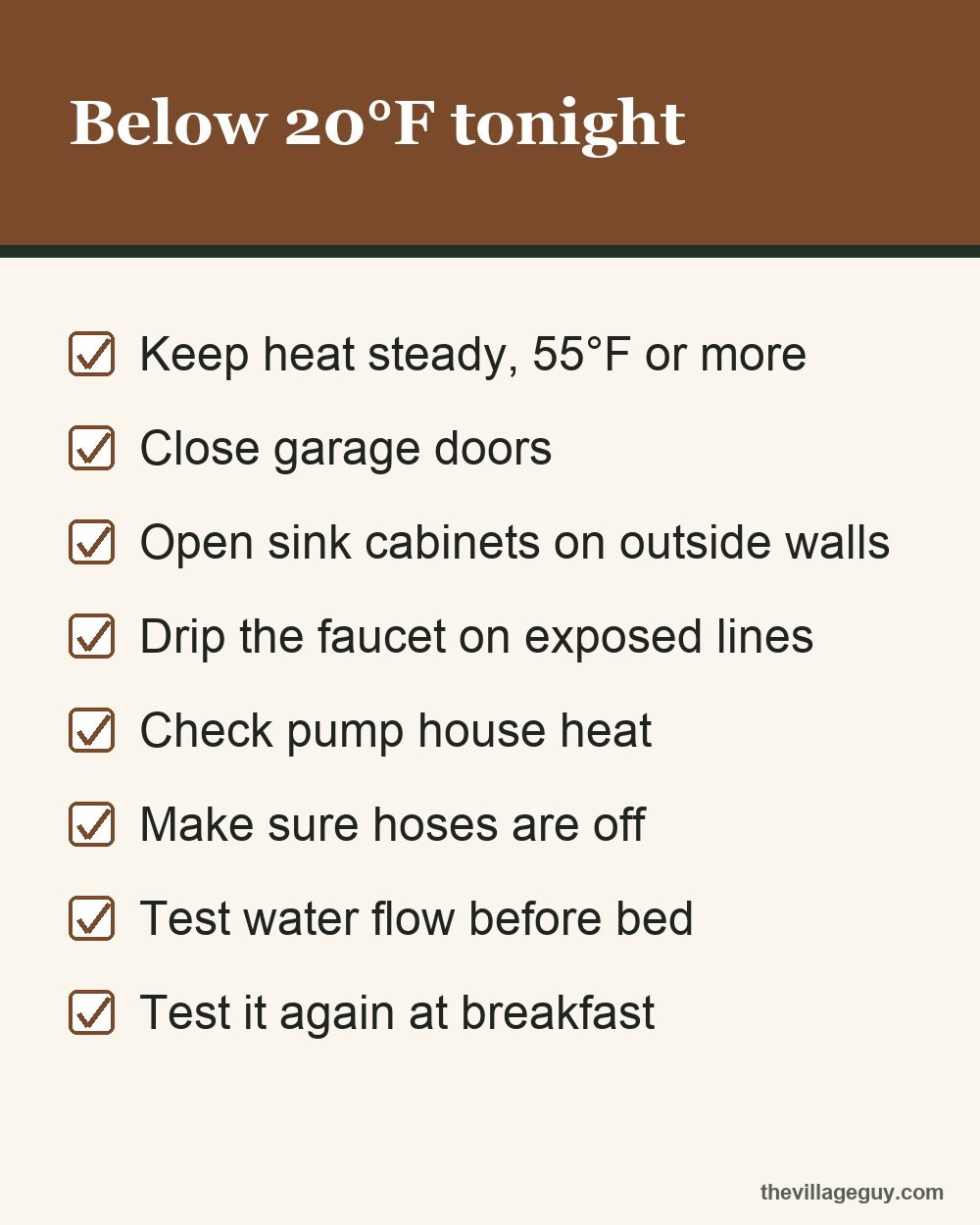
On nights at or below 20°F
- Keep the thermostat steady day and night, and no lower than 55°F
- Close garage doors if water lines run through the garage
- Open kitchen and bathroom sink cabinets on outside walls, and move cleaners out of reach of children and pets
- Let a slow, steady drip run from the faucet served by the most exposed pipes
- Check water flow at the far faucet before bed and again first thing in the morning
A word on dripping if you have a septic system. The University of Minnesota’s septic program warns that a thin, constant trickle can freeze inside the drain line, and that leaving water running all the time can overload the system. Drip on the coldest nights, not all winter, and fix leaky toilets and showerheads.
Heat tape (heat cable) helps on pipes you cannot keep warm any other way, and it is a real fire risk when misused. Back in 1996 the U.S. Consumer Product Safety Commission estimated that faulty heat tapes caused about 1,500 fires a year. Use tape certified by a testing lab such as UL, plug it into a GFCI-protected outlet, and never wrap it over itself unless the instructions say you can.
Rural trouble spots: wells, pump houses, crawl spaces and mobile homes
Well pressure tanks and pump houses
The Water Systems Council notes that most well pumps sit deep in the well, below frost depth, and that a pitless adapter joins the house line to the casing below the frost line. Above ground, the weak points are the pressure tank, the tank tee and the pressure switch, because they sit in air that can drop below freezing. The council advises insulating exposed pipes and keeping an above-ground pump where it stays above 40°F, inside an insulated enclosure.
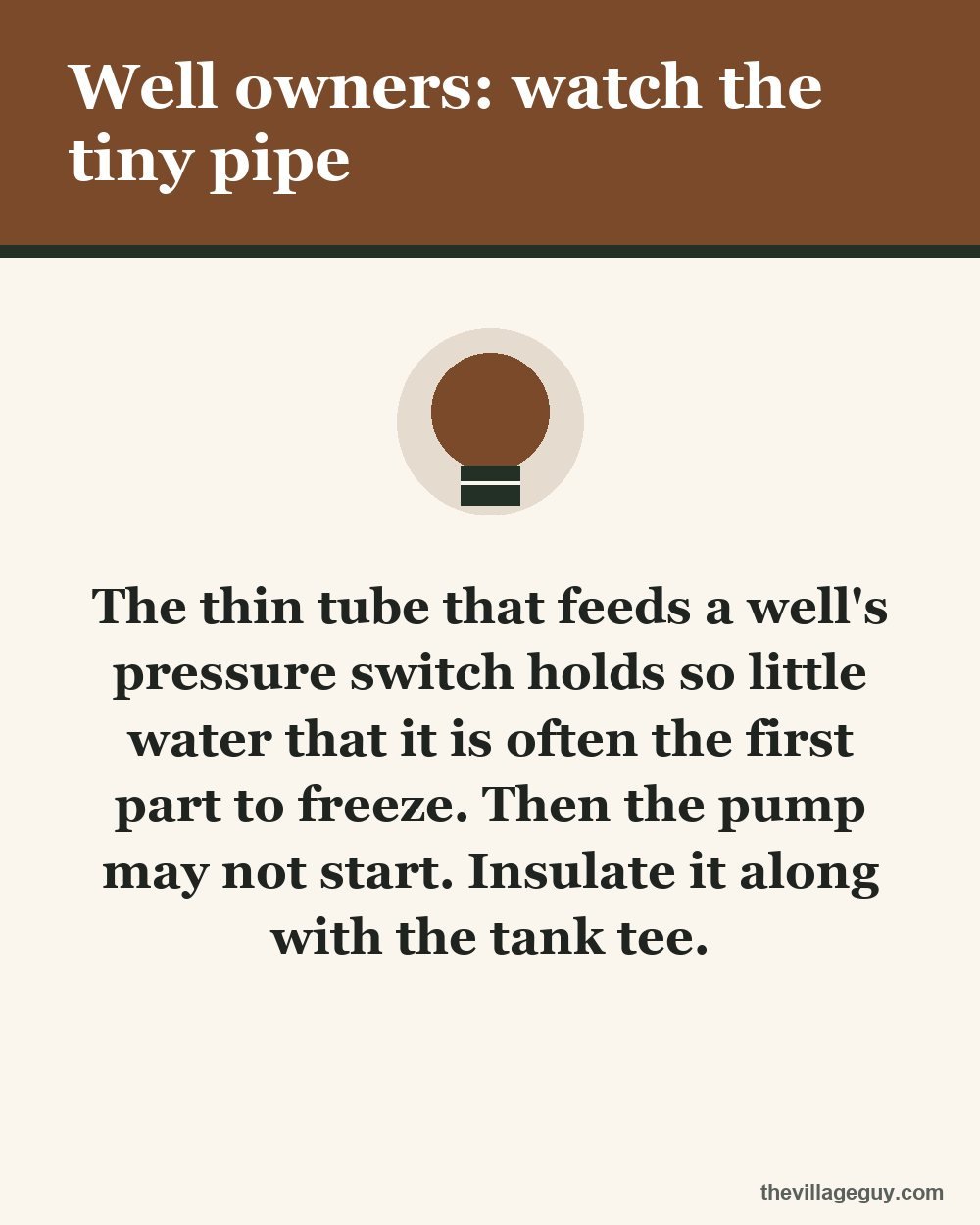
Of those, the short tube that feeds the pressure switch deserves extra care. A thin line holds very little water, so it freezes before the bigger pipes do, and if it freezes the switch cannot sense pressure and the pump may not start. Wrap and insulate it along with the tank tee.
Safety: Pump houses are small, dry and full of wood, insulation and wiring. If you add heat, use a thermostat-controlled heater or heat cable made for the location, on a properly installed GFCI circuit, and keep it clear of anything that burns. A bare heat lamp or an extension cord run across the yard is a fire waiting for a cold night. If your system freezes, switch off the pump’s breaker and call a licensed well contractor or plumber.
Crawl spaces
NC State Extension advises closing foundation vents when temperatures stay below freezing for a long stretch and reopening them when the weather warms, so the crawl space can dry out again in spring. Insulate the pipes, seal gaps around the rim joist and the water entry, and keep the crawl space door shut.
Mobile and manufactured homes
Water lines under a manufactured home are only as warm as the skirting and belly wrap around them. Washington State’s installation rules, for example, require freeze protection that follows the home maker’s instructions or heat tape listed for use with manufactured homes. Patch torn belly fabric, close skirting gaps, and protect the short riser where the supply line comes out of the ground.
Empty cabins, hunting camps and seasonal houses
An empty building is the hardest case, because nobody notices a faucet that has stopped running. Either keep it heated and checked, or shut the water off and drain it. Halfway measures are how pipes split in February.
Read your insurance policy first. The NAIC says policies generally require a minimum indoor temperature, or the water shut off, when a home is vacant, and Triple-I notes that many policies limit coverage once a home sits unoccupied for a set period, typically 30 to 60 consecutive days.
If you will drain the system
- Turn off power to the well pump and the water heater (or set a gas heater to off) before draining anything
- Shut off the main water valve, or the valve after the pressure tank on a well
- Open every faucet, hot and cold, plus outdoor taps, and leave them open
- Drain the pressure tank and the water heater following their manuals
- Flush toilets and sponge out what is left in tanks and bowls
- Pour RV (plumbing) antifreeze into sink, tub, shower and floor drain traps, never automotive antifreeze
- Leave a note on the panel and the main valve listing what you shut off
NDSU Extension recommends RV antifreeze in the U-shaped traps so the water left in them cannot freeze and crack them. On septic, keep it to the traps: the University of Minnesota septic program says not to add antifreeze, salt or additives to the system itself.
If you keep the heat on instead, set it at 55°F or higher, open sink cabinets, and have someone check the place regularly, especially after a power cut. A remote temperature alarm is a sensible extra for a place you cannot see.
How to thaw frozen pipes safely, step by step
The Red Cross says to suspect a frozen pipe when you open a faucet and only a trickle comes out. Likely spots are against exterior walls and where the water line enters through the foundation. This Old House’s plumber notes that frost on the outside of a pipe is a good clue to where the ice plug sits.
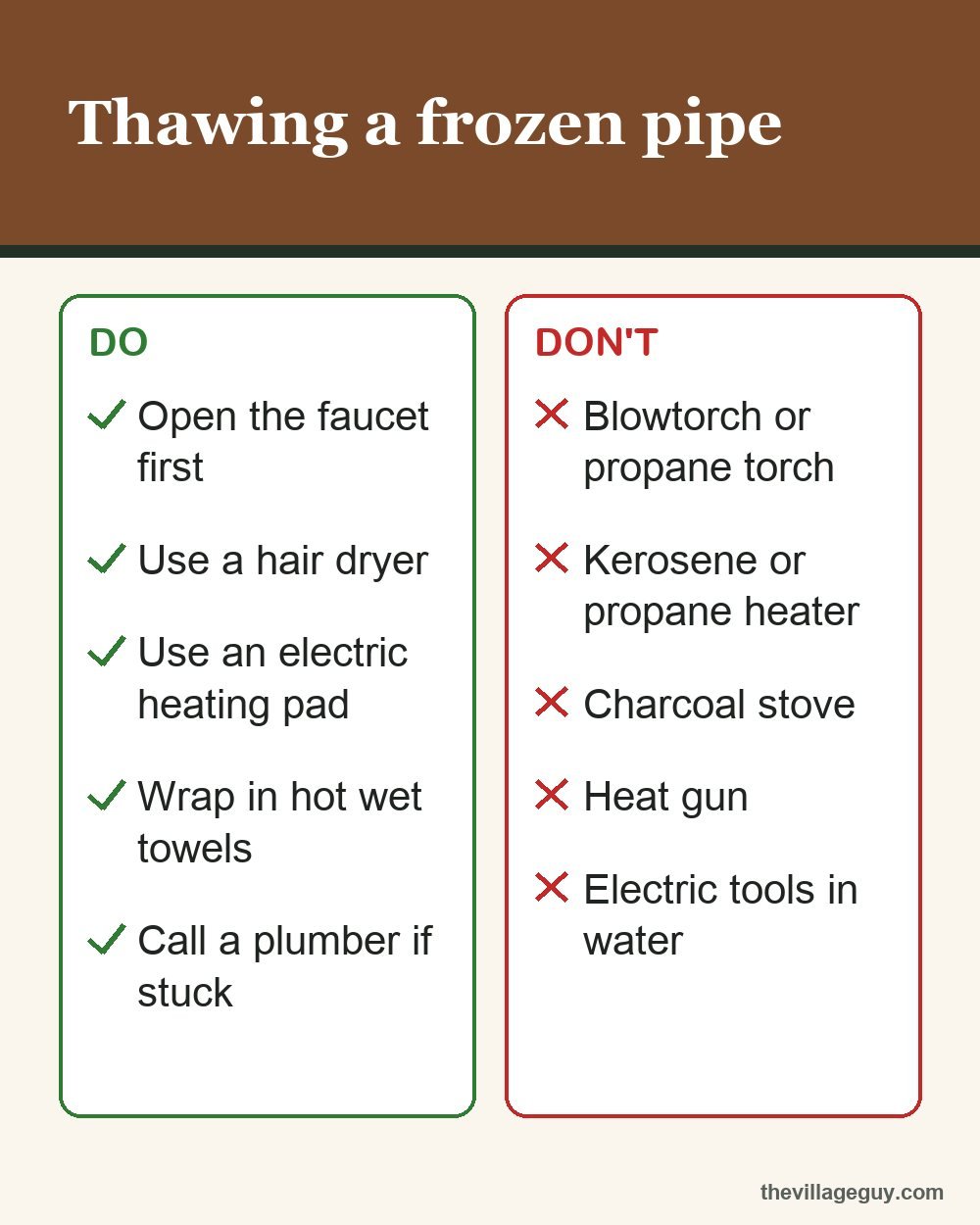
Safety: Never use a blowtorch, propane torch, kerosene or propane heater, charcoal stove or any other open flame to thaw a pipe. Flames can ignite framing and insulation inside walls, and fuel-burning heaters in enclosed spaces can produce carbon monoxide. Keep electric heaters, hair dryers and cords away from standing water, and do not use anything electrical while standing in water.
- Open the faucet that the frozen pipe feeds, so melting water and steam have a way out.
- Find the frozen section: start at the faucet and work back toward where the line enters the house.
- Apply gentle heat, working from the faucet end toward the frozen area. The Red Cross lists an electric heating pad, an electric hair dryer, a portable space heater kept away from anything flammable, or towels soaked in hot water.
- Keep heating until full water pressure returns.
- Check every other faucet in the house; one frozen pipe often has company.
- Call a licensed plumber if you cannot find or reach the frozen section, or cannot thaw it.
Travelers also rules out torches and heat guns as fire hazards. NC State Extension explains why you work from the open faucet toward the ice: steam trapped behind the plug can burst the pipe.
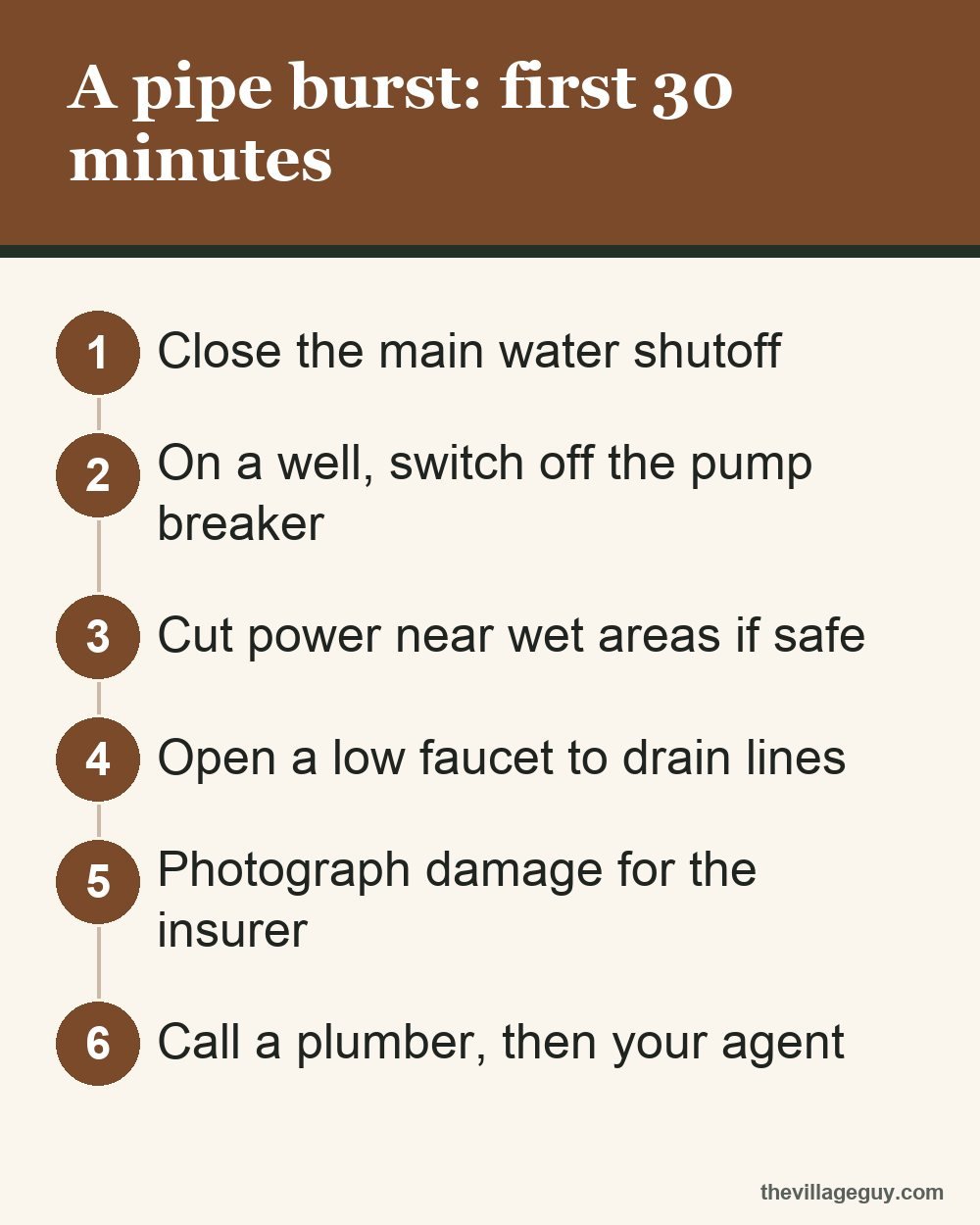
If a pipe bursts: the first half hour
Travelers points out that you may not know a pipe has split until it thaws, because the leak is plugged with ice. That is why the shutoff matters more than the mop.
- Close the main water shutoff right away; on a well, also switch off the pump’s breaker
- Switch off power to any area where water is near outlets, cords or appliances, if you can reach the panel without stepping in water
- Open a faucet at the lowest point of the house to drain what is left in the lines
- Photograph the damage and the broken pipe before cleanup, for your insurer
- Call a licensed plumber, then your insurance agent
- Start drying right away with fans and a dehumidifier to limit mold
When the power goes out, a well pump stops too, so dripping is impossible and the house starts cooling. If a long outage will push the inside temperature toward freezing, shut off the main and open the faucets to drain the lines. Run a generator only outside, at least 20 feet from doors, windows and vents as the CDC advises, with battery carbon monoxide alarms near bedrooms. If a wood stove is your backup heat, plan the fuel with this guide to how much a cord of firewood is and how much you need.
The same cold snap freezes livestock water. For the flock, see keeping chickens warm in winter; more cold-weather jobs are in the Village Guy guides.
Frozen pipes FAQ
Will pipes freeze at 32 degrees?
Rarely, unless they are fully exposed. Pipes in insulated walls or heated rooms lose heat slowly. Hose bibs, pipes in drafts and lines in an unheated pump house can freeze after a long spell just below 32°F, which is why outdoor faucets get drained in fall regardless.
How long does it take for pipes to freeze?
There is no reliable single number, because insulation, wind and pipe size all change the answer. American Family Insurance says about 20°F for a few hours is enough to put exposed pipes at risk, so plan around the forecast low and the length of the cold spell.
Should I drip hot or cold water to keep pipes from freezing?
Sources differ: the Red Cross says to let the cold water drip, Triple-I says to open both hot and cold faucets a little, and State Farm simply says to let faucets drip. The point of dripping is pressure relief and movement, so drip whichever faucet is fed by the pipe at risk. On septic, keep it to the coldest nights.
Does homeowners insurance cover frozen pipes?
Often, says the National Association of Insurance Commissioners: policies cover a sudden and accidental discharge from plumbing if you took reasonable steps such as keeping the heat on. Whether the pipe repair itself is covered depends on the policy, so ask your agent or your state insurance department before you need to.
Sources
- American Red Cross: Preventing and Thawing Frozen Pipes (pipes at risk, 55°F, thawing, no open flames)
- State Farm Newsroom: Frozen Pipes? Not So Nice! (January 2026) (archived copy; risk below 20°F in uninsulated attics, crawl spaces and exterior walls)
- University of Illinois IDEALS: An Investigation into Freezing and Bursting Water Pipes in Residential Construction (Gordon, 1996) (how pipes burst)
- University of Illinois Extension: Water Pipes (250 gallons a day from a 1/8-inch crack)
- USGS Water Science School: Water Density (ice about 9 percent less dense than water)
- NC State Extension Healthy Homes: Preventing Frozen Pipes (foundation vents, thawing direction)
- Travelers: How to Help Prevent Frozen Pipes (no torches or heat guns, hidden bursts)
- Insurance Information Institute: The Homeowner’s Severe Cold Weather Survival Guide (65°F in severe cold)
- Insurance Information Institute: Understanding the Role of Vacancy Insurance (vacancy clauses)
- NAIC: Will My Homeowners Insurance Policy Cover Water Damage From a Burst Pipe? (coverage conditions)
- Water Systems Council (wellcare): Winterizing and Protecting Pipes (pumps, pitless adapters, 40°F)
- U.S. CPSC: CPSC Re-Issues Heat Tape Guidelines (heat tape fire risk and safe use)
- Washington State WAC 296-150I-0310: Instructions for manufactured home installation (manufactured home freeze protection)
- NDSU Extension: Preparing Flood-damaged Homes for Winter (RV antifreeze in traps)
- University of Minnesota Onsite Sewage Treatment Program: Freezing problems and septic systems (trickles, running water, antifreeze)
- American Family Insurance: How to Prevent Pipes From Freezing (20°F for a few hours)
- CDC: Prevent Carbon Monoxide Poisoning (generator placement)
- This Old House: How to Unfreeze Pipes (finding the ice plug)