
Most of us learned in school that cows have four stomachs. It is a good story, and it is nearly right. The accurate answer to how many stomachs does a cow have is one: a single stomach divided into four compartments, each with its own lining, shape and job. Together they turn grass, hay and silage, which your own stomach could do very little with, into beef, milk and calves.
Below: each compartment, the route a mouthful of grass travels, how a calf’s stomach develops, and, for anyone keeping a family milk cow or a few feeder steers, the feeding habits and warning signs that keep that big fermentation vat healthy.
Quick answer: A cow has one stomach with four compartments: the rumen, reticulum, omasum and abomasum. The first three ferment, sort and squeeze plant material; the abomasum is the “true stomach” that uses acid and enzymes much like yours. Calves are born with all four, but only the abomasum does real work until the rumen develops.
In this guide
- How many stomachs does a cow have?
- The four compartments, one by one
- The route a mouthful of grass takes
- Microbes do the heavy lifting
- Chewing the cud: digestion by the numbers
- A calf’s stomach is built for milk first
- Cow stomach vs. other animals
- Feeding the rumen on a small farm
- Stomach trouble that needs a vet
- Cow stomach FAQ
How many stomachs does a cow have? One, split four ways
Anatomists count one stomach with four chambers: the rumen, the reticulum, the omasum and the abomasum. The first three are grouped as the forestomach because they sit ahead of the abomasum, the part that works like a human stomach. Mississippi State University Extension calls the abomasum the “true stomach.”
The four-stomach shorthand survives because the chambers look so different. The rumen is a huge muscular sack, the reticulum is lined with a honeycomb pattern, the omasum is stuffed with thin folds like the pages of a closed book, and the abomasum has a glandular lining that secretes acid. Seen side by side on a dissection table, they really do look like four separate organs.
Cattle share this layout with sheep, goats and deer. Ohio State University Extension groups these animals as foregut fermenters: they ferment plant fiber in a multi-chambered stomach before the food ever reaches the true stomach and intestines. That design explains almost everything else here, from cud chewing to bloat.
The four compartments, one by one
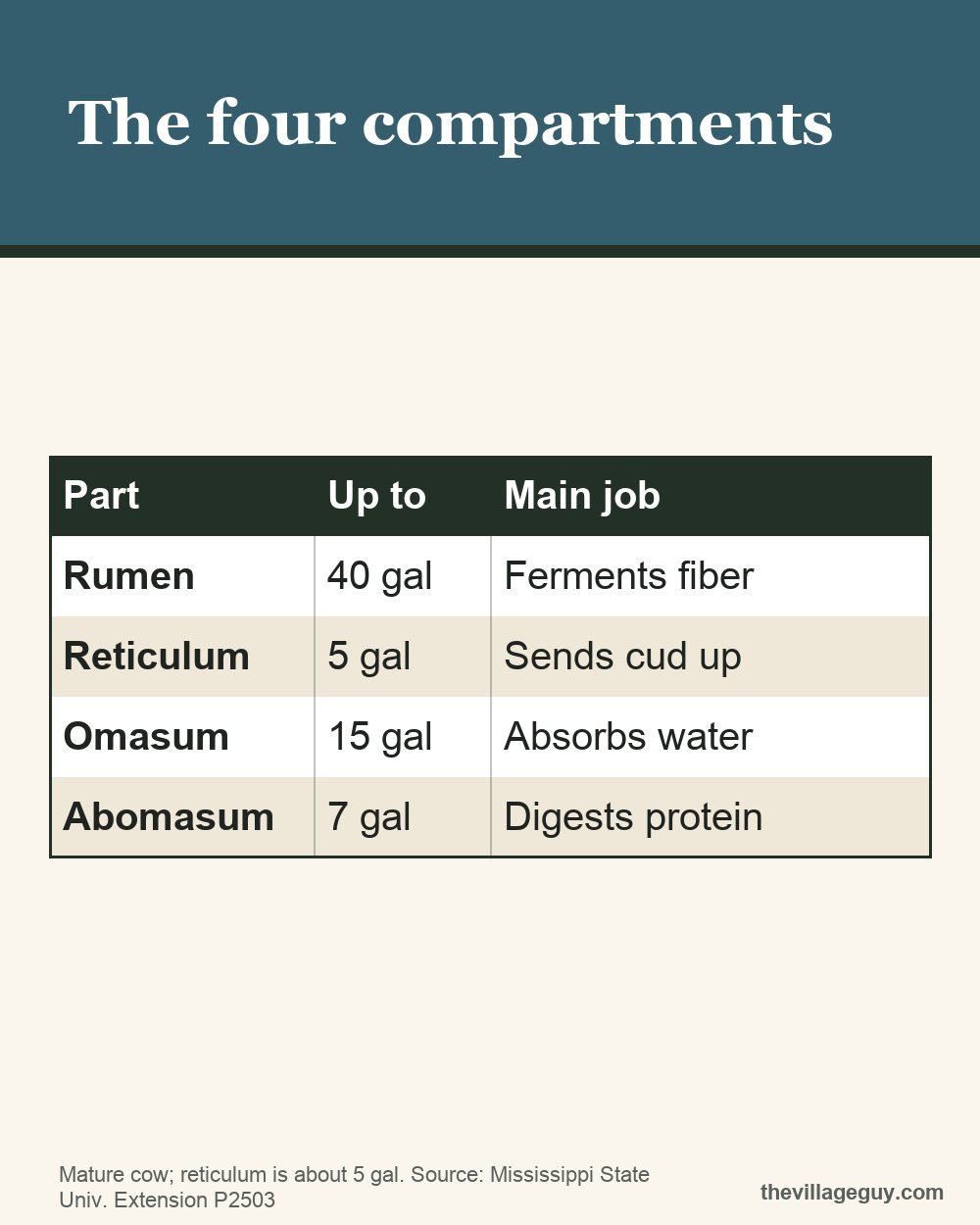
Each chamber has a distinct job, and the sizes are lopsided. The figures below are for a mature cow and come from Mississippi State University Extension’s guide to ruminant digestion; Penn State Extension describes the rumen as holding 40 to 60 gallons of material, so treat the numbers as a range that shifts with the size of the animal.
| Compartment | Also called | Capacity, mature cow | Main job |
|---|---|---|---|
| Rumen | Fermentation vat | Up to 40 gal (151 L) | Microbes ferment fiber and starch into fatty acids the cow absorbs |
| Reticulum | Honeycomb, “hardware stomach” | About 5 gal (19 L) | Works with the rumen to move cud back up; traps heavy objects |
| Omasum | Manyplies | Up to 15 gal (57 L) | Leaf-like folds absorb water and some nutrients |
| Abomasum | True stomach | Up to 7 gal (26.5 L) | Hydrochloric acid and pepsin start protein digestion |
Rumen: the fermentation vat
The rumen fills most of the left side of a cow’s belly, which is why bloat shows up as a swelling high on that side. It holds no oxygen and stays close to neutral, at about pH 6.5 to 6.8 according to MSU Extension. Those conditions suit the bacteria, protozoa and fungi that do the actual digesting of fiber.
Reticulum: the honeycomb
The reticulum sits at the front of the rumen, and the two work so closely together that scientists usually call the pair the reticulorumen. Heavy things a cow swallows by accident, such as nails, staples or short pieces of wire, tend to sink and settle here, which earned it the nickname “hardware stomach.”
Omasum: the many folds
The omasum is a round chamber packed with leaf-like folds that multiply its surface area. Water absorption happens here, so material leaving the omasum is drier and more concentrated than the soupy mix in the rumen.
Abomasum: the true stomach
The abomasum secretes hydrochloric acid and the enzyme pepsin. MSU Extension gives its pH as 3.5 to 4.0, far more acidic than the rumen next door. This is where protein digestion begins, including protein from the rumen microbes that wash downstream with the feed.
The route a mouthful of grass takes
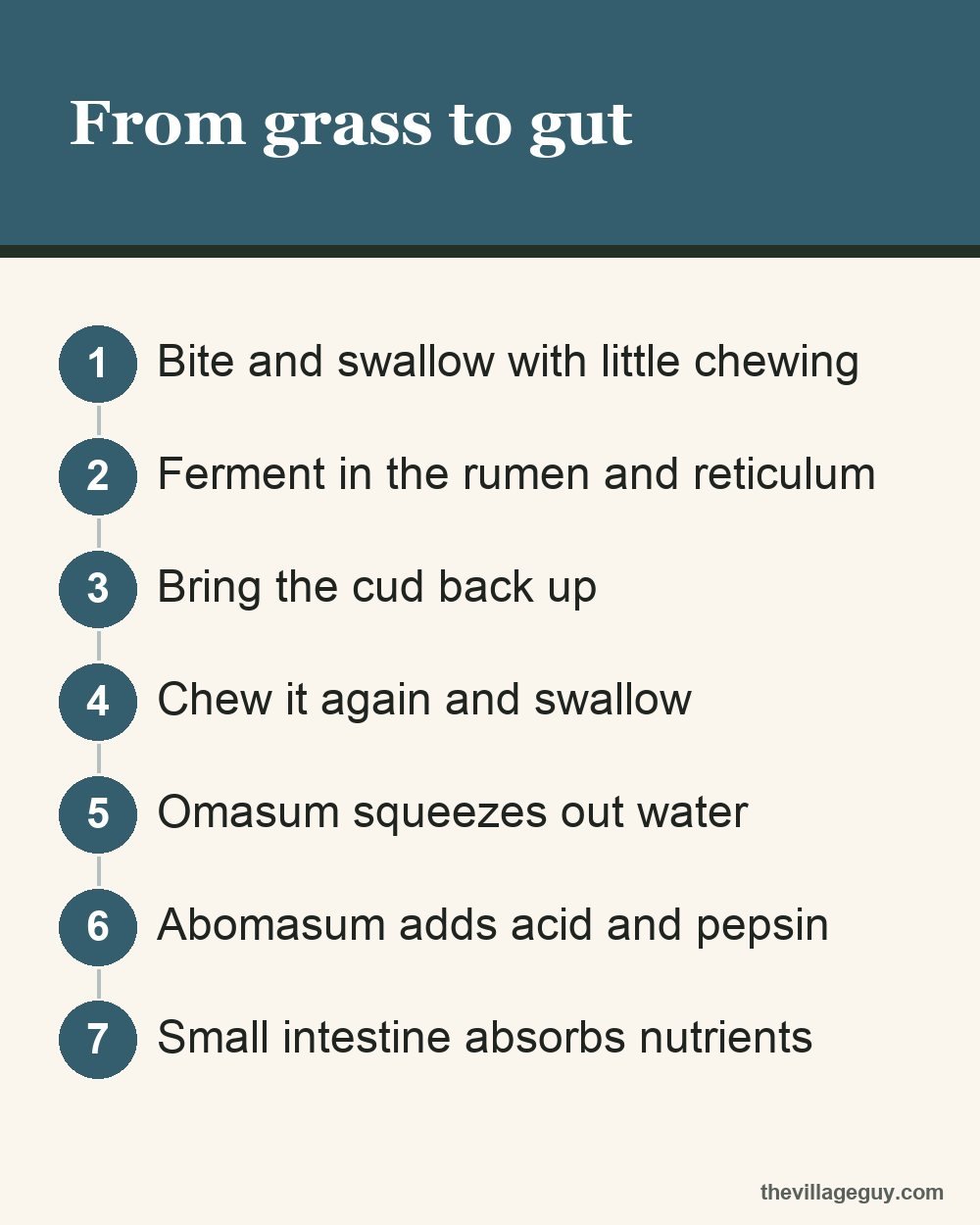
Food does not march straight through a cow. It goes down, comes back up, goes down again, and only then moves on.
- Bite and swallow. A grazing cow wraps her tongue around a clump of grass, tears it off and swallows it with little chewing. MSU Extension counts 25,000 to more than 40,000 bites a day while cattle graze.
- Soak and ferment. The food lands in the rumen and reticulum, where it mixes with saliva and microbes. Gas rises to the top, coarse fiber floats as a mat, and liquid settles below.
- Bring it back up. Contractions push a soft ball of partly fermented feed, the cud, back up the esophagus.
- Chew it again. The cow re-chews the cud slowly, breaking fiber into smaller pieces and adding more saliva, then swallows it. This is rumination.
- Repeat until small enough. Coarse pieces stay behind for more fermentation; MSU Extension notes solid feed can stay in the rumen for up to 48 hours.
- Squeeze out water. Fine particles pass into the omasum, which absorbs water and some nutrients.
- Digest with acid. The abomasum adds acid and pepsin and begins breaking down protein.
- Absorb and finish. The small intestine, up to 150 feet long in a mature cow, absorbs most remaining nutrients; the large intestine reclaims water before manure leaves the body.
Microbes do the heavy lifting
A cow cannot break down cellulose, the tough fiber in plant cell walls, with her own enzymes. Her rumen microbes can. Penn State Extension estimates about 150 billion microorganisms in a single teaspoon of rumen contents, a mix of bacteria, protozoa and fungi.
Those microbes ferment fiber and starch and release volatile fatty acids, mainly acetic, propionic and butyric acid. The cow absorbs them straight through the rumen wall. The University of Minnesota Extension says these acids supply 50 to 70 percent of a cow’s energy. MSU Extension adds that acetate is used to build body fat, while propionate is turned into glucose by the liver.
Fermentation also makes gas, mostly carbon dioxide and methane with a little hydrogen sulfide, which collects above the rumen contents. A healthy cow gets rid of it by belching. When she cannot, pressure builds fast, and that is bloat.
A handy rule of thumb: you feed the microbes, and the microbes feed the cow. Sudden ration switches starve some microbe populations and let others boom, and the cow pays for the upset.
Chewing the cud: digestion by the numbers
Rumination takes up a surprising share of a cow’s life. MSU Extension describes a typical day as a bit more than one-third grazing, about one-third ruminating and slightly less than one-third idling. All that chewing has a purpose: it drives saliva production, and saliva buffers the acids the microbes produce.
| Measure | Figure | Source |
|---|---|---|
| Share of the day spent ruminating | About one-third | Mississippi State Univ. Extension |
| Rumination in one Ohio dairy herd | 418 min/day (Jerseys) to 559 min/day (late-lactation Holsteins) | Ohio State Buckeye Dairy News |
| Saliva produced by a mature cow | Up to 50 quarts (about 12.5 gal) a day | Mississippi State Univ. Extension |
| Grazing bites per day | 25,000 to more than 40,000 | Mississippi State Univ. Extension |
| Time solid feed can stay in the rumen | Up to 48 hours | Mississippi State Univ. Extension |
| Stomach share of total gut volume | About 70% in ruminants | Ohio State Univ. Extension |
| Small intestine length, mature cow | Up to 150 ft (46 m) | Mississippi State Univ. Extension |
The Ohio State figures come from one herd over one summer, so read them as a real-world spread, not a rule. Researchers track rumination because changes can flag illness, stress or a feeding problem early. Without collars, use your eyes: a cow lying quietly and chewing her cud is usually a comfortable cow.
A calf’s stomach is built for milk first
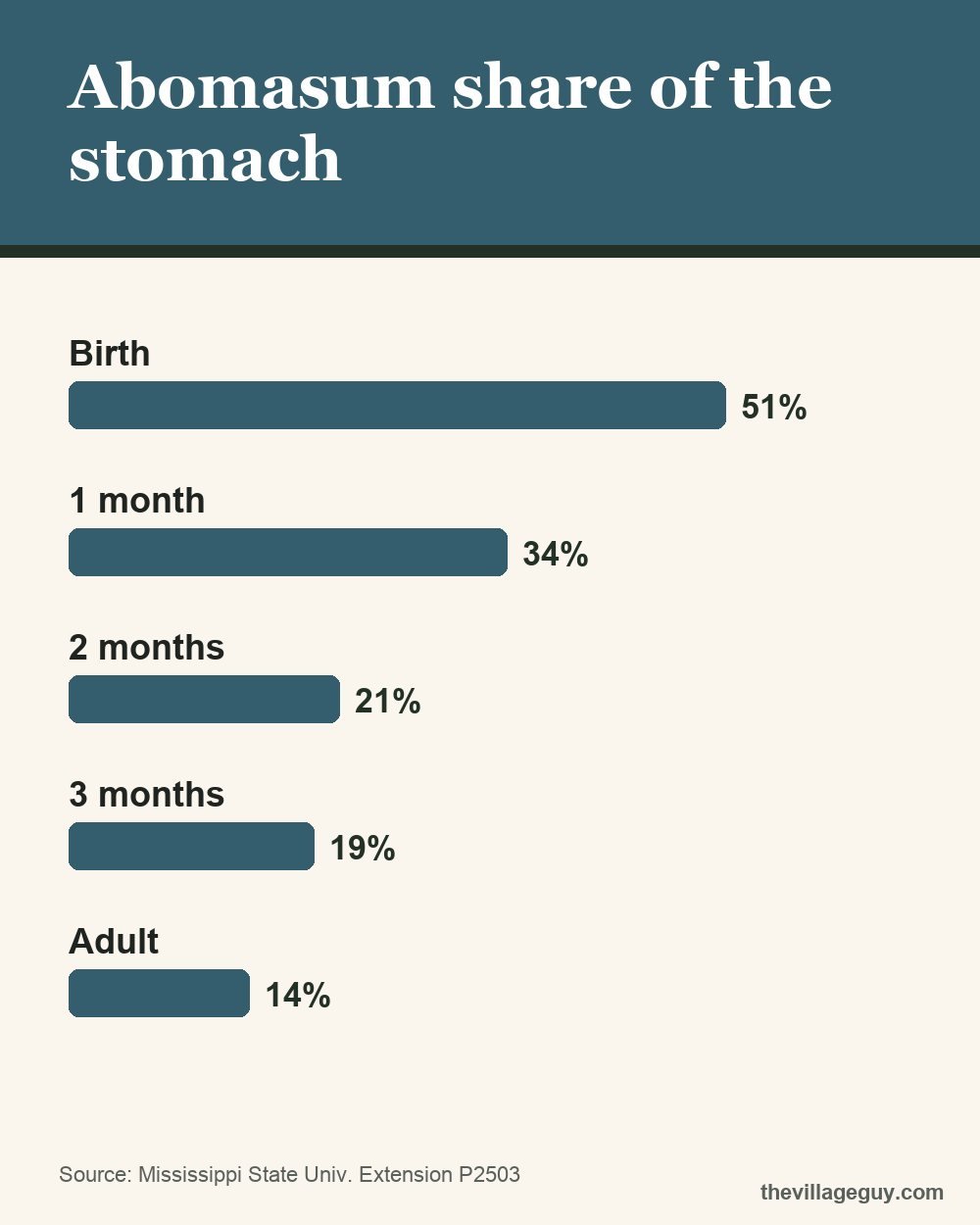
A newborn calf has all four compartments, but the proportions are flipped. At birth the abomasum is the biggest part of the stomach, and the rumen is small and not yet doing much. MSU Extension describes calves from birth to about 2 to 3 months as functionally nonruminants.
| Age | Reticulorumen | Omasum | Abomasum |
|---|---|---|---|
| Birth | 35% | 14% | 51% |
| 1 month | 55% | 11% | 34% |
| 2 months | 65% | 14% | 21% |
| 3 months | 66% | 15% | 19% |
| Adult | 62% | 24% | 14% |
Shares of the total stomach in cattle by age, as published by Mississippi State University Extension.
Milk skips the rumen. When a calf suckles, muscular folds form the esophageal (reticular) groove, a channel that shunts milk past the reticulorumen straight to the omasum and abomasum. The rumen picks up its microbes from the calf’s surroundings and, MSU Extension suggests, from licking by older animals.
What this means for a bottle calf
Ohio State dairy specialists explain that offering calf starter early encourages rumen fermentation, which produces butyrate, a compound that drives growth of the rumen lining and its papillae. They recommend free access to clean water from the first week of life, note that calves usually do not eat much starter until about three weeks old, and advise starting weaning only once a calf eats 2 to 3 pounds of starter a day for at least three days in a row.
Hay is less important early than many people assume. The same Ohio State article says forage does little for rumen development at this stage and can crowd out starter if offered too soon. Your vet or extension office can help set a feeding plan for your breed and setup.
Cow stomach vs. other animals
Plenty of animals eat grass, but they ferment fiber in different places. Ohio State Extension compares how much of the gut the stomach takes up, and the gap is striking.
| Animal | Stomach type | Chambers | Where fiber is fermented | Stomach share of gut volume |
|---|---|---|---|---|
| Cattle, sheep, goats, deer | Ruminant (foregut fermenter) | 4 | Rumen, before the true stomach | About 70% |
| Llamas, alpacas, camels | Camelid | 3 | First compartment (C1) | Not in the Ohio State table |
| Horse | Simple stomach, hindgut fermenter | 1 | Cecum and large intestine | 9 to 10% (cecum 16%) |
| Pig | Simple stomach | 1 | Mostly the large intestine, to a limited degree | 29% |
| Human | Simple stomach | 1 | Large intestine, to a small degree | Not in the Ohio State table |
The Merck Veterinary Manual illustrates the llama stomach as having three compartments, with the second working much like a ruminant’s reticulum. That difference is one reason camelid feeding advice is a subject of its own.
On mixed farms, remember that a horse ferments fiber after its small stomach, in the cecum and colon, so rumen-based feeding rules do not carry over. Ask your vet before sharing feed, minerals or supplements between cattle and horses.
Feeding the rumen on a small farm
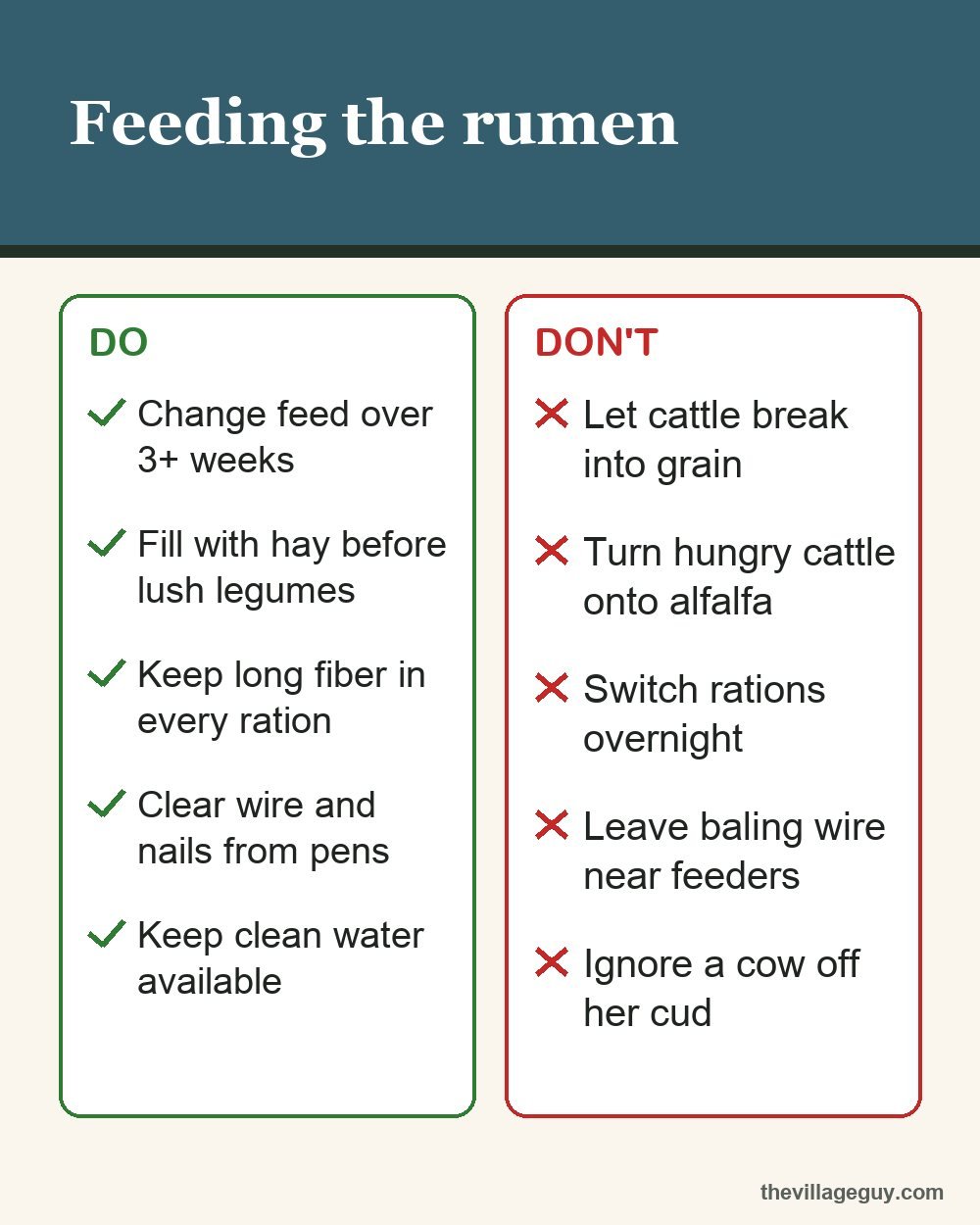
Most digestive emergencies in cattle start with a feeding change that happened too fast. The rumen’s microbes need time to shift populations, and a sudden switch from hay to grain, or from dry winter feed to lush spring legumes, gives the wrong microbes a head start. MSU Extension’s guide to beef cattle nutritional disorders recommends introducing concentrates gradually over three to four weeks and keeping at least 10 percent roughage in a finishing diet.
- Build every ration on long-stem hay or pasture, then add grain only if the cattle need it.
- Stretch any switch to grain over at least three weeks, raising the amount in small steps.
- Fill hungry cattle with dry hay before turning them onto lush alfalfa, clover or small-grain pasture.
- Lock grain bins and feed rooms so a loose cow cannot gorge on concentrate overnight.
- Walk pastures, pens and feed bunks for baling wire, nails, staples and other metal after any construction or fencing job.
- Ask your feed supplier whether magnets are fitted on mixers and grain-handling equipment.
- Keep clean water available at all times, and check that waterers are not frozen or fouled.
- Write down every feed change with the date, so you and your vet can match any upset to its cause.
Tip: Think in weeks, not days. A three-week ramp-up feels slow, but it is the time MSU Extension gives the rumen to adjust, and it is far cheaper than a vet call for grain overload.
Stomach trouble that needs a vet
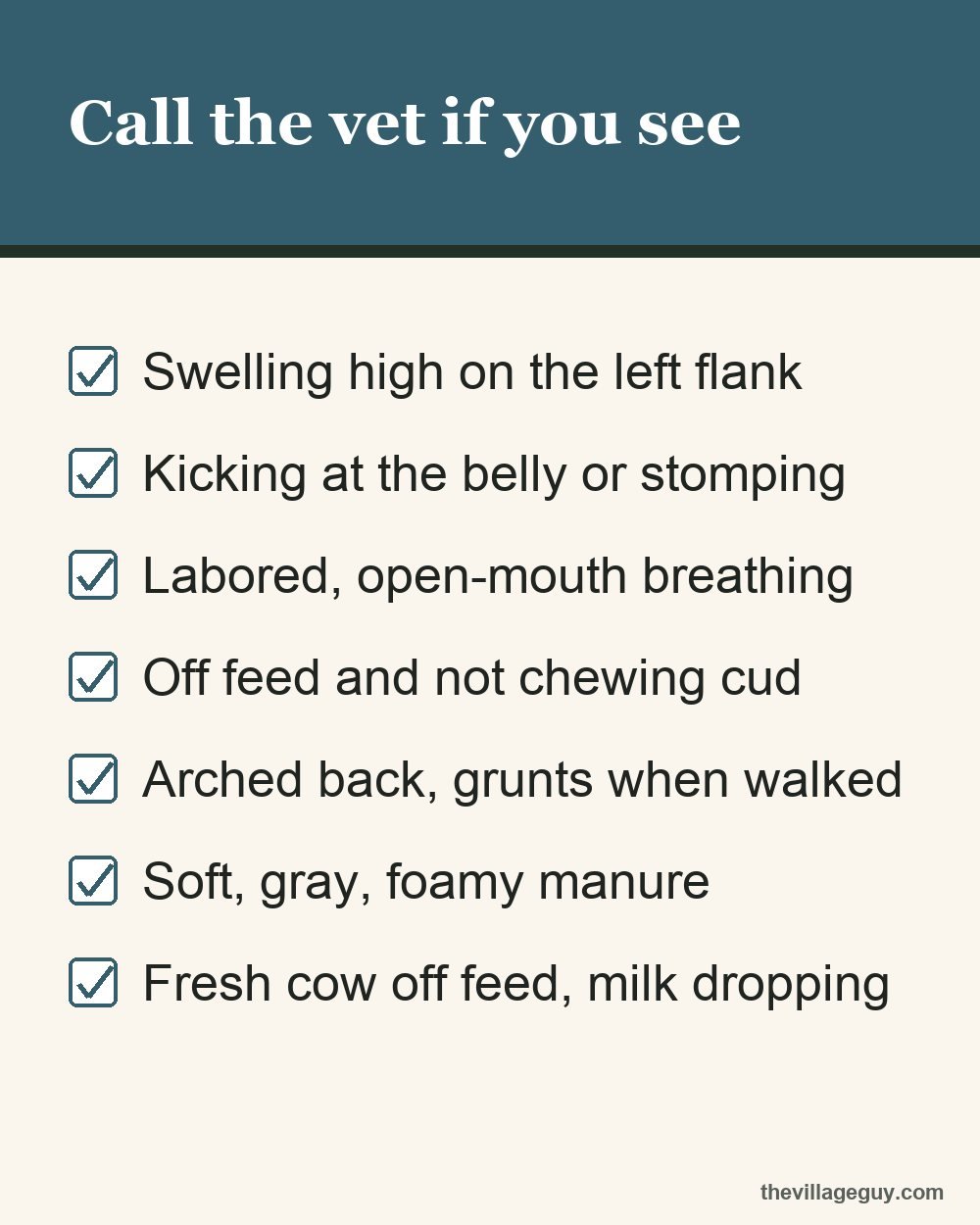
Safety: Bloat is an emergency. MSU Extension notes that cattle with bloat swell rapidly on the left side and may die within an hour. Call your veterinarian immediately, and ask your vet now, on a calm day, what they want you to do while you wait for them in a bloat emergency.
These are the stomach problems small-farm owners hear about most, with signs you can see from the fence. Only a vet can confirm what is wrong and decide on treatment.
| Problem | What you may notice | Who is most at risk |
|---|---|---|
| Bloat (frothy or free-gas) | Swelling high on the left flank, kicking at the belly, stomping, labored or open-mouth breathing | Cattle on lush legumes or small-grain pasture, or on high-grain diets |
| Acidosis (grain overload) | Off feed, weak and wobbly, diarrhea, dehydration, manure that is soft, gray and foamy | Cattle that break into grain or are switched to grain too fast |
| Hardware disease | Off feed, depressed, arched back, reluctant to move, grunting when made to walk | Cattle grazing near old fencing, scrap or recent building work |
| Displaced abomasum | Eating less (often refusing grain first), milk yield dropping, less manure than normal | Dairy cows, mostly within the first month after calving |
The Merck Veterinary Manual reports that about 80 to 85 percent of abomasal displacements happen within one month of calving, and that the condition is far more common in dairy cows than in beef cattle. If you keep a family milk cow, that first month after she calves is the time to watch her appetite most closely.
A two-minute daily gut check
- Watch each cow eat at the morning feeding and note any that hang back.
- Look at the left flank from behind for a swelling high up near the hip bone.
- Check that resting cows are chewing their cud at some point during the day.
- Glance at fresh manure for diarrhea, foam, a gray color or an unusually small amount.
- Watch how each animal stands and walks, looking for an arched back or reluctance to move.
- Track a milk cow’s yield and appetite daily for the first month after calving.
- Call your vet the same day for any cow that is off feed and not chewing her cud.
Cow stomach FAQ
Which of a cow’s stomachs is the true stomach?
The abomasum, the fourth compartment. It is the only one that secretes hydrochloric acid and pepsin, so it works much like a human stomach. It is also the compartment that can shift out of place in dairy cows after calving, a condition called a displaced abomasum.
Do calves have four stomachs?
Calves are born with all four compartments, but for roughly the first 2 to 3 months they digest mainly like a single-stomached animal. Milk travels through the esophageal groove straight to the abomasum, and the rumen grows and gains microbes as the calf starts eating starter and other solid feed.
Do goats and sheep have four stomachs too?
Yes. Sheep, goats and deer are ruminants with the same four compartments as cattle, just smaller. Llamas, alpacas and camels are the common exception: the Merck Veterinary Manual describes a three-compartment stomach in llamas.
Why do some cows have a magnet in their stomach?
Some farmers and vets place a smooth, heavy magnet in the reticulum to hold swallowed bits of wire or nails so they cannot pierce the stomach wall, the problem known as hardware disease. MSU Extension lists these intraruminal magnets as a prevention option where hardware cannot be ruled out. Ask your vet whether they make sense for your herd.
For more practical guides to cattle, poultry and country living, browse all of The Village Guy’s guides, or find out who is behind The Village Guy.
Sources
- Mississippi State University Extension: Understanding the Ruminant Animal Digestive System (P2503) (compartment capacities and pH, saliva, grazing bites, time budget, calf stomach proportions, esophageal groove, intestine length)
- Mississippi State University Extension: Beef Cattle Nutritional Disorders (P2519) (bloat, acidosis and hardware disease signs; gradual grain introduction; roughage; magnets)
- University of Minnesota Extension: The ruminant digestive system (volatile fatty acids supply 50 to 70 percent of a cow’s energy)
- Penn State Extension: From Feed to Milk: Understanding Rumen Function (rumen holds 40 to 60 gallons; about 150 billion microorganisms per teaspoon)
- Ohio State University Extension: The Gastrointestinal Tract (AS-1022) (stomach share of gut volume in ruminants, pigs and horses; foregut vs hindgut fermenters)
- Ohio State Buckeye Dairy News: Rumination Time, the Impacts of Dietary and Environmental Factors (measured rumination minutes per day by pen)
- Ohio State Buckeye Dairy News: Starter Success for Dairy Calves (starter, butyrate and rumen development; water from week one; weaning guideline)
- Merck Veterinary Manual: Left or Right Displaced Abomasum and Abomasal Volvulus in Cattle (timing after calving, dairy cows most affected, signs)
- Merck Veterinary Manual: Stomach, llama (three-compartment camelid stomach)