Chickens will eat almost anything that fits in a beak, which is exactly why feeding them takes a little thought. Left to choose, a hen picks the tastiest thing in the run (a spilled blueberry, a fat grub) over the boring pellet that actually keeps her laying. So what do chickens eat when they are fed well? A complete feed matched to their age makes up the bulk of the diet, treats and scraps fill a small share, and a short list of kitchen foods stays out of the run entirely.
Quick answer: Backyard chickens should eat a complete commercial feed for their age (chick starter, then grower, then layer feed with about 16 percent protein from 18 to 20 weeks), plus clean water, with treats and scraps kept under 10 percent of the diet. Greens, insects, most fruit flesh and cooked vegetables make good treats; avocado, chocolate, raw or dried beans, green potatoes, moldy food and salty snacks do not.
In this guide
- What do chickens eat: the 90/10 diet
- Feed by age: starter, grower, layer
- How much chickens eat and drink
- Grit, oyster shell and eggshells
- What can chickens eat from the kitchen
- Grapes, bananas and tomatoes
- What not to feed chickens: 15 foods to avoid
- Feeding mistakes that cost eggs
- Copy-ready feeding checklists
- Chicken feeding FAQ
What do chickens eat: the 90/10 diet
Chickens are omnivores. Given a yard, they eat seeds, small grains, leaves, grass, insects and worms. That foraging menu sounds wholesome, but it does not add up to a laying hen’s needs: University of Kentucky poultry specialists estimate chickens get only about 5 to 10 percent of their dietary needs from foraging, and Oregon State notes that pasture offers little feed value in late fall and winter. Maryland Extension puts pasture’s contribution a bit higher, at 5 to 20 percent, depending on forage and breed.
So the working rule most extension services use is simple. Roughly 90 percent of what a chicken eats should be a complete feed made for its age and purpose, and treats, scratch and scraps together should stay under 10 percent. Texas A&M’s veterinary school, Colorado State and the University of Illinois all draw the line at 10 percent.
Tip: A quick way to hold the line is the clean-up test. Oregon State suggests giving no more scratch or scraps than the flock can finish in about 20 minutes; Colorado State’s organic flock guide is stricter at 5 to 10 minutes. Whatever is left after that is attracting rats, not feeding hens.
Feed by age: starter, grower, layer
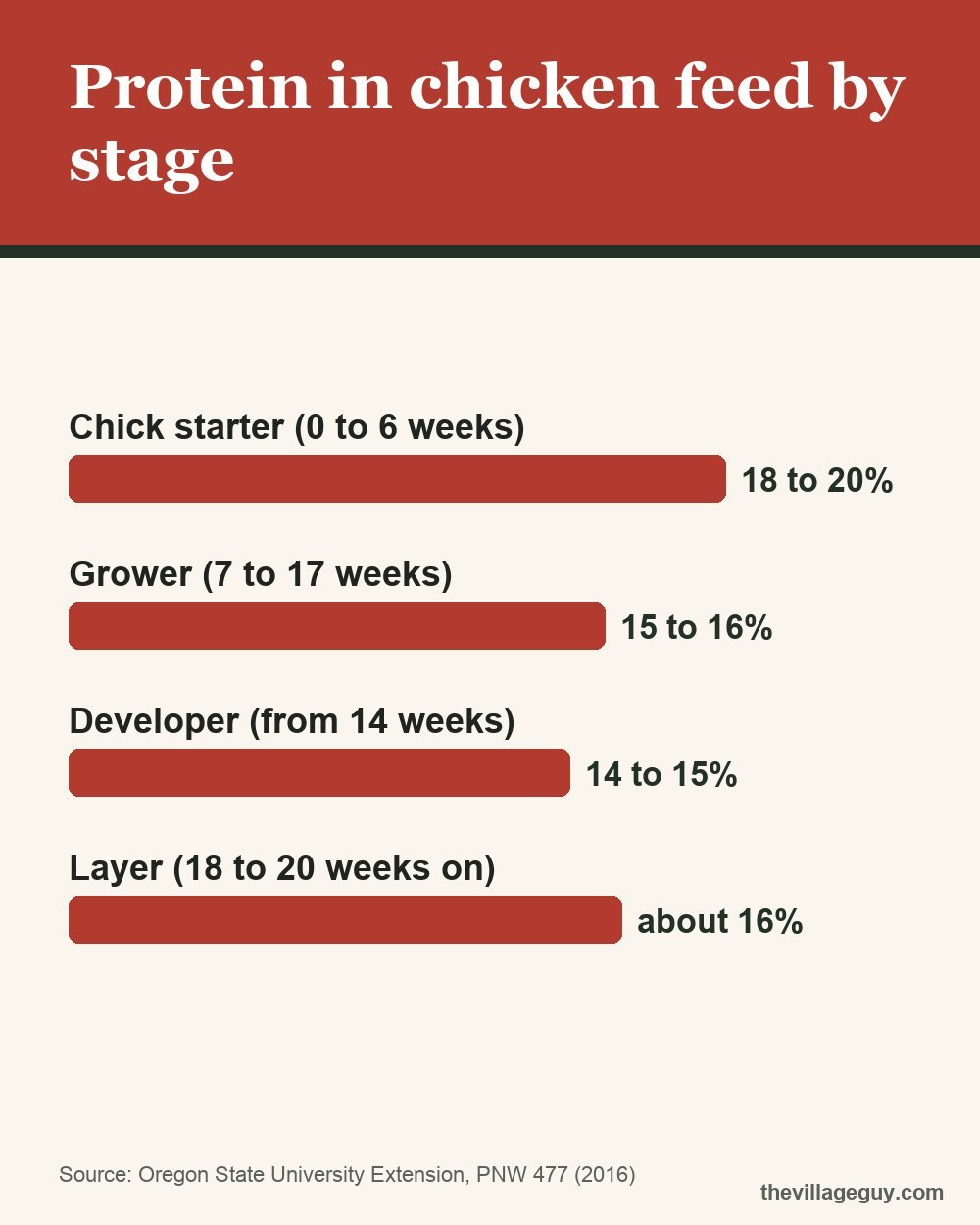
Bagged feeds are formulated as complete diets, so a small flock on the right bag needs very little else. The catch is that “right” changes as birds grow. These are the stages Oregon State University Extension lays out in its laying-hen feeding guide; labels and other extension services vary by a point or two of protein.
| Stage | Age | Protein | What to know |
|---|---|---|---|
| Chick starter | Hatch to about 6 weeks | 18 to 20% | Often medicated against coccidiosis; skip meat-bird starter for layer chicks |
| Grower | About 7 to 17 weeks | 15 to 16% | Sustains steady growth to maturity |
| Developer (optional) | From about 14 weeks | 14 to 15% | Interchangeable with grower in practice |
| Layer | 18 to 20 weeks or first egg, whichever comes first | About 16% | Extra calcium (3 to 4%) for shells |
| All-purpose or flock raiser | All ages | Varies | Layers need free-choice oyster shell alongside it |
Two rules matter more than the brand. First, do not give layer feed to chicks or young pullets: Maryland Extension warns that its high calcium can cause improper bone formation, kidney failure and death. Second, do not feed laying hens starter or grower rations; Maryland notes that broiler starter in particular can mean poor shells. Mixed-age flocks are where this gets awkward, and a common answer is an all-purpose feed for everyone with oyster shell in a separate dish for the hens.
Medicated starter usually carries a coccidiosis preventive. Oregon State notes that withdrawal times appear on the label when they apply to eggs, so read it before laying hens get anything medicated, and ask a vet about any flock health question beyond the label.
How much chickens eat and drink
A laying hen eats about a quarter pound of feed a day (100 to 150 grams), according to Kentucky and Alabama extension guides. Mississippi State gives a range of 1/4 to 1/3 pound depending on weather, body size and how hard she is laying, and heavy dual-purpose breeds land toward the top of it. Mississippi State also calls full feeding (feed always available) the best method for steady production.
Here is the worked example from Alabama Cooperative Extension, with numbers you can scale to your own flock:
- 10 hens x 0.25 lb a day = 2.5 lb of layer feed a day
- One 50 lb bag lasts about 20 days for 10 hens
- 6 hens: about 1.5 lb a day, so a 50 lb bag lasts roughly a month
Water matters even more than feed. Oregon State says chickens drink two to three times as much water by weight as they eat, and more in hot weather; Alabama’s figure works out to about one gallon a day for every 16 laying hens. Check waterers every day, and in a freeze several times a day (the winter fixes are in our guide to keeping chickens warm in winter).
Keep the feed itself fresh
Feed goes stale. Alabama Extension recommends using feed no more than 3 months past its manufacture date, stored dry and out of the sun in rodent- and insect-proof containers, and Maryland adds that bags left on a concrete floor pick up moisture. Wet feed molds, and Kentucky warns that the mycotoxins molds produce stay in the feed even after you scrape the mold away. Moldy feed goes in the trash, not the run.
Grit, oyster shell and eggshells
These two extras get mixed up constantly, and they do different jobs. Grit is insoluble stone that sits in the gizzard and grinds whole grains and forage. Oyster shell is soluble calcium for eggshells. Oregon State is clear that oyster shell cannot stand in for grit because it is too soft to grind anything. Extension advice on grit differs, so this table shows where the sources land.
| Your situation | Grit | Oyster shell |
|---|---|---|
| Complete layer feed only, birds confined | Not needed, says Alabama Extension (the feed is already ground) | Optional, free-choice in a separate dish |
| Birds get scratch or whole grains | Yes, insoluble grit (Oregon State, Maryland) | Free-choice |
| Free-range or on pasture | Kentucky recommends it; birds on bare ground often find their own | Free-choice |
| All-purpose feed for laying hens | Only if feeding grains | Required for good shells (Oregon State) |
| Thin, rough or cracked shells | No change | Offer it; hens that need calcium will eat it |
Your own eggshells can be the calcium source if you prepare them. Kentucky suggests boiling shells, removing the membrane and crushing them, which kills any Salmonella and makes them look less like an egg (so hens do not learn to break their own). Alabama suggests drying shells in the sun for 1 or 2 days or in a 350°F oven for 10 minutes. Either way, crush them well.
What can chickens eat from the kitchen
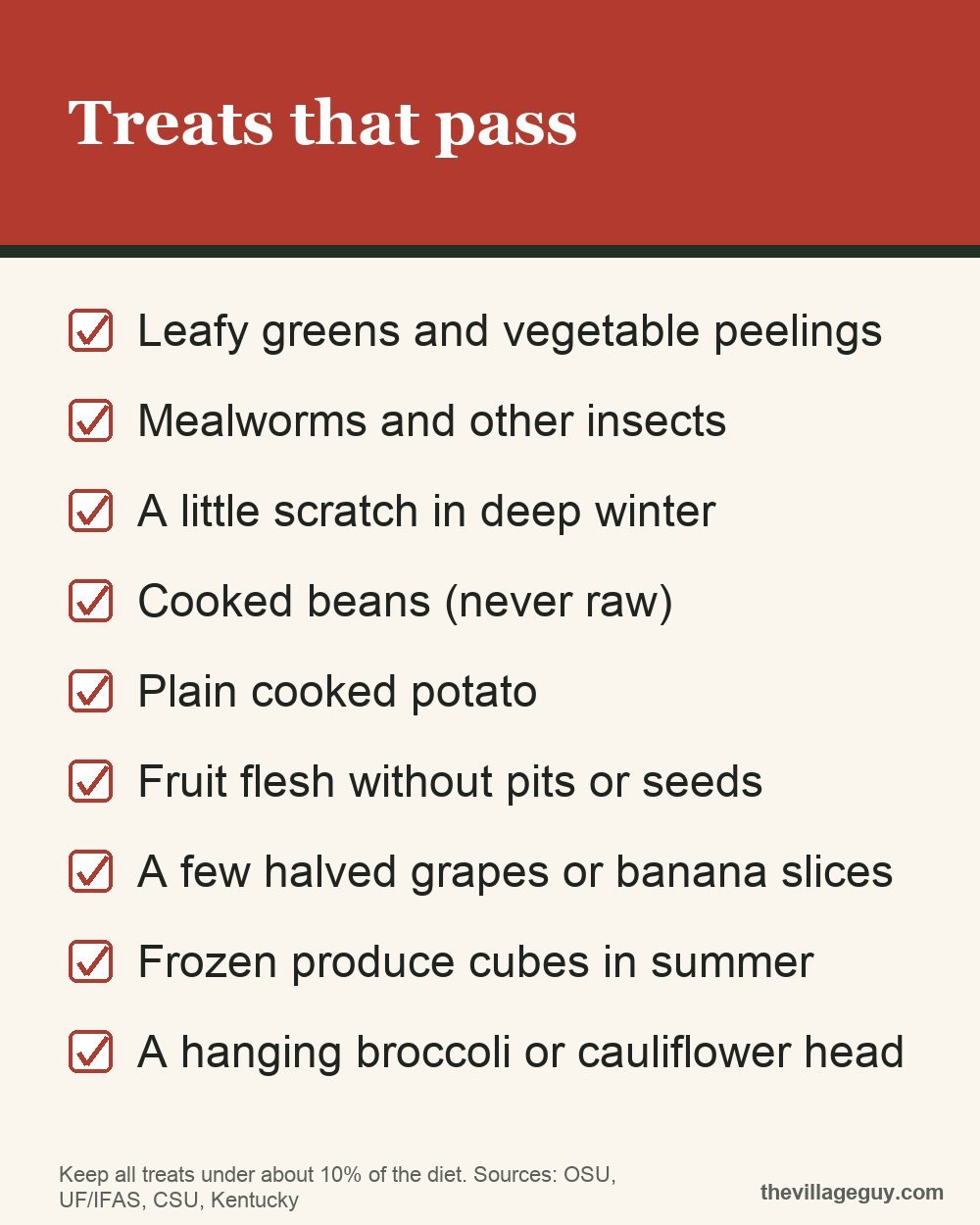
Most produce scraps are fine in moderation, and a few are genuinely useful. Oregon State notes that greens help keep yolks a deep orange, which is why a carton from a flock with access to greens looks so different from a supermarket dozen. Kentucky says leftover fruits and vegetables can be good for chickens, as long as scraps are cleared away before they rot.
Treats that fit the season
Colorado State’s Boulder County extension suggests hanging a cauliflower or broccoli head for hens to peck at, and warm oatmeal on the coldest winter days. Kentucky adds that winter is the one time a little scratch or cracked corn makes sense, for the extra energy. In summer, Mississippi State poultry specialists say frozen cut fruit and vegetables in ice-cube trays are an acceptable hot-weather treat, as long as they do not replace the feed hens tend to skip in the heat.
Scraps with a catch
Cooked beans are generally safe even though raw ones are not, and plain cooked potato is fine in moderation, according to University of Florida extension. Fruit flesh is fine; the pits and apple seeds are the problem. Bread splits the experts: the University of Illinois veterinary college says to avoid bread and crackers altogether, while Colorado State lists bread products among acceptable scraps. If you feed it, keep it to a token amount, and never anything moldy.
Grapes, bananas and tomatoes
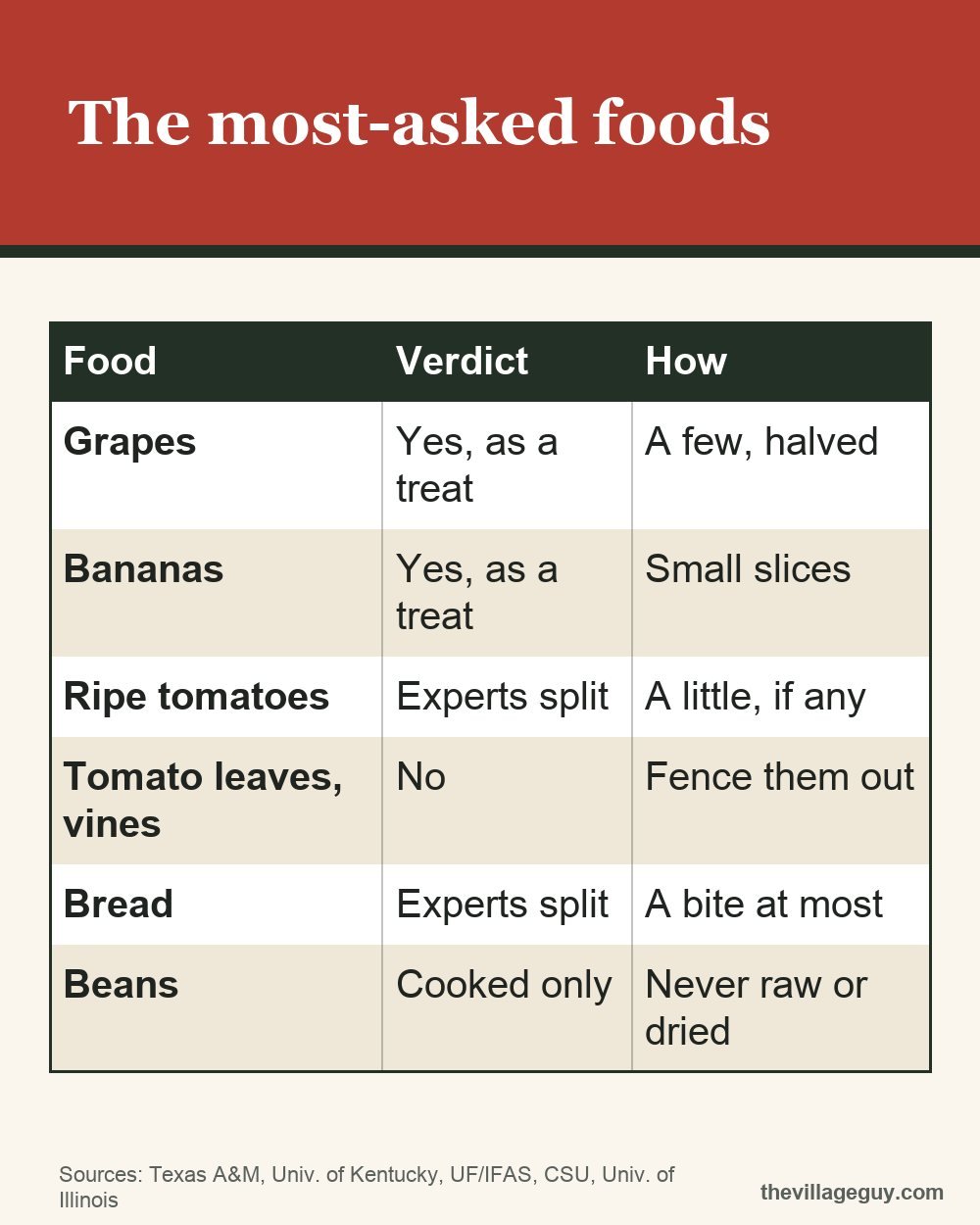
These three get more questions than every other treat combined. Two have a straightforward answer. The third depends on which extension service you ask.
Can chickens eat grapes?
Yes, as an occasional treat. None of the extension poultry guides cited here list grapes as harmful to chickens. The grape and raisin poisoning that worries pet owners is documented in dogs, where the Merck Veterinary Manual describes acute kidney injury. Grapes are still sugary fruit, so offer a few per bird, cut in halves for bantams and young birds, and toss any that are moldy.
Can chickens eat bananas?
Yes, also as a treat. Bananas do not appear on any of the do-not-feed lists from Kentucky, Florida, Texas A&M or Colorado State. Mashed or sliced banana is soft and sweet, so it fits the same small-portion rule as other fruit.
Can chickens eat tomatoes?
Here the sources disagree, and it is worth knowing how. Texas A&M’s veterinary school lists tomato plants (leaves and vines) among foods poisonous to chickens. The University of Kentucky’s urban poultry guide goes further and lists tomatoes themselves, along with peppers and eggplant, on its do-not-feed list. Many keepers do share ripe tomatoes. The cautious middle path is to feed only a little ripe red fruit, if any, and never let birds into tomato vines, leaves or green fruit.
What not to feed chickens: 15 foods to avoid
This list combines the do-not-feed advice from four university sources. Each row names who flags it, so you can see where the agreement is strongest.
| Food | Why it is a problem | Flagged by |
|---|---|---|
| 1. Avocado, especially skin and pit | Persin, linked to breathing and heart problems | Florida, Texas A&M, Colorado State |
| 2. Chocolate | Theobromine and caffeine | Florida, Kentucky |
| 3. Coffee grounds, tea and energy drinks | Caffeine affects the heart and nervous system | Florida |
| 4. Raw or dried beans | Phytohemagglutinin (cooked beans are generally safe) | Florida, Kentucky, Texas A&M |
| 5. Raw, green or sprouting potatoes and peels | Solanine | Florida, Kentucky, Texas A&M, Colorado State |
| 6. Moldy or rotting food | Mold toxins; rotting food can harbor botulism | Florida, Kentucky |
| 7. Salty foods (chips, cured meat) | Dehydration and kidney damage | Florida, Texas A&M, Colorado State |
| 8. Onions in quantity | Can damage red blood cells and flavor eggs | Florida, Texas A&M |
| 9. Alcohol | Dehydration, respiratory failure, death | Florida |
| 10. Fruit pits and apple seeds | Release cyanide compounds when crushed | Florida, Texas A&M |
| 11. Rhubarb | Listed as poisonous to chickens | Texas A&M |
| 12. Tomato plants (leaves and vines) | Listed as poisonous to chickens | Texas A&M |
| 13. Raw meat | On the do-not-feed list | Kentucky |
| 14. Junk food and peanuts | On the do-not-feed list | Kentucky |
| 15. Citrus | Colorado State advises leaving it out of scraps | Colorado State |
If a bird does get into something on this list and seems weak, wobbly or short of breath, call a veterinarian who sees poultry. Do not try to treat poisoning at home with remedies from a forum.
Safety: Wash your hands with soap and water after handling chickens, their feeders or anything in the run, and keep birds out of the kitchen. The CDC warns that backyard poultry can carry Salmonella while looking perfectly healthy.
Feeding mistakes that cost eggs
Most feeding problems are not poisonings. They are slow leaks in the diet that show up weeks later as fewer eggs, thin shells or odd-looking yolks.
Diluting the feed. Scratch and scraps are not complete foods, and Alabama Extension warns that hens who fill up on them eat too little of the feed that keeps them laying. Stirring scratch into the feeder is the same mistake with extra steps, since it dilutes every mouthful. If production has already slipped, our guide to why chickens stop laying walks through feed alongside light, molt and age.
Leaving out calcium. Hens on all-purpose feed without oyster shell often lay thin or rough shells. Oregon State suggests watching for shells with a sandpaper feel as the cue.
Feeding stale or damp feed. Old feed loses nutrients and damp feed molds, and neither shows up on the scale until egg numbers drop.
Surprises from the ingredient list. Alabama Extension notes that layer feeds with fish meal can give eggs a fishy flavor and those with cottonseed meal can turn whites green. A green or pink white in an egg that also smells off is a different story, covered in our guide to telling if eggs are bad.
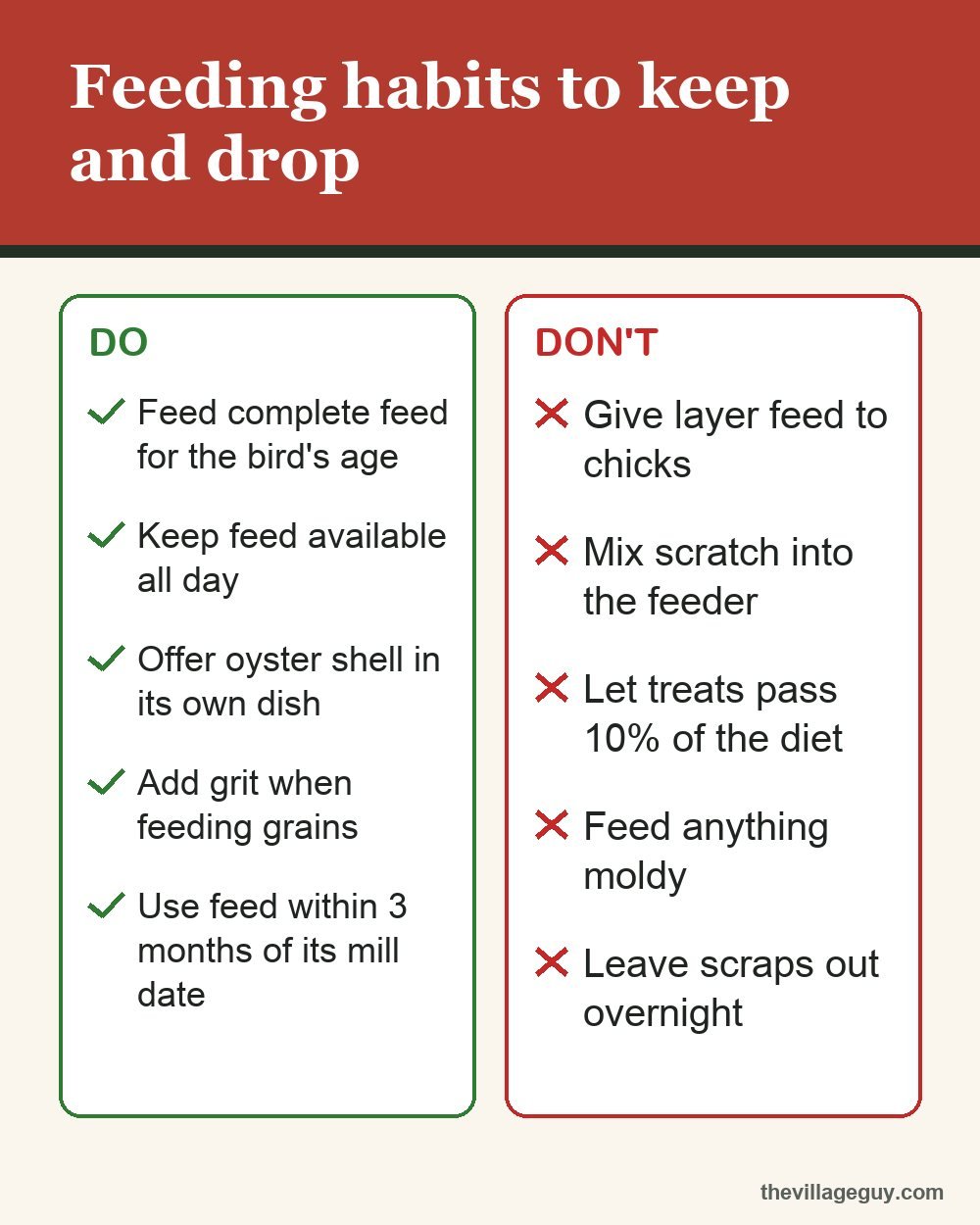
Copy-ready feeding checklists
Print these or keep them on your phone by the feed bin. Housing, predators and winter care each have their own write-up in the site’s guide index.
Every day
- Top up the feeder so complete feed is always available.
- Refill and rinse waterers, and check them again on hot or freezing days.
- Give treats only after the birds have eaten feed, and only what they clear in about 20 minutes.
- Pick up leftover scraps before evening so they do not draw rodents.
- Wash your hands after feeding and collecting eggs.
Every week
- Check the oyster shell dish and refill it.
- Look inside the feed bin for damp, caked or musty feed.
- Scrub waterers and feeders.
- Check a few eggs for thin or rough shells.
When things change
- Switch pullets to layer feed at 18 to 20 weeks or the first egg.
- Read the manufacture date and buy only feed you will use within 3 months.
- Add grit if you start feeding scratch or whole grains.
- Move to a little afternoon scratch in deep winter and frozen produce in heat waves.
Chicken feeding FAQ
What do chickens eat in the wild?
Free-living chickens eat seeds, small grains, leaves, grass, insects and worms. Kentucky’s poultry extension notes that grass and clover mostly add fiber, since chickens get few nutrients from them, which is why foraging cannot replace a complete feed for laying hens.
Can chickens eat bread?
Experts disagree. The University of Illinois veterinary college says to avoid bread and crackers entirely, while Colorado State lists bread products as acceptable scraps. If you give any, keep it to a bite or two per bird, and never moldy bread.
Can chickens eat eggshells?
Yes, and they are a useful calcium source once they are dried or boiled and crushed. Crushing them well keeps them from looking like eggs, which helps stop hens from learning to break and eat their own.
Do roosters need different food from hens?
Alabama Extension advises feeding roosters the same diet as the hens, with plenty of clean water and enough feeder space that they do not fight over it. Keeping one feed for the whole adult flock is simpler and is the common approach.
Sources
- Oregon State University Extension (PNW 477, 2016): How to Feed Your Laying Hens (feed stages and protein levels, oyster shell vs grit, 20-minute rule, water 2 to 3 times feed by weight, greens and yolk color, winter pasture value)
- University of Kentucky Extension (ASC-241, 2018): Urban Poultry (1/4 lb a day, foraging supplies 5 to 10 percent, do-not-feed list, botulism from rotting food, eggshell preparation, mycotoxins, winter scratch)
- Alabama Cooperative Extension System (ANR-2913, 2022): Feeding the Laying Hen (100 to 150 g a day, 50 lb bag example, water per hen, grit, feed age limit, fish meal and cottonseed meal effects, roosters)
- Mississippi State University Extension: Feeds and Nutrition (1/4 to 1/3 lb a day, full feeding)
- University of Maryland Extension: Feeding the Flock (layer feed harms chicks, pasture 5 to 20 percent, grit with scratch, feed storage off concrete)
- UF/IFAS Extension Holmes County (2026): 10 Foods You Should Never Feed Chickens (avocado, chocolate, beans, potatoes, mold, salt, onions, alcohol, pits, caffeine)
- Texas A&M College of Veterinary Medicine (2023): Backyard Chickens Part 2 (treats under 10 percent, poisonous foods including tomato plants and rhubarb, oyster shell)
- Colorado State University Extension: Raising Poultry the Organic Way (10 percent treats, scraps to skip, 5 to 10 minute rule, avocado skins and pits)
- CSU Extension Boulder County: Backyard and Small Flock Poultry (2020) (hanging broccoli or cauliflower, warm oatmeal in winter)
- University of Illinois College of Veterinary Medicine: Care and Feeding of Backyard Chickens (10 percent limit, avoid bread and crackers)
- Mississippi State University Extension (2026): Protect backyard chickens, livestock from extreme heat (frozen produce treats in hot weather)
- Small and Backyard Poultry (extension.org): What Does a Chicken Eat? (omnivores, foraging foods, grass mostly fiber)
- Merck Veterinary Manual: Grape, Raisin, and Tamarind Toxicosis in Dogs (grape kidney injury documented in dogs)
- CDC: Backyard Poultry (handwashing, Salmonella in healthy-looking birds)