Goats are pregnant for about 150 days, which is five months give or take a few days. The Merck Veterinary Manual puts the normal range at 145 to 155 days, and breed, the number of kids she carries, her age and even the season can nudge a doe toward either end. So the short answer to how long are goats pregnant is “about five months,” and the useful answer is a due-date window, a way to confirm she is actually bred, and a plan for the last six weeks, when most of the work (and most of the risk) happens.
Quick answer: A goat’s pregnancy lasts about 150 days, with a normal range of 145 to 155 days. To find the due date, add 150 days to the breeding date and watch closely from about day 145. Confirm pregnancy with a blood test from about 25 to 30 days after breeding or an ultrasound from about 30 to 45 days, then feed and watch the doe carefully through the final six weeks.
In this guide
- How long are goats pregnant? The 150-day rule
- Goat gestation period by breed and litter size
- Working out the due date: a worked example
- How to tell if a goat is pregnant: tests compared
- Signs a goat is pregnant, from breeding to the last month
- Feeding and care in the last six weeks
- What you’ll need: the kidding kit
- Signs kidding is close, and what labor looks like
- When to call the vet
- Goat pregnancy FAQ
How long are goats pregnant? The 150-day rule
Cornell’s 4-H goat program puts it simply: a doe’s pregnancy lasts about 150 days. The Merck Veterinary Manual, the reference most vets reach for, gives 145 to 155 days with an average of 150, and lists breed, litter weight, environment and parity (how many times she has kidded) as the things that shift it. A doe that kids on day 147 or day 153 is within normal.
| Measure | Days | Roughly |
|---|---|---|
| Short end of normal | 145 | About 4 months 3 weeks |
| Average | 150 | About 5 months |
| Long end of normal | 155 | About 5 months 1 week |
| Final six weeks begin | About 108 | Start of late gestation |
Goats are ruminants like cattle, with the same four-compartment stomach described in our explainer on how many stomachs a cow has, and that matters late in pregnancy: as the uterus grows, it squeezes the rumen and leaves less room for feed, a point Merck stresses when it explains pregnancy toxemia.
Goat gestation period by breed and litter size
Good published data by breed is thin. Here is what the sources support.
Standard breeds
Standard dairy and meat breeds are planned around the 150-day average; neither Merck nor Cornell gives separate figures by breed.
Nigerian Dwarfs and other miniatures
Miniature breeders often plan for slightly shorter pregnancies. The Oregon Zoo’s species page lists 145 to 153 days for Nigerian Dwarf goats, which overlaps almost entirely with the general range but sits toward its shorter end. Treat that as a reason to start watching a little earlier.
How many kids to expect
Merck says first-time does usually have one or two kids, while triplets and quadruplets are not uncommon in later kiddings. The Oregon Zoo lists three to four kids for Nigerian Dwarfs. Litter size matters for more than the head count: Merck names carrying multiple fetuses as the single most important risk factor for pregnancy toxemia, so a doe that ultrasounds with triplets needs closer feeding and watching than a doe with a single.
Working out the due date: a worked example
The math is breeding date plus 150 days. If you saw the buck cover her twice, count from the first date and note the second. If she ran with a buck for weeks, an ultrasound can estimate how far along she is.
Say a doe was bred on October 15, 2026. Here is her calendar:
| Day after breeding | Date | What to do |
|---|---|---|
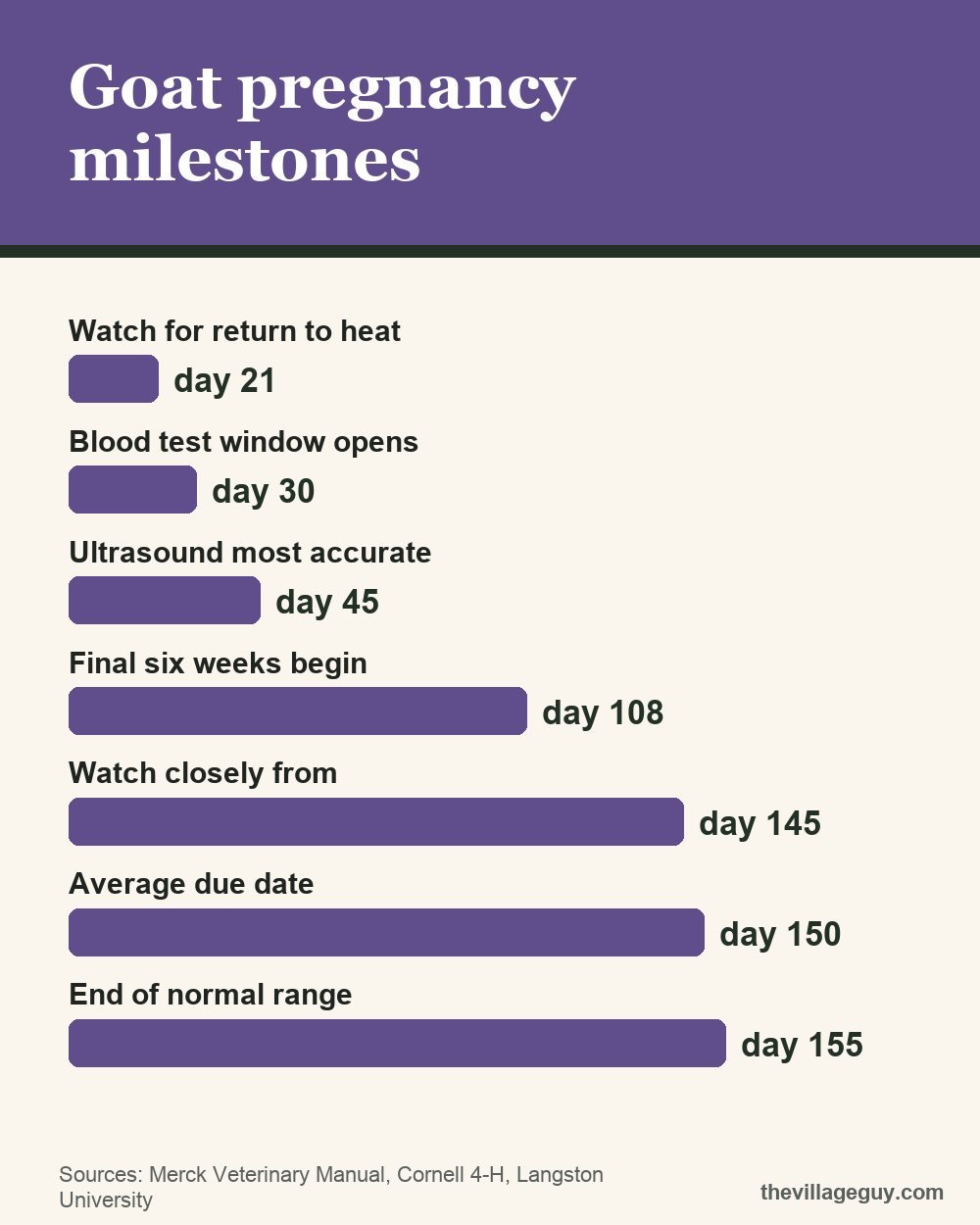
| Day 21 | Nov 5, 2026 | Watch for a return to heat; keep watching for 1 to 2 months |
| Day 30 | Nov 14, 2026 | Blood pregnancy test window has opened |
| Day 45 | Nov 29, 2026 | Ultrasound is at its most accurate from about here |
| Day 108 | Jan 31, 2027 | Final six weeks: review feeding and body condition with your vet |
| Day 145 | Mar 9, 2027 | Kidding pen ready, kit packed, checks start |
| Day 150 | Mar 14, 2027 | Average due date |
| Day 155 | Mar 19, 2027 | End of the normal range; call your vet if she has not kidded |
A phone calendar can do the counting: add reminders 21, 30, 108, 145 and 150 days after the breeding date.
How to tell if a goat is pregnant: tests compared
Looking at her is not enough for the first three months: a round doe may simply have a full rumen. These are the methods that work, with timing from the Merck Veterinary Manual and Langston University’s goat research center.
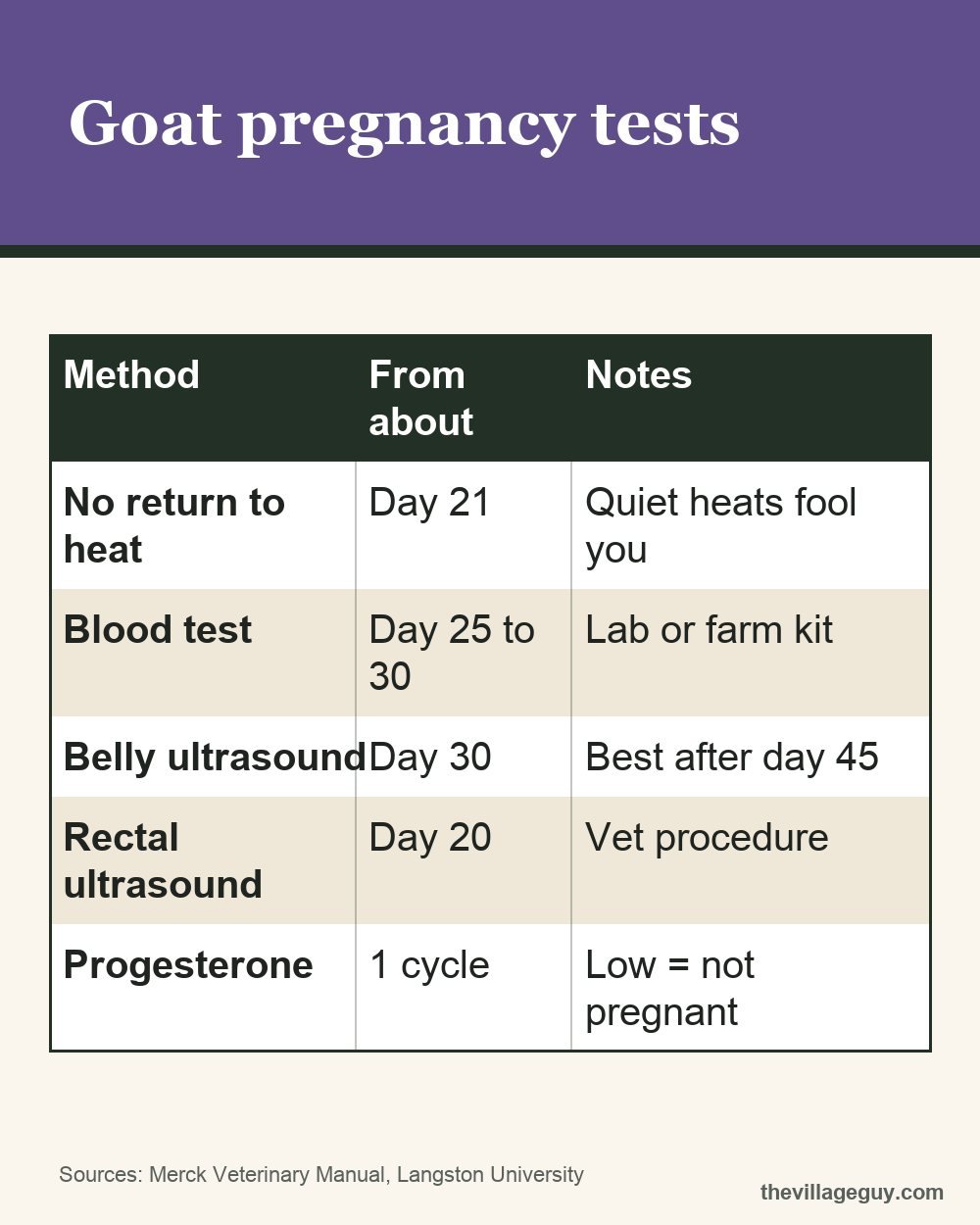
| Method | Earliest useful | Strengths | Watch out for |
|---|---|---|---|
| No return to heat | About 21 days | Free, needs only observation | Quiet heats get missed; does can stop cycling for other reasons |
| Blood test (pregnancy protein) | About 25 to 30 days | Mail-in lab or on-farm kit; no special equipment | False positive possible if a pregnancy was lost in the past 15 days; poor at counting kids |
| Transabdominal ultrasound | About 30 days | Shows live kids; most accurate after 45 days; counts best up to about 85 days | Needs a vet or trained technician |
| Transrectal ultrasound | About 20 days | Earliest image | Harder and slower; a vet procedure |
| Progesterone test | One cycle after breeding | A low result means not pregnant | A high result cannot tell pregnancy from pseudopregnancy |
Langston University notes that the blood test needs a sample of at least 5 cc drawn as early as 26 days after breeding, and that lab results usually come back 5 to 7 days after the lab receives it. Merck calls ultrasound the gold standard because it confirms that kids are alive, not just that pregnancy proteins are present.
The pseudopregnancy trap
Some does look and act pregnant without being pregnant. Merck describes pseudopregnancy, or hydrometra, as sterile fluid building up in the uterus while progesterone stays high, so the doe stops cycling. Roughly half of cases are thought to follow early embryonic loss before about day 40, and it is more common in older does and does bred out of season. On ultrasound it shows as a fluid-filled uterus with no kids. That is why ultrasound beats “she never came back into heat.” Merck says it is treatable and the doe may conceive again if it is caught early.
Signs a goat is pregnant, from breeding to the last month
Physical signs come late, and none is proof on its own.
First two months
The first sign is the absence of one: no heat about 21 days after breeding. Cornell advises watching closely for one to two months, because cycles vary and a single missed heat can be a quiet one.
Months three and four
The belly begins to widen, though rumen fill and the number of kids make this a poor test. If you still have no confirmation by now, an ultrasound can settle it, and Merck notes it counts kids most accurately up to about 85 days.
The last month
Kids do most of their growing now. Merck says about 80 percent of fetal growth happens in the final six weeks, which is why the doe can suddenly look much wider in the final stretch. Cornell notes the udder may look shiny and fill with milk days before kidding, though some fill a week ahead and others on the day itself.
- Record the breeding date and buck the same day
- Watch for heat at about 21 days, and keep watching for another month
- Book a blood test for 30 or more days after breeding
- Ask your vet about an ultrasound at about 45 days to confirm live kids
- Schedule a recheck if the test was taken soon after a possible loss
- Note the expected kid count from the scan in your records
Feeding and care in the last six weeks
The main late-pregnancy threat is pregnancy toxemia (ketosis before kidding). The growing kids demand more energy just as the uterus crowds the rumen, so the doe cannot eat enough and breaks down body fat faster than her liver can handle.
Who is at risk
Merck lists carrying multiple kids as the most important risk factor, followed by body condition at either extreme: thin does (body condition 2 or less on a 5-point scale) and fat does (4 or more). Anything that cuts feed intake adds risk: lameness, bad teeth, pneumonia, a cold snap, transport or a stressful handling day. Most cases appear one to three weeks before kidding.
What prevention looks like
Merck advises not letting does enter the last six weeks with a body condition below 2.5 out of 5, noting that it takes about six weeks to raise condition by one point, so the check has to happen at breeding and mid-pregnancy, not the week before kidding. It also recommends grain in the last six weeks for does carrying multiples, sorting does by condition and litter size, adequate feeder space, forage testing and good parasite control, and warns against slimming down fat does in late pregnancy. Cornell’s advice for small herds matches: increase feed in the last six weeks, when the kids do most of their growth. Work out the actual ration with your vet or extension agent.
Safety: A late-pregnant doe that skips her grain, lies around more than her herdmates, grinds her teeth, wanders aimlessly, trembles or seems blind needs a vet the same day. Merck says pregnancy toxemia can progress to collapse and death over about 2 to 4 days, and treatment works best when it starts early. Do not wait to see if she eats tomorrow.
Vaccines, hooves and housekeeping
Many goat vaccination programs time a booster in late pregnancy so the doe passes protection to her kids through colostrum. Which vaccines, and exactly when, is a question for your vet, who knows the diseases in your area.
- Score each doe’s body condition at breeding and again at mid-pregnancy
- Sort or feed does carrying multiples separately if they get pushed off the feeder
- Test your hay or ask your extension office how to get it analyzed
- Ask your vet about vaccine booster timing before kidding
- Trim hooves and check teeth before the last month, not during it
- Watch every doe at grain time in the last six weeks for a skipped meal
- Keep fresh water and good hay available at all times
What you’ll need: the kidding kit
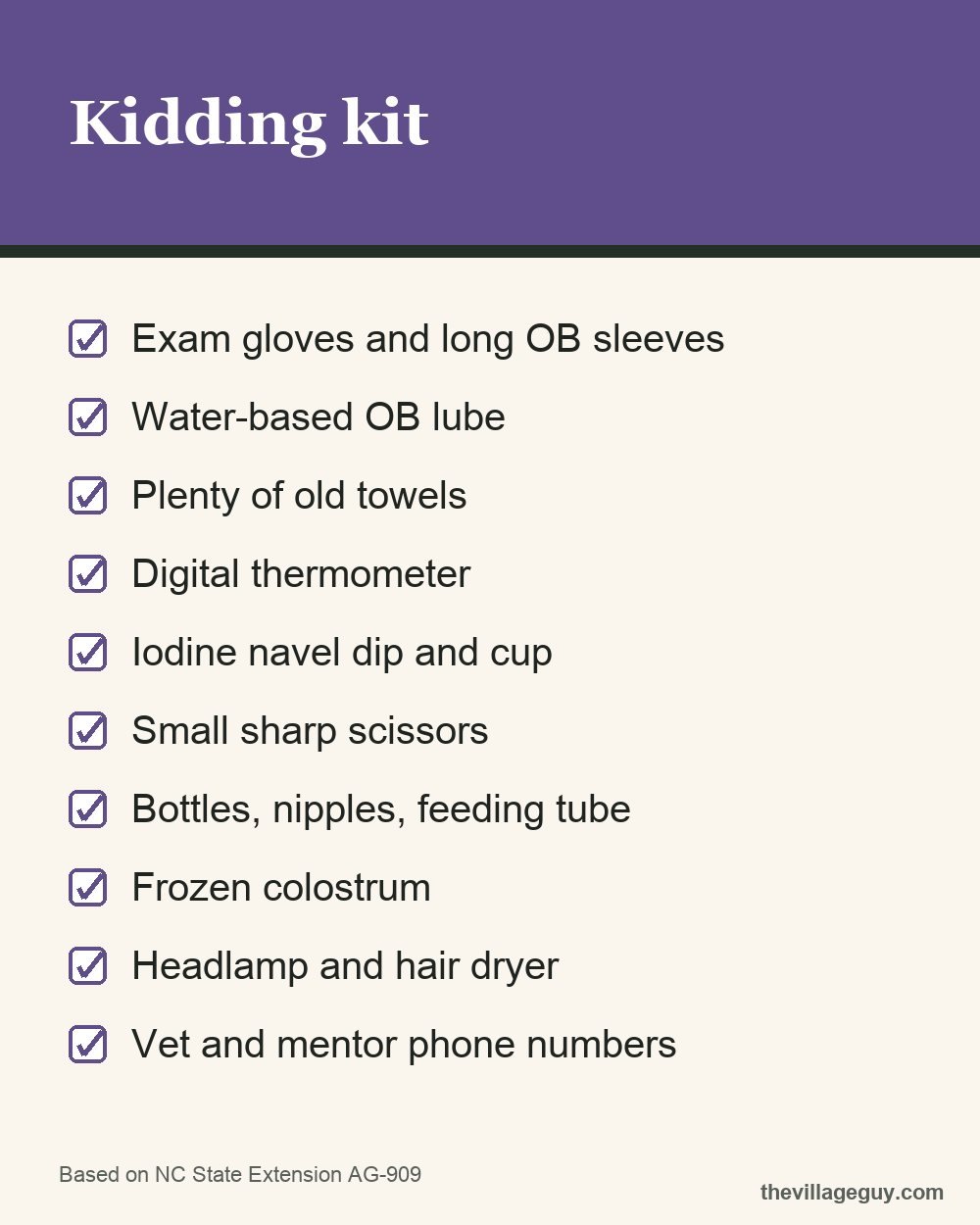
Pack the kit by about day 140. This list follows NC State Extension’s lambing and kidding cheat sheet, minus the prescription items your vet should advise on.
- Disposable exam gloves and long OB sleeves: shoulder-length sleeves keep your arm clean if you have to check a kid’s position; buy plenty, since you change them every time.
- Obstetric lubricant: a large bottle of water-based OB lube; there is no such thing as too much during an assisted delivery.
- Stack of old towels: absorbent cotton, enough for several kids, to clear faces and rub newborns dry.
- Digital livestock thermometer: a fast-reading rectal thermometer; NC State gives 101.5 to 103.5°F as normal for a newborn kid.
- Navel dip and a small cup: iodine solution for dipping navels, which NC State says is often enough to prevent navel infection.
- Small sharp scissors: for trimming a long cord to about 2 inches before dipping.
- Bottles, nipples and a feeding tube with 60 mL syringe: for a weak kid that cannot nurse; ask your vet to show you tube feeding before you need it.
- Frozen colostrum: saved from your own herd or a trusted source, for a kid whose mother has none.
- Headlamp and a hair dryer: hands-free light for night checks, and a dryer to warm a chilled, wet kid.
- Notebook and phone numbers: your vet and an experienced goat mentor, written where anyone can find them.
Safety: Heat lamps cause barn fires. If you use one for a chilled kid, choose a lamp with a guard, secure it with chain or wire (never just the clamp), keep it well away from bedding and walls, and take it out once the kid is dry and warm.
Signs kidding is close, and what labor looks like
Look for several signs together rather than any single one.
Days to hours before
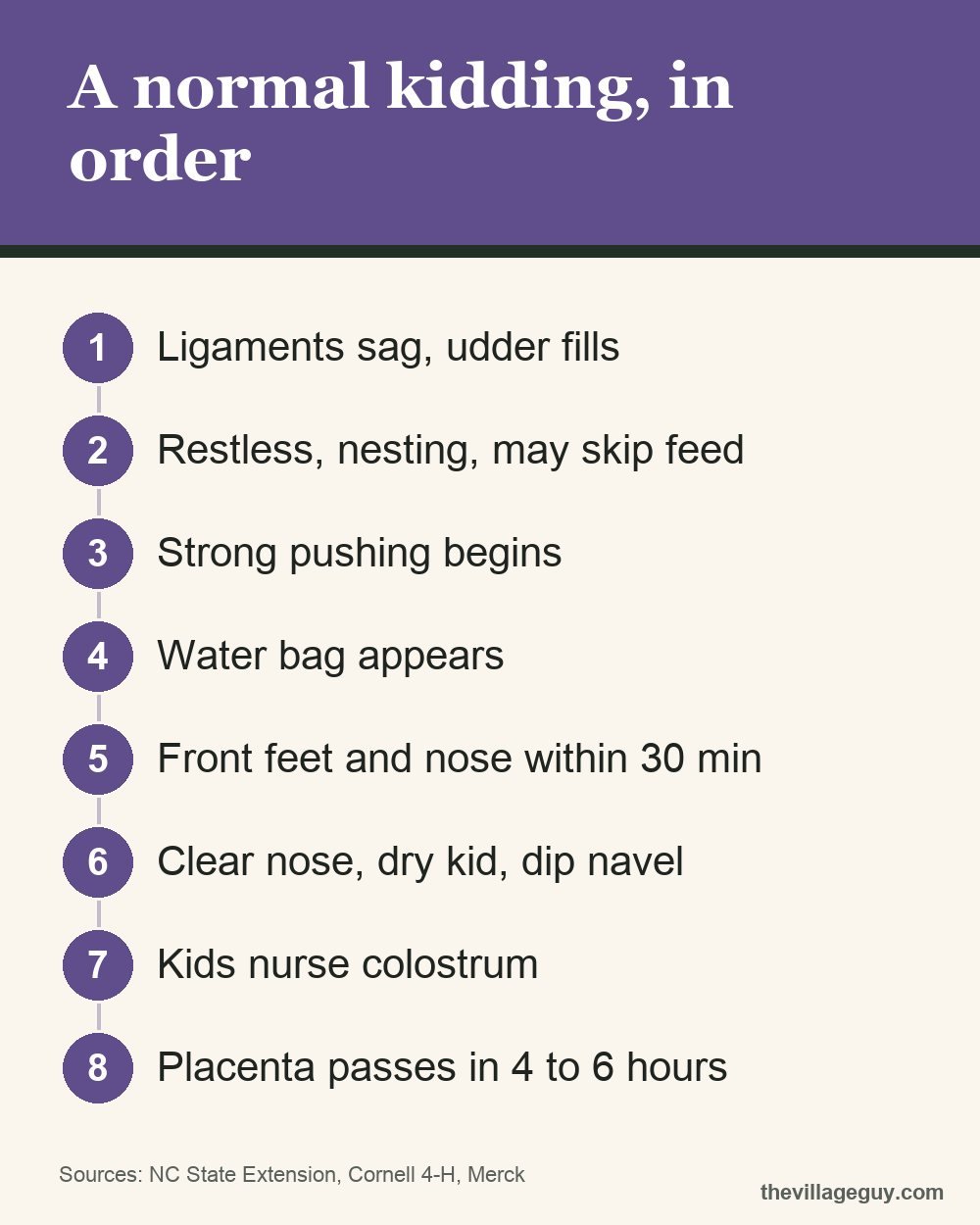
Cornell says the ligaments on either side of the tailhead sag, and the udder may look tight and shiny. Merck lists udder development, behavior changes (isolating herself, calling, nesting) and vulvar discharge, and notes that progesterone drops sharply 12 to 24 hours before kidding. NC State adds that a doe may stop eating when kidding is less than about three hours away, and may be restless, paw at bedding to make a nest and make soft calling sounds. Cornell advises against milking her out early unless the udder is painfully swollen, because that lowers colostrum quality.
Active labor
Once strong contractions start, the water bag usually appears first, though it can break before you see it. NC State says front feet should appear within about 30 minutes of the water bag, with the head resting on the legs just above the knees, like a diver. Fluid should be clear or slightly yellow; dark yellow or brown fluid signals a stressful delivery. After the last kid, NC State says the placenta usually passes 4 to 6 hours later.
The first hour after birth
Clear the kid’s nose and mouth, let the doe lick it, and dry it with a towel if she is busy with a sibling. NC State says kids need colostrum equal to 10 percent of their body weight within 24 hours, ideally within the first 12: a 10-pound kid needs about 1 pound (16 ounces).
- Set up a clean, dry, draft-free kidding pen by day 145
- Feel the tailhead ligaments every morning and evening from day 145
- Note the time when the water bag appears or strong pushing starts
- Check that front feet and a nose are showing within 30 minutes
- Dip each navel in iodine once the kid is breathing well
- Confirm every kid nurses within the first hours
- Note the time the placenta passes
When to call the vet
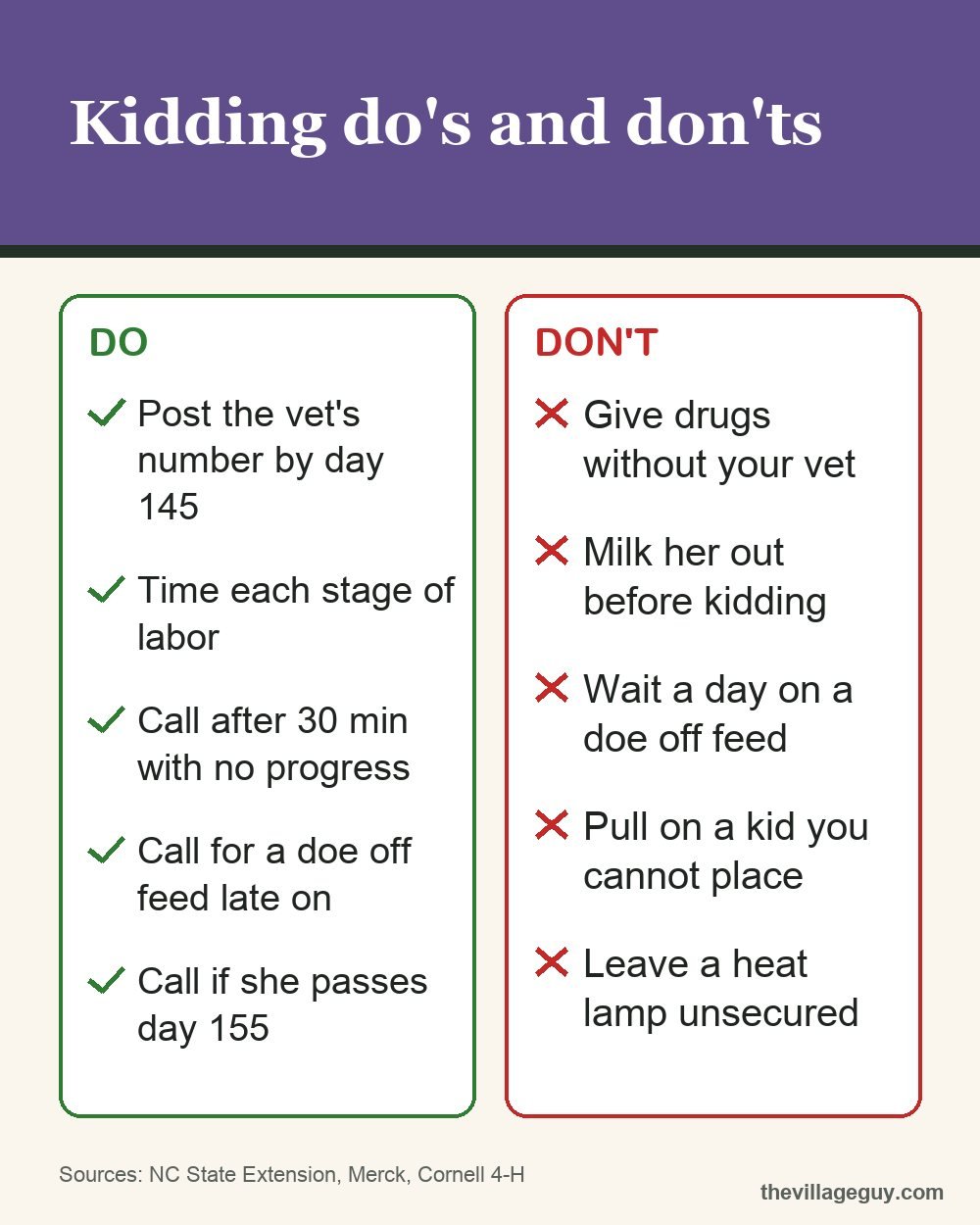
Have your vet’s number on the barn wall before day 145, and call early rather than late.
| Situation | Why it matters | Action |
|---|---|---|
| Late-pregnant doe off grain, lying down a lot, trembling or wandering | Possible pregnancy toxemia | Call the same day |
| More than 30 minutes of hard labor without progress | NC State says she likely needs help | Assist if trained, otherwise call now |
| A kid presented in a way you do not recognize or cannot correct | Malpresentations can kill kid and doe | Call now |
| Cervix does not seem open when you check | May need veterinary delivery | Call now |
| Past day 155 with no kidding | Outside the normal range | Call for an exam and ultrasound |
| Placenta not passed in the time your vet advises | Usually passes 4 to 6 hours after birth | Call for advice |
Do not give any medication during pregnancy or kidding without your vet’s direction. Some livestock medicines are not safe for pregnant does, and the right product and dose depend on the animal.
More livestock and homestead guides are collected on our guides page, and you can read how this site checks its facts on the about page.
Goat pregnancy FAQ
How many months is a goat pregnant?
About five months. At 145 to 155 days, a goat’s pregnancy runs from just under five months to a little over, so a doe bred in mid-October is due in mid-March.
Can you tell if a goat is pregnant by feeling her belly?
Not reliably in the first months. A full rumen and a thick-bodied doe fool experienced eyes, and kids are hard to feel until late. Merck notes that even X-rays only become fully accurate after about day 70, so for an early answer use a blood test or an ultrasound.
How can you tell how far along a goat is?
Without a breeding date, ask your vet for an ultrasound, which can estimate fetal age and, per Merck, counts kids most accurately up to about 85 days. Belly size is a poor guide.
What if my goat goes past 155 days?
Day 155 is the long end of Merck’s normal range, so a doe still waiting after that deserves a vet exam. First check your dates: an unnoticed repeat breeding about three weeks after the first would push the real due date later. An ultrasound can show whether the kids are alive and roughly how far along she is.
Sources
- Merck Veterinary Manual: Pregnancy in Goats (gestation range, litter size, late fetal growth, signs of kidding)
- Merck Veterinary Manual: Pregnancy Determination in Goats (blood test, ultrasound, progesterone, pseudopregnancy)
- Merck Veterinary Manual: Pregnancy Toxemia in Sheep and Goats (signs, risk factors, prevention)
- Cornell CALS NYS 4-H: When Will My Doe Kid? (150 days, heat checks, late feeding, kidding signs)
- Langston University E (Kika) de la Garza American Institute for Goat Research: Pregnancy Detection (ultrasound and blood test timing)
- NC State Extension: Lambing and Kidding Cheat Sheet for Beginning Small Ruminant Producers (labor signs and timing, kidding kit, newborn care)
- Oregon Zoo: Nigerian Dwarf Goat (Nigerian Dwarf gestation and litter size)