A full cord of firewood is a tight stack 4 feet high, 4 feet deep and 8 feet long, or any other tidy shape that adds up to 128 cubic feet. That is the legal answer to how much is a cord of wood, and it matters more than the price tag, because the most common way to overpay for firewood is to buy a stack that only looks like a cord.
Quick answer: A cord of wood is 128 cubic feet of firewood stacked tight, usually 4 x 4 x 8 feet. Price varies a lot by region and season: Maine’s state survey put a delivered cord of seasoned wood at $355 in October 2026, while other dated sources show roughly $150 to $500. A 1,500-square-foot home heated mainly with wood may burn about four cords in an average winter.
In this guide
- How much is a cord of wood by volume
- Face cord vs full cord, rick and half cord
- Loose loads: thrown cords and pickup trucks
- What a cord costs in 2026
- Turn any quote into a price per full cord
- How much firewood you need for winter
- How long a cord of wood lasts
- Check the delivery before you burn it
- Where to stack a cord when it arrives
- Cord of wood FAQ
How much is a cord of wood by volume
The definition most states use comes from NIST Handbook 130, the model rulebook for weights and measures. It defines a cord as the amount of wood in a space of 128 cubic feet “when the wood is ranked and well stowed.” Ranked and well stowed means the pieces sit in rows, touching and parallel, stacked compactly. A pile tossed off a dump truck is not a cord until somebody stacks it.
The cord of wood dimensions everyone quotes, 4 x 4 x 8 feet, are only one way to reach 128. A stack 2 feet deep, 4 feet high and 16 feet long works too, and so does a row of 16-inch splits 4 feet high and 24 feet long. The shape is flexible; the cubic feet are not.
How much of a cord is actually wood
A cord measures space, so it includes air and bark. The University of Wisconsin forestry extension puts an average Lake States cord at 79 cubic feet of solid wood, 92 cubic feet of wood plus bark, and the rest air. The Maine Forest Service gives 80 to 90 cubic feet of solid wood. Crooked or carelessly stacked pieces mean more air and less fuel in the same 128 cubic feet.
Face cord vs full cord, rick and half cord
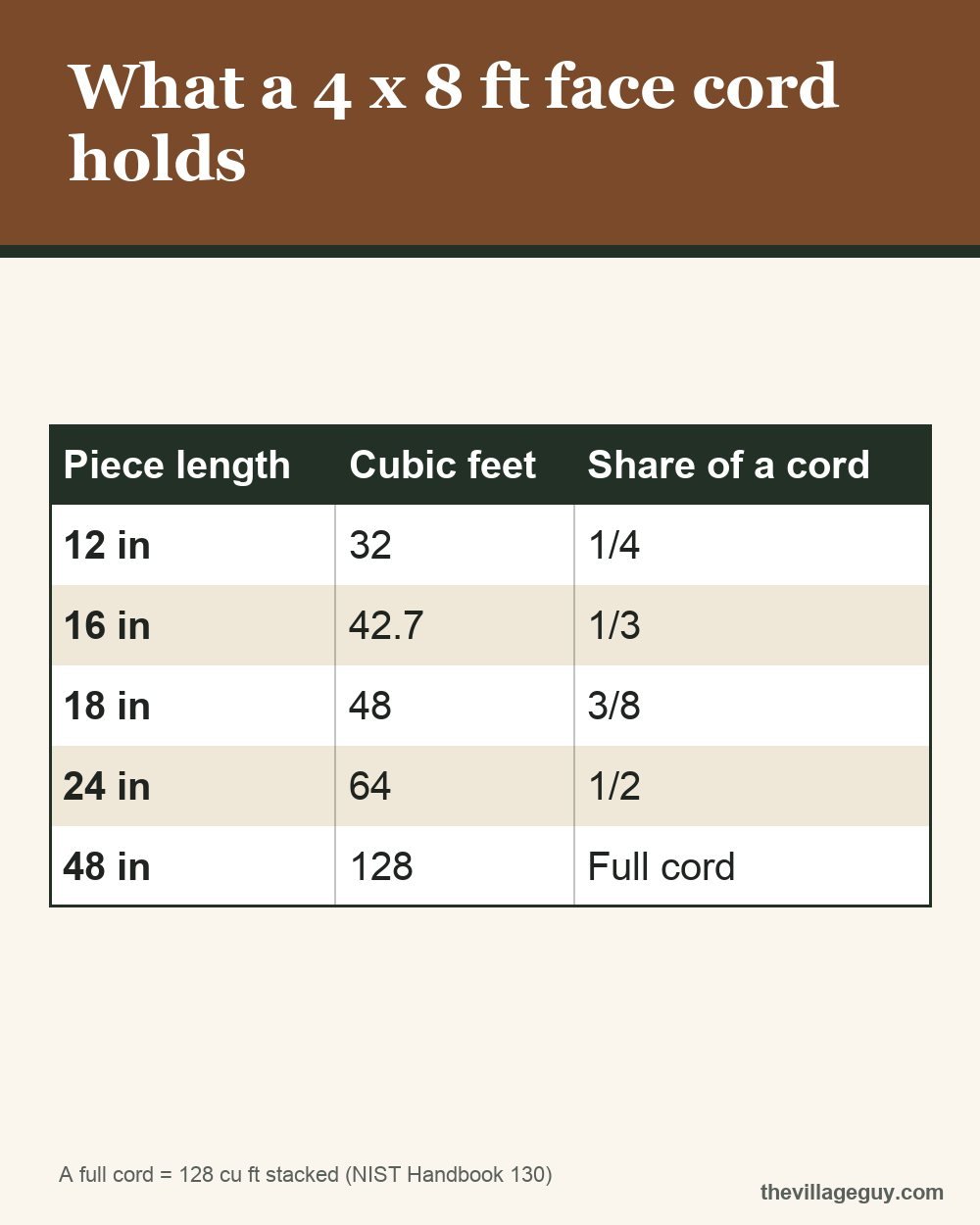
A face cord (also called a rick or rank in different regions) is a stack 4 feet high and 8 feet long, but only one row deep. Its depth equals the length of the pieces, so its volume depends entirely on how long the seller cuts the wood. With the usual 16-inch splits, a face cord is one third of a full cord. With 24-inch pieces it is half.
| Piece length | Volume of a 4 x 8 ft face | Share of a full cord |
|---|---|---|
| 12 inches | 32 cu ft | 1/4 cord |
| 16 inches | 42.7 cu ft | 1/3 cord |
| 18 inches | 48 cu ft | 3/8 cord |
| 20 inches | 53.3 cu ft | about 0.42 cord |
| 24 inches | 64 cu ft | 1/2 cord |
| 48 inches | 128 cu ft | 1 full cord |
A half cord is simply 64 cubic feet, for example 4 feet high, 8 feet long and 2 feet deep. A “half cord” delivered as one row of 16-inch wood is really a third of a cord.
NIST’s model regulation goes further: it says the terms “face cord,” “rack,” “pile,” “truckload” or terms of similar import shall not be used when advertising or selling firewood. Sellers are supposed to use cords, fractions of a cord or cubic meters. Not every state enforces that section, so you will still see face cords and ricks advertised. Treat those words as a cue to ask for the cubic feet.
Loose loads: thrown cords and pickup trucks
Wood thrown loose into a truck bed or bin takes up more room than the same wood stacked, because the pieces land at every angle. Maine spells out the conversion: according to the Maine Forest Service, a “thrown cord” of 12- or 16-inch pieces is the wood, bark and air in 180 cubic feet, and a thrown cord of 24-inch pieces fills 195 cubic feet. In other words, a loose load has to be about 40 to 50 percent bigger than 128 cubic feet to equal one stacked cord.
Utah State University Extension estimates a pickup load at about 64 cubic feet, roughly half a cord, but beds vary, so measure yours.
Worked example: one pickup bed, two answers
Say your bed measures 6.5 feet long and 5 feet wide inside, and the wood sits level at 2 feet deep. That is 6.5 x 5 x 2 = 65 cubic feet of space.
- Stacked tight in rows: 65 / 128 = about 0.51 cord.
- Thrown loose (16-inch pieces, using Maine’s 180 cubic foot thrown cord): 65 / 180 = about 0.36 cord.
Same truck, same wood, and the loose load holds about 30 percent less fuel. If a seller prices a “truckload” at a half-cord price, ask whether it will be stacked or thrown.
What a cord costs in 2026
There is no national price list for firewood, and anyone who quotes one figure for the whole country is guessing. The table below sticks to named, dated sources. Prices vary by region and by season, so read these as reference points, then get local quotes.
| Source and date | Price reported | What it covers |
|---|---|---|
| Maine Department of Energy Resources survey, October 26, 2026 | $355 per cord | Informal statewide dealer survey; seasoned wood, two-cord minimum, local delivery included |
| Vermont Public, February 3, 2026 | Often more than $400 a cord, plus delivery | Kiln-dried firewood in parts of Vermont during a cold, short-supply winter |
| WCAX News (Vermont), October 7, 2026 | $200 to $500 per cord | The station’s general estimate for wood stove firewood |
| HomeAdvisor cost guide, 2025 | About $300 average; most pay $150 to $500 | National cost guide; varies with wood type and location |
Maine’s survey also converts each heating fuel to dollars per million Btu. Its October 2026 table lists cordwood at $16.14 per million Btu against $43.53 for heating oil and $39.02 for propane. Those are raw fuel costs, before the efficiency of your stove or furnace, but the gap explains why so many rural households still split wood.
What pushes the price up or down
| Factor | Lower price | Higher price |
|---|---|---|
| Dryness | Green, freshly cut | Seasoned or kiln-dried |
| Species | Softwoods and light hardwoods | Dense hardwoods such as oak, hickory and locust |
| Processing | Log length or unsplit rounds | Cut and split to your stove’s length |
| Delivery | You haul it | Long delivery runs, stacking service |
| Timing | Ordered well ahead of need | Mid-winter orders in a short-supply year |
The Maine Forest Service notes that hardwood usually costs more than softwood and dry wood more than green, and suggests buying green wood this year for next winter. Vermont Public reported the same pattern from the selling side: wood that has not had time to cure costs less. It also noted that buyers who run short in mid-winter may pay a premium. UNH Extension adds that stacking may cost extra.
Turn any quote into a price per full cord
Sellers quote by the face cord, half cord, truckload or bundle. Convert everything to one number: price per full cord.
The formula: cubic feet = length x height x depth (all in feet). Price per full cord = quoted price x 128 / cubic feet.
| Example quote | Actual volume | Price per full cord |
|---|---|---|
| $150 for a face cord of 16-inch splits | 4 x 8 x 1.33 = 42.7 cu ft | $450 |
| $200 for a face cord of 24-inch splits | 4 x 8 x 2 = 64 cu ft | $400 |
| $250 “half cord” delivered as one row of 16-inch wood | 42.7 cu ft (really 1/3 cord) | $750 |
| $8 bundle labeled 0.75 cu ft | 0.75 cu ft | About $1,365 |
These are illustration numbers, not market prices; plug in your own quotes. Under NIST rules, packaged firewood under 16 cubic feet must show its volume on the label, which makes the bundle math easy and the result sobering.
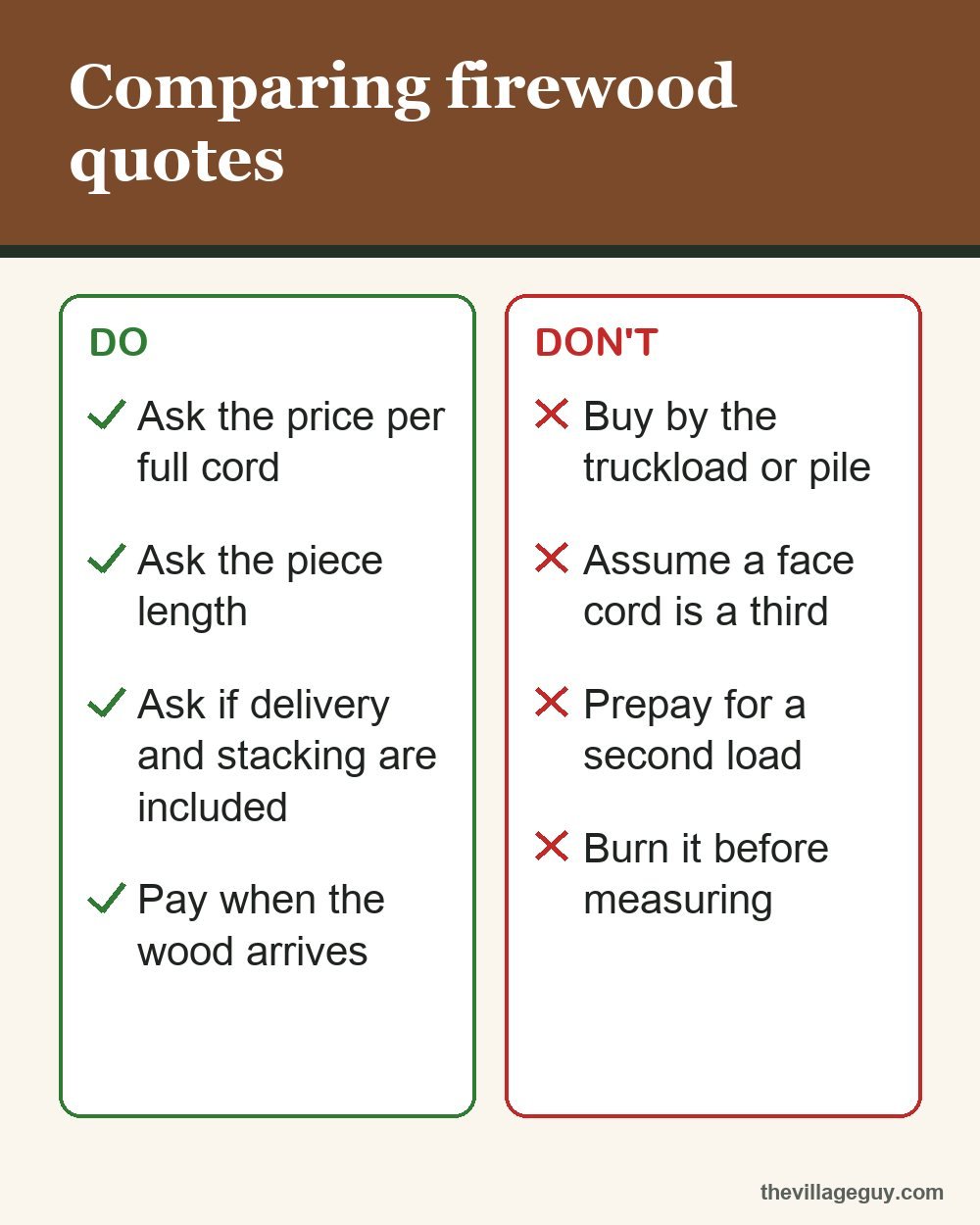
Tip: Ask every seller the same three things: the price per full cord, the piece length, and whether the price includes delivery and stacking. Quotes that answer all three are easy to compare; quotes that dodge them tell you something too.
Copy and send one of these when you call or text a supplier:
- Hi, what is your price per full cord (128 cubic feet, stacked), and what length are the splits?
- Is that price for seasoned or green wood, and roughly how long has it been split?
- Does the price include delivery to my address and stacking, or are those extra?
- Please include the quantity in cords, the species and the price on the delivery receipt.
How much firewood do I need for winter
West Virginia University Extension estimates that a 1,500-square-foot home might burn four cords of seasoned wood in an average heating season. The University of Kentucky’s forestry extension uses about 3.5 cords as a “middle of the road” figure for getting a home through winter, and stresses that stove type and wood density change the answer. Treat those as starting points for a house where wood is the main heat.
| Pushes your number up | Pushes your number down |
|---|---|
| Long, cold winters (northern states, high elevation) | Short or mild winters |
| Drafty or poorly insulated house | Tight, well-insulated house |
| Older, non-certified stove or open fireplace | Modern EPA-certified stove |
| Light woods such as pine, poplar or basswood | Dense hardwoods such as oak or hickory |
| Wood is the only heat source | Furnace or heat pump carries part of the load |
| Wood not fully dry | Wood below 20 percent moisture |
Species matters more than most buyers expect: Utah State University Extension credits a cord of red oak with 24.6 million Btu and a cord of white pine with 15.9 million, so the pine cord carries about two thirds of the heat.
Measure your own burn rate
Extension estimates are averages; your house is not. Watch your own stack using this conversion: one running foot of a 4-foot-high row of 16-inch splits is 5.33 cubic feet, which is exactly 1/24 of a cord.
During two ordinary winter weeks, note how many feet of row you burn. If it is half a foot a day, that is 3.5 feet a week, or about 0.15 cord. Over a 28-week season that comes to roughly four cords, which lines up with the WVU estimate. Then add some margin for the coldest stretch, because running out in February is far more expensive than having leftovers, and leftover wood just becomes next year’s driest fuel.
How long a cord of wood lasts
The honest answer to how long does a cord of wood last is a division problem, because it depends almost entirely on how many cords your house eats per season. The chart below assumes a 28-week heating season (about mid-October to late April) and shows how long one cord lasts at different seasonal totals.
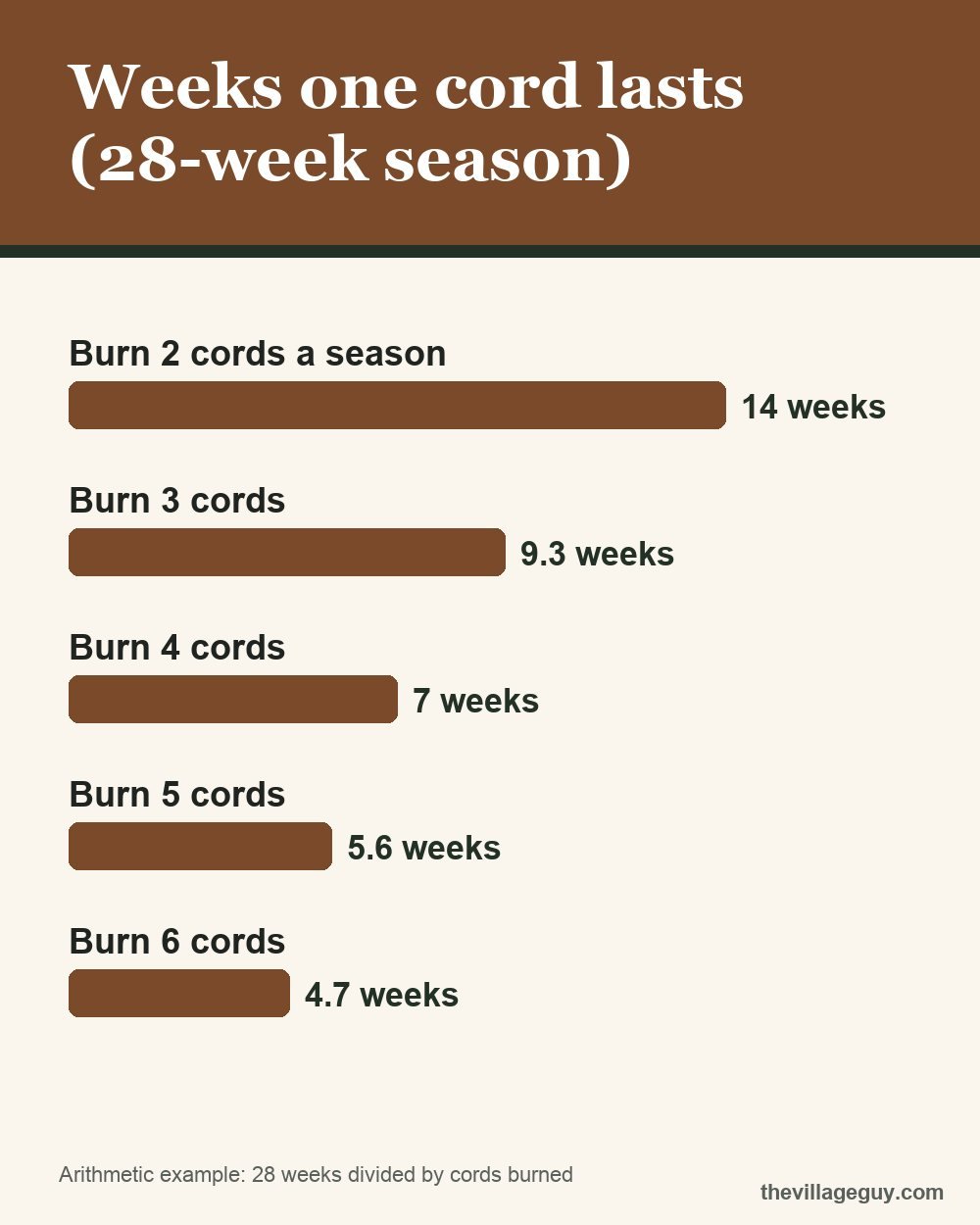
Real burning is lumpy: a week of October evening fires uses a fraction of what a January cold snap demands. For a stove lit only on weekends, one cord can stretch across a whole winter. Dry wood also goes further than damp wood, because less heat is wasted boiling water out of the logs.
Check the delivery before you burn it
A short delivery is easiest to dispute before any of it has gone up the chimney. UNH Extension’s advice boils down to this: stack it, measure it, keep the receipt, and call the seller before burning any of it if it looks short.
- Order in cords or fractions of a cord, not in face cords, loads or piles.
- Confirm the piece length fits your stove’s firebox before the wood is cut.
- Pay on delivery rather than in advance, and never pay for a second load before it arrives.
- Note the delivery vehicle’s license plate number, as UNH Extension suggests.
- Keep the new delivery separate from any wood you already had.
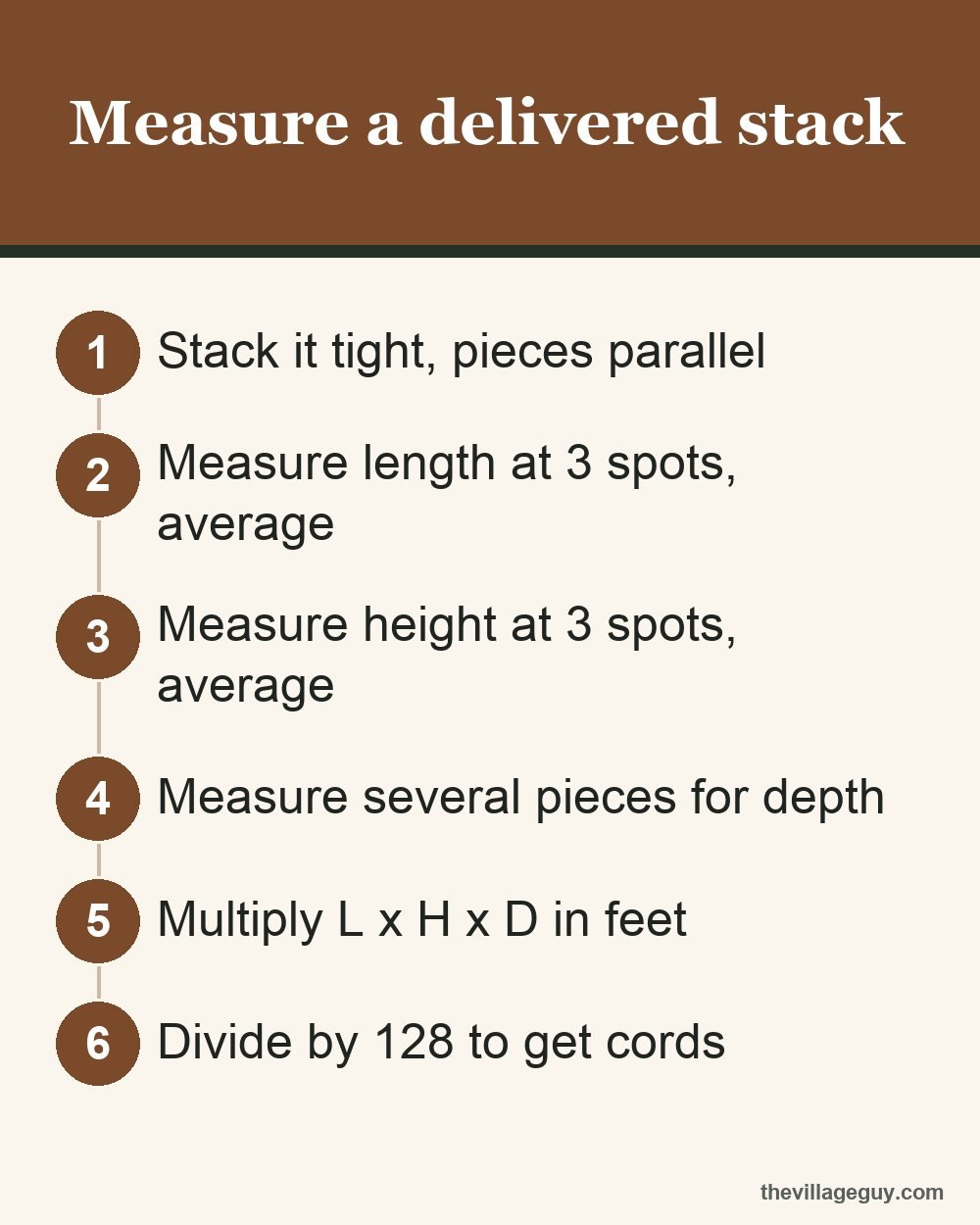
- Stack the wood tight, with pieces touching and parallel.
- Measure the stack’s length and height at several points and average them.
- Measure several pieces to get the average piece length (the stack’s depth).
- Multiply length x height x depth in feet, then divide by 128 to get cords.
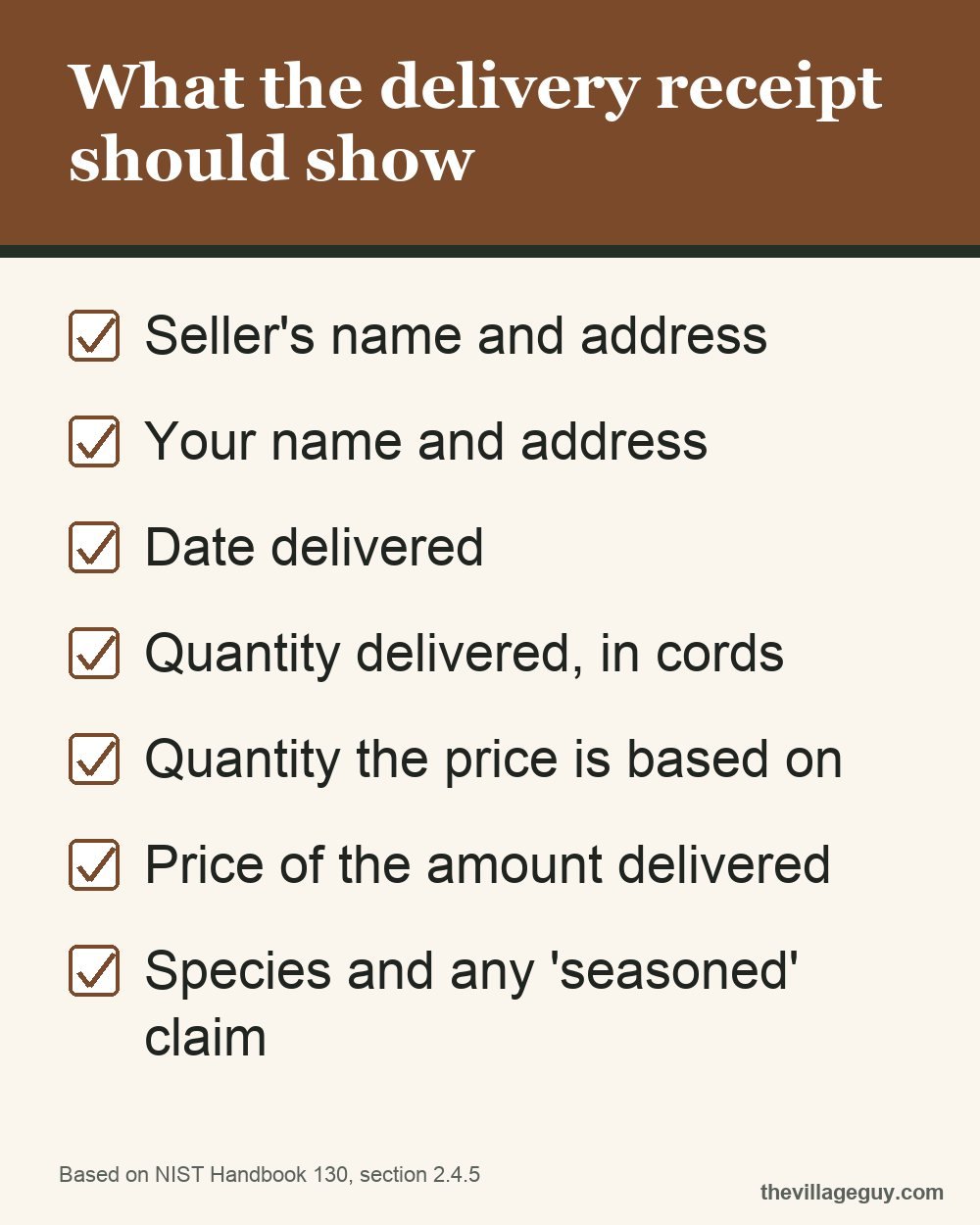
- Check the receipt for the seller’s name and address, your name and address, the date, quantity, price and species.
- Photograph the stack next to the tape measure before burning any of it.
- Call the seller first if it measures short, then your state weights and measures office if that goes nowhere.
NIST Handbook 130 says a delivery ticket or invoice should come with every sale of loose firewood, and it should name the wood “in the most descriptive terms commercially practicable,” including any quality claims. If the ad promised seasoned oak, that promise belongs on the receipt.
Where to stack a cord when it arrives
A full cord stacked 4 feet high in 16-inch rows needs 24 feet of running length, or three 8-foot rows side by side. Plan the spot before the truck arrives, or the driveway becomes the woodshed.
- Off the ground: the University of Kentucky suggests 4 to 6 inches of clearance for airflow and to deter wood-boring insects.
- Away from the house: the same Kentucky fact sheet advises placing drying and storage stacks at least 30 feet from any structure to limit fire risk.
- Top covered, sides open: EPA Burn Wise recommends covering only the top of the pile, because covering the sides traps moisture.
- Close to home, not cross-country: buy wood cut near where you will burn it. Extension foresters in West Virginia and Kentucky warn that moving firewood spreads emerald ash borer and other forest pests.
Safety: Refuse deliveries mixed with painted, stained or pressure-treated lumber, plywood or particle board; EPA Burn Wise lists coated, painted and pressure-treated wood, plywood and particle board among the things you should never burn. Have your stove and chimney installed and maintained according to the manufacturer’s instructions and local codes, and keep working smoke and carbon monoxide alarms in any home that burns wood.
For more practical guides to wood heat, chickens, cattle and the kitchen garden, browse all The Village Guy guides, or read who writes this site and how the facts are checked.
Cord of Wood FAQ
How much is a face cord of wood?
A face cord costs whatever share of a full cord it actually holds. With 16-inch pieces that is one third, so a fair face-cord price is roughly a third of the local full-cord price, sometimes a little more because small orders carry the same delivery cost. Always ask the piece length: a face cord of 12-inch wood holds only a quarter cord.
How much does a cord of wood weigh?
Much more than most pickups are rated to carry. Utah State University Extension lists dry cords from about 1,984 pounds (basswood) to 4,728 pounds (Osage-orange). Red oak runs about 4,888 pounds green and 3,528 pounds dry. Check your truck’s payload rating before you volunteer to haul a full cord home.
Is a rick of wood the same as a face cord?
In most regions, yes: rick, rank and face cord all describe a single row 4 feet high and 8 feet long, with depth set by the piece length. Because the depth varies, none of them is a fixed amount, which is why NIST’s model regulation tells sellers to avoid such terms and sell by the cord instead.
Is it cheaper to buy green firewood?
Usually, yes, and the Maine Forest Service suggests buying green wood this year to burn next winter. The catch is time: wood needs to dry below 20 percent moisture before it burns cleanly, and EPA Burn Wise says to season it for at least six months. Green wood bought in November will not be ready for this January.
Sources
- NIST: Handbook 130 (2026), Method of Sale of Commodities, section 2.4 (cord definition, prohibited terms, packaging, receipts)
- Connecticut DCP: Firewood and Stove Wood Regulations (a state adoption of the NIST rules)
- UNH Extension: What You Need to Know Before Buying Firewood (buyer steps)
- UNH Extension: Heating Your Home with Wood (measuring, stacking fees)
- University of Wisconsin: What Is a Cord? (solid wood per cord, face cord)
- Maine Forest Service: Firewood Facts (thrown cord, face cord fractions, price factors)
- Maine Department of Energy Resources: Heating Fuel Prices, Oct. 26, 2026 (cordwood price, cost per million Btu)
- Vermont Public: Putting another log on the fire (Feb. 3, 2026) (Vermont prices and supply)
- WCAX: Vermonters turn to wood stoves (Oct. 7, 2026) (price estimate)
- HomeAdvisor: Cord of Wood Cost (2025) (national range)
- WVU Extension: Heating with Firewood (cords per season, buy local)
- University of Kentucky Extension: Firewood (FORFS 17-11) (cords per winter, stack placement)
- Utah State University Extension: Wood Heating (weight and Btu per cord, pickup load)
- EPA Burn Wise: Best Wood-Burning Practices (moisture, storage, what never to burn)