
A truly rotten egg rarely keeps its secret once the shell is open. The smell reaches you before the yolk settles in the bowl. The tricky cases come earlier: the carton date that passed last Tuesday, the egg that bobbed up in a bowl of water, the clutch you found behind the hay bales in November. This page shows how to tell if eggs are bad with six checks, ranked by how much each one can actually prove, and with the USDA, FDA and extension guidance behind every call.
Quick answer: Crack the egg into a separate small bowl, then look and sniff. A sulfur, sour or musty smell, a pink, green or pearly white, or black or green spots mean the egg is spoiled, so throw it out. The float test only shows age (a floater is old, not proven bad), and the USDA says refrigerated raw eggs in the shell keep 3 to 5 weeks after you buy them.
In this guide
- How to tell if eggs are bad: the 6 checks ranked
- Checks 1 and 2: the carton code and the shell
- The egg float test: sink, tilt or float
- Check 4: candling with a flashlight
- Checks 5 and 6: crack, look and sniff
- Spoiled or just odd? Keep-or-toss table
- Backyard eggs: hidden nests, frozen shells and broody hens
- Why a normal-smelling egg can still make you sick
- Copy-ready bad-egg routine
- Bad egg FAQ
How to tell if eggs are bad: the 6 checks ranked
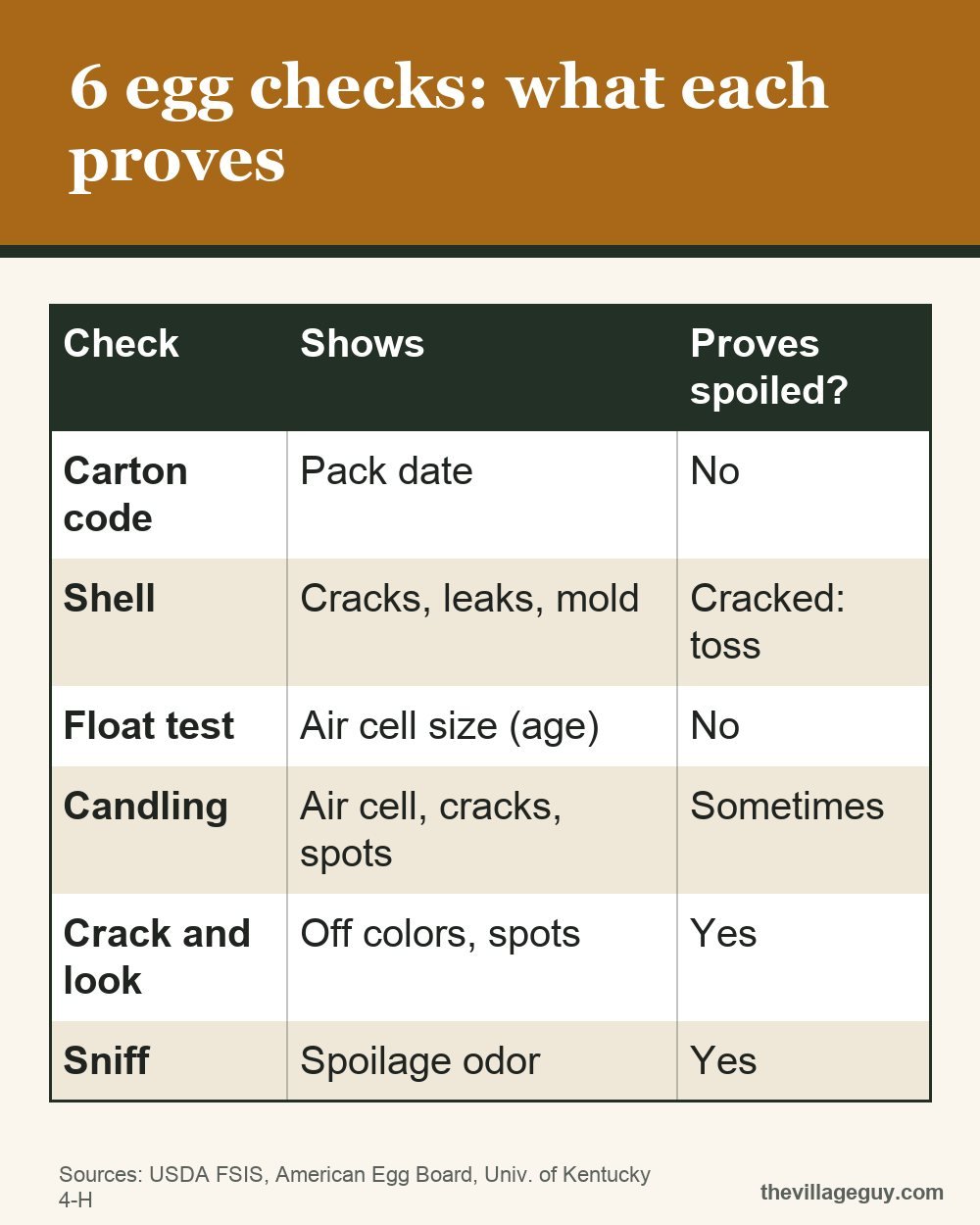
Every popular egg test answers a slightly different question. The carton answers “how old?”, the float test answers “how much air is inside?”, and only your eyes and nose on a cracked egg answer “has this spoiled?”. Knowing which question each check answers stops you binning good eggs and, more importantly, stops a floater from getting a free pass because it “only tilted a bit”.
| Check | What it tells you | What it cannot tell you | How much to trust it |
|---|---|---|---|
| 1. Carton code | Pack day and the packer’s quality window | Whether this egg spoiled | A starting point |
| 2. Shell inspection | Cracks, leaks, mold on the shell | Anything inside | Decisive for cracked or leaking eggs |
| 3. Float test | Rough age, from the size of the air cell | Spoilage or bacteria | A sorting tool, not a verdict |
| 4. Candling | Air cell depth, hairline cracks, spots, dark masses | Smell | Very useful for farm eggs |
| 5. Crack and look | Off colors, spots, a watery white | Germs you cannot see | Strong evidence |
| 6. Sniff | Spoilage odors, raw or cooked | Salmonella | The final word on spoilage |
Notice the bottom row. Smell catches spoilage bacteria, but the germs that cause food poisoning are a separate crowd, and they usually leave no clue at all. That gap gets its own section further down, and every claim on this page traces to the agencies listed at the bottom (here is how this site checks its facts).
Checks 1 and 2: the carton code and the shell
Read the pack date, not just the printed date
Cartons that carry the USDA grade shield must show a three-digit pack date, a Julian code that counts the days of the year, with 001 for January 1. It sits on the short end of many cartons, often next to a plant number that starts with P. Any “Exp” or “Sell by” date on a USDA-graded carton can be no more than 30 days after packing, and a “Best if used by” date no more than 45 days, according to the USDA. Neither is a safety deadline, and federal rules do not require a date at all (some state egg laws do).
A worked example: a carton stamped 305 was packed on November 1 in a non-leap year (January to October add up to 304 days). The American Egg Board says refrigerated shell eggs keep without significant quality loss for about 4 to 5 weeks beyond the pack date. The USDA’s own rule of thumb runs from the day you buy them: use raw shell eggs within 3 to 5 weeks, even if a sell-by date passes in that time. So a 305 carton bought on November 4 is comfortably usable into early December, provided it lived in a fridge at 40°F (4°C) or colder.
Then look hard at the shell
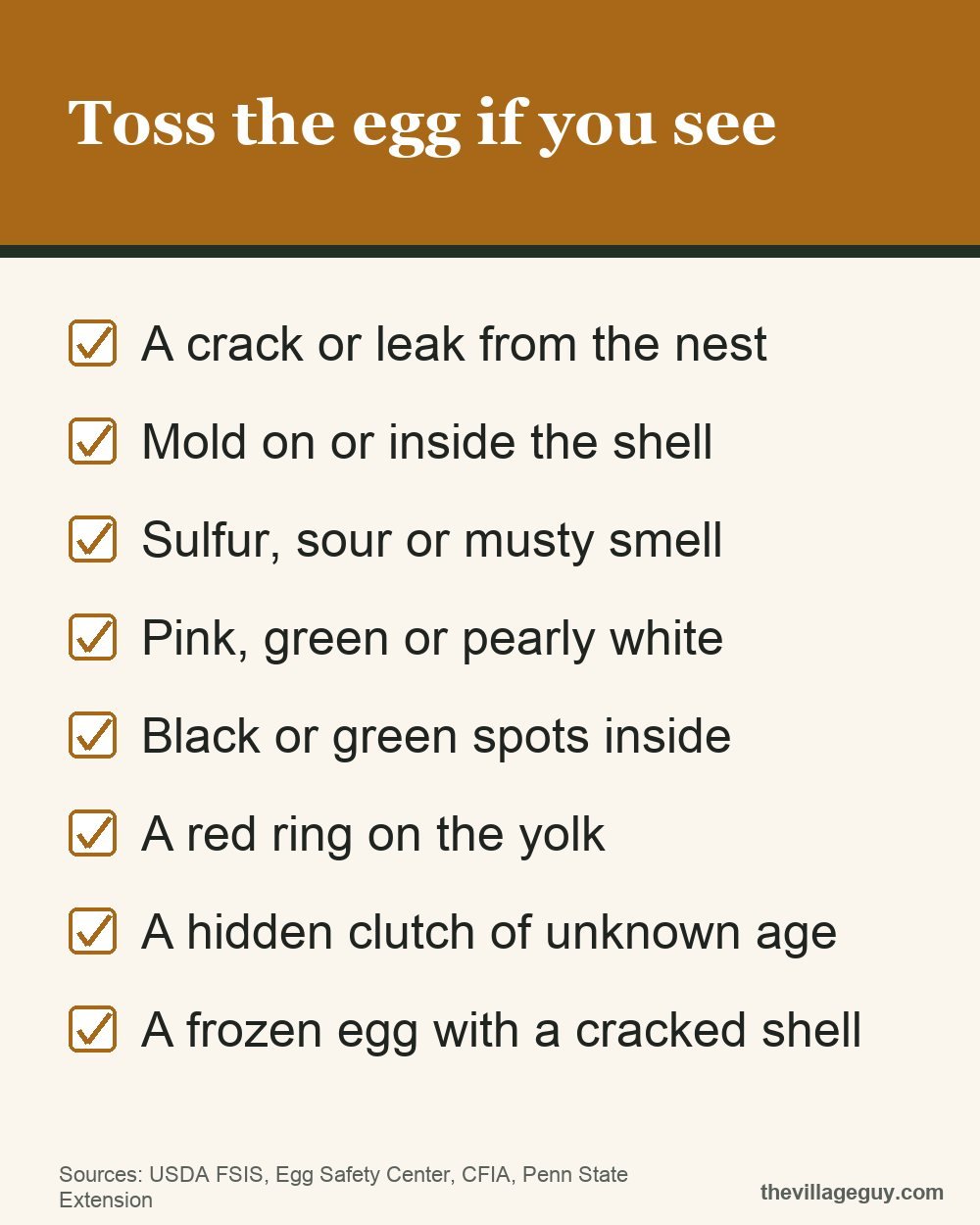
Turn each egg under good light before it goes near a bowl. Federal grading rules class an egg with a cracked shell as a “check” and one whose membranes are broken too as a “leaker”, and both count as “restricted” eggs under those rules for a reason: the CDC notes that bacteria on the shell enter more easily through a crack. Throw away eggs that are leaking, cracked from the nest, or carry mold on or inside the shell.
One exception has a clear rule. If a store-bought egg cracks on the way home, Iowa State University Extension advises breaking it into a clean container, covering it, refrigerating it and using it within 2 days. Eggs that crack while boiling are safe to eat.
The egg float test: sink, tilt or float
The egg float test works because of the air cell, the pocket of air at the wide end of the shell. As an egg ages, the American Egg Board explains, moisture and carbon dioxide escape through the pores and air moves in, so the cell grows and the egg gets more buoyant.
- Fill a deep bowl or jar with tap water that is no colder than the eggs.
- Lower one egg in gently with a spoon.
- Note whether it lies flat, tilts up, stands on its point or floats.
- Dry each tested egg and use it within a few days.
Lying flat on the bottom means a small air cell and a fresh egg. Tilting or standing on end means an older egg. Floating means a large air cell. Iowa State calls an egg that floats or stands on end poor quality and likely old, to be used right away or thrown out, and the USDA adds that a floater may be perfectly safe: crack it into a bowl and judge it by smell and appearance.
Two limits matter. The American Egg Board notes that even a very fresh egg can have a large enough air cell to float, and that the salt-water version of the test proves nothing, because enough salt floats any egg. And because the CDC warns that colder water can pull bacteria into a warm egg, float only eggs you plan to use soon, in water that is not colder than they are.
Check 4: candling with a flashlight
Candling is how egg graders see inside a shell, and it costs nothing but a dark room and a bright flashlight. The 4-H poultry program at the University of Kentucky describes the grip: hold the small end between your thumb and first two fingers, put the large end against the light at a slant, and twirl the egg with a turn of the wrist.
Three things are worth reading. First, the air cell: a Grade AA egg has a cell 1/8 inch (about 3 mm) deep or less, a Grade A egg up to 3/16 inch (about 5 mm), and anything deeper drops to Grade B. Second, the yolk: in a fresh egg the thick white holds it near the center as you twirl, while in an old egg it drifts toward the shell and shows more clearly. Third, anything unusual. A hairline crack glows as a bright line, and the Canadian Food Inspection Agency describes a black rot as an egg that candles dark inside and usually has a very rank odor.
Dark brown shells are hard to candle with a household flashlight, and the University of Alaska Fairbanks notes that graders use a special light with a magnifier for them. If you cannot see through the shell, fall back on checks 5 and 6.
Checks 5 and 6: crack, look and sniff
This is the check that settles the question, and the method matters as much as the verdict. The USDA’s advice is to crack the egg into a bowl and examine it for an off-odor or unusual appearance before deciding to use or discard it. Use a small separate bowl every time, so one bad egg cannot sink a whole cake batter.
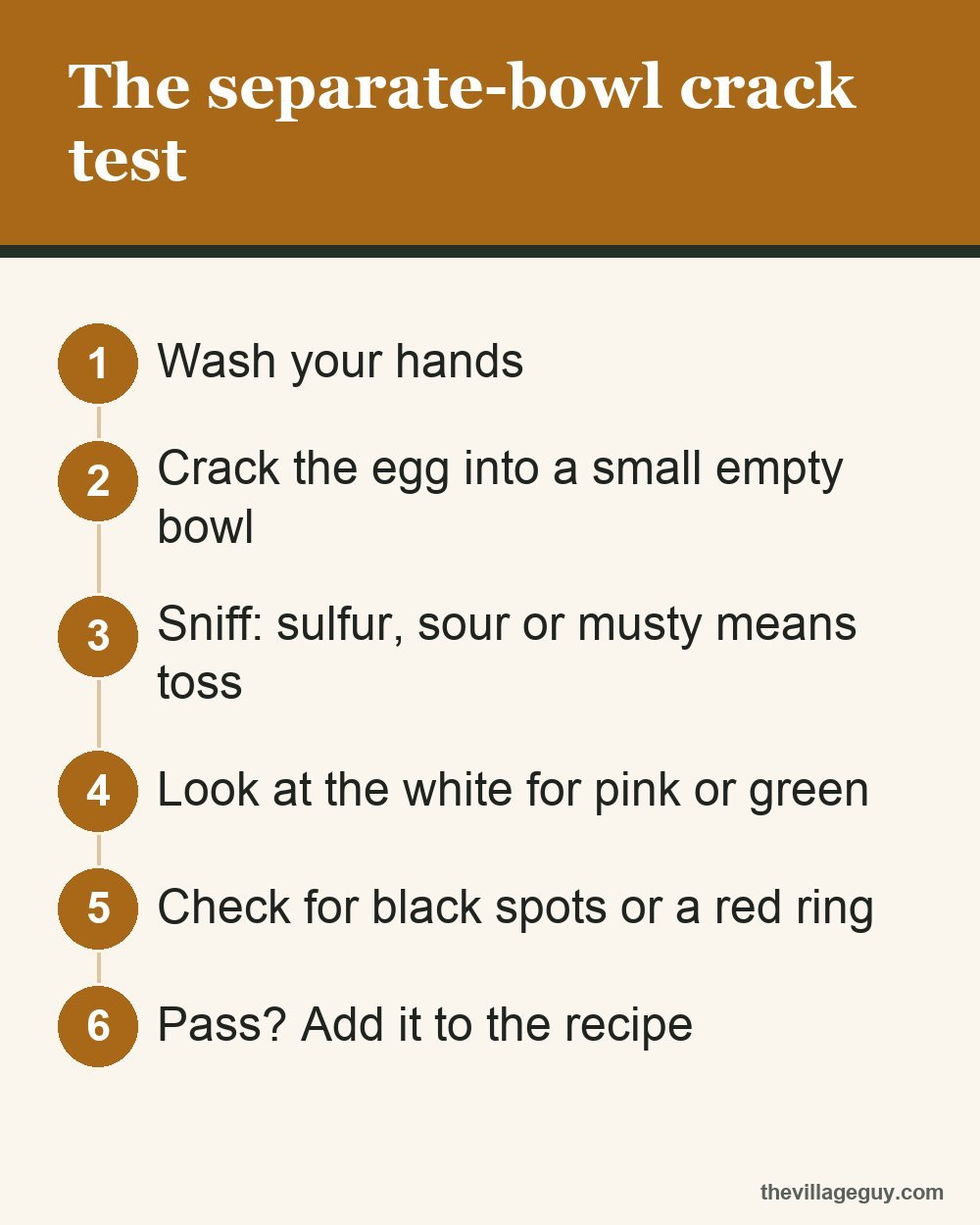
A spoiled egg smells unpleasant whether raw or cooked, the USDA says, and you will not need a trained nose. Canadian grading guidance describes sour eggs as giving off a sour odor when broken, sometimes with bubbles at the air cell line. Never taste a doubtful egg to decide: the CDC’s rule for any food you are unsure about is to throw it out, not test it with a fork.
Old is not the same as bad. A fresh egg has a tall, rounded yolk and a thick white that hugs it. An older one spreads across the plate with a flat yolk and a thin, watery white. That egg has lost quality, not safety, and it still scrambles perfectly well.
Spoiled or just odd? Keep-or-toss table
Plenty of harmless quirks look alarming, and a couple of genuinely spoiled eggs look almost normal. The Egg Safety Center puts it plainly: egg appearance is not usually related to food safety, with a short list of exceptions. Here is that list beside the common false alarms.
| What you see or smell | What it is | Keep or toss |
|---|---|---|
| Pink, green or pearly (iridescent) white | Spoilage by Pseudomonas bacteria | Toss |
| Black or green spots inside the egg | Bacterial or mold contamination | Toss |
| Sulfur, sour or musty smell, raw or cooked | Spoilage | Toss |
| Red ring on the yolk | Embryo development in a fertile egg (a “blood ring”) | Toss |
| Small red or brown fleck | Blood or meat spot from egg formation | Keep; lift it out with a knife tip if you like |
| Cloudy white | Carbon dioxide that has not escaped yet: a very fresh egg | Keep |
| Thin white, flat yolk | An older egg | Keep, if it smells normal |
| Green-gray ring around a hard-cooked yolk | Overcooking: iron and sulfur reacting | Keep |
| Deep orange or pale yellow yolk | Pigments in the hen’s feed | Keep |
The blood spot surprises a lot of new chicken keepers. It comes from a tiny blood vessel that ruptured as the yolk formed, and the American Egg Board says the egg is fine to eat. Graders pull these eggs, which is why supermarket cartons rarely have them and backyard baskets often do.
Backyard eggs: hidden nests, frozen shells and broody hens
Village eggs come with problems a supermarket never has to solve. A grocery carton has a pack date; an egg from under the lilac bush has a mystery. (For coops, feed and the rest of the flock basics, browse the Village Guy guides library.)
The hidden clutch
The University of Alaska Fairbanks warns that when hens nest wherever they like, you will not know how old the eggs are or what they have touched. A clutch of unknown age is the one situation where the cautious answer is simply to discard the lot. Moving the flock back to the nest boxes (and collecting at least twice a day, as UAF and Clemson Extension both recommend) fixes the problem at the source.
Eggs that froze in the coop
Raw egg expands when it freezes, so cold snaps crack shells. Penn State Extension’s guidance is short: if the shell cracked, throw the egg away; if it stayed intact, keep it frozen and thaw it in the refrigerator before use. UAF suggests collecting three or more times a day during winter extremes, and the same coop changes that help birds through a hard freeze are covered in our guide to keeping chickens warm in winter.
Eggs from under a broody hen
If a hen has been sitting and a rooster is around, some eggs may be developing. Federal rules list eggs showing blood rings or containing embryos among inedible eggs, so candle anything that came from under a broody hen, and toss eggs showing a red ring or a web of blood vessels.
Dirty but whole
Arizona Cooperative Extension advises discarding eggs that are soiled, cracked or leaking if the debris cannot be removed with a dry brush. A clean, dry, whole egg can be judged by the usual six checks.
Why a normal-smelling egg can still make you sick
Here is the uncomfortable fact behind every egg test. Spoilage bacteria make food smell and look bad; disease-causing bacteria often do not. University of Nebraska-Lincoln Extension says pathogens may grow in foods without any noticeable change in odor, appearance or taste. The FDA adds that fresh eggs, even those with clean, uncracked shells, may contain Salmonella.
So the six checks above protect you from rotten eggs, and storage and cooking protect you from the invisible ones. According to the FDA, Salmonella symptoms (diarrhea, fever, stomach cramps and vomiting) usually start 12 to 72 hours after eating and last 4 to 7 days. Young children, older adults, pregnant people and anyone with a weakened immune system face the highest risk of severe illness, so a doctor’s call is the right move if someone in those groups gets sick.
Safety: Keep eggs at 40°F (4°C) or colder, cook them until both yolk and white are firm, and cook egg dishes to 160°F (71°C). Do not leave eggs or egg dishes out more than 2 hours (1 hour above 90°F). After a power cut, the CDC says to discard refrigerated eggs once the power has been off for 4 hours or more. For recipes that use raw egg, use pasteurized eggs.
Copy-ready bad-egg routine
Paste these into the notes app on your phone or tape them inside a cupboard door. The first list is for the carton or basket; the second is for the moment of truth at the bowl.
Before you crack
- Read the three-digit pack code and work out the pack date.
- Write the purchase or collection date on the carton in marker.
- Discard any egg that is leaking, moldy or cracked from the nest.
- Candle farm eggs that are questionable, especially from broody hens.
- Set floaters and tilters aside to use first, after a crack test.
- Store the carton on an inside shelf of a fridge at 40°F or colder.
At the bowl
- Crack each egg into a small separate bowl, never straight into the batter.
- Sniff before you look: any sulfur, sour or musty smell means the trash.
- Check the white for pink, green or pearly tints.
- Look for black or green spots and red rings on the yolk.
- Wash the bowl in hot, soapy water after a bad egg before reusing it.
- Wash your hands with soap and water after handling a spoiled egg.
Bad egg FAQ
Is it safe to eat eggs that float?
A floating egg is old, and the USDA says it may still be perfectly safe. Crack it into a separate bowl: if it smells normal and has no off colors, cook it thoroughly and use it soon. If you have a carton full of floaters, the bigger lesson is about storage time, and the date on the carton will usually confirm it.
How long are eggs good after the date on the carton?
Iowa State University Extension says refrigerated eggs stay safe and good quality for 3 to 5 weeks after a sell-by or similar date code, because those codes are mostly for stock rotation. That assumes the eggs were refrigerated the whole time. Eggs that sat in a warm car or on a counter overnight have used up much of that margin.
Can you tell if an egg is bad by shaking it?
Not reliably. A sloshing sound can suggest a thin, older white, but food safety agencies do not list the shake test among their checks, and it cannot detect spoilage. The separate-bowl crack test answers the same question in ten seconds with far better evidence.
Is an egg bad if the yolk breaks easily?
Not by itself. A yolk that flattens and breaks at the slightest touch is a sign of age, because the yolk membrane and the white both weaken over time. If the egg smells normal and the colors look right, it is fine for scrambling or baking, though it will make a messy fried egg.
Sources
- USDA FSIS: Shell Eggs from Farm to Table (3 to 5 week storage, pack date and dating rules, float test advice, off-odor check, green ring on cooked yolks)
- FDA: What You Need to Know About Egg Safety (Salmonella in clean eggs, symptoms and timing, 40°F, 160°F, 2-hour rule)
- American Egg Board: Important Food Safety Information (air cell growth, salt-water myth, 4 to 5 weeks beyond pack date, cloudy whites, blood spots)
- Egg Safety Center: Appearance FAQ (Pseudomonas off-colors, black or green spots, yolk color, green ring)
- Iowa State University Extension AnswerLine: Egg Safety Q&As (float interpretation, cracked eggs within 2 days, date codes)
- University of Kentucky 4-H Poultry: Interior egg grading by candling (candling grip, air cell depths by grade, yolk movement with age)
- Canadian Food Inspection Agency: Shell egg grade verification (black rot, sour rot and blood ring definitions)
- 7 CFR 57.1 (Cornell LII): Definitions (checks, leakers, inedible eggs including blood rings and embryos)
- University of Alaska Fairbanks Extension: Safe Egg Handling for Small Egg-Laying Flocks (hidden nests, collection frequency, candling dark shells)
- Penn State Extension: How Freezing Affects Egg Quality (frozen shell eggs: discard if cracked, thaw intact eggs in the fridge)
- University of Arizona Cooperative Extension: Egg Safety for Backyard Chicken Owners (discard soiled eggs that a dry brush cannot clean)
- University of Nebraska-Lincoln Extension: How Food Spoils (pathogens can grow without changing odor or appearance)
- CDC: Backyard Poultry (cracked eggs, cold water pulling bacteria in, 160°F)
- CDC: Keep Food Safe After a Disaster or Emergency (discard refrigerated eggs after 4 hours without power, never taste to test)