A full-grown beef cow in the United States typically weighs around 1,350 to 1,400 pounds (610 to 635 kg), or roughly two-thirds of a ton balanced on four hooves. That is the short answer to how much does a cow weigh, but the honest answer depends on the breed, the animal’s age and sex, whether she is pregnant, how full her rumen is, and even the time of day you weigh her.
This page gives you sourced weight benchmarks from a newborn calf to a mature bull, shows you how to estimate weight on a small farm with nothing more than a tape measure, and turns those numbers into practical sums for hay, water and freezer beef.
Quick answer: The average U.S. beef cow weighs about 1,350 to 1,400 lb (610 to 635 kg). A mature Holstein dairy cow is about 1,500 lb, a Jersey runs roughly 800 to 1,200 lb, and mature beef bulls commonly weigh 1,700 to 2,300 lb or more. Newborn calves usually weigh somewhere around 80 to 90 lb.
In this guide
How much does a cow weigh? The short answer
Strictly speaking, a cow is a female that has had a calf. Most people asking about cow weight mean cattle in general, so this page covers cows, calves, steers and bulls, and labels which is which.
For a grown beef cow, the best broad figure is about 1,350 pounds. University of Wyoming Extension reports that the average U.S. beef cow weighed 1,350 pounds in 2009, and Oklahoma State University specialists have since said most data put today’s average beef cow at 1,350 to 1,400 pounds. Dairy breeds sit on either side of that: a Holstein is heavier, a Jersey much lighter.
Individual animals vary a lot around those averages. A Dexter can stay under 750 pounds, while University of Wyoming Extension, citing American Cattleman, notes that about 16 percent of U.S. beef cows weighed more than 1,500 pounds in 2010. That spread is why anyone feeding, hauling or treating cattle is better off estimating each animal than trusting a national average.
9 weight benchmarks, calf to bull
These are the reference points worth knowing, each tied to a named source. Breed, frame size and condition will move any single animal up or down.
| Animal | Typical weight | Metric | Source and notes |
|---|---|---|---|
| Newborn beef calf | About 86 lb | 39 kg | 20-year average in an NDSU Extension herd data set (yearly means 81 to 90 lb) |
| Newborn Holstein calf | 90 lb or more | 41 kg | Holstein Association USA |
| Beef calf at weaning | About 520 to 555 lb | 236 to 252 kg | Regional averages from USDA’s Beef 2017 study, as reported by Western Livestock Journal |
| Dexter cow (small breed) | Under 750 lb | Under 340 kg | Oklahoma State’s description of the ideal 3-year-old Dexter cow |
| Jersey cow | 800 to 1,200 lb | 363 to 544 kg | Oklahoma State breed profile; medium-sized cows preferred |
| Average U.S. beef cow | 1,350 to 1,400 lb | 612 to 635 kg | University of Wyoming and Oklahoma State extension |
| Cattle at slaughter, 2025 average | 1,432 lb live | 650 kg | USDA NASS; mostly steers and heifers, all classes averaged |
| Mature Holstein cow | About 1,500 lb | 680 kg | Holstein Association USA; stands about 58 in at the shoulder |
| Mature beef bull | 1,700 to 2,300 lb | 771 to 1,043 kg | Bull sizes used in NDSU Extension feeding examples |
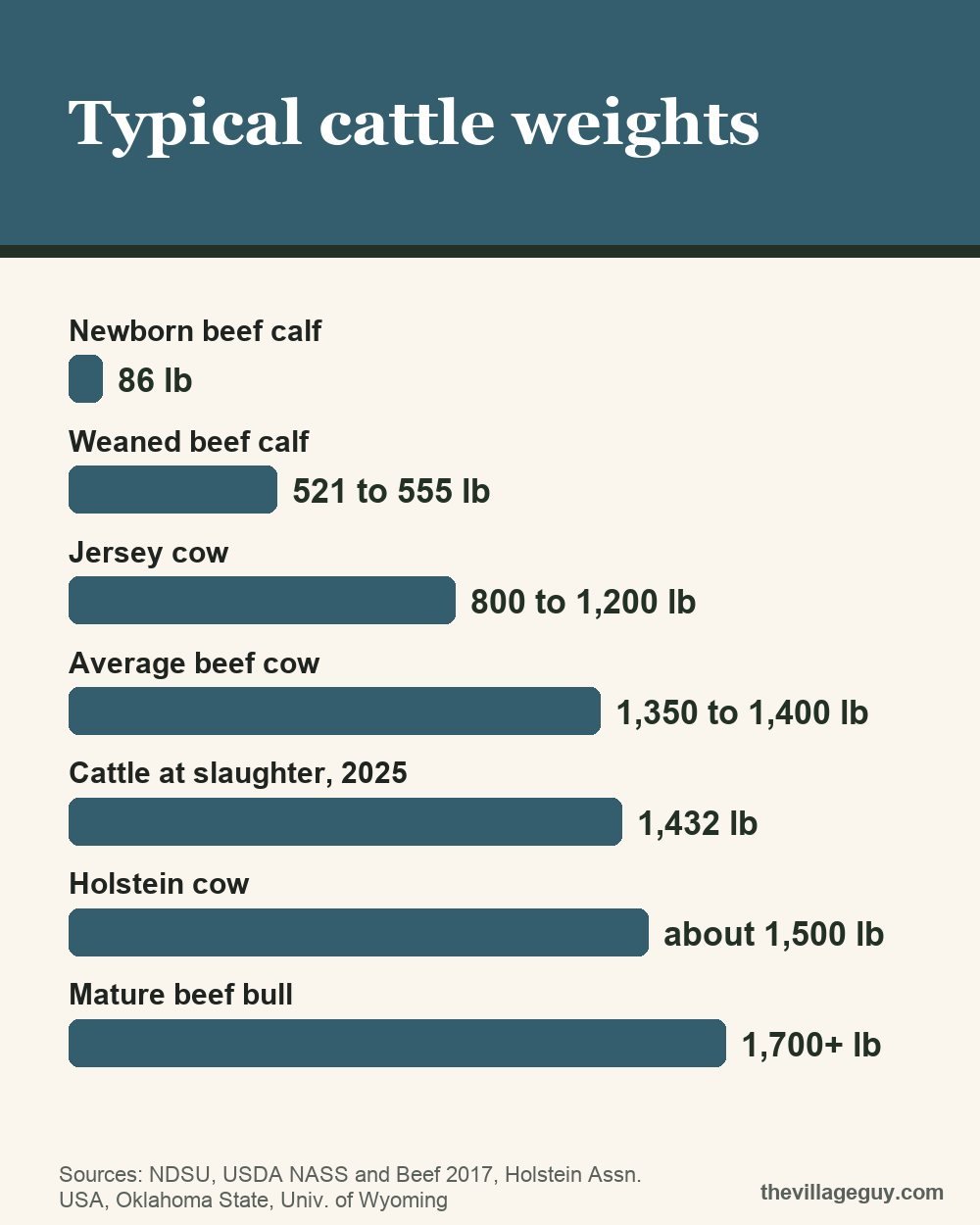
Two of those rows deserve a note. The slaughter figure is an average across every class of cattle USDA counted in 2025; steers made up 49.7 percent of federally inspected slaughter and heifers 31.7 percent, so it mostly reflects finished young cattle. The weaning figure comes from a USDA survey of cow-calf operations in 24 states, and the East region averaged lighter calves (521 lb) than the Central (555 lb) and West (553 lb).
Average cow weight has crept up
The cow your grandparents ran was smaller. University of Wyoming Extension reports that the average U.S. beef cow weighed 1,047 pounds in 1975 and 1,350 pounds in 2009, a gain of about 300 pounds in roughly four decades. The Wyoming authors credit genetic selection: ranchers used growth data to pick bulls whose calves gained faster and weaned heavier, and their daughters grew into bigger cows.
Bigger is not automatically better on a small place. In a Wyoming study the extension authors cite, 1,000-pound cows weaned calves about as heavy as those of 1,400-pound cows, and they also describe Oklahoma research in which 1,400-pound cows produced one fewer calf over their lifetimes than 1,100-pound cows. On a fixed amount of grass, their model supported 100 small cows, 88 moderate cows or 78 big ones.
Average cow weight by type
| Type | Examples | Typical mature cow weight | What it means for you |
|---|---|---|---|
| Small breeds | Dexter | Under about 750 lb | Lighter on pasture and fences; less feed per head |
| Small dairy | Jersey | 800 to 1,200 lb | A common family milk cow size |
| Commercial beef | Angus, Hereford and crosses | About 1,350 to 1,400 lb on average | The national benchmark for feed and stocking sums |
| Large dairy | Holstein | About 1,500 lb | Big frame, big appetite, big water needs |
Treat breed averages as a starting point only. The herd you buy from, and how its cows were raised and fed, can matter as much as the breed name on the sale sheet.
How much does a bull weigh?
Mature beef bulls usually weigh 1,700 to 2,300 pounds. North Dakota State University’s Dickinson Research Extension Center uses those three sizes (1,700, 2,000 and 2,300 pounds) when it talks about feeding mature bulls, and says its own bulls gained roughly 300 pounds a year as they matured.
Following that pattern, NDSU notes, a bull weighing 1,300 pounds as a yearling would be expected to reach about 1,600 pounds at 2, 1,900 at 3 and 2,200 at 4. The center prefers bulls with a mature weight of 2,200 pounds or less, partly because heavy bulls are harder on fences, gates and equipment.
For carcass comparison, USDA’s 2025 slaughter summary put the average dressed weight of bulls at 917 pounds, against 955 for steers, 871 for heifers and 658 for cows. Small breeds sit far below all of this: Oklahoma State describes an ideal Dexter bull as weighing under 1,000 pounds.
Safety: A 2,000-pound bull can crush a person against a fence without meaning to. Never measure, tape or treat a bull without a proper chute or headgate, and never work one alone.
Why the same cow weighs different amounts
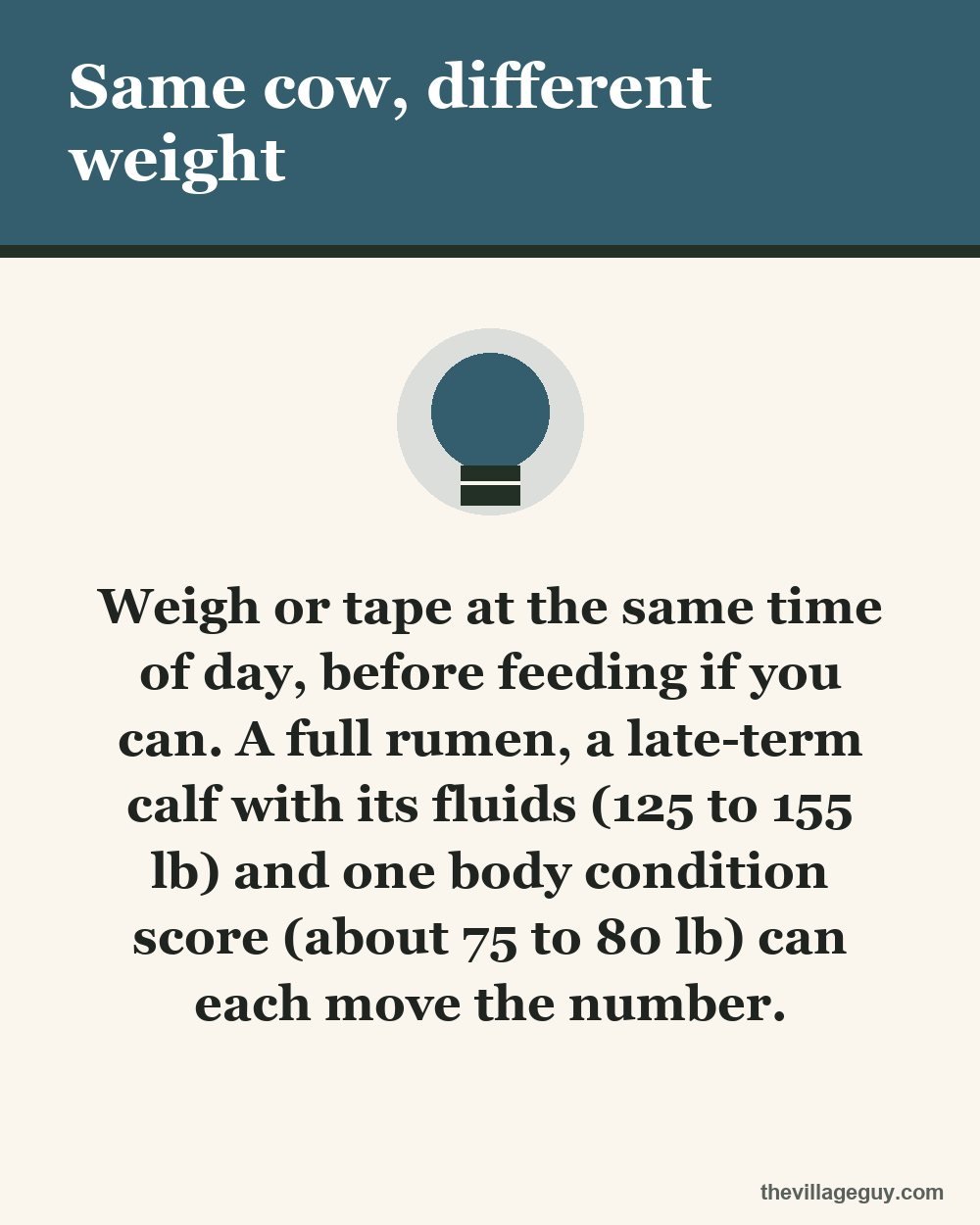
Put the same cow on a scale at 7 a.m. and again at 5 p.m. and you will likely get two different numbers. Three things move a cow’s weight around without her really gaining or losing tissue.
Gut fill
A cow carries a large volume of feed and water in her rumen at any moment; our explainer on how a cow’s four-compartment stomach works puts that chamber at up to 40 gallons. After a big drink or a full night of grazing she weighs more than after hours without feed. That is why buyers and researchers try to weigh cattle at a consistent time and fill.
Pregnancy
Late in pregnancy, a cow is carrying more than a calf. University of Nebraska-Lincoln Extension notes that the fetus and its fluids can total about 125 to 155 pounds in late gestation, which is why body weight alone can make a thin pregnant cow look fine on paper.
Body condition
Body condition scoring rates fat cover on a 1 to 9 scale for beef cows. UNL Extension’s rule of thumb is that one score equals about 75 to 80 pounds of live weight; other extension services put it closer to 100 pounds, with larger-framed cows at the high end. Oklahoma State frames it as roughly 7 percent of a cow’s weight at a score of 5.
Estimate weight with a tape: a worked example
Few small farms own a livestock scale, and you rarely need one. A cloth tape measure and a little arithmetic will get you close enough for feeding, deworming conversations with your vet, and trailer planning. Oregon State University Extension publishes the standard formula: heart girth times heart girth times body length, divided by 300, gives body weight in pounds, with both measurements in inches.
- Heart girth: the distance around the body just behind the front legs and shoulder blades.
- Body length: from the point of the shoulder to the pin bone, the bony point beside the tail head.
- The sum: girth × girth × length ÷ 300 = estimated pounds.
| Step | Example cow |
|---|---|
| Heart girth | 70 in |
| Body length | 78 in |
| Girth × girth | 70 × 70 = 4,900 |
| × body length | 4,900 × 78 = 382,200 |
| ÷ 300 | About 1,274 lb (578 kg) |
Oregon State Extension uses this same 70-inch, 78-inch example.
Penn State Extension says weight tapes are accurate to within about 3 to 5 percent for animals over 330 pounds, and a little less accurate for lighter calves. On a 1,274-pound estimate, 5 percent is about 64 pounds either way: fine for feed planning, too loose for selling by the pound. Breed-specific dairy weigh tapes print the conversion directly on the tape; UMaine Extension notes the Holstein calf tape it describes works up to about 282 pounds.
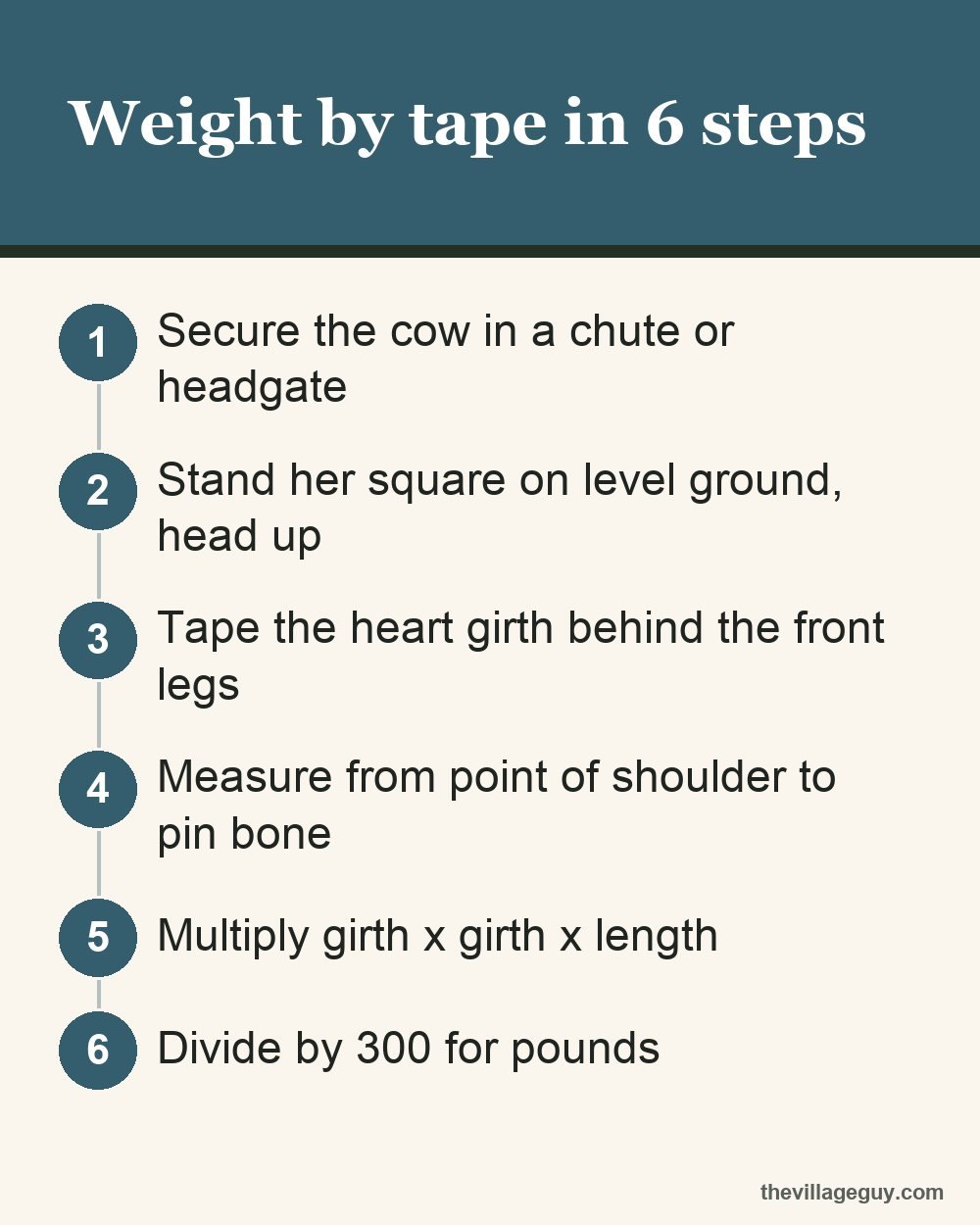
- Pen the cow in a chute or headgate so she stands still and you stay safe.
- Get her standing squarely on level ground with her head up, not grazing.
- Run the tape around the heart girth just behind the front legs and shoulder blades.
- Pull the tape snug against the hide without squeezing, then read the number where the end meets the tape.
- Measure body length from the point of the shoulder to the pin bone.
- Write both numbers down before doing any math.
- Repeat each measurement once more and use the average.
- Tape at the same time of day each time, ideally before the morning feed, so gut fill stays similar.
Feed and water by body weight
Once you know roughly what a cow weighs, feeding stops being guesswork. University of Wyoming Extension gives the rule of thumb that a beef cow eats about 2.5 percent of her body weight in air-dry forage each day.
| Cow weight | Air-dry forage per day (2.5%) | Over a 150-day hay season |
|---|---|---|
| 1,000 lb | 25 lb | 3,750 lb (about 1.9 tons) |
| 1,200 lb | 30 lb | 4,500 lb (2.25 tons) |
| 1,400 lb | 35 lb | 5,250 lb (about 2.6 tons) |
Daily figures from University of Wyoming Extension; the 150-day column is simple multiplication and does not include hay wasted at the feeder.
Bulls eat a bit less for their size once they stop growing. NDSU’s figures work out to just under 2 percent of body weight in dry matter to hold a mature bull steady, about 37 pounds a day for a 2,000-pound bull.
Water needs climb with body weight, milk production and temperature. Alabama Cooperative Extension’s table, adapted from the National Research Council’s beef cattle nutrient requirements, gives these daily amounts:
| Animal | At 50°F | At 70°F | At 90°F |
|---|---|---|---|
| Growing steer or heifer, 600 lb | 6 gal | 8 gal | 13 gal |
| Dry, pregnant cow, 1,100 lb | 7 gal | 10 gal | 17 gal |
| Dry, pregnant cow, 1,300 lb | 9 gal | 12 gal | 19 gal |
| Nursing cow, 1,300 lb | 15 gal | 20 gal | 22 gal |
| Mature bull, 1,600 lb or more | 10 gal | 13 gal | 22 gal |
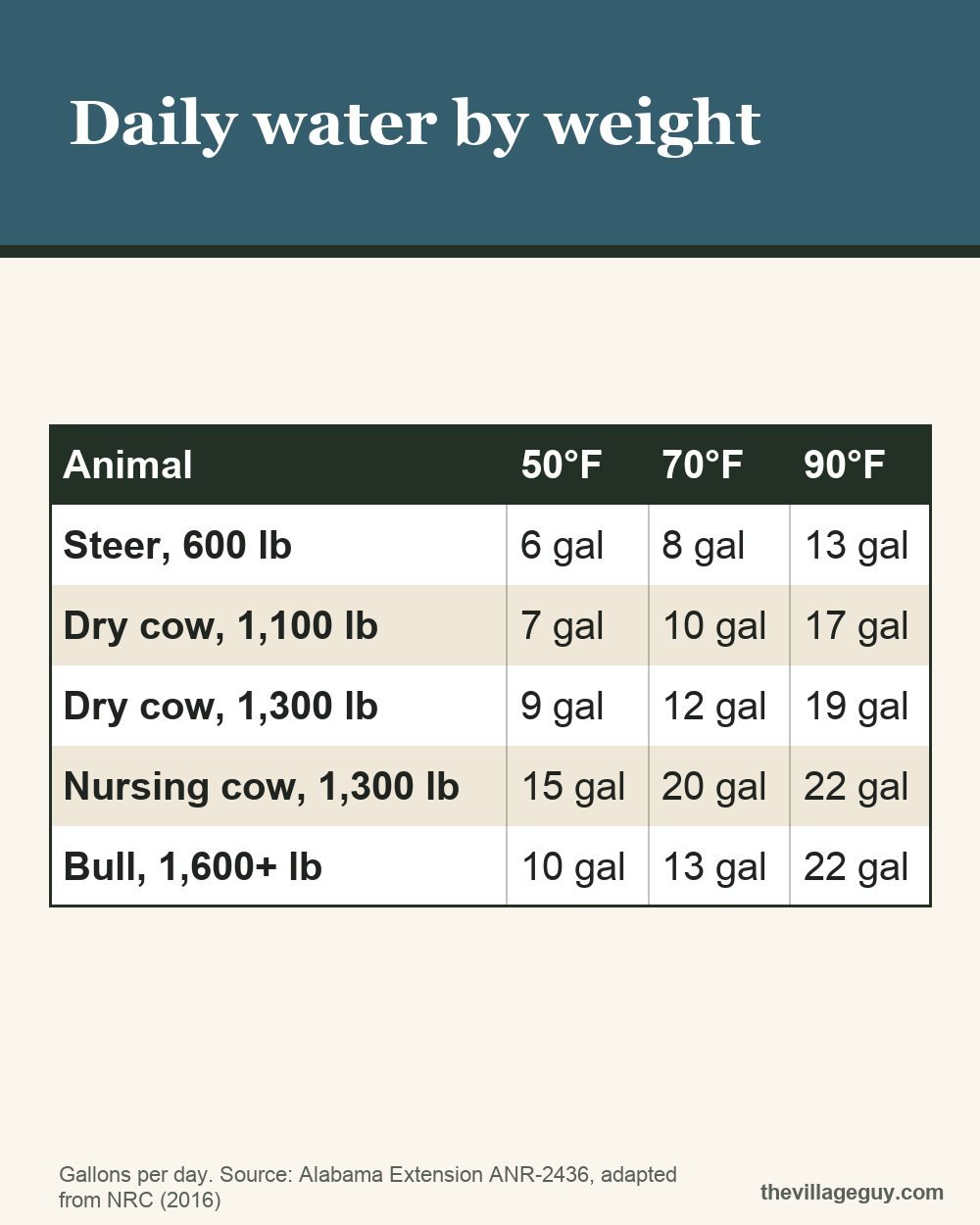
Alabama Extension adds that cattle on hay need more water than cattle on lush pasture, which can be up to 80 percent water, and that cattle do not adapt well to water restriction. In winter, a frozen line to the stock tank is the usual culprit; our guide to the temperature at which pipes freeze covers how to protect exposed water lines.
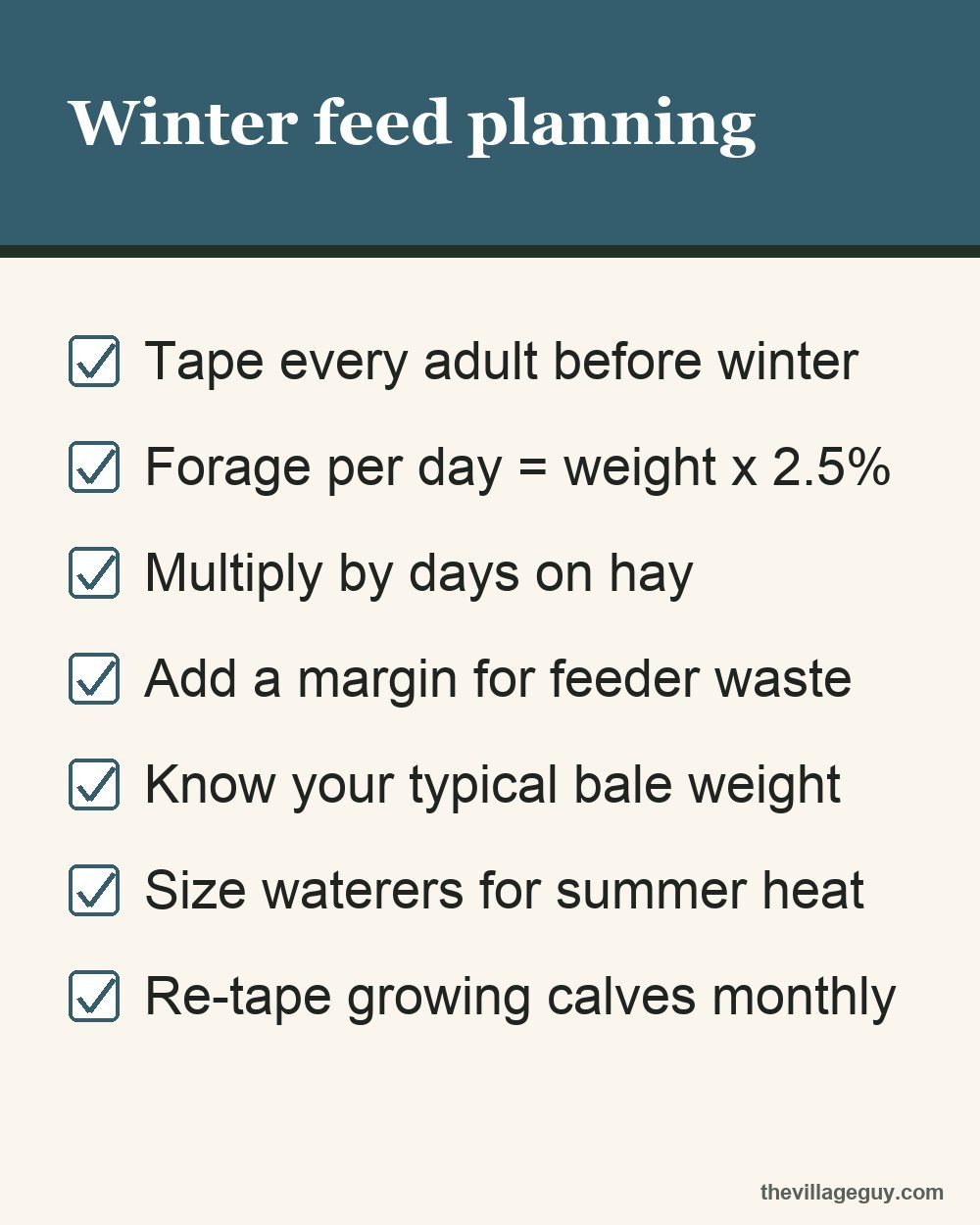
- Estimate every adult animal’s weight with a tape before winter feeding starts.
- Multiply each weight by 2.5 percent to get pounds of air-dry forage per day.
- Multiply that daily total by the number of days you expect to feed hay, then add a margin for waste.
- Weigh or ask the seller for the weight of a typical bale so you can convert pounds into bales.
- Size water tanks and waterers for your herd’s hot-weather needs, not its winter needs.
- Re-tape growing calves monthly so feed amounts keep pace with their gains.
From live weight to freezer beef
If you are buying a quarter or a side of beef, or raising a steer for your own freezer, live weight is only the first of three numbers. The animal loses its hide, head, feet and organs at slaughter, the carcass loses moisture while it chills, and bone and fat are trimmed during cutting.
USDA’s 2025 slaughter summary shows how big the first step is: cattle averaged 1,432 pounds live and 878 pounds dressed, so the carcass was about 61 percent of live weight. University of Wisconsin Extension walks through a full example for a 1,200-pound animal:
| Stage | How it is figured | Weight |
|---|---|---|
| Live animal | On the scale before slaughter | 1,200 lb |
| Hot carcass (hanging weight) | × 62% dressing percentage | 744 lb |
| Chilled carcass | Minus 3.5% chilling shrink | 718 lb |
| Take-home beef | × 67% cutting yield | About 481 lb |
In that example, the freezer gets about 40 percent of the animal’s live weight. Wisconsin Extension notes that chilling alone can take 2 to 5 percent in the first 24 hours, and that boneless cuts lower the final yield. Ask your processor which weight their price is based on before you compare quotes.
Cow weight FAQ
How much does a cow weigh in tons and kilograms?
An average 1,350-pound beef cow is about two-thirds of a short ton (2,000 lb) and roughly 612 kg. A 1,500-pound Holstein is three-quarters of a ton, about 680 kg. Even a big 2,300-pound bull is only a little over one ton.
How much does a newborn calf weigh?
Most beef calves are born somewhere in the 80 to 90 pound range; an NDSU Extension data set covering 20 years of herd records averaged 86 pounds. Holstein calves are typically 90 pounds or more, and growth is fast: UMaine Extension’s worked example follows a Holstein calf from 90 pounds at birth to 180 pounds at about 60 days.
Is a heavier cow a better cow?
Not necessarily. Research summarized by University of Wyoming Extension found that lighter cows can wean calves nearly as heavy as big cows while eating less, so more of them fit on the same grass. The right size depends on your forage, your climate and what you plan to sell.
Does a cow’s weight change with the seasons?
Yes. A cow can lose condition through a hard winter or early lactation and regain it on good grass, and pregnancy adds weight through gestation. That is why extension specialists pair weight with body condition scoring: the score tells you whether a change is fat, fill or calf.
For more practical cattle, poultry and homestead guides, see The Village Guy’s full guide library, or read about the site.
Sources
- University of Wyoming Extension: Beef Cow Size: Industry Trends, Economics, and Implications for Grazing Wyoming Rangelands (B-1343) (average cow weight 1975 and 2009; forage at 2.5 percent of body weight; cow size and productivity research)
- Oklahoma State University Extension: Beef Cattle Research Update (average beef cow now 1,350 to 1,400 lb; confirmed from search-result text)
- USDA NASS: Livestock Slaughter 2025 Summary (April 2026) (average live weight 1,432 lb; dressed weights by class; slaughter mix)
- Holstein Association USA: Holstein breed history (mature cow about 1,500 lb and 58 in tall; calves 90 lb or more)
- Oklahoma State University: Breeds of Livestock, Jersey Cattle (Jersey cows 800 to 1,200 lb; confirmed from search-result text)
- Oklahoma State University: Breeds of Livestock, Dexter Cattle (ideal Dexter cow under 750 lb, bull under 1,000 lb; confirmed from search-result text)
- NDSU Dickinson Research Extension Center: BeefTalk, How Much Should Bulls Weigh? (1,700 to 2,300 lb mature bulls; 300 lb per year gain; dry matter needs)
- Journal of Extension: Maximizing Use of an Extension Beef Cattle Data Set, Part 3 (NDSU) (birth weight 20-year average 86 lb, yearly means 81 to 90 lb; confirmed from search-result text)
- Western Livestock Journal: Report offers cow-calf insights (USDA Beef 2017 regional weaning weights)
- Oregon State University Extension: Livestock weight calculator (heart girth formula and worked example)
- Penn State Extension: Monitoring Dairy Heifer Growth (weight tape placement; accuracy 3 to 5 percent over 330 lb; confirmed from search-result text)
- University of Maine Extension: Calculating the Average Daily Gain of a Dairy Calf or Heifer (Bulletin 1078) (Holstein calf tape range)
- University of Nebraska-Lincoln Extension: Body Condition Scoring Beef Cows (EC281) (75 to 80 lb per condition score; 125 to 155 lb fetus and fluids in late gestation)
- Alabama Cooperative Extension System: Water Requirements of Beef Cattle (ANR-2436) (daily water by class, weight and temperature)
- University of Wisconsin Extension: How much meat should a beef animal yield? (live to hanging to take-home example)