Most pullets lay their first egg somewhere between 18 and 22 weeks of age, roughly four and a half to five months after hatching. That is the University of Florida’s range for when do chickens start laying eggs, and the spread comes from two things you can predict: the breed you chose and the season she reaches that age. A Leghorn-type hen hatched in spring tends to sit at the early end. A heavy dual-purpose bird that hits 20 weeks in December may make you wait until the days lengthen.
Below is a week-by-week timeline, a breed table, the 5 signs that the first egg is close, what those first eggs look like, and the numbers on how many eggs a hen lays a year and how long she keeps it up.
Quick answer: Chickens usually start laying at 18 to 22 weeks old, depending on breed and season (University of Florida IFAS Extension). Production-bred layers often start near 18 weeks; heavier dual-purpose breeds tend to start later, and pullets that mature during short winter days may not lay until spring unless they get supplemental light.
In this guide
When Do Chickens Start Laying Eggs? A Week-by-Week Timeline
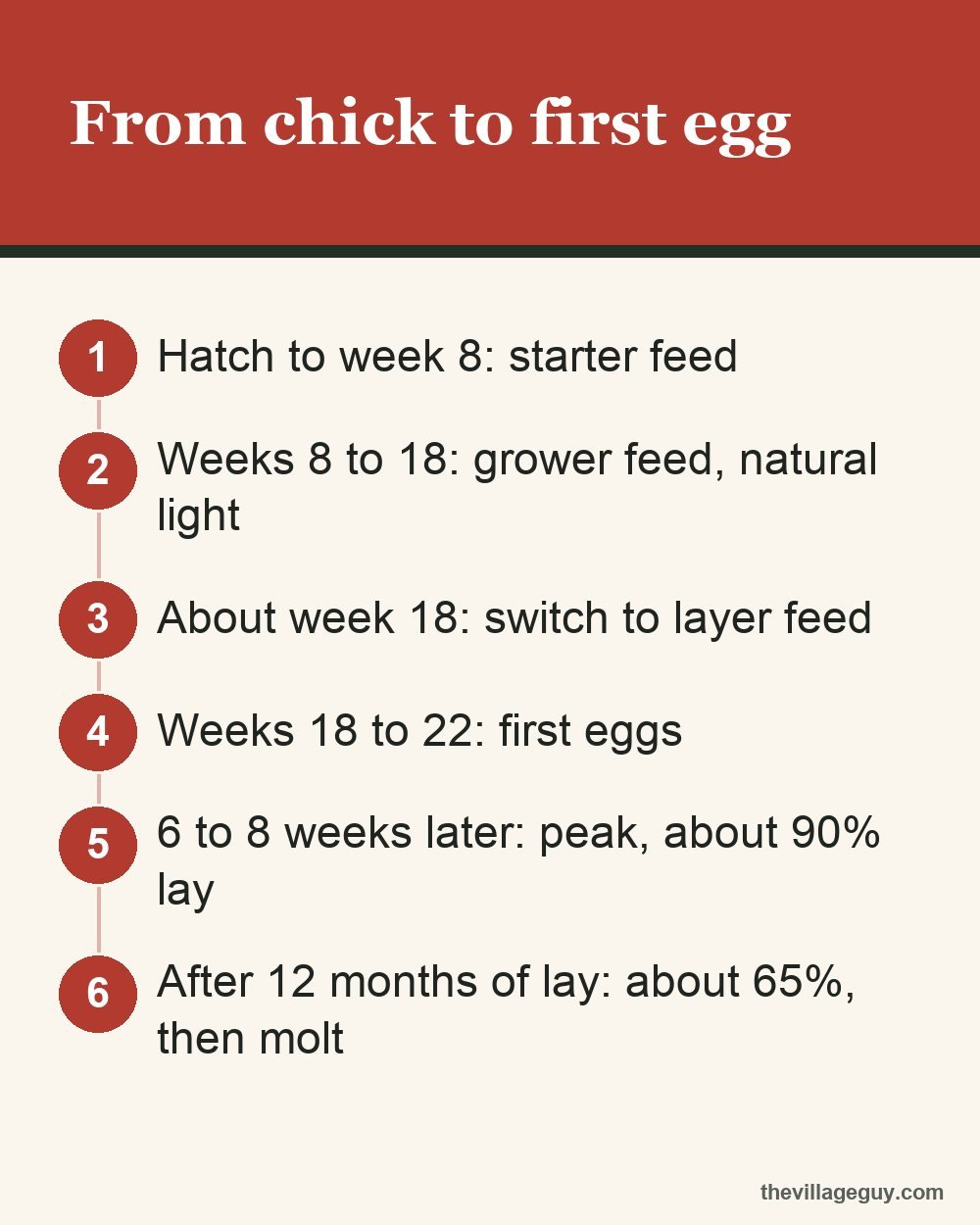
Here is the whole arc from chick to seasoned layer, stitched together from university extension bulletins and feed-maker guidance. Ages are approximate; individual birds run early or late.
| Age | What is happening | What you do |
|---|---|---|
| Hatch to week 8 | Chick stage, under brooder heat at first. | Feed a starter or starter-grower ration. |
| Weeks 8 to 18 | Growing pullet; frame and organs develop. | Stay on grower or starter-grower feed with natural daylight only; Arizona’s guide advises against added light from 8 to 20 weeks to avoid early maturity. |
| Weeks 16 to 18 | Body nearly adult; comb starts to color. | Switch to layer feed at week 18, or as early as 16 if mixing with older hens (Purina). |
| Weeks 18 to 22 | First eggs for most birds (Florida). | Check nests daily; expect odd eggs at first. |
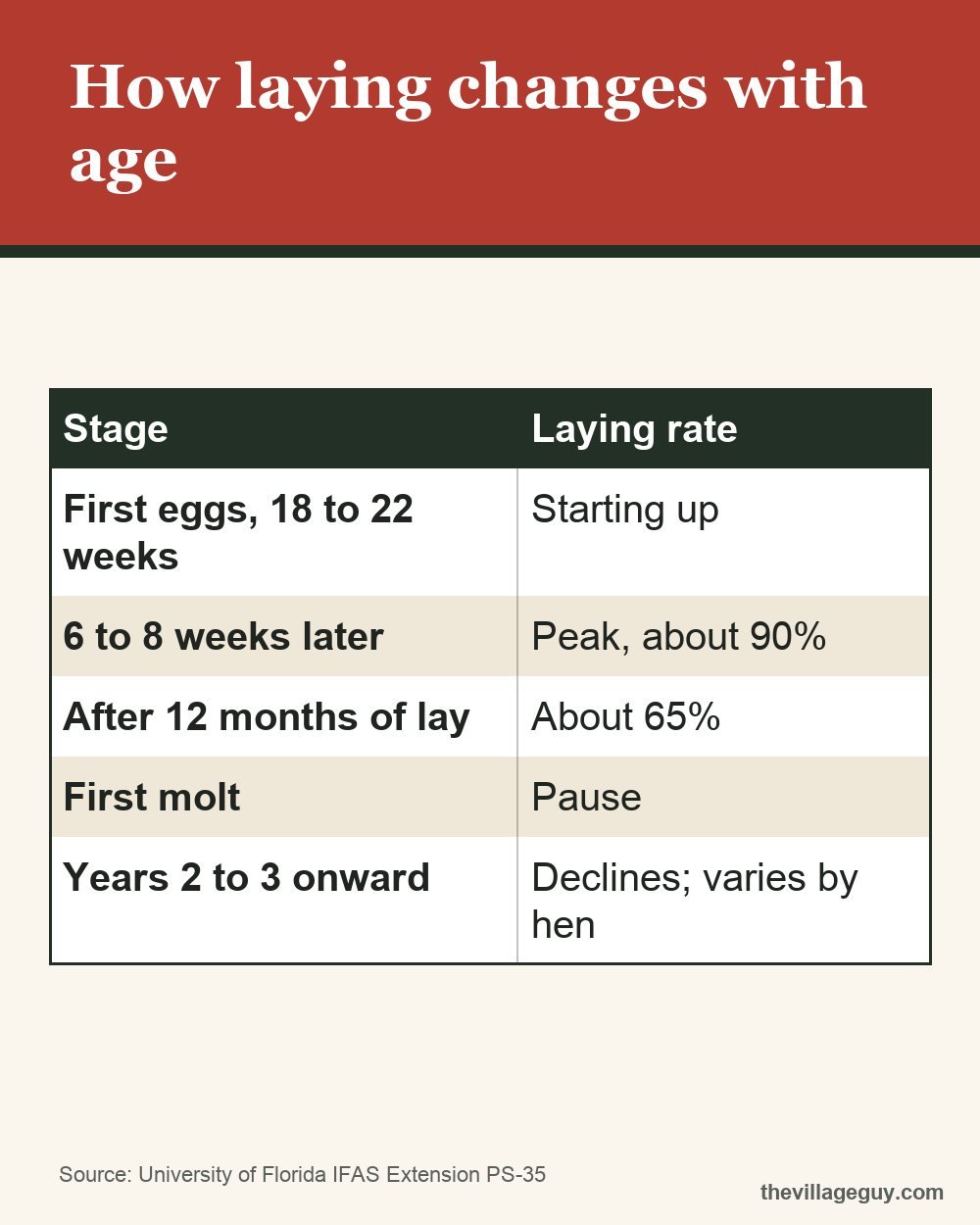
| 6 to 8 weeks after first egg | Flock reaches peak, about 90% lay (Florida). | Keep feed, water and routine steady. |
| About 12 months of lay | Rate falls to about 65% (Florida), then the first molt. | Expect a pause while feathers regrow. |
| Years 2 to 3 onward | Many hens decline significantly (Florida). | Plan replacements and retirement. |
Oregon State University’s bulletin gives a slightly different curve for well-managed pullets: laying starts at 18 to 20 weeks and peaks at about 35 weeks of age at over 90% production, holding that peak for about 10 weeks. Purina puts peak performance at about 30 weeks. Different flocks, same shape: a steep climb, a short plateau, then a slow slide.
Breed and Season Change the Date
Breed type
Birds bred for egg numbers mature and lay earliest and most. Heavier dual-purpose breeds carry more body to build first. The University of Maryland rates egg output by breed, and the University of Kentucky’s poultry team notes that commercial-type layers tend to be flighty and high-strung, which is worth weighing against their egg count.
| Breed type | Examples | Egg output (Maryland rating) | Expect first eggs |
|---|---|---|---|
| Egg-type and sex-links | Leghorn, Australorp, red and black sex-links | Excellent | Early end of 18 to 22 weeks |
| Good layers | Ameraucana, Marans, Hamburg | Good | Mid-range |
| Dual-purpose | Rhode Island Red (good); Plymouth Rock, Wyandotte, Orpington, Brahma (fair) | Good to fair | Later end of the range or beyond |
| Bantams | Many breeds in miniature | Not rated; smaller eggs | Varies; ask your hatchery |
The timing column is a general guide built on Florida’s 18 to 22 week range; individual strains vary. The University of Maine’s breed bulletin adds two planning numbers: three bantam eggs equal about two large eggs, and a family flock needs about 1.5 hybrid layers per person or 2 heritage-breed hens per person for a steady supply.
Season
Day length is the trigger for laying, so a pullet that reaches laying age as days shorten often waits. Purina notes that shorter fall and winter days can delay the first egg and that, without supplemental light, young hens may wait until spring. You can work out your own window from the hatch date:
- Hatched April 1: week 18 falls around August 5 and week 22 around September 2, while days are still long. Eggs are likely on schedule.
- Hatched August 15: week 18 falls around December 19 and week 22 around January 16, the shortest days of the year. A delay into late winter or spring would be normal.
If you want winter eggs from late-hatched pullets, the University of Arizona suggests restarting supplemental light at 18 weeks and adding only 15 to 30 minutes a week until reaching 14 hours. Our guide to why chickens stop laying in winter walks through a full lighting schedule.
5 Signs a Pullet Is About to Lay
Hens give fair warning. Look for several of these together rather than relying on one.
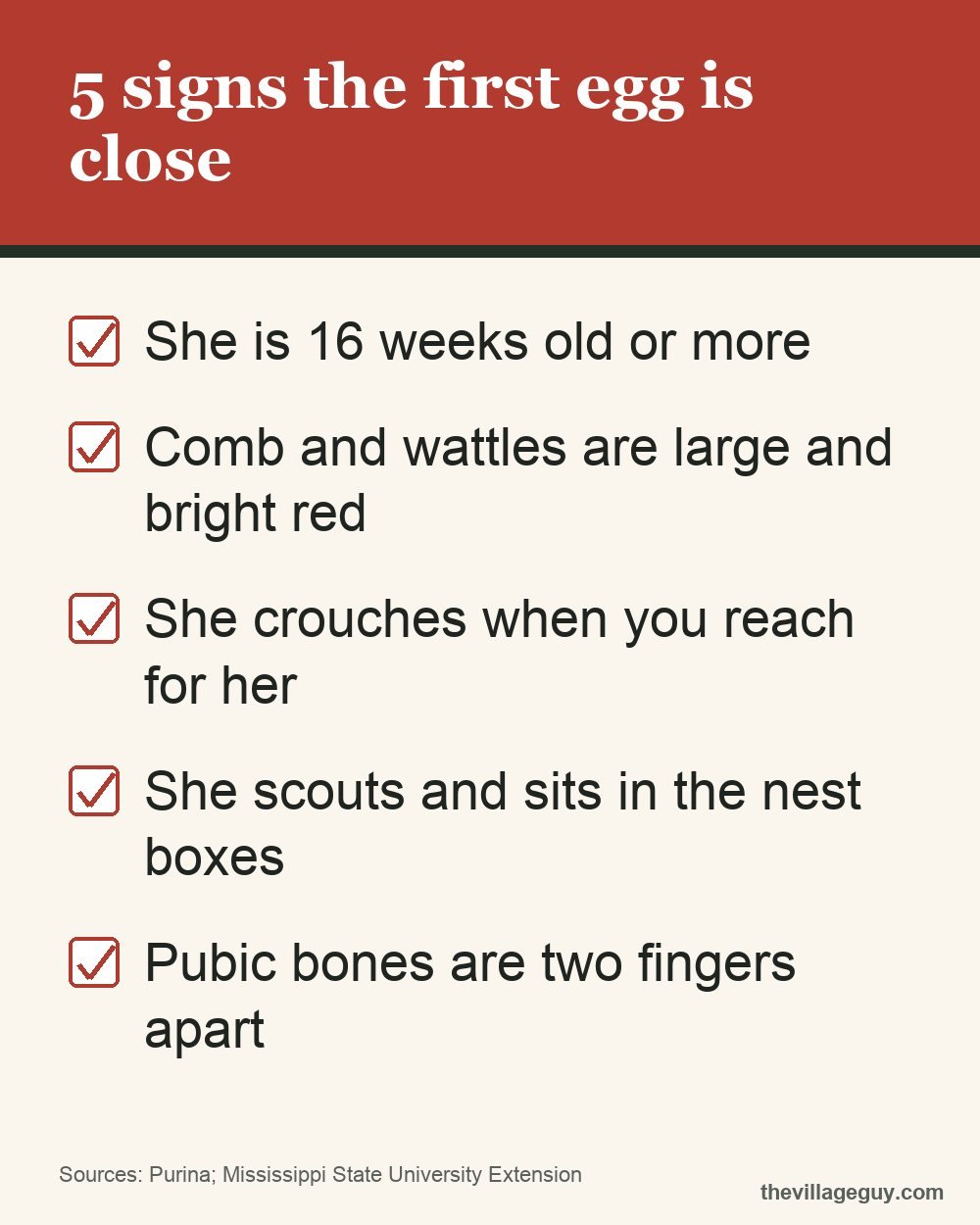
1. The calendar says 16 weeks or more
Before about 16 weeks, eggs are unlikely for any breed, and Purina treats 16 weeks as the earliest point to offer layer feed. From 18 weeks on, start checking nests daily.
2. Comb and wattles grow and turn bright red
Mississippi State University Extension describes a laying hen’s comb and wattles as large, bright red and glossy, against small, dull and shriveled in a non-layer. A pullet’s comb goes from pale pink to that full red as she matures.
3. She crouches when you reach for her
Purina lists crouching (the “squat,” wings slightly out, as if for a rooster) among the behavior changes before laying, along with spending more time with the rooster if you have one.
4. She scouts the nest boxes
Pullets close to lay investigate the nesting area, stepping in and out and rearranging bedding. Purina suggests golf balls or decoy eggs in the boxes to show them where eggs belong.
5. Her pubic bones spread
Two thin pubic bones sit on either side of the vent. Mississippi State says a laying hen should have at least two finger widths between them, with a large, moist vent, while a non-layer’s bones sit one finger width or less apart. Pick her up calmly at dusk and feel gently; it takes a few tries to learn.
What First Eggs Look Like (and Why)
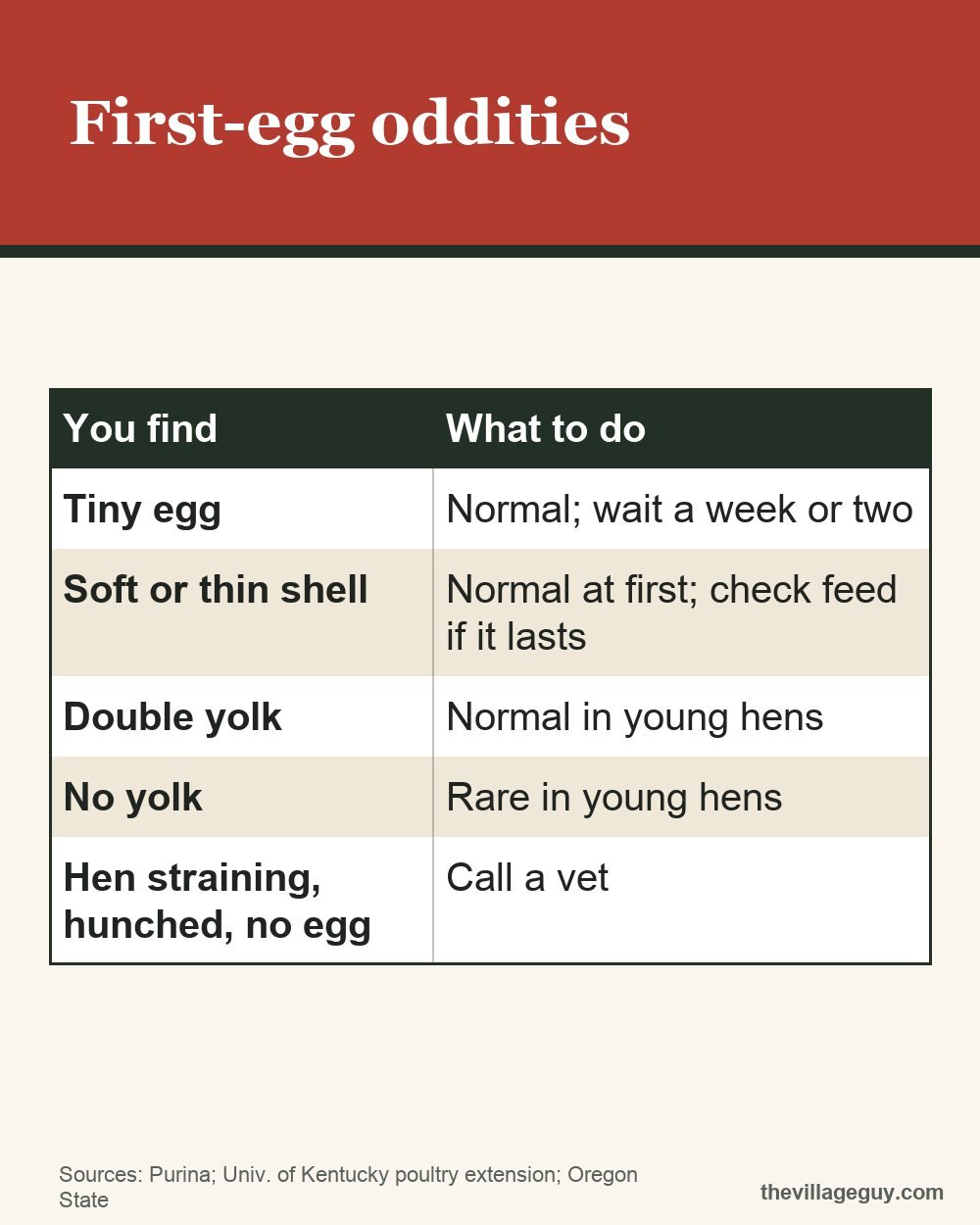
Purina warns that the first few eggs may be irregular: small, soft-shelled, missing a yolk or carrying two. Production usually settles into a steadier pattern after about a week. The reasons are mechanical. The University of Kentucky’s poultry anatomy page explains that young hens sometimes release two yolks in quick succession, giving an oversized double-yolker, and that, rarely, a young hen produces an egg with no yolk at all.
The same page explains why even a top layer cannot exceed one egg a day. Forming and laying an egg takes about 25 to 26 hours, with 20 or more of those hours spent building the shell. The next yolk is usually released 30 to 75 minutes after she lays, so each egg arrives a bit later than the last. When laying gets too late in the day, she skips a day and starts a new run. Those runs of consecutive eggs are called clutches.
Getting Ready for the First Egg: Copy-Ready Checklist
Most of the prep is about feed and nests. For details on rations by age, see our guide to what chickens eat at each stage, from starter to layer feed. The short version: switch to layer feed at about 18 weeks, because the University of Florida warns that young birds fed a high-calcium layer diet get an unbalanced calcium to phosphorus ratio, with more sickness and deaths. Purina’s spec for layer feed is 16 percent protein and 3.25 to 4.5 percent calcium.
Weeks 16 to 18
- Write each pullet’s hatch date on the coop calendar and mark weeks 18 and 22.
- Buy layer feed and plan to switch at about week 18, mixing it in over several days.
- Set out oyster shell in a separate dish once layer feed starts.
- Add clean bedding to the nest boxes and keep them dim.
- Place a golf ball or wooden egg in each nest box.
- Block off any corners or under-shelf spaces where hens might start a hidden nest.
- Remove anyone still sleeping in the nest boxes so they learn to roost on perches.
Weeks 18 to first egg
- Check combs, wattles and nest-box visits each evening.
- Collect eggs at least once a day, and twice in very hot or freezing weather.
- Keep pullets near the coop in the morning, when most eggs arrive.
- Log the date of the first egg from each hen if you can tell them apart.
- Decide whether to add winter light if the flock matures during short days.
Once eggs are coming in, our guide on how to wash fresh eggs covers cleaning them without stripping the protective bloom.
How Many Eggs Does a Chicken Lay a Year?
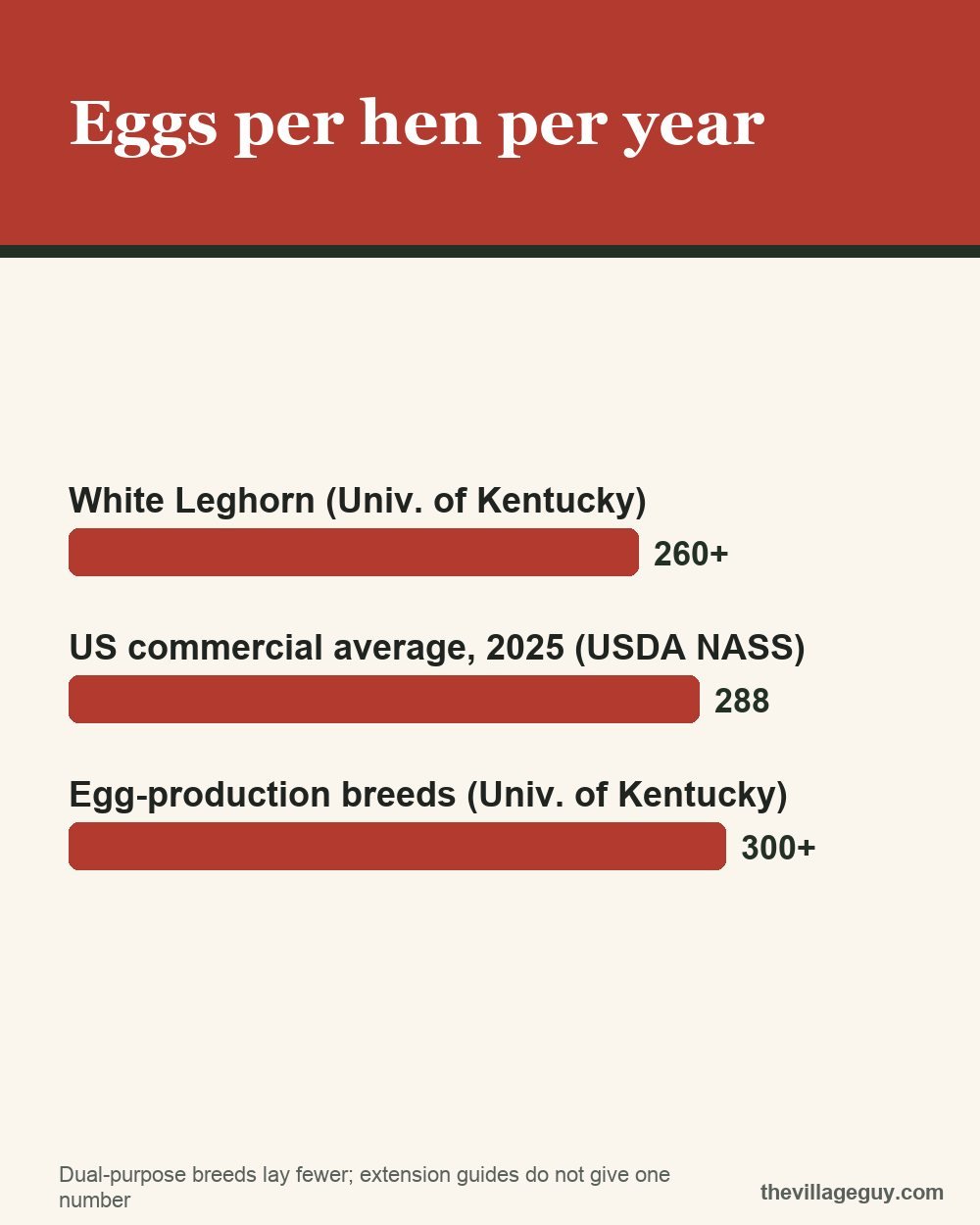
It depends heavily on the bird. The best benchmark comes from the USDA: in its Chickens and Eggs 2025 Summary, the National Agricultural Statistics Service put the US annual average at 288 eggs per layer on hand, down 1 percent from 290 in 2024. Those are commercial hens selected and managed for maximum output, with controlled lighting.
Backyard birds vary around that figure. The University of Kentucky’s breed guide says a White Leghorn can produce 260-plus eggs in 12 months and that breeds developed for egg production can exceed 300 in a year, while dual-purpose hens “lay reasonably well.” Most extension bulletins stop short of a single number for dual-purpose breeds, which is honest: strain, feed, light and age move it a lot.
So how many eggs does a chicken lay in a day?
One at most, because of the 25 to 26 hour cycle. A hen at peak lays most days; at the University of Florida’s 90% flock peak, that works out to about 9 eggs per hen every 10 days on average. At about 65% by the end of the first year, it is closer to 6 or 7.
How Long Do Chickens Lay Eggs, and What Age Do They Stop?
Hens lay in cycles. The University of Florida says good layers produce for about 50 to 60 weeks, then rest during a molt. Mississippi State notes that late molters, which lay 12 to 14 months before molting, are generally the better layers, while early molters tend to be poorer layers. Virginia Tech says production hens can lay efficiently for two laying cycles.
The honest answer to what age do chickens stop laying eggs is that there is no single age. The University of Florida, Oregon State and Virginia Tech all say production usually declines significantly after two to three years, and Florida stresses that this varies greatly from bird to bird. Older hens molt more often and lay fewer eggs, but many keep laying at a reduced rate rather than stopping on a set birthday. Mississippi State adds a neat detective trick for yellow-skinned breeds: pigment fades from the vent, eye ring, beak and finally the shanks as a hen lays, so a fully yellow beak suggests she has not laid for at least four weeks.
For more on raising a flock from chicks, browse all our village life guides.
Laying Age FAQ
Do hens need a rooster to start laying eggs?
No. Penn State Extension states that roosters are not necessary in a flock for hens to lay eggs. A rooster only matters if you want fertile eggs to hatch. Day length and maturity, not male company, switch laying on.
Should I add light to make pullets lay sooner?
Not before they are ready. The University of Arizona advises keeping pullets on naturally declining light from 8 to 20 weeks of age to prevent early maturity and prolapse, then restarting light at 18 weeks and increasing it slowly. Pushing an underdeveloped pullet into lay can cause problems that a few weeks of patience avoids.
My hen is 30 weeks old and still not laying. Is something wrong?
Not necessarily. A heavy-breed pullet that came of age in late autumn may simply be waiting for longer days. Check that she is on layer feed with water always available, look for a hidden nest, and watch her comb. If she looks dull, thin or unwell, or the whole flock has stalled, work through the causes in our not-laying troubleshooting guide and call a vet if birds seem sick.
What time of day do chickens lay eggs?
Mostly in the morning and early afternoon. Kentucky’s poultry anatomy page notes that hens almost never ovulate after 3:00 p.m., and the egg follows about a day later, so late-afternoon eggs are uncommon. That is why a midmorning check catches most of them.
Sources
- University of Florida IFAS Extension: Factors Affecting Egg Production in Backyard Chicken Flocks (PS-35) (first eggs at 18 to 22 weeks, peak of about 90%, about 65% after 12 months, 50 to 60 weeks of lay, decline after 2 to 3 years, calcium for young birds)
- Oregon State University Extension: Why did my chickens stop laying? (PNW 565) (laying at 18 to 20 weeks, peak near 35 weeks lasting about 10 weeks, decline after 2 to 3 years)
- Purina Animal Nutrition: When Do Chickens Start Laying Eggs? (first egg near 18 weeks, layer feed timing and spec, behavior signs, decoy eggs, irregular first eggs, peak near 30 weeks)
- University of Arizona Extension: Lighting Schedules for Arizona Backyard Laying Flocks (natural light for pullets 8 to 20 weeks, restart light at 18 weeks)
- Mississippi State University Extension: Culling Hens (layer comb and vent traits, pubic bone spacing, molt timing, pigment fading)
- Poultry Extension (University of Kentucky): Avian Reproductive System, Female (25 to 26 hour egg cycle, clutches, double yolks, ovulation timing)
- Poultry Extension (University of Kentucky): Selecting a Chicken Breed for Small or Backyard Poultry Flocks (Leghorn 260-plus eggs, egg breeds 300-plus)
- University of Maryland Extension: Choosing the Best Poultry Breed for Your Small Farm (FS-987) (egg production ratings by breed)
- University of Maine Cooperative Extension: Match Your Need to the Right Breed (Bulletin 2104) (bantam egg size, hens per person)
- USDA NASS: Chickens and Eggs 2025 Summary (288 eggs per layer in 2025, 290 in 2024)
- Penn State Extension: Successfully Raising a Small Flock of Laying Chickens (roosters not needed for laying)