An egg straight from the nest box is cleaner than it looks and dirtier than you would like. The smear of mud or droppings on the shell is the obvious problem; the less obvious one is that a careless wash can pull that mess through the shell and into the egg. Learning how to wash fresh eggs properly comes down to one rule that the egg industry has followed for decades (warm water, never cold, never a soak) plus knowing when it is better not to wash at all.
Quick answer: Dry-clean first with a dedicated brush, fine sandpaper or a dry paper towel, and stop there if the shell comes clean. If you must wash, do it right before use or right before refrigerating: rinse each egg under running water that is at least 90°F and at least 20°F warmer than the egg, never soak it, dry it fully and keep it in the fridge at 40°F or colder from then on. Discard cracked or heavily soiled eggs.
In this guide
- Should you wash fresh eggs? A decision table
- What washing does to the shell
- How to clean fresh eggs without water
- How to wash fresh eggs in 7 steps
- Wash water temperature, worked out
- Soap, sanitizer and what to skip
- After washing: dry, chill, label
- Selling eggs: whose rules apply
- Fewer dirty eggs to begin with
- Egg washing FAQ
Should you wash fresh eggs? A decision table
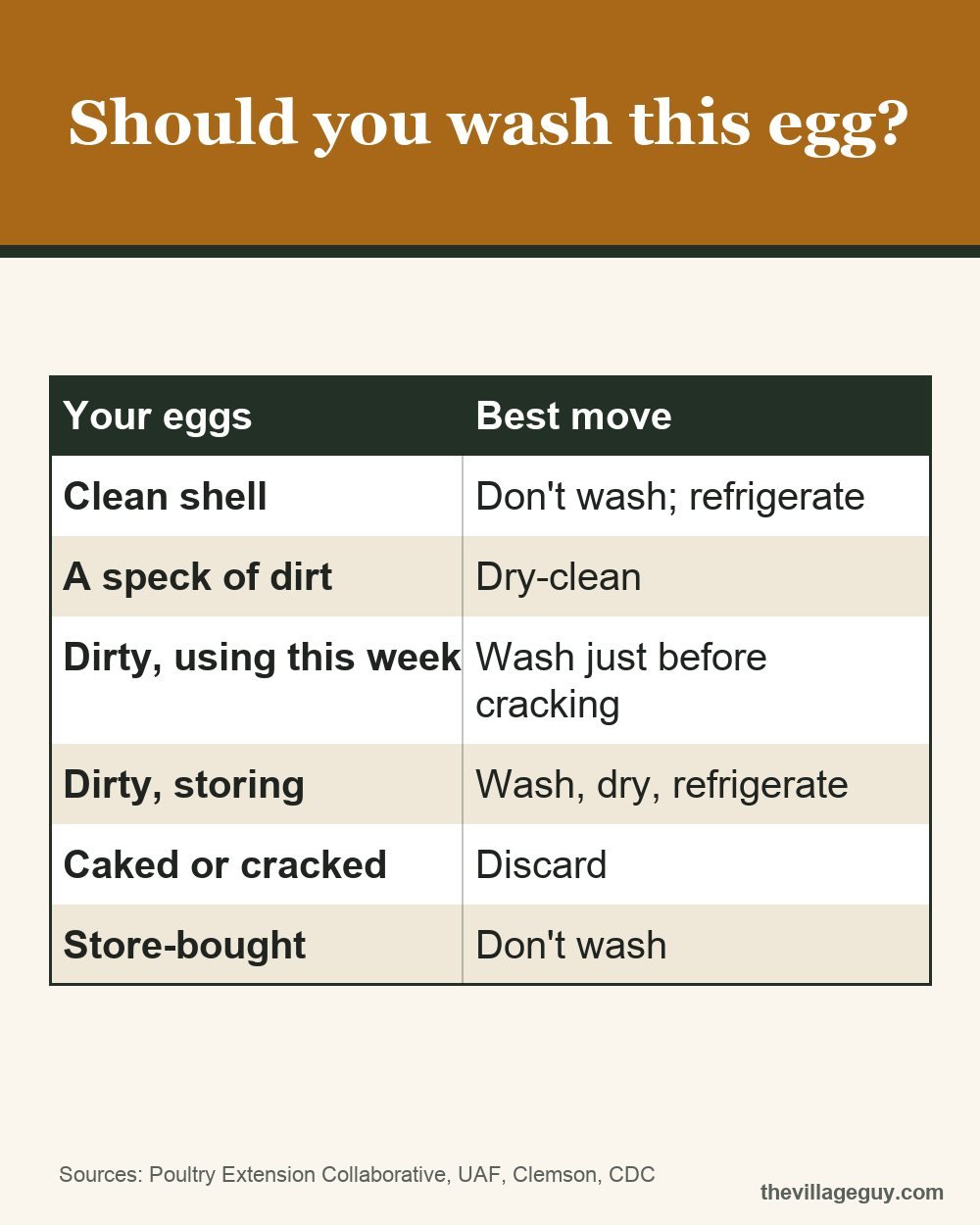
Extension specialists split on this, and the split is mostly about timing rather than whether washing is good or bad. A University of California, Davis poultry specialist writing for the multi-university Poultry Extension Collaborative says not to wash freshly laid eggs before storing them, and to wash right before use if you must. The University of Alaska Fairbanks takes the other route for small producers: wash as soon as you collect, then cool and dry quickly. Both agree on warm water, no soaking and refrigeration afterward. Match your situation to a row.
| Your eggs | Best move | Why |
|---|---|---|
| Clean shell, for your own kitchen | Do not wash. Refrigerate in a carton. | Nothing to remove, and every wash is a small risk |
| A speck or two of dirt | Dry-clean with a brush, sandpaper or paper towel | Removes debris without water at the pores |
| Dirty, and you will use them this week | Dry-clean now; wash each one just before cracking | Shortest time between washing and cooking |
| Dirty, and you need them clean in storage | Wash in warm water, dry, refrigerate at once | Washed eggs must stay cold from then on |
| Caked in droppings or mud, or cracked | Discard | More likely to be contaminated |
| Bought from a store | Do not wash | USDA-graded eggs are washed and sanitized before packing |
What washing does to the shell
An eggshell looks solid but is full of tiny pores, and a hen lays each egg with a thin protein coat called the cuticle (the “bloom”) over them. The Poultry Extension Collaborative describes the cuticle as a natural barrier against microbes, backed up by the shell, two inner membranes and antimicrobial proteins in the white. None of those defenses is foolproof, which is why both the washing method and the cold storage afterward matter.
The temperature trap
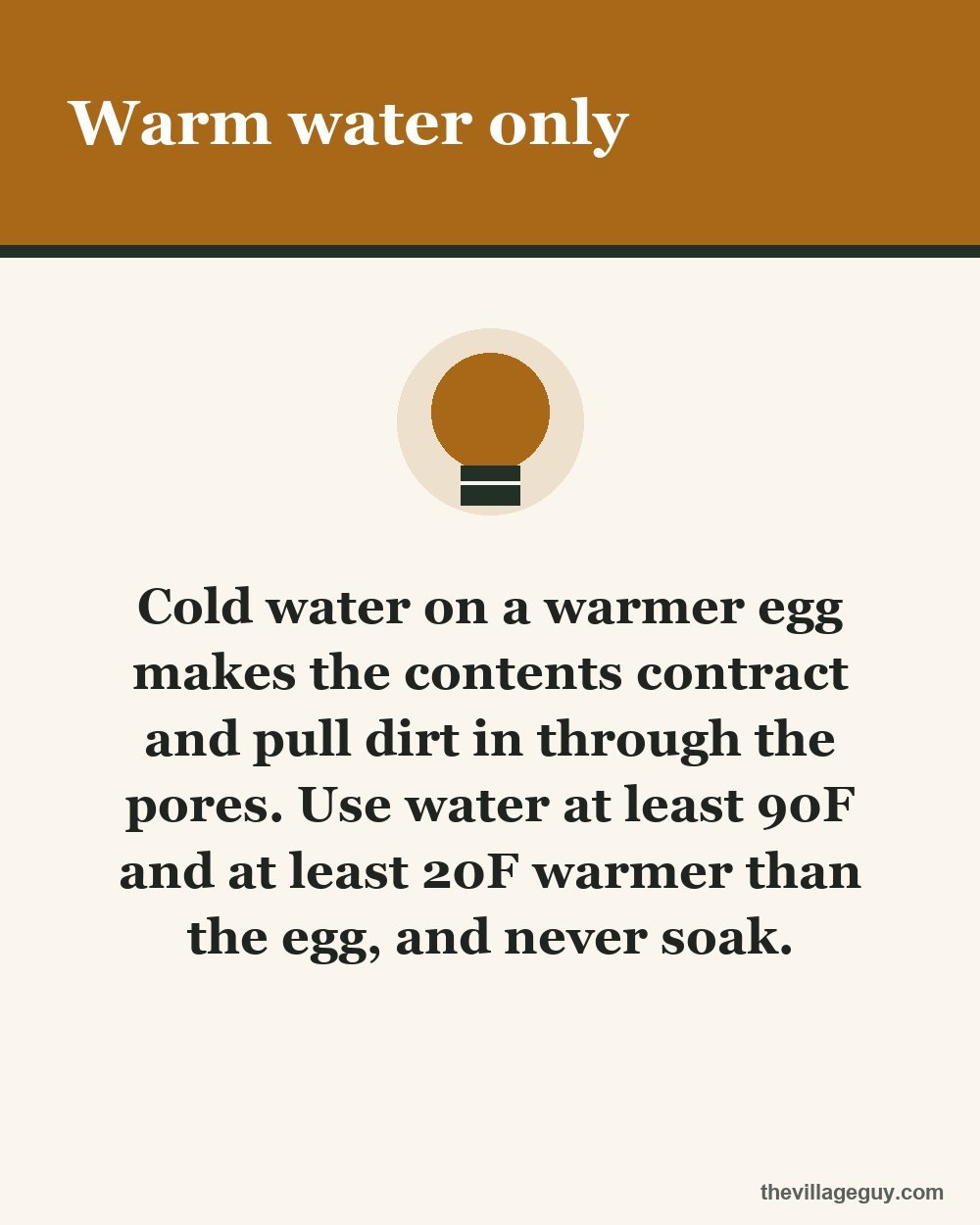
The real danger in washing is a reversed temperature gap. When cold water hits a warmer egg, the contents and membranes contract and draw liquid in through the pores, carrying whatever was on the shell with it. Keeping the water warmer than the egg prevents that suction, which is why the federal grading rule for egg plants sets wash water at 90°F or higher and at least 20°F warmer than the eggs, and why the CDC tells backyard keepers not to wash warm, fresh eggs in colder water. Ireland’s food safety authority uses the metric equivalent: at least 11°C above the egg.
Why America washes and Europe does not
US producers began washing and refrigerating eggs in the early 1970s, according to the USDA Agricultural Research Service, and Canada, Japan and the Scandinavian countries do the same. The European Union went the other way: its egg marketing rules say Class A eggs shall not be washed or cleaned, because washing can damage the cuticle and shell. Both systems work because each is consistent. US eggs lose most of their cuticle in washing and stay refrigerated for life; European eggs keep the cuticle and are often sold unrefrigerated. A backyard keeper who washes eggs and then leaves them on the counter is mixing the two systems and getting the weaknesses of both.
The science is less tidy than either camp suggests. ARS researchers note that the cuticle dries and comes off over time, and a 2024 study of commercially washed table eggs found that washing did not significantly change how many bacteria stuck to the shell. Neither finding makes careless washing safe; they simply explain why refrigeration does more of the heavy lifting than the bloom.
How to clean fresh eggs without water
Dry cleaning is the first choice in nearly every extension guide, and it handles most eggs from a well-kept nest. The CDC lists fine sandpaper, a brush or a cloth; Clemson Extension suggests fine sandpaper or a soft scrub brush; the Poultry Extension Collaborative suggests a clean paper towel or a stiff toothbrush kept only for eggs. Arizona Cooperative Extension draws the line clearly: if a dry brush cannot remove the debris, the egg should be discarded rather than scrubbed into submission.
Dry-cleaning kit
- Keep a fine-grit sanding sponge or sandpaper block just for eggs.
- Keep a stiff toothbrush or vegetable brush labeled for eggs only.
- Stack clean paper towels by the egg basket.
- Work over the trash can or a sheet of newspaper, not the kitchen counter.
- Rub gently in small circles and stop as soon as the spot lifts.
- Wash your hands with soap and water when you finish.
Treat the sanding tool like a cutting board for raw chicken: it lives with the eggs, gets cleaned or replaced often and never touches food directly.
How to wash fresh eggs in 7 steps
When dry cleaning is not enough, this sequence follows the steps that Clemson Extension and the University of Alaska Fairbanks give small flock owners, scaled down to a kitchen sink.
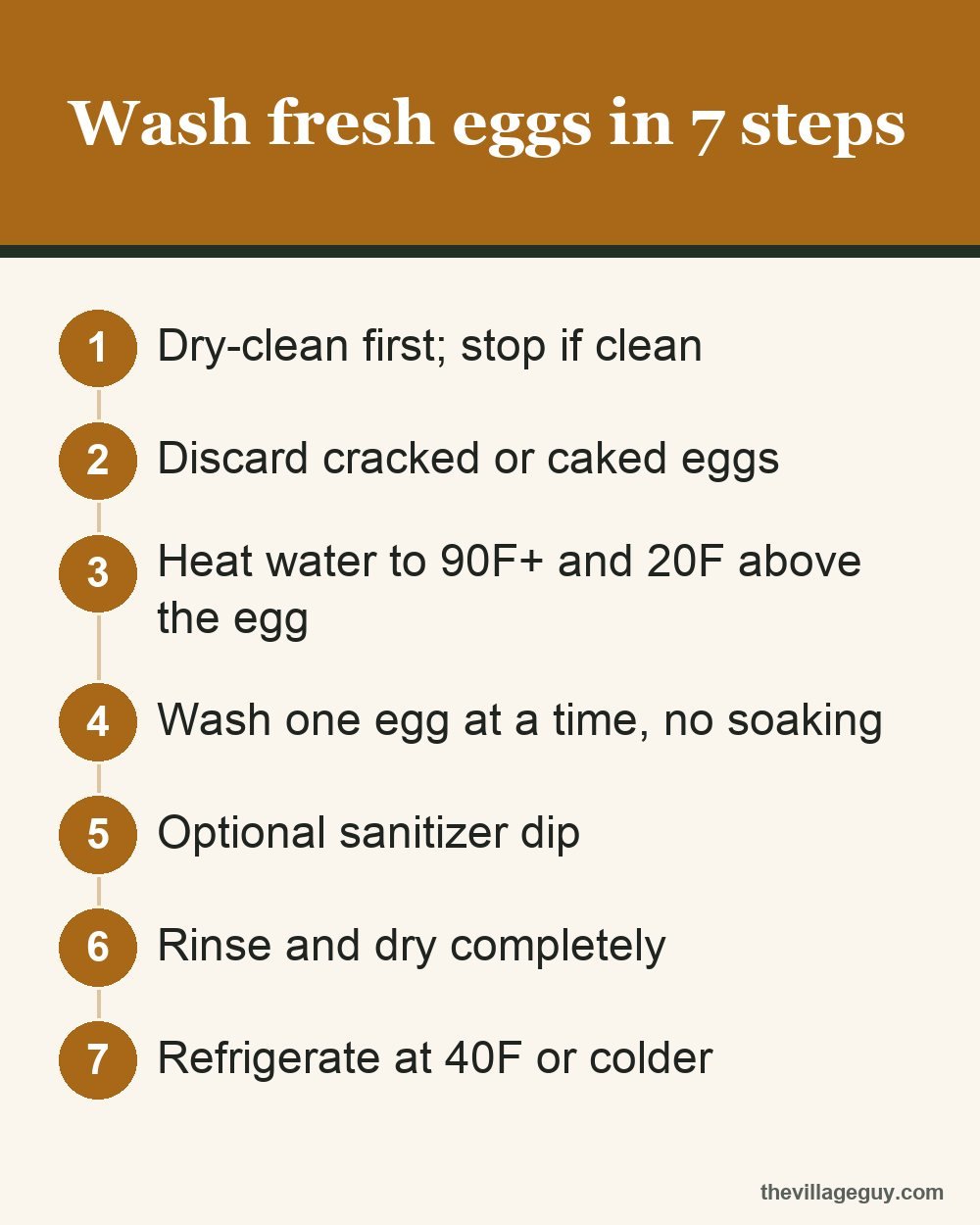
- Dry-clean first. Brush or sand off loose material. If the egg is now clean, skip to step 7.
- Sort out the rejects. Set aside any egg that is cracked, leaking or caked in droppings and discard it.
- Set the water temperature. Heat water to at least 90°F and at least 20°F warmer than the eggs, and check it with a kitchen thermometer (the next section has the numbers).
- Wash one egg at a time. Rinse under warm running water or wipe with a cloth dipped in warm water and a little mild, unscented dish detergent. Do not leave eggs sitting in a bowl.
- Sanitize if you choose to. Clemson and UAF both suggest a quick dip in 1 tablespoon of unscented household bleach per gallon of warm water.
- Rinse and dry completely. A final warm rinse, then pat dry with a clean towel or let the eggs air-dry on a rack.
- Refrigerate right away. Pack them into a clean carton and put them on an inside shelf of a fridge at 40°F or colder.
Wash water temperature, worked out
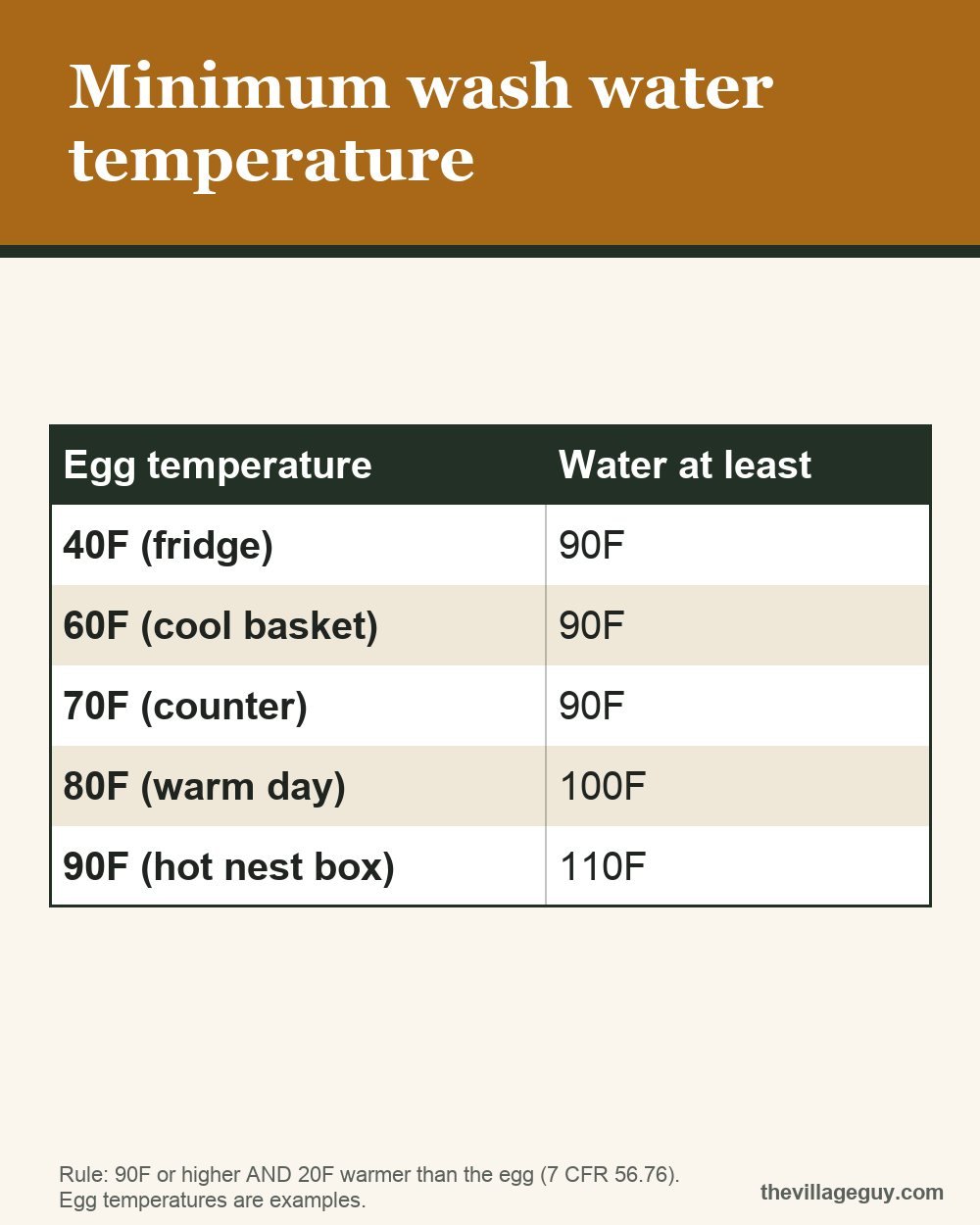
The federal rule for egg-grading plants gives two numbers, and you need whichever is higher: the water must be at least 90°F, and it must be at least 20°F warmer than the inside of the egg. This explains why washing straight from the fridge is so easy, and washing straight from a sun-baked nest box is not.
| Where the eggs have been | Rough egg temperature | Minimum water temperature |
|---|---|---|
| Refrigerator | 40°F | 90°F (the floor applies) |
| Cool porch or basket on a fall morning | 55 to 60°F | 90°F |
| Kitchen counter for a while | 70°F | 90°F |
| Basket on a warm afternoon | 80°F | 100°F |
| Nest box on a hot day | 90°F | 110°F |
The egg temperatures above are rough examples; the rule itself is fixed. If you are unsure how warm the eggs are, err hotter within what your hands can comfortably stand, and keep the contact brief. This arithmetic is one more reason the Poultry Extension Collaborative’s approach (dry-clean, refrigerate, wash right before use) is the easiest for most households: eggs come out of the fridge at about 40°F, so any water at 90°F or above satisfies both numbers.
Soap, sanitizer and what to skip
Commercial plants must use approved cleaning compounds and a sanitizing rinse of 100 to 200 parts per million of available chlorine, under 7 CFR 56.76. At home, Clemson Extension’s version is a mild, unscented, non-foaming dish detergent in clean drinking water, followed by a sanitizer dip of 1 tablespoon of unscented household bleach per gallon. UAF adds that extremely dirty eggs call for a mild detergent approved for washing eggs.
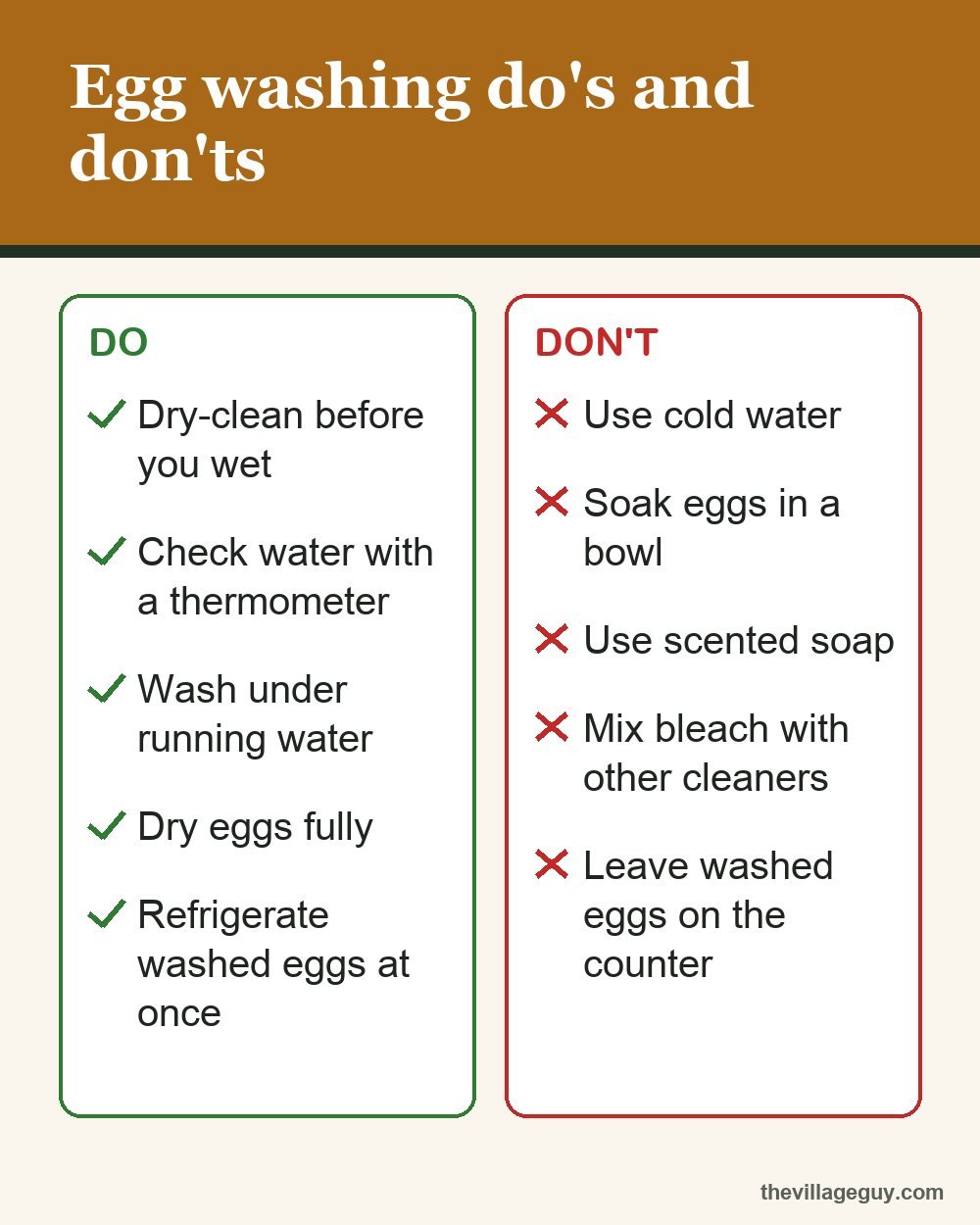
The things to skip matter as much. The University of Alaska Fairbanks says never let eggs soak, because even one to three minutes in water can let bacteria in. The federal rule for plants bans standing or soaking eggs outright and requires wash water to be changed at least every 4 hours; the home version is simply fresh water for every batch. Clemson specifies unscented products for both the detergent and the bleach, so leave the scented dish soap by the sink.
Safety: Never mix bleach with ammonia, vinegar or other cleaners; the CDC warns the combination produces toxic fumes. Use plain, unscented household bleach, measure it, and mix the sanitizer in a well-ventilated spot.
After washing: dry, chill, label
A washed egg has made a one-way trip into the cold chain. Store it dry, in a clean carton, on an inside shelf of a fridge at 40°F or colder (the FDA’s number for home storage), and do not take it back out to sit on the counter. The UC Davis specialist points out that eggs that warm up develop condensation, which can help microbes enter; Iowa State Extension says refrigerated eggs should not be left out for more than 2 hours.
Label each carton with the collection date. Clemson Extension suggests using backyard eggs within 45 days of collection for best quality, and writing the date down is the only way that number means anything. If an egg cracks during washing, treat it as a cracked egg (the rules are in our guide to telling if eggs are bad).
- Collected 11/19, washed, refrigerated. Use by 1/3.
- Collected 11/19, unwashed, dry-cleaned. Keep refrigerated.
Selling eggs: whose rules apply
Once eggs leave your kitchen for a farm stand or a neighbor’s fridge, washing stops being a personal choice. FDA’s egg safety rule, which includes a 45°F refrigeration requirement, applies to farms with 3,000 or more laying hens; USDA’s temperature and labeling rules for producer-packers exempt flocks of 3,000 or fewer. That does not leave small sellers unregulated: states set their own rules for small-flock egg sales, and they vary widely on cleaning, candling, labeling, carton reuse and refrigeration. Before selling a single dozen, call your state department of agriculture or county extension office and ask what applies to you.
The BC Egg video below shows what a commercial grading station does to every egg (washing, candling and grading), which is a useful benchmark for what customers assume has happened to theirs.
Fewer dirty eggs to begin with
The best egg wash is the one you never need. Most dirty eggs trace back to the nest box, the collection routine or a muddy run, and Clemson Extension notes that eggs leave the hen by the same route as droppings, so a clean environment is half the battle. Thin or cracked shells also invite trouble, and a calcium shortfall in the diet is a common cause (see our guide to what chickens eat).
- Provide at least one nest box per five hens, and no fewer than two boxes, as University of Kentucky specialists recommend.
- Size boxes about 12 by 12 by 12 inches and keep them fairly dark.
- Line nests with clean, dry bedding and keep it topped up.
- Collect eggs at least twice a day, and three times in very hot or very cold weather.
- Wash the collection basket between uses.
- Replace wet coop litter promptly, especially in a muddy winter.
Dry, deep bedding pays off twice in winter: cleaner eggs and warmer birds, as covered in our guide to keeping chickens warm in winter. More flock and kitchen guides are collected in the Village Guy guides index.
Egg washing FAQ
Should you wash store-bought eggs?
No. USDA-graded eggs are washed and sanitized at the packing plant before they reach the carton. USDA researchers advise against washing eggs at home because wash water can be drawn into the egg through the pores, and extra handling raises the chance of cross-contamination in your kitchen.
Do washed eggs need to be refrigerated?
Yes. Washing removes most of the cuticle, so a washed egg should go straight into a fridge at 40°F or colder and stay there. US egg safety advice is built on that cold chain, and moving washed eggs back and forth between fridge and counter invites condensation on the shell.
Is it OK to wash eggs right before using them?
Yes, and for home kitchens it is often the simplest approach. The Poultry Extension Collaborative recommends it for dirty eggs because it shortens the time in which any microbes on a damp shell can grow. Use water at 90°F or warmer, rinse briefly and crack the egg into a separate bowl.
Why are my fresh eggs so dirty?
The usual culprits are too few nest boxes, thin or wet nest bedding, muddy feet from the run and eggs left in the nest too long, where they get stepped on or broken. Eggs that break in the nest also smear the rest of the clutch, which is one more reason to collect at least twice a day.
Sources
- Poultry Extension Collaborative (Dr. Richard Blatchford, UC Davis), Proper Handling for Safe Eggs, Dec. 2023, via UC ANR (cuticle and shell defenses, do not wash before storing, wash right before use, no soaking, dry cleaning, condensation, cold water suction)
- 7 CFR 56.76 (Cornell LII): Minimum facility and operating requirements for shell egg grading and packing plants (90°F and 20°F rule, no soaking, 4-hour water changes, 100 to 200 ppm chlorine rinse, eggs dry before packing)
- CDC: Backyard Poultry (fine sandpaper, brush or cloth; colder water pulls bacteria into warm eggs; refrigerate after collection)
- Clemson Cooperative Extension HGIC: Backyard Chickens and Their Eggs (20°F warmer water, mild unscented detergent, 1 tablespoon bleach per gallon, use within 45 days, collect twice daily)
- University of Alaska Fairbanks Cooperative Extension: Safe Egg Handling for Small Egg-Laying Flocks and Operations (wash at 90°F or above, never soak, sanitizer, 45°F storage)
- University of Arizona Cooperative Extension: Egg Safety for Backyard Chicken Owners (2025) (avoid washing, discard eggs a dry brush cannot clean)
- USDA Agricultural Research Service: How We Store Our Eggs, and Why (washing and refrigeration since the early 1970s, other countries, cuticle dries and comes off)
- USDA Agricultural Research Service: How We Store Our Eggs, Bonus Content (home washing may draw water in through the pores)
- Commission Regulation (EC) No 589/2008, Article 2 (Class A eggs shall not be washed or cleaned)
- Food Safety Authority of Ireland: Egg Washing (water at least 11°C above the egg, soaking risk)
- Effect of Egg Washing and Hen Age on Cuticle Quality and Bacterial Adherence in Table Eggs (Microorganisms, 2024) (washing did not significantly change bacterial adherence)
- FDA: Small Entity Compliance Guide for the Egg Safety Rule (rule covers farms with 3,000 or more laying hens; 45°F refrigeration)
- 9 CFR 590.50 (Cornell LII): Egg temperature and labeling requirements (producer-packers with 3,000 or fewer layers exempt)
- University of Kentucky Extension (ASC-241): Urban Poultry (nest box size, one box per five hens, minimum two, nest bedding)
- Iowa State University Extension AnswerLine: Egg Safety Q&As (refrigerated eggs out no more than 2 hours)
- CDC: Mold Clean Up Guidelines (never mix bleach with ammonia or other cleaners)