The best firewood to burn is dense, dry hardwood: oak, hickory, black locust, beech, sugar maple and ash top nearly every university heat table, because a heavy cord simply holds more fuel than a light one. Dryness matters even more than species, though, and a cord of perfectly seasoned pine will outperform a cord of soggy oak every time.
This guide ranks common species by heat, then sorts them by job: long overnight burns, quick shoulder-season fires, kindling, open fireplaces and fire pits. It also shows how to work out whether cheap wood is actually a bargain, and which materials never belong in a stove at all.
Quick answer: For heating, the best firewood to burn is seasoned dense hardwood such as hickory, oak, black locust, beech, sugar maple and white ash, which deliver roughly 24 to 30 million Btu per cord in university extension tables. Lighter woods like pine, basswood and willow give about half to two thirds as much. Whatever the species, burn it below 20 percent moisture.
In this guide
The best firewood to burn, ranked by heat
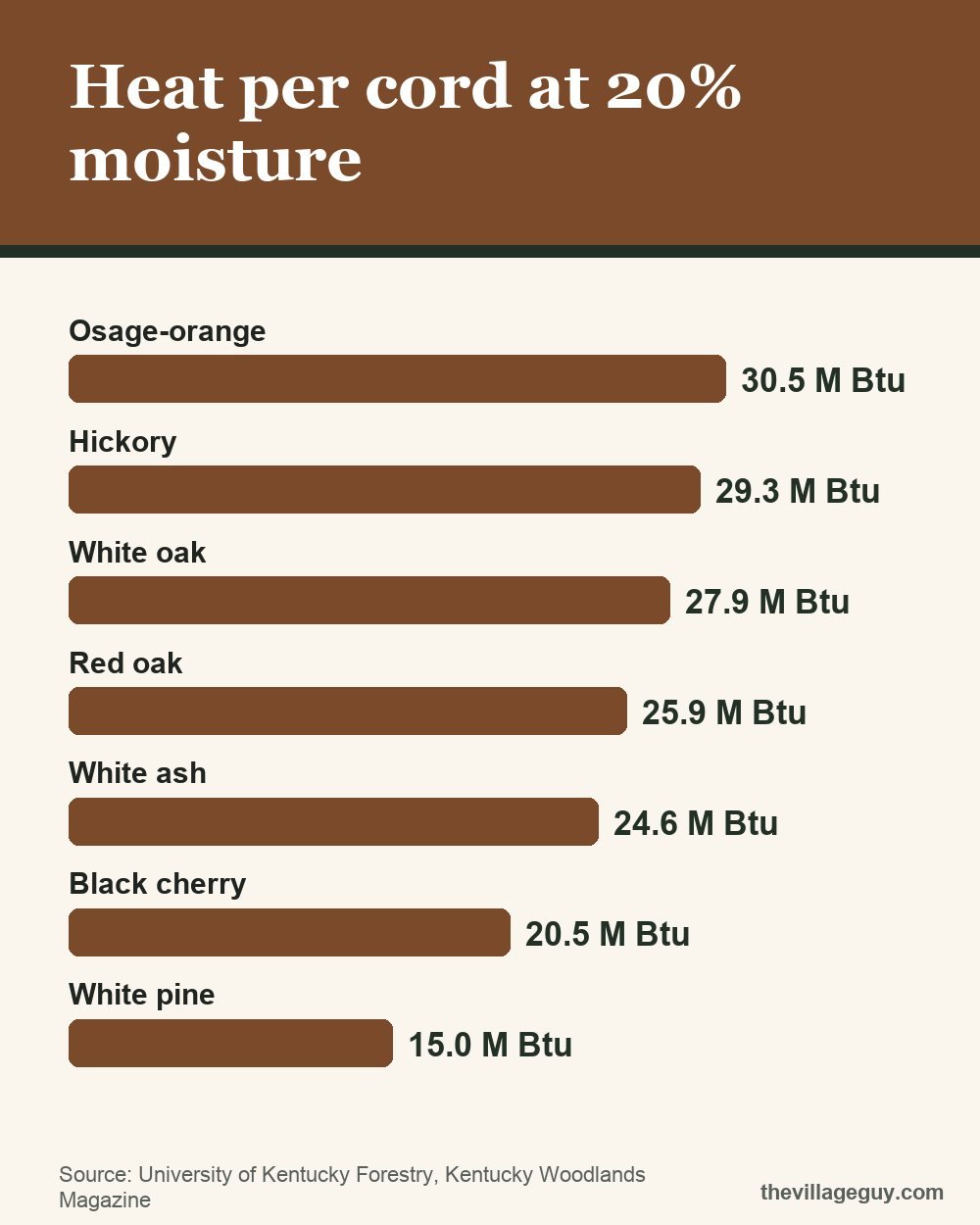
Heat per cord is the number that matters for anyone heating a house, and two extension tables make a useful cross-check. The University of Kentucky’s forestry department ranks species at 20 percent moisture content, and Utah State University Extension publishes its own figures along with splitting, spark and coal ratings. Their numbers are close for most species but not identical, which is normal: different labs, different wood samples and different assumptions.
| Species | Million Btu per cord (Kentucky, 20% moisture) | Million Btu per cord (Utah State) | Splitting (Kentucky / Utah State) | Sparks (Utah State) |
|---|---|---|---|---|
| Osage-orange | 30.5 | 32.9 | Fair / Easy | Many |
| Hickory | 29.3 | Not listed | Good / not listed | Not listed |
| Black locust | 28.3 | 27.9 | Good / Difficult | Few |
| White oak | 27.9 | 29.1 | Good / Medium | Few |
| Beech | 26.3 | 27.5 | Good / Difficult | Few |
| Sugar maple | 25.9 | 25.5 (hard maples) | Good / Easy | Few |
| Red oak | 25.9 | 24.6 | Fair / Medium | Few |
| White ash | 24.6 | 24.2 | Excellent / Medium | Few |
| Black walnut | 22.6 | 22.2 | Excellent / Easy | Few |
| Hackberry | 21.7 | 21.2 | Good / Easy | Few |
| Black cherry | 20.5 | 20.4 | Good / Easy | Few |
| American elm | 20.5 | 20.0 | Poor / Difficult | Few |
| Sycamore | 20.2 | 19.5 | Poor / Difficult | Few |
| Silver maple | 19.3 | 19.0 | Good / Medium | Few |
| Hemlock | 17.3 | 19.3 | Excellent / Easy | Many |
| Basswood | 15.2 | 13.8 | Excellent / Easy | Few |
| White pine | 15.0 | 15.9 | Good / Easy | Moderate |
| Eastern redcedar | 20.2 | 13.0 | Fair / Easy | Many |
Two things jump out. First, the gap between top and bottom is large: a cord of Osage-orange or hickory holds about twice the heat of a cord of basswood or white pine, so you split, stack and carry half as much wood for the same warmth. Second, the sources disagree in places (black locust’s splitting, eastern redcedar’s heat), so treat any single figure as approximate rather than gospel.
Why heavy wood wins
Pound for pound, dry wood from almost any tree holds a similar amount of energy. You can see it in Utah State’s own table: divide each species’ heat per cord by its dry weight per cord and most land close to 7,000 Btu per pound, from white oak (4,200 pounds, 29.1 million Btu) to basswood (1,984 pounds, 13.8 million Btu). The difference between species is how many pounds of wood fit into a cord.
That is why the hardwood and softwood labels mislead. The University of Kentucky’s firewood fact sheet tells buyers not to pay attention to those labels at all, because some hardwoods are dense (hickory) and others are light, and the same goes for softwoods. Utah State’s figures make the point: pinyon, a softwood, rates 27.1 million Btu per cord, above red oak, while basswood, a hardwood, sits near the bottom.
Tip: Heft a dry split in each hand. With seasoned wood, the heavier species almost always gives more heat per armload. With unseasoned wood the test fails, because water adds weight without adding heat.
Moisture is the great equalizer. West Virginia University Extension notes that evaporating the water in green wood can steal up to 15 percent of its potential heat, and the University of Maryland found that dense species such as hickory and black locust can take more than a year to dry. A top-ranked species is only top-ranked once it is dry; our firewood seasoning guide covers how long each type needs.
Best wood for a wood stove, fireplace or fire pit
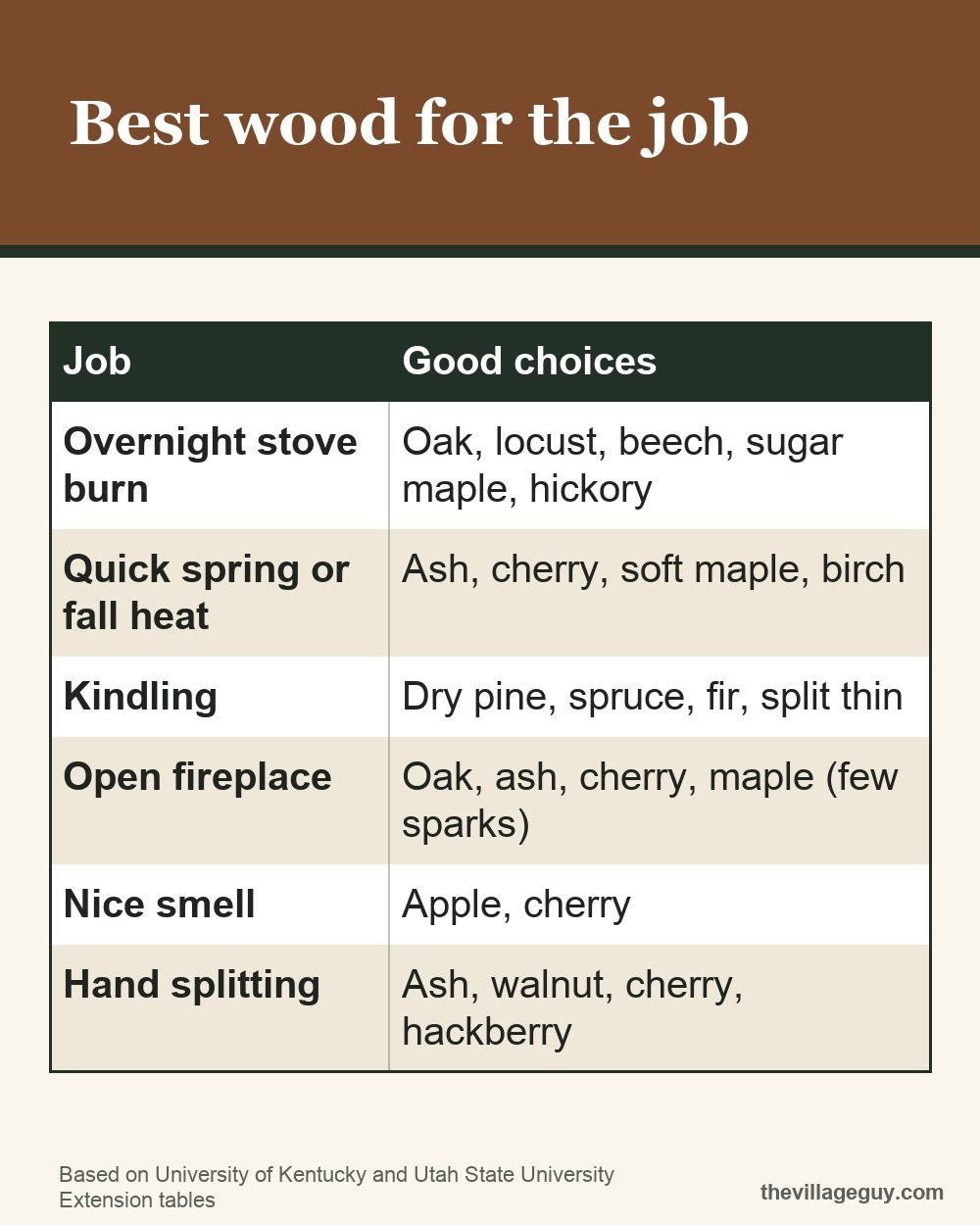
The best wood for wood stove heating is not always the best wood for an open fireplace or a backyard fire pit. Stoves reward dense wood that makes long-lasting coals; open fires reward wood that does not throw sparks onto the rug or the neighbor’s lawn. Utah State’s ratings for sparks, coals and fragrance, combined with Kentucky’s heat values, sort the common species by job.
| Job | Good choices | Why |
|---|---|---|
| Long overnight burns in a stove | Oak, black locust, beech, sugar maple, hickory | Highest heat per cord; Utah State rates oak, locust, beech and maple coals as excellent |
| Quick heat on cool fall and spring days | Ash, black cherry, soft maple, birch | Moderate heat, few sparks; good for short fires you do not want roaring all night |
| Kindling | Dry pine, spruce, fir, cedar split thin | Easy to split into thin sticks; burns fast, so it is ideal for getting a fire going |
| Open fireplace or fire pit near people | Oak, ash, cherry, maple, hackberry | Utah State rates their sparks as few |
| Nice smell | Apple, cherry | Utah State rates their fragrance excellent, with low smoke and few sparks |
| Splitting by hand | Ash, black walnut, black cherry, hackberry | Rated easy or excellent to split; elm and sycamore rate poor or difficult in both tables |
Utah State points out that woods which spark or pop can throw embers out of an open fireplace and cause a fire, and that conifers do this more because of their resin. Its table also flags a few dense hardwoods, including Osage-orange and mulberry, as heavy sparkers, which is worth knowing before you build a fire pit fire next to a hay barn.
A simple stove rotation built from the table:
- Keep a bin of thin, dry softwood kindling next to the stove for every lighting.
- Use medium splits of ash, cherry or soft maple to bring a cold stove up to temperature.
- Save the densest oak, hickory or locust for the evening load and the coldest nights.
- Burn lighter woods on mild days so the stove runs hot and clean instead of smoldering.
- Keep the stove door closed when burning pine, spruce, hemlock, cedar or Osage-orange.
- Use a spark screen and keep a clear zone around any fire pit, whatever the species.
Where pine, spruce and fir fit
Softwoods have a reputation problem that is only partly deserved. Their heat per cord is lower (white pine rates about 15 million Btu in both tables), and Utah State notes they tend to spark more because of their resin. In a closed stove, though, sparking matters far less than in an open fireplace.
The bigger creosote risk comes from how wood is burned. Illinois Extension says creosote is highly flammable and recommends seasoned wood and hot fires rather than long, slow burns to reduce it, and West Virginia University Extension links green wood to creosote buildup. Dry softwood burned hot makes excellent kindling and shoulder-season fuel; wet wood of any species smoldered overnight is what clogs chimneys.
A Utah State Extension article also notes that construction scraps (usually softwood) are fine to burn if they have not been treated or painted. Anything painted, stained, pressure-treated or glued is not, as the section on what never to burn explains.
Western firewood species
Most heat tables are built around eastern hardwoods, which is little help in Montana or New Mexico. Utah State’s table covers the species western wood burners actually cut.
| Western species | Million Btu per cord (Utah State) | Sparks | Coals |
|---|---|---|---|
| Gambel oak | 30.7 | Not rated | Not rated |
| Pinyon | 27.1 | Many | Not rated |
| Rocky Mountain juniper | 21.8 | Many | Poor |
| Larch (tamarack) | 21.8 | Many | Fair |
| Lodgepole pine | 21.1 | Many | Fair |
| Douglas-fir | 20.7 | Few | Fair |
| Quaking aspen | 18.2 | Few | Good |
| Ponderosa pine | 16.2 | Many | Fair |
| Cottonwood | 15.8 | Few | Good |
| White fir | 14.6 | Few | Poor |
A Utah State Extension article adds that Gambel (scrub) oak and bigtooth maple produce the least smoke and burn the hottest of the local options.
Is cheap wood a bargain? Price per million Btu
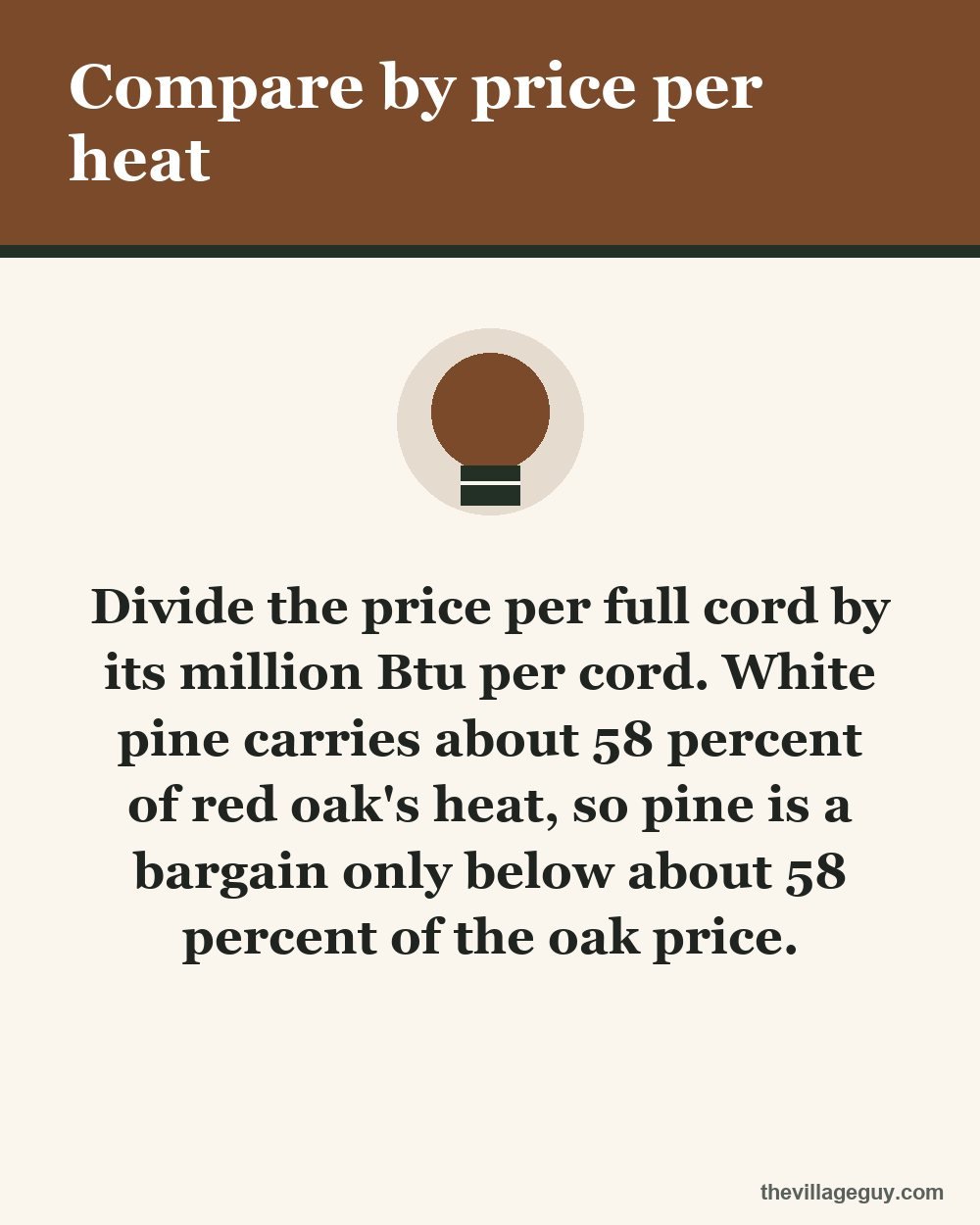
A cheaper cord of light wood can cost more per unit of heat than a pricier cord of oak. Divide the price per cord by the million Btu per cord and you get a number you can compare across species, and even against other fuels.
The formula: price per million Btu = price per full cord / million Btu per cord.
| Example cord | Heat (Kentucky) | Cost per million Btu |
|---|---|---|
| Red oak at $350 | 25.9 | $13.51 |
| White pine at $250 | 15.0 | $16.67 |
| White pine at $200 | 15.0 | $13.33 |
| Mixed hardwood at $300, assume 22 | 22 (assumed) | $13.64 |
The prices above are illustrations, not quotes; prices vary widely by region and season. The useful takeaway is the break-even ratio: white pine holds about 58 percent of red oak’s heat per cord (15.0 / 25.9), so pine is only a bargain if it costs less than about 58 percent of the oak price. Stove efficiency is the same for both, so it cancels out of the comparison.
For current price references and how to convert face-cord quotes into full-cord prices, see what a cord of wood costs and holds.
What never to burn
The best firewood is natural, untreated, dry wood. EPA’s Burn Wise guidance (now an archived program, but still the clearest federal list) names materials that release toxic chemicals or damage appliances, and the CDC adds one that country people meet more often than they would like.
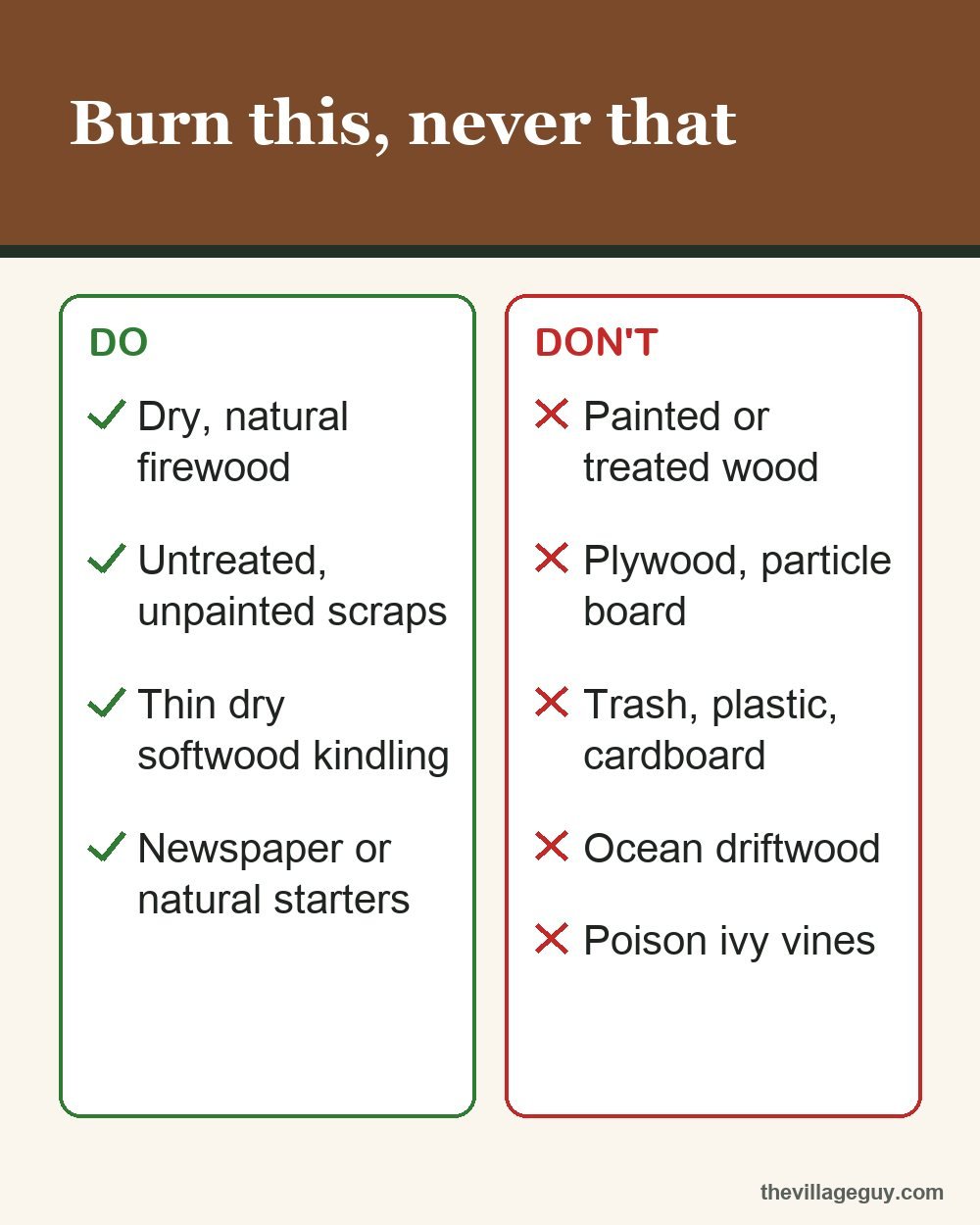
- Household trash: cardboard, plastics, foam, and the colored inks on magazines, boxes and wrappers.
- Treated wood: coated, painted and pressure-treated wood.
- Glued wood and salt wood: plywood, particle board, any wood with glue on or in it, and ocean driftwood.
- Bad wood: wet, rotted, diseased or moldy wood.
- Everything else on EPA’s list: plastic, asbestos, rubber, manure and animal remains.
- Poison ivy, oak and sumac: the CDC’s NIOSH says not to burn these plants, because inhaling the smoke can cause severe allergic respiratory problems. Check vine-covered logs before they go on the pile.
Safety: Never start or revive a fire with gasoline, kerosene or charcoal starter, which EPA warns against. Burning trash or treated wood can damage your stove and chimney as well as your lungs. Keep working smoke and carbon monoxide alarms, have the chimney inspected and swept as needed, and follow your stove manufacturer’s instructions and local codes, including any burn bans.
Buying firewood by species
Most sellers sell “mixed hardwood,” which can mean anything from mostly oak to mostly soft maple and poplar. You are allowed to ask. NIST Handbook 130, the model weights and measures rulebook, says that when a seller declares the species mix (for example 50 percent hickory and 50 percent softwood), the percentages should be accurate within 10 percent, and that the receipt should describe the wood, including any quality claims.
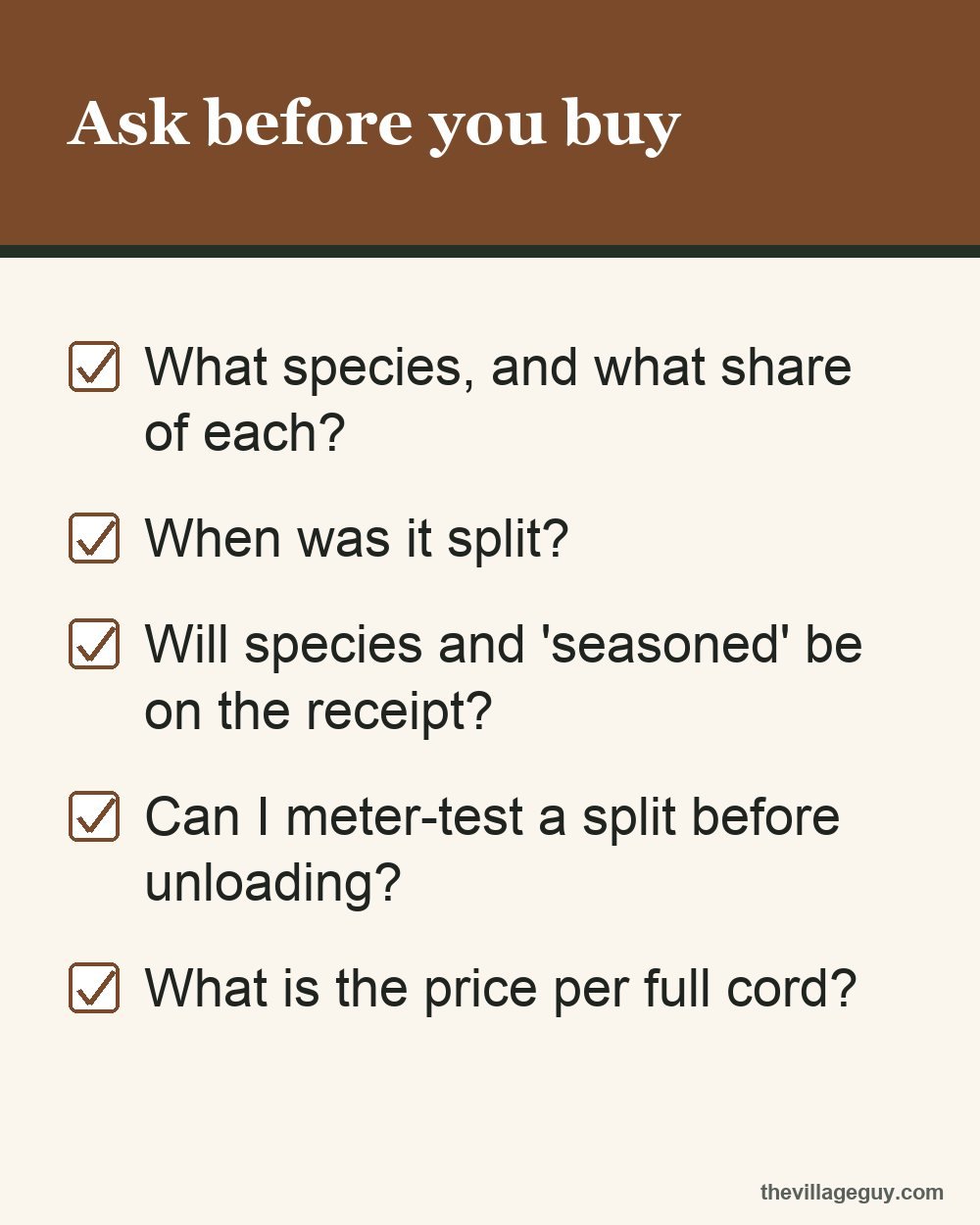
- Ask what species make up the load and roughly in what share.
- Ask for any species or “seasoned” claim to be written on the receipt.
- Ask when the wood was split, since dense species need the longest drying.
- Split a sample piece and test it with a moisture meter before unloading.
- Compare quotes by price per million Btu, not just price per cord.
- Buy wood cut close to home; extension foresters warn that moving firewood spreads emerald ash borer and other pests.
Copy one of these into a text to a supplier:
- What species are in your mixed hardwood right now, and roughly what share is oak, hickory or maple?
- Do you have a load that is mostly dense hardwood for overnight burning, and what is the price per full cord?
- When was this wood split, and can you put the species and “seasoned” on the receipt?
For more wood heat, homestead and garden guides, visit The Village Guy guides.
Best Firewood FAQ
What is the hottest burning firewood?
Among common North American species, Osage-orange tops both the Kentucky (30.5 million Btu per cord) and Utah State (32.9) tables, with hickory, black locust and white oak close behind. In the West, Utah State lists Gambel oak at 30.7. Osage-orange also throws a lot of sparks, so it is better suited to a closed stove than an open fireplace.
Is pine bad to burn in a wood stove?
Dry pine is fine in a wood stove; it just carries less heat per cord and sparks more, so it suits kindling and mild days. The real chimney risk is wet wood and cool, smoldering fires of any species, which build creosote. Burn pine dry and hot, and keep the stove door closed.
What firewood burns the longest?
Dense hardwoods with good coals burn longest per load: Utah State rates the coals of oaks, black locust, beech, honeylocust and the maples as excellent. A full firebox of dry oak or locust, loaded per your stove manual, will hold heat far longer than the same volume of pine or poplar.
What firewood smells the best?
Utah State rates apple and cherry as having excellent fragrance, along with low smoke and few sparks, which makes them pleasant in a fireplace. Juniper and western redcedar also smell excellent but throw many sparks, so keep them in a closed stove or a well-screened fire.
Sources
- Kentucky Woodlands Magazine (University of Kentucky Forestry): Firewood and Fine Wines, Comparison of Properties Affecting Firewood (heat per cord at 20 percent moisture, splitting ratings)
- Utah State University Extension: Wood Heating (heat and weight per cord, splitting, smoke, sparks, coals, fragrance, resin)
- Utah State University Extension: The Best Wood for Burning (2014) (Gambel oak and bigtooth maple, construction scraps, annual sweeping)
- University of Kentucky Extension: Firewood (FORFS 17-11) (ignore hardwood and softwood labels; density matters)
- WVU Extension: Heating with Firewood (heat lost to moisture, creosote, buy local)
- University of Maryland Extension: Measuring Wood Moisture and Drying Time (FS-1074) (dense species dry slowly)
- Illinois Extension: Burning Safety (creosote, seasoned wood, hot fires)
- EPA Burn Wise: Best Wood-Burning Practices (materials never to burn, no gasoline or kerosene, under 20 percent moisture)
- CDC NIOSH: Poisonous Plants (do not burn poison ivy, oak or sumac)
- NIST: Handbook 130 (2026), section 2.4 (species declarations within 10 percent, receipt contents)
- EPA: Burn Wise Best Practices Videos (video listings and descriptions)