Eggs are one of the few fresh foods that come with a built-in wrapper, and that wrapper buys more time than most people expect. How long do fresh eggs last? In a refrigerator at 40°F (4°C), the USDA puts raw eggs in the shell at 3 to 5 weeks after you buy them, and eggs from your own hens, which start their clock the morning they are laid, can keep good quality for longer. On a warm counter the story changes fast. This guide pulls together the whole fresh-egg chain (collecting, washing or not, refrigerating, storing and checking) with the official timelines and the places where farm habits part ways with them.
Quick answer: Refrigerated at 40°F or colder, store-bought eggs keep 3 to 5 weeks after purchase (USDA), and backyard eggs are best used within about 45 days of collection (Clemson Extension), though USDA lab tests found refrigerated eggs, washed or unwashed, still Grade A after 15 weeks. At room temperature, unwashed eggs lose quality within about a week, and US food safety agencies recommend refrigerating all eggs.
In this guide
- How long do fresh eggs last: the timeline table
- Day one: collecting eggs so they keep
- Washed or unwashed: the storage consequences
- Do fresh eggs need to be refrigerated?
- How long do unwashed eggs last?
- How to store fresh eggs in the fridge
- Freezing and other long-term storage
- Checking an egg before you use it
- Copy-ready egg storage checklists
- Fresh egg storage FAQ
How long do fresh eggs last: the timeline table
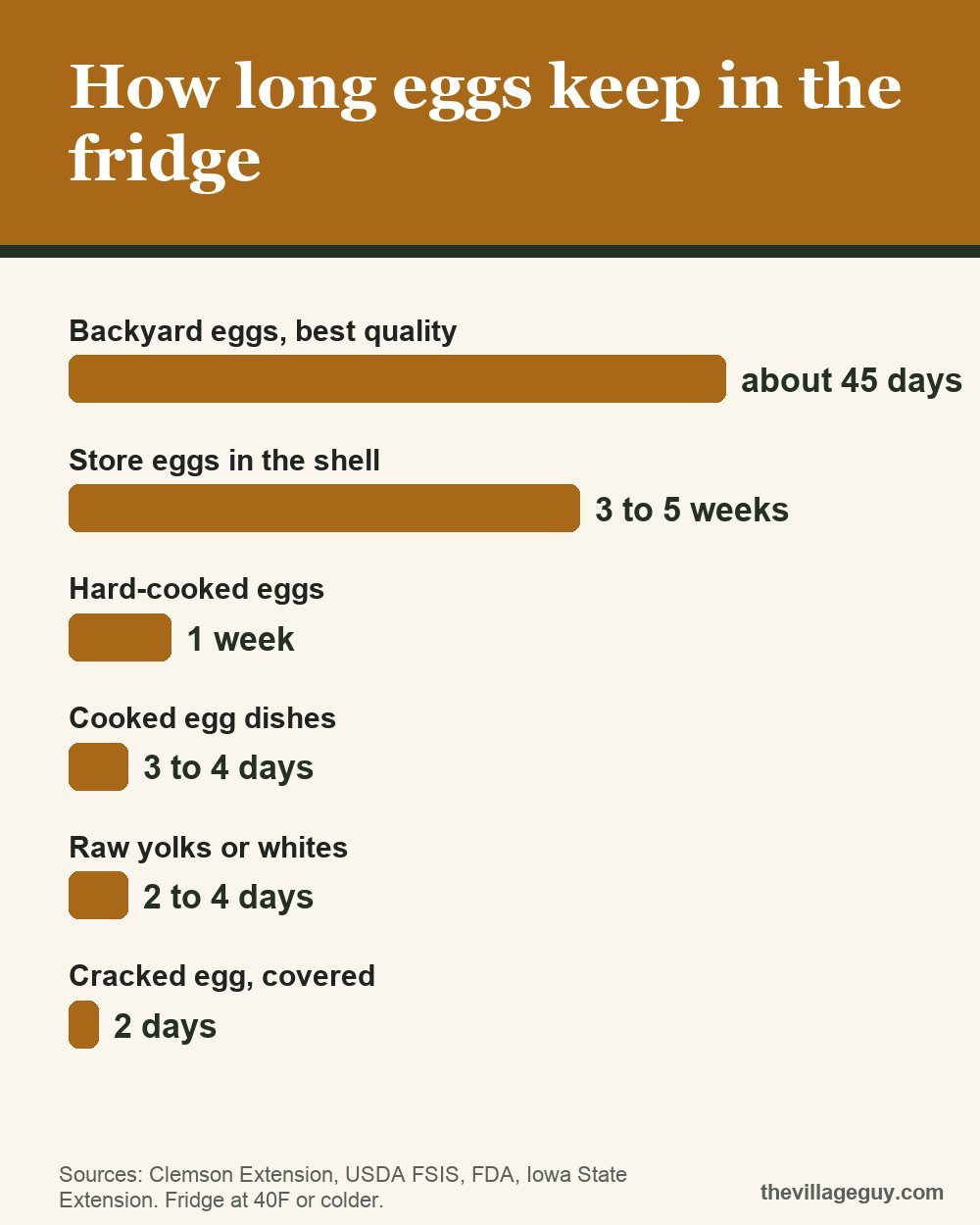
Most egg storage questions are really one of the rows below. The times assume eggs that went into the cold promptly and stayed there; an egg that spent an afternoon in a hot truck has already spent some of its allowance.
| The egg | Where | How long | Source |
|---|---|---|---|
| Store-bought, in the shell | Fridge, 40°F or colder | 3 to 5 weeks after purchase | USDA FSIS |
| Store-bought, counted from the pack date | Fridge | About 4 to 5 weeks after packing without significant quality loss | American Egg Board |
| Backyard eggs, washed or unwashed | Fridge | Best quality within about 45 days of collection | Clemson Extension |
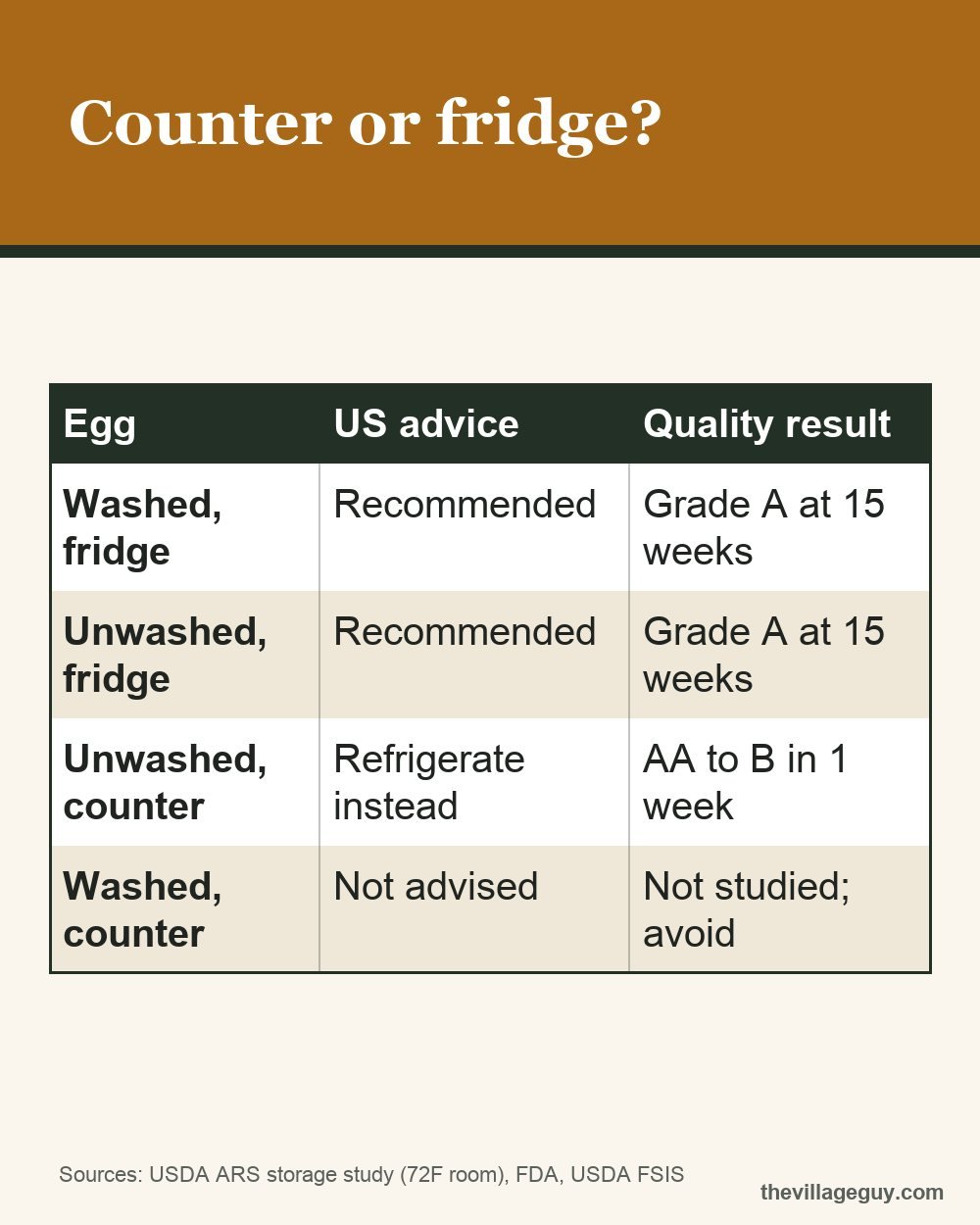
| Unwashed eggs, in the shell | Counter, about 72°F | Peak quality for about a week; dropped from Grade AA to B in one week in USDA tests | Poultry Extension Collaborative; USDA ARS |
| Washed eggs, in the shell | Counter | Not recommended; refrigerate, and do not leave out more than 2 hours | FDA, USDA |
| Cracked egg, out of the shell | Fridge, covered | Use within 2 days | Iowa State Extension |
| Raw yolks or whites | Fridge, covered | 2 to 4 days | USDA storage chart |
| Hard-cooked eggs | Fridge | 1 week | FDA |
| Cooked egg dishes | Fridge | 3 to 4 days | FDA |
| Beaten raw eggs, out of the shell | Freezer | Use within 1 year | FDA |
Notice the two ways of counting for store-bought eggs. The USDA’s 3 to 5 weeks starts at your purchase; the egg board’s 4 to 5 weeks starts at the pack date printed on the carton. Both sources agree that the sell-by date is not a safety cutoff, and our guide to telling if eggs are bad shows how to read the three-digit pack code.
Day one: collecting eggs so they keep
Storage life is decided in the first few hours. An egg left in a nest box picks up dirt, gets stepped on, bakes in summer and freezes in a January cold snap, and every one of those shortens its life before it reaches the kitchen. Clemson Extension recommends gathering at least twice a day, preferably with a morning collection, and three times a day in hot weather; the University of Alaska Fairbanks suggests three or more collections during winter extremes so eggs do not freeze.
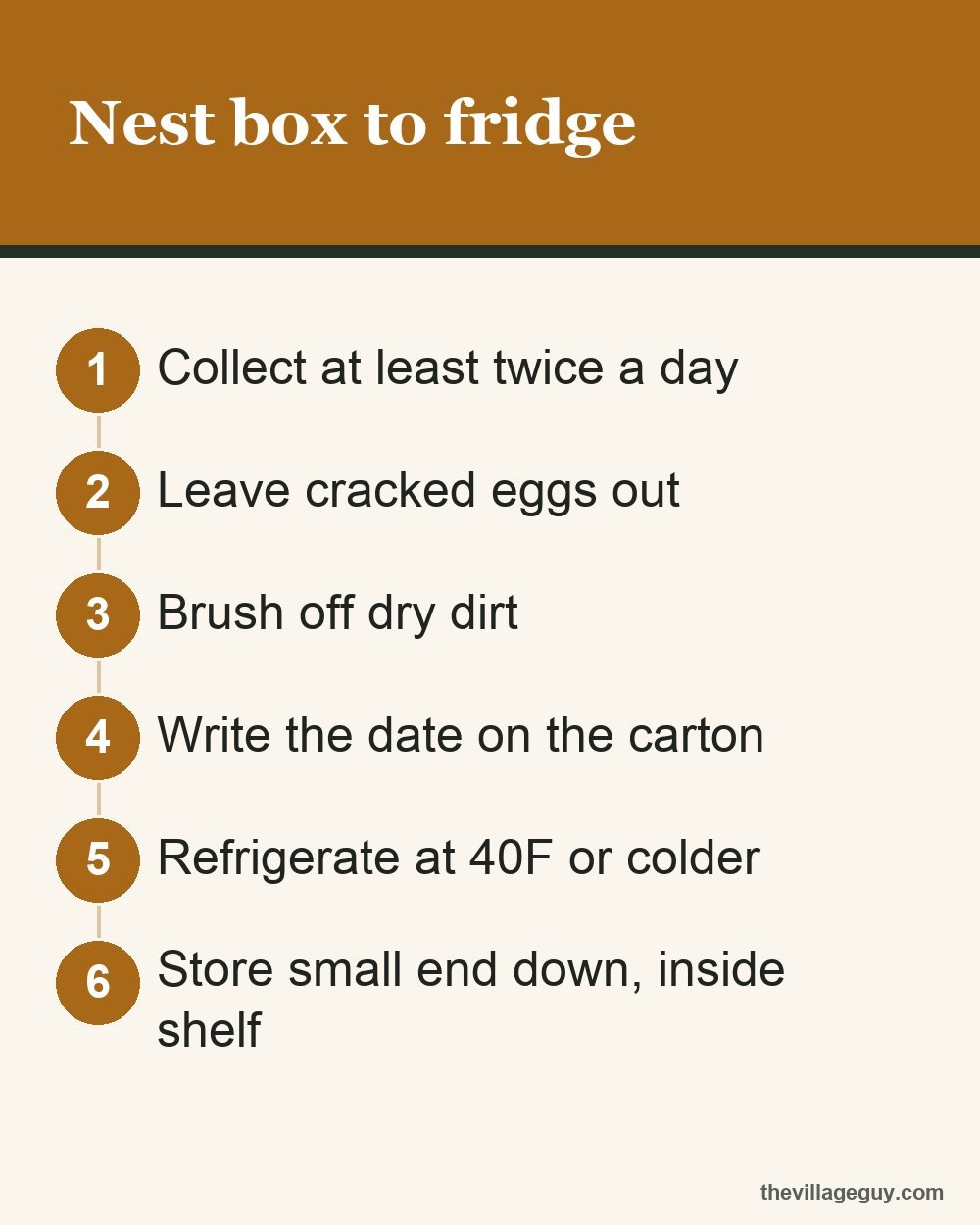
Three habits matter most. First, set aside cracked eggs at the coop; the CDC says to throw them away because bacteria on the shell get in more easily. Second, get eggs into the refrigerator as soon as possible, which Iowa State, Arizona and Utah State extension guides all stress. Third, put a date on them. Without a collection date, a backyard egg in a plain carton is just a mystery with a shell.
Egg supply has a rhythm too. Hens slow down as days shorten, so the eggs you collect in late fall and winter are precious, and the reasons behind that slump are covered in our guide to why chickens stop laying. The flip side is a spring flush that can outrun any household, which is where freezing earns its place (see below).
Washed or unwashed: the storage consequences
Washing is its own topic, covered step by step in our guide on how to wash fresh eggs, but it has one big consequence for storage. A hen lays each egg with a thin protein coat called the cuticle, or bloom, over the shell pores. Washing removes most of it. So the simple storage rule is: a washed egg belongs in the fridge from then on, without exceptions.
An unwashed egg has more options in theory, but the bloom is not a force field. USDA Agricultural Research Service scientists note that the cuticle dries and comes off over time, and UF/IFAS Extension adds that it can be damaged by handling. Extension guides such as Arizona’s and the Poultry Extension Collaborative’s recommend leaving clean eggs unwashed and refrigerating them anyway, which keeps both the bloom and the cold.
Tip: If you dry-clean eggs and refrigerate them unwashed, you can wash each one just before cracking it. Straight from a 40°F fridge, any water at 90°F or warmer meets the warm-water rule.
Do fresh eggs need to be refrigerated?
The official US answer is yes. The FDA says to store eggs promptly in a clean refrigerator at 40°F or below, and the USDA’s egg advice is built on the same cold chain. Farm practice often differs, especially with unwashed eggs, and the reasons on both sides are worth knowing.
What the counter camp gets right
Much of the world sells unwashed eggs unrefrigerated, and the European Union’s marketing rules forbid washing Class A eggs at all. A University of California, Davis poultry specialist writing for the Poultry Extension Collaborative says eggs that were not refrigerated when bought do not need to be refrigerated, though cooling keeps them fresher longer, and that at room temperature they stay at peak freshness for about one week.
Why US agencies still say refrigerate
Quality and safety both favor the cold. In a USDA ARS study of 5,400 eggs stored four ways for 15 weeks, every refrigerated group (washed, unwashed or oiled) was still Grade A at the end, while unwashed eggs at 72°F fell from Grade AA to Grade B in a single week. ARS sums it up as refrigeration stretching shelf life from about 21 days to 15 weeks. On safety, Salmonella can be inside an egg before the shell even forms, UF/IFAS Extension notes, and it cannot be detected by sight, smell or taste. Iowa State Extension adds that any Salmonella in or on an egg multiplies at room temperature.
Once cold, keep it cold
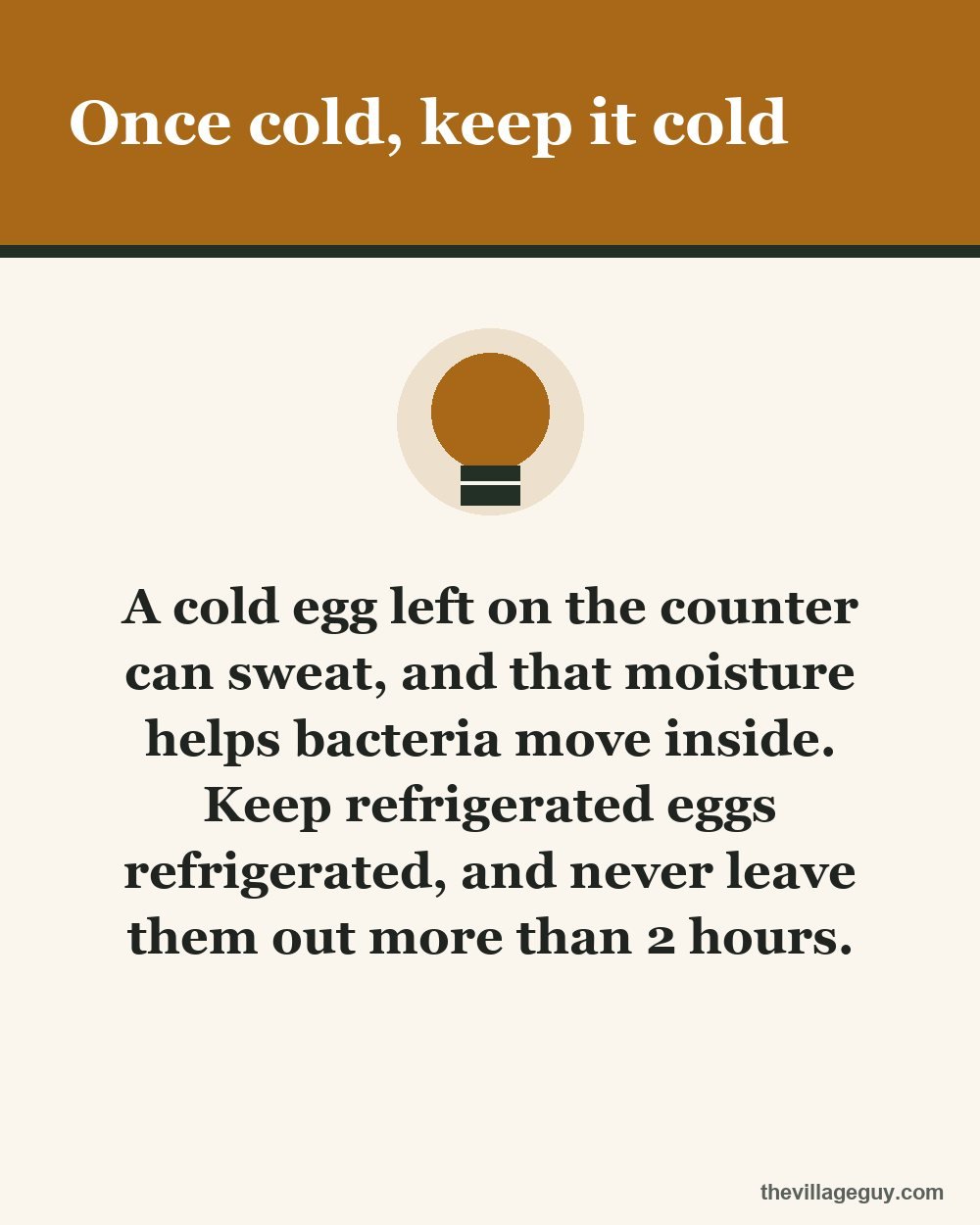
The worst option is the middle one: fridge to counter and back. Utah State Extension warns that a cold egg left at room temperature can sweat, and the moisture helps bacteria move into the egg. Refrigerated eggs should not sit out more than 2 hours (1 hour when it is above 90°F, per the FDA).
Safety: In an outage, keep the fridge door shut. CDC emergency guidance lists eggs with the perishables to throw away once a refrigerator has been without power for 4 hours or more. A fridge thermometer on the egg shelf settles arguments, and when in doubt, throw it out. Anyone pregnant, elderly, very young or immunocompromised should stick strictly to refrigerated, fully cooked eggs.
How long do unwashed eggs last?
This is where the sources spread out, partly because “last” can mean “still top quality” or “still safe to eat”. Here is what each one says, in their own terms.
- Refrigerated, best quality: Clemson Extension suggests using backyard eggs within 45 days of collection.
- Refrigerated, longer: University of Arizona Cooperative Extension says unwashed eggs in a carton can be kept up to 2 to 3 months in a household refrigerator.
- Refrigerated, in the lab: USDA ARS found unwashed refrigerated eggs still Grade A after 15 weeks.
- At room temperature: About a week of peak freshness, per the Poultry Extension Collaborative; USDA ARS measured a drop from Grade AA to B in a week at 72°F. No US agency publishes a room-temperature safety timeline, because their advice is to refrigerate.
A practical way to use those numbers: plan on eating refrigerated unwashed eggs within about six weeks, treat older ones as baking and scrambling eggs once they pass a crack-and-sniff check, and do not keep eggs on the counter for more than a few days if you keep them there at all.
How to store fresh eggs in the fridge
Where the eggs sit in the fridge matters almost as much as whether they are in it. The FDA says to keep eggs in their original carton, and the American Egg Board, Iowa State and Utah State all say the main compartment, not the door, because door temperatures swing every time someone hunts for the mustard.
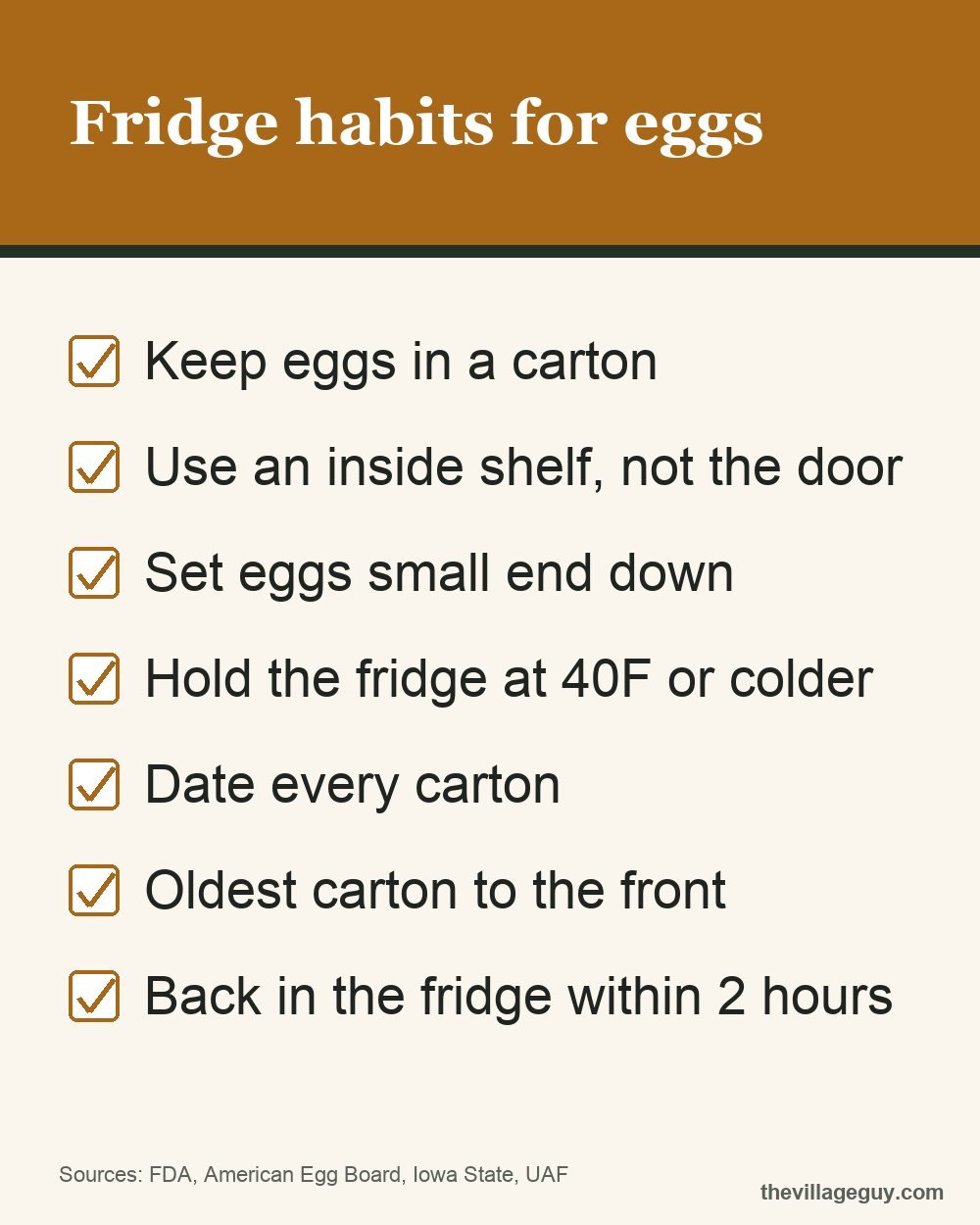
The University of Alaska Fairbanks recommends storing eggs small end down in the carton, which it says keeps the air cell stable at the top. For backyard eggs, reuse only clean cartons (or buy new ones), and rotate the oldest eggs to the front. A plain label does the rest:
- Eggs collected 11/25 (unwashed). Best by 1/9.
- Eggs collected 11/25 (washed). Keep cold. Best by 1/9.
- Spring surplus, beaten whole eggs, 3 tbsp per egg. Frozen 4/14. Use by 4/14 next year.
Freezing and other long-term storage
When hens out-lay the household, freezing is the method extension services back. Eggs cannot be frozen in the shell, which cracks as the contents expand, so break them out first. The National Center for Home Food Preservation gives these steps:
- Whole eggs: mix yolks and whites without whipping in air, and add 1 1/2 tablespoons sugar or corn syrup, or 1/2 teaspoon salt, per cup, depending on how you will use them. Three tablespoons of mixture equals one egg; ice-cube trays make handy single portions.
- Yolks: add the same sugar, corn syrup or salt per cup to prevent graininess. One tablespoon equals one yolk.
- Whites: freeze plain. Two tablespoons equals one white.
- All: pack with 1/2 inch of headspace, label with the date and what you added, and use within a year (the FDA’s guide for frozen eggs).
Utah State Extension adds two cautions: freezing does not kill Salmonella, so cook frozen eggs thoroughly, and do not use stored eggs in uncooked foods like eggnog or smoothies. If eggs freeze by accident in the coop, the rules are different (an intact shell can be kept frozen and thawed in the fridge; a cracked one goes in the trash), and the coop fixes that prevent it are in our guide to keeping chickens warm in winter.
Water glassing and other old methods
Water glassing (submerging unwashed eggs in lime water or sodium silicate) has made a comeback online. Extension food safety specialists do not back it: Utah State calls it neither safe nor a recommended way to store eggs long term, noting that Salmonella can be inside an egg before it is laid and that lime water may seep through the shell. UF/IFAS Extension adds that older research found water-glassed eggs did not adequately preserve egg white quality at room temperature. Coating eggs in mineral oil is another farm practice; in the USDA ARS study, washed, oiled, refrigerated eggs held Grade A quality as well as other refrigerated eggs, but the refrigeration did most of the work.
Checking an egg before you use it
Storage times are averages, and every egg still gets the final word. Our guide to how to tell if eggs are bad ranks six checks in detail; here is the short version for stored eggs.
- Float test: a floater has a big air cell and is old, which the USDA says may still be safe. It is a sorting tool, not a verdict.
- Look after cracking: a pink, green or pearly white, or black or green spots, means spoilage.
- Sniff: a sulfur, sour or musty smell, raw or cooked, means the trash.
- Old but fine: a flat yolk and thin, runny white mean an older egg that is still good for scrambling and baking.
Copy-ready egg storage checklists
Four short lists cover the whole chain. Keep the first one by the coop door and the rest on the fridge. More flock, garden and winter guides are gathered in the Village Guy guides.
At the coop
- Collect eggs at least twice a day, and three times in heat waves or hard freezes.
- Use a clean basket or carton for collecting.
- Leave cracked eggs behind for the trash, not the kitchen.
- Brush off loose dirt while the shell is dry.
- Get the eggs into the fridge within the hour.
In the kitchen
- Write the collection date on every carton.
- Decide once: washed eggs stay refrigerated for good.
- Store cartons on an inside shelf, never in the door.
- Set eggs small end down.
- Keep a fridge thermometer reading 40°F or below.
- Move the oldest carton to the front each time you add one.
- Return eggs to the fridge within 2 hours of taking them out.
For long storage
- Freeze surplus eggs out of the shell, never whole in the shell.
- Add sugar, corn syrup or salt to whole eggs and yolks before freezing.
- Label frozen packs with the date, the egg count and the additive.
- Thaw frozen eggs in the fridge and cook them thoroughly.
- Skip water glassing and other untested room-temperature methods.
Before cooking
- Check the date and use the oldest eggs first.
- Crack each egg into a separate small bowl.
- Sniff and look before it joins the recipe.
- Use pasteurized eggs for anything served raw or lightly cooked.
Fresh egg storage FAQ
Can you refrigerate eggs that were sold unrefrigerated?
Yes, and it helps. Eggs from a farm stand or a friend’s counter keep their quality longer once chilled, as the Poultry Extension Collaborative notes. The one-way rule applies from then on: once they are cold, keep them cold, because a chilled egg brought back to room temperature can sweat.
How long do hard-boiled eggs last?
The FDA says to eat hard-cooked eggs, peeled or in the shell, within 1 week of cooking, and to refrigerate them within 2 hours. The American Egg Board is stricter for peeled eggs, advising that they be eaten the same day, so keep them in the shell until you need them.
Do farm fresh eggs last longer than store-bought eggs?
They can, mostly because their clock starts sooner: a backyard egg goes from nest to fridge in hours, while a carton’s 3 to 5 weeks starts at your purchase, after packing and shipping. Once refrigerated, washed and unwashed eggs held similar quality in USDA tests, so steady cold matters more than where the egg came from.
Can you freeze eggs in the shell?
No. The contents expand as they freeze and crack the shell, and the American Egg Board says eggs can be frozen but not in the shell. Break them into a bowl, beat or separate them, and freeze them as described above.
Sources
- USDA FSIS: Shell Eggs from Farm to Table (3 to 5 weeks refrigerated, do not freeze in shell, float test, date rules)
- FDA: What You Need to Know About Egg Safety (40°F, original carton, 3 weeks best quality, hard-cooked 1 week, frozen 1 year, leftovers 3 to 4 days, 2-hour rule)
- USDA Agricultural Research Service: How We Store Our Eggs, and Why (5,400-egg storage study, Grade A after 15 weeks refrigerated, AA to B in a week at 72°F, cuticle dries)
- USDA Agricultural Research Service: How We Store Our Eggs, Bonus Content (refrigeration extends shelf life from about 21 days to 15 weeks)
- American Egg Board: Important Food Safety Information (4 to 5 weeks beyond pack date, main compartment, freezing out of shell, hard-boiled storage)
- Clemson Cooperative Extension HGIC: Backyard Chickens and Their Eggs (use within 45 days, collection frequency)
- University of Arizona Cooperative Extension: Egg Safety for Backyard Chicken Owners (2025) (unwashed eggs up to 2 to 3 months refrigerated, refrigerate promptly)
- Poultry Extension Collaborative (UC Davis), Proper Handling for Safe Eggs (2023), via UC ANR (unrefrigerated eggs at peak freshness about a week, cuticle, storing unwashed)
- Utah State University Extension: Storing Eggs Safely (2023) (sweating, water glassing not recommended, freezing method, freezing does not kill Salmonella)
- UF/IFAS Extension Wakulla County: Safe Egg Storage (2026) (refrigeration at 41°F or below, Salmonella undetectable by senses, water glassing research, cuticle damage)
- National Center for Home Food Preservation: Freezing Eggs (additive amounts, measures per egg, headspace)
- Iowa State University Extension AnswerLine: Egg Safety Q&As (2026) (door temperature swings, cracked eggs within 2 days, Salmonella multiplies at room temperature)
- University of Alaska Fairbanks Cooperative Extension: Safe Egg Handling for Small Egg-Laying Flocks (small end down, winter collection frequency)
- CDC: Keep Food Safe After a Disaster or Emergency (discard refrigerated eggs after 4 hours without power)
- CDC: Backyard Poultry (throw away cracked eggs, refrigerate after collection)
- Commission Regulation (EC) No 589/2008, Article 2 (Class A eggs not washed in the EU)
- USDA FSIS: Kitchen Companion, Your Safe Food Handbook (raw yolks and whites 2 to 4 days refrigerated)
- Penn State Extension: How Freezing Affects Egg Quality (eggs frozen in the shell: discard if cracked, thaw intact eggs in the fridge)