
A cow carries her calf for about 283 days, sees almost all the way around her own body, hears high-pitched sounds better than you do, and can remember a bad experience for months. Those are the kinds of cow facts that make cattle easier to understand and easier to keep, and every one on this page is checked against a university, USDA, veterinary or breed-association source.
The page is organised by topic: vocabulary first, then body, senses, behavior, pregnancy and calving, breeds, the U.S. herd in numbers, and the basics of caring for a first family cow. Where we have a deeper guide on a topic, you will find a short summary and a link rather than a repeat.
Quick answer: Cows are ruminants with one four-compartment stomach, a normal rectal temperature of about 98 to 102.8°F, and a gestation period of about 283 days (roughly 9 months). They see more than 300 degrees around them, are most sensitive to sound near 8,000 Hz, and are strongly social herd animals. The U.S. had 86.2 million cattle and calves on January 1, 2026.
In this guide
- Cow facts at a glance
- Cow, heifer, steer, bull: the vocabulary
- Body and anatomy facts
- How cows see, hear and sense the world
- Behavior: social animals with long memories
- Cow gestation period: how long are cows pregnant?
- Breeds you will meet in the U.S.
- U.S. cattle by the numbers
- Care basics for a first family cow
- Cow facts FAQ
Cow facts at a glance
If you only read one section, make it this one. Each row is a verified figure with its source, and most link to a fuller explanation further down or in one of our other cattle guides.
| Fact | Figure | Source |
|---|---|---|
| Stomach | One stomach, four compartments (rumen, reticulum, omasum, abomasum) | Mississippi State Univ. Extension |
| Average gestation | About 283 days; most practical range 279 to 286 | American Hereford Association |
| Heat (estrous) cycle | About 21 days; estrus averages 18 hours | Merck Veterinary Manual |
| Normal rectal temperature | 98.0 to 102.4°F (beef cow); 100.4 to 102.8°F (dairy cow) | Merck Veterinary Manual |
| Field of vision | More than 300 degrees | Temple Grandin, Colorado State Univ. |
| Best hearing | Around 8,000 Hz (people: 1,000 to 3,000 Hz) | Temple Grandin |
| Front teeth | Lower jaw only; calves have 20 temporary teeth | Cornell Small Farms Program |
| Average U.S. beef cow weight | About 1,350 to 1,400 lb | Univ. of Wyoming, Oklahoma State extension |
| Natural life expectancy | About 20 years | De Vries and Marcondes (2020) |
| Milk per U.S. dairy cow, 2025 | 24,390 lb for the year | USDA NASS |
| U.S. cattle and calves, Jan. 1, 2026 | 86.2 million head | USDA NASS |
Cow, heifer, steer, bull: the vocabulary
Farmers use these words precisely, and getting them right makes everything else easier, from reading a sale bill to understanding USDA reports. “Cattle” is the general word for the species; “cow” technically means a grown female that has had a calf.
| Term | Meaning | How USDA counts it |
|---|---|---|
| Calf | A young animal of either sex, usually until weaning | “Calves under 500 pounds” |
| Heifer | A young female that has not yet had a calf | “Heifers 500 pounds and over,” split into beef replacement, milk replacement and other heifers |
| Cow | A female that has had at least one calf | “Cows and heifers that have calved,” split into beef cows and milk cows |
| Steer | A male castrated when young, raised for beef | “Steers 500 pounds and over” |
| Bull | An intact (uncastrated) male, usually kept for breeding | “Bulls 500 pounds and over” |
Two more you will hear: a “fresh” cow is one that has recently calved and started milking, and an “open” cow is one that is not pregnant. Mississippi State Extension recommends putting cows that are still open at the end of the breeding season at the top of the marketing list.
Body and anatomy facts
One stomach, four rooms
Cattle are ruminants. Their single stomach is divided into four compartments, and the biggest, the rumen, is a fermentation vat where microbes break down grass fiber the cow could never digest alone. Cows bring that food back up and chew it again as cud for a large part of each day. Our explainer on how many stomachs a cow has and what each compartment does covers capacities, calf development and the digestive warning signs that need a vet.
Teeth: no top front teeth
The Cornell Small Farms Program points out that cattle’s incisors are absent from the upper jaw, so a grazing cow wraps her tongue around grass and tears it rather than nipping it off. Calves have 20 temporary teeth, and the permanent front teeth come in pairs on a schedule that lets you estimate age. That timetable, and how teeth limit a cow’s working life, is in our guide to how long cows live on and off the farm.
Size and weight
The average U.S. beef cow now weighs about 1,350 to 1,400 pounds, a mature Holstein about 1,500, and mature beef bulls commonly 1,700 to 2,300. A cow’s weight swings with gut fill, pregnancy and body condition, so small farms estimate it with a heart-girth tape. See how much a cow weighs, with a weight-tape worked example for benchmarks and the formula.
Normal vital signs
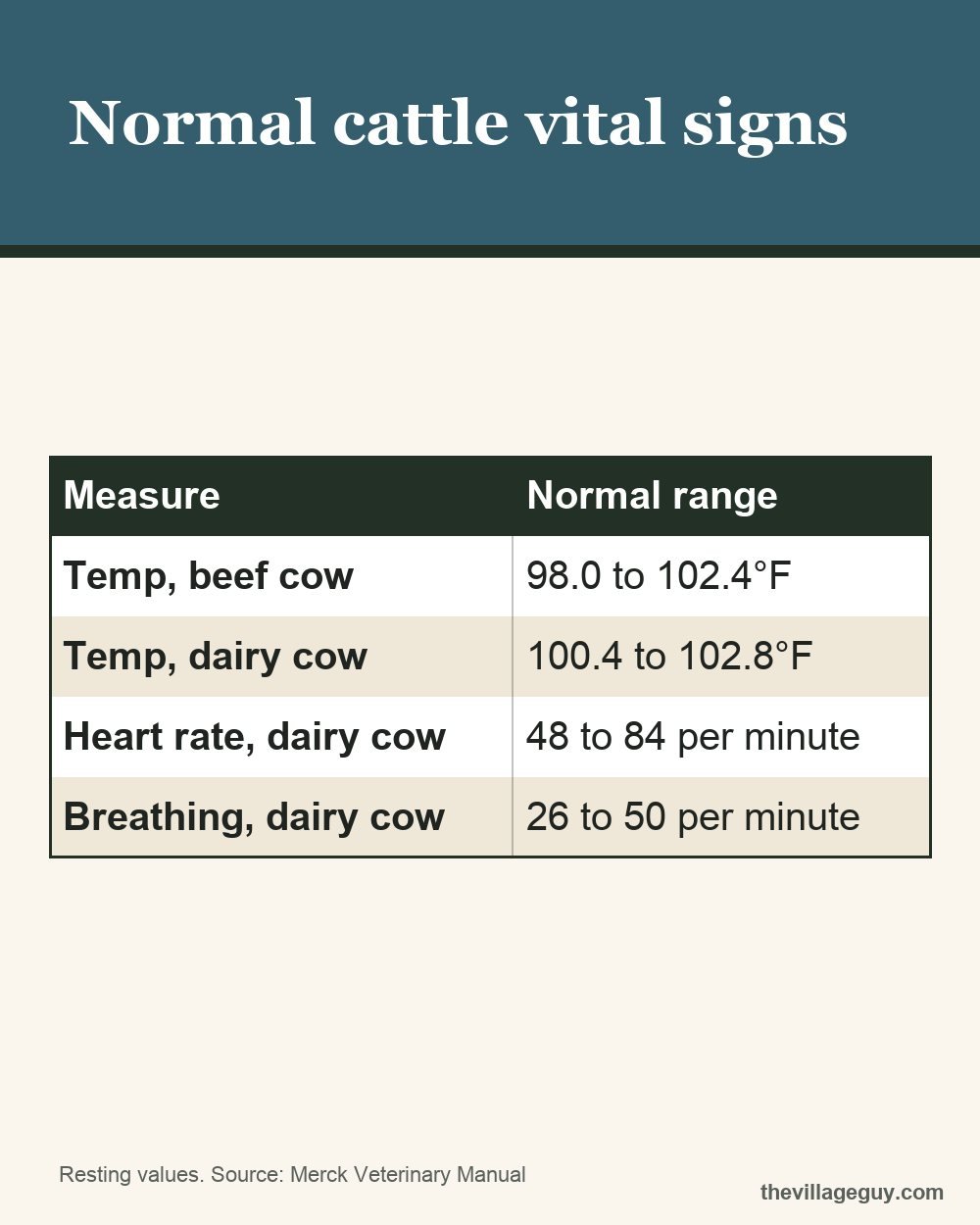
Knowing what normal looks like is one of the most useful things a new cattle keeper can learn, because it is the first thing a vet will ask about on the phone. The Merck Veterinary Manual lists these resting ranges:
| Measure | Normal range |
|---|---|
| Rectal temperature, beef cow | 98.0 to 102.4°F (36.7 to 39.1°C) |
| Rectal temperature, dairy cow | 100.4 to 102.8°F (38.0 to 39.3°C) |
| Resting heart rate, dairy cow | 48 to 84 beats per minute |
| Resting breathing rate, dairy cow | 26 to 50 breaths per minute |
- Rectal temperature: ___ °F, taken at ___ (time)
- Eating and drinking: normal / reduced / not at all since ___
- Chewing cud: yes / no; manure: normal / loose / scant / none
- Breaths per minute at rest: ___; standing or lying down: ___
Those four lines are worth jotting down before you phone the vet about a sick animal.
How cows see, hear and sense the world
Much of what looks like stubbornness in cattle is really their senses at work. Temple Grandin, the Colorado State University animal scientist known for her research on livestock handling, has summarized how cattle perceive their surroundings.
Vision
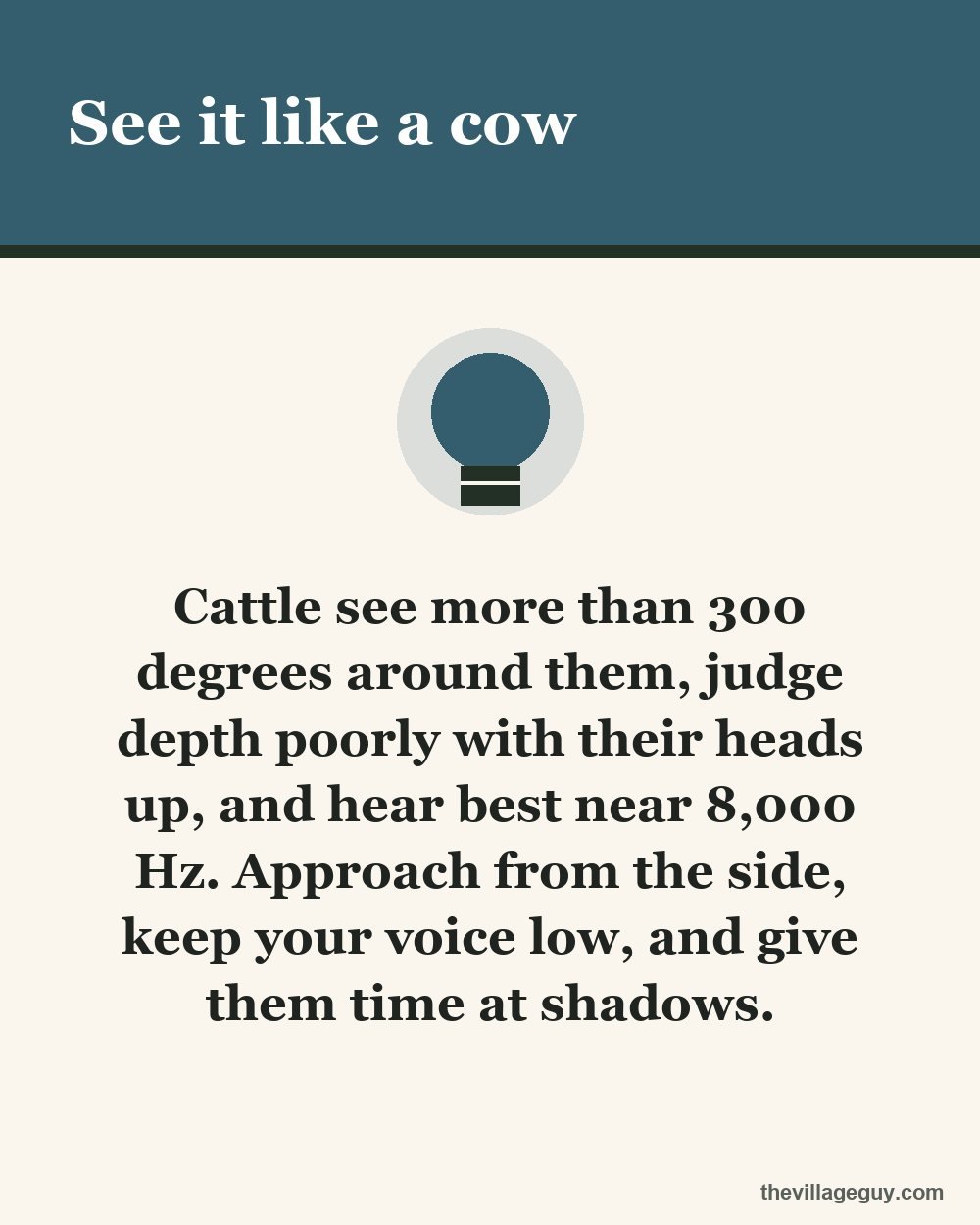
Grandin reports that cattle have a visual field in excess of 300 degrees, with a blind spot directly behind them. Their depth perception at ground level, while moving with heads up, is probably poor, and research on farm animal color vision shows they are dichromats, seeing fewer colors than people. That combination explains a classic cattle-handling headache: cows balk at shadows, drain grates and anything with sharp light-and-dark contrast, because they cannot tell how deep it is.
Hearing
Cattle are more sensitive than people to high-frequency sound. Grandin gives their peak sensitivity as about 8,000 Hz, compared with 1,000 to 3,000 Hz for the human ear, and notes that yelling and high-pitched noises are especially stressful. Squealing gates, whistles and shouting carry more weight for a cow than for you.
Memory
Cattle remember. Grandin cites research showing cattle and sheep could remember an aversive experience for many months, and warns that a bad first experience with something new can create a lasting fear. A rough first trip through a chute can make every later trip harder.
Behavior: social animals with long memories
Cattle are herd animals to the core. Grandin describes isolation as a strong stressor: an animal separated from its herd mates is likely to become highly agitated. Cattle also try to keep visual contact with each other, readily follow a leader, and stay calmer in groups.
For a small farm, the practical lesson is blunt: a single cow kept alone is a stressed cow. If you only want one animal for milk or beef, plan on a companion, even a steer or a second heifer.
Flight zone and point of balance
Every animal has a flight zone, its personal space. Step inside it and a cow that is not fully tame will move away; approach head-on or when she is excited and the zone gets bigger. Grandin places the point of balance at the shoulder: stand behind it and the animal moves forward, stand in front of it and she backs up. She also advises alternating pressure rather than constant pushing, moving in straight lines rather than circling, and never chasing a lone straggler, because the herd will draw it back.

Cow gestation period: how long are cows pregnant?
The average cow gestation period is about 283 days, a little over nine months. An article in the American Hereford Association’s magazine notes that individual breeds and family lines run slightly shorter or longer than that average, and quotes retired Montana researcher Michael MacNeil calling 279 to 286 days the most practical range.
A few patterns are well established. Heifers tend to have shorter pregnancies and smaller calves than mature cows; bull calves tend to be carried longer than heifer calves; and the sire of the calf influences gestation length more than the cow does. The same article cites a study in which each extra day of gestation added at least a pound to the calf’s birth weight.
Cycles, breeding age and the 365-day goal
The Merck Veterinary Manual puts the cow’s estrous cycle at about 21 days, with estrus (standing heat) lasting about 18 hours on average and often less. Beef heifers bred at 13 to 15 months old calve at 22 to 24 months, and Merck notes that dairy heifers are most profitable over their lifetimes when they calve at 23 to 25 months.
Many herds aim for one calf per cow every year. Subtract a 283-day pregnancy from 365 days and you get just 82 days for a cow to recover from calving and conceive again, which is why late-calving cows so often fall out of step. Merck adds that ultrasound can identify cows that are not pregnant at 28 to 32 days after breeding.
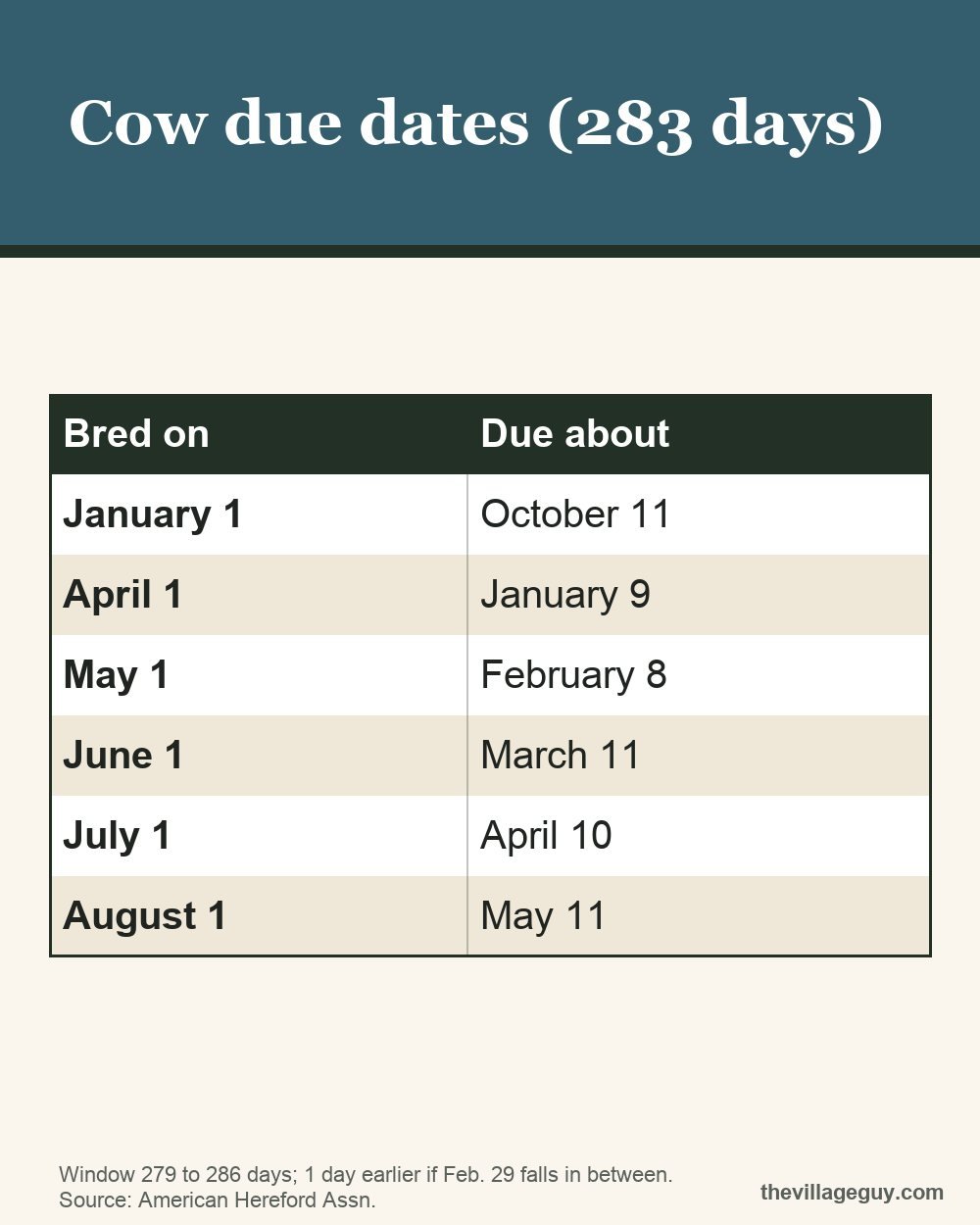
| Bred on | Due about (283 days) | Normal window (279 to 286 days) |
|---|---|---|
| January 1 | October 11 | October 7 to 14 |
| April 1 | January 9 | January 5 to 12 |
| May 1 | February 8 | February 4 to 11 |
| June 1 | March 11 | March 7 to 14 |
| July 1 | April 10 | April 6 to 13 |
| August 1 | May 11 | May 7 to 14 |
Dates assume no February 29 falls during the pregnancy; in a leap year, move the due date one day earlier.
USDA’s Beef 2017 study, as reported by Western Livestock Journal, found most U.S. beef calves (55.6 percent) are born from February through April, which lines up with breeding in May, June and July.
Calving: what normal looks like
The Merck Veterinary Manual describes three stages of labor. Stage 1, when the cervix opens, may last 1 to 24 hours, with 1 to 4 hours normal. In stage 2 a heifer should deliver within 1 to 4 hours and a mature cow with a normally presented calf in under 3 hours; Merck advises that if no progress is evident within an hour, help may be needed. The afterbirth normally comes out within 12 hours.
Safety: A cow that strains for an hour with no progress, a calf coming backward or with only one leg showing, or a cow that stops trying are all reasons to call your veterinarian right away. Delays can cost the calf, the cow or both. Agree on a calving plan and an after-hours number with your vet before the season starts.
Colostrum, the first milk, is time-critical. Merck notes that a calf’s ability to absorb antibodies drops by 6 to 8 hours after birth and the gut closes to them by 24 hours, so the target is 3 to 4 liters (about 3 to 4 quarts) of colostrum as soon as possible after calving.
- Write each cow’s breeding date on a calendar and count forward 283 days.
- Move cows due within two weeks to a clean, sheltered calving area you can see easily.
- Stock a calving kit your vet approves, including gloves, lubricant, a navel dip and clean towels.
- Keep a source of frozen or powdered colostrum on hand for a calf that cannot nurse.
- Note the time when stage 2 labor starts so you know when an hour has passed.
- Confirm the calf stands and suckles, or is fed colostrum, within its first few hours.
Breeds you will meet in the U.S.
Breed shapes size, temperament, milk and feed needs. The table pulls together verified figures for a handful of breeds a small-farm buyer is likely to encounter. For beef breeds, the most useful recent comparison is a USDA Meat Animal Research Center and University of Nebraska study of 108,957 weight records from 5,156 cows, published in the Journal of Animal Science in 2021 and summarized by Western Livestock Journal.
| Breed | Main use | Verified size note | Source |
|---|---|---|---|
| Angus | Beef | Heaviest at maturity of the breeds in the USDA study; used as the base for comparison | USMARC study via WLJ |
| Hereford | Beef | About 38.5 lb lighter than Angus at maturity in that study | USMARC study via WLJ |
| Simmental | Beef | About 73.5 lb lighter than Angus in that study | USMARC study via WLJ |
| Holstein | Dairy | About 1,500 lb and 58 in at the shoulder; calves 90 lb or more | Holstein Association USA |
| Jersey | Dairy | Usually 800 to 1,200 lb; its U.S. association dates to 1868 | Oklahoma State; American Jersey Cattle Association |
| Dexter | Beef, milk and draft | Most cows 36 to 42 in at the hip; black, red or dun; from Kerry, Ireland | American Dexter Cattle Association |
Crossbreeding adds another wrinkle. The same USDA study measured direct heterosis (hybrid vigor) for mature weight at 2.4 percent, meaning crossbred cows tended to be a little heavier than the average of their parent breeds. Bigger cows eat more, so that extra size is not free.
U.S. cattle by the numbers
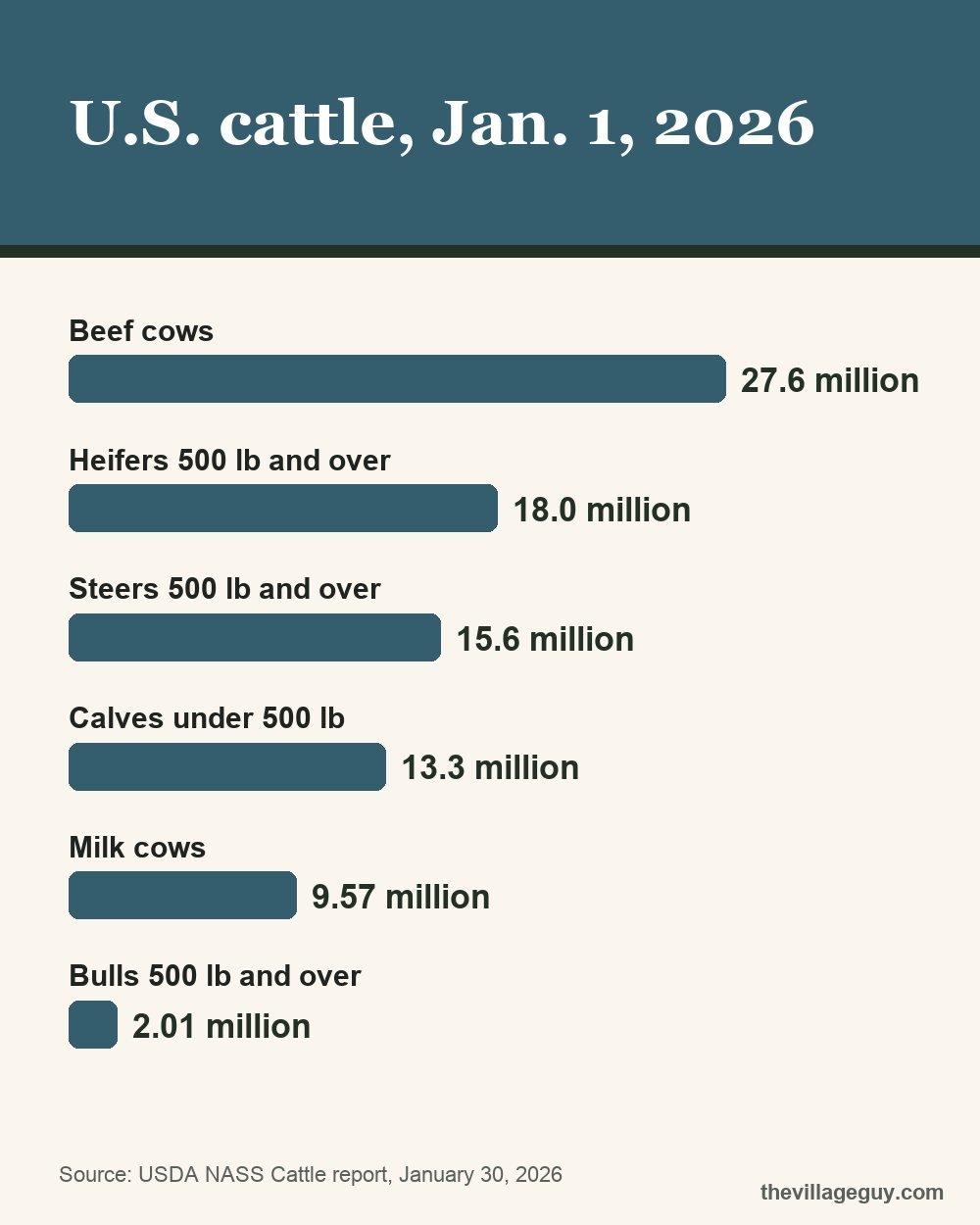
USDA’s National Agricultural Statistics Service counts the national herd every January. Its January 30, 2026 report put the total at 86.2 million cattle and calves, slightly below the 86.5 million a year earlier.
| Measure | Figure | Source |
|---|---|---|
| Beef cows, Jan. 1, 2026 | 27.6 million | USDA NASS Cattle report |
| Milk cows, Jan. 1, 2026 | 9.57 million | USDA NASS Cattle report |
| 2025 U.S. calf crop | 32.9 million | USDA NASS Cattle report |
| State with the most cattle | Texas, 12.1 million head | USDA NASS Cattle report |
| Milk per cow, 2025 | 24,390 lb (about 67 lb a day averaged over the year) | USDA NASS Milk Production |
| Total U.S. milk, 2025 | 232 billion lb | USDA NASS Milk Production |
| Average live weight at slaughter, 2025 | 1,432 lb | USDA NASS Livestock Slaughter |
Many of the people raising those cows are not running big ranches. In USDA’s Beef 2017 study, 81 percent of cow-calf operations treated cattle as a supplemental source of income, and 58.5 percent had no defined breeding season, according to Western Livestock Journal’s summary. If you are thinking about a few cows on a few acres, you are in good company.
Care basics for a first family cow
Cattle are hardy, but they are big, social and expensive to get wrong. The essentials are fresh water, enough forage, a companion, safe fences, a way to restrain an animal for treatment, and a vet who will come out. Our weight guide has the daily numbers: a beef cow eats about 2.5 percent of her body weight in air-dry forage, and water needs run from roughly 7 to 22 gallons a day depending on size, milk and heat.
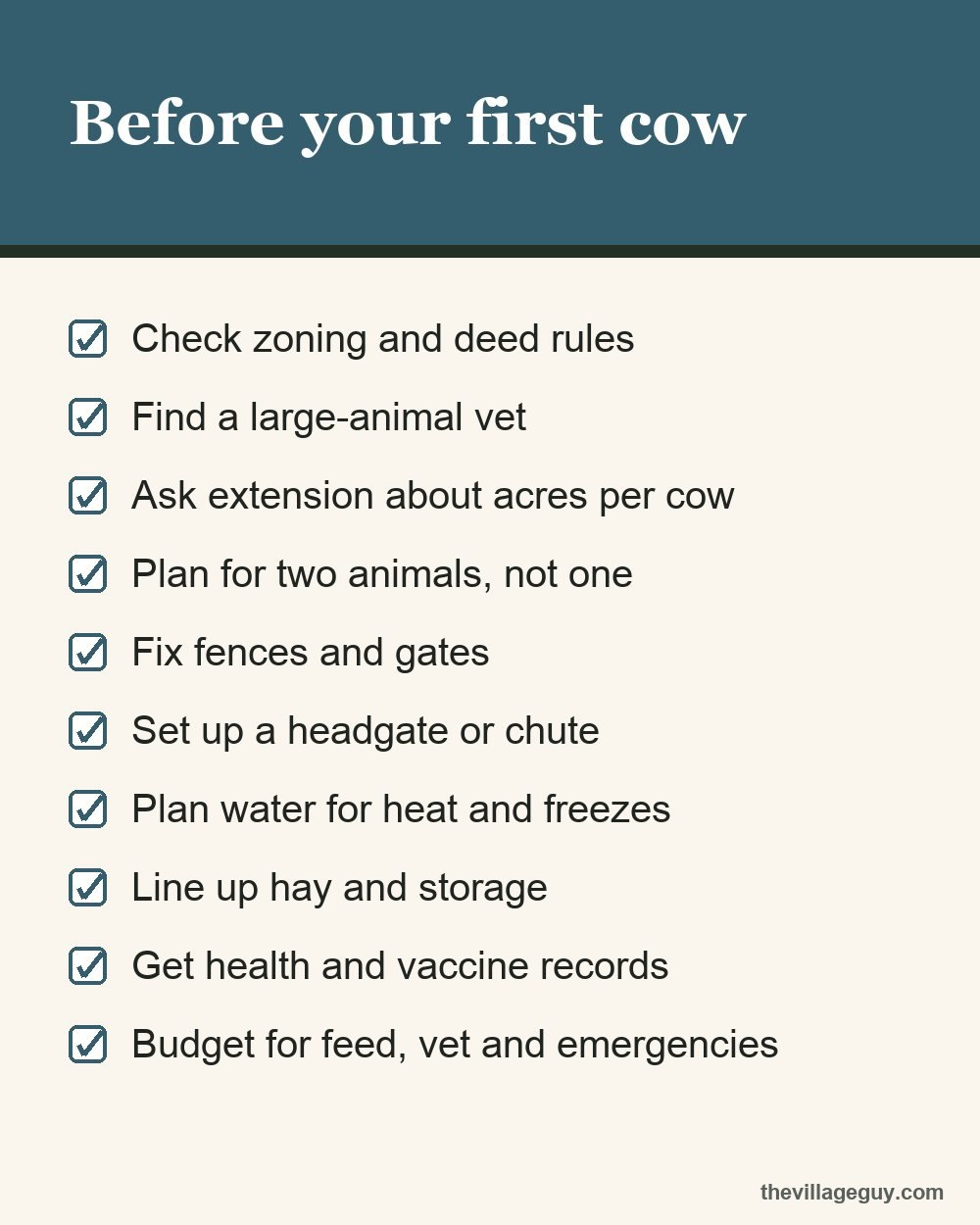
Before you bring home your first cow
- Check zoning and any homeowner or deed rules on keeping cattle with your town or county.
- Find a large-animal veterinarian who will take you on before you buy, and ask about their call-out area.
- Ask your county extension office how many acres of pasture your land can support per animal.
- Plan on at least two animals so neither has to live alone.
- Build or repair fencing and gates suited to cattle, and walk the full line for gaps.
- Set up a headgate or chute so the animal can be held safely for the vet, weighing or treatment.
- Arrange a water supply that works in both summer heat and winter freezes.
- Line up a hay source and storage for the months your pasture will not carry the herd.
- Ask the seller for health records, vaccination history and the animal’s age or birth date.
- Learn normal temperature, heart rate and breathing rate before you ever need them.
- Choose a breed and size that fits your fences, facilities and feed supply.
- Budget for feed, minerals, vet care and an emergency fund before the animal arrives.
A weekly herd check
- Count every animal and look at each one standing and walking.
- Watch for cud chewing among animals lying down and at rest.
- Score body condition on any animal that looks thinner than last week.
- Check waterers, tank heaters and float valves for leaks or ice.
- Walk the fence line after storms and fix sagging wire or posts.
- Note any animal that is off feed, isolated from the group or breathing hard, and call your vet.
Cow facts FAQ
How long are cows pregnant in months?
About nine and a quarter months. The 283-day average works out to roughly 9.3 months, and most calves arrive between day 279 and day 286. A heifer calving for the first time often runs a little shorter than a mature cow.
Can cows see color?
Yes, but not the way people do. Research summarized by Temple Grandin shows farm animals, including cattle, are dichromats, so they see a narrower range of colors. Contrast and movement matter more to a cow than color, which is why a flapping coat or a dark shadow can stop a herd.
How much milk does a cow give a day?
The average U.S. dairy cow produced 24,390 pounds of milk in 2025, according to USDA. Spread across the whole year, including the weeks she is dried off before calving, that is about 67 pounds a day; cows near peak lactation produce more, and a family cow of a smaller breed typically produces less.
How many calves can a cow have in her lifetime?
A beef cow that calves first at 2 and then once a year could, in principle, have eight or more calves by age 10. Records are far higher: Ireland’s RTÉ reports that Big Bertha, recognized by Guinness World Records as the oldest cow recorded, produced 39 calves. Most commercial cows leave the herd long before reaching numbers like that.
More cattle, poultry and homestead guides are collected in The Village Guy’s guide library, and you can read about The Village Guy and how the site works.
Sources
- American Hereford Association, Hereford World (January 2014): 283 Days (average gestation 283 days; practical range 279 to 286; heifers shorter, bull calves longer, sire effect; extra day adds a pound or more)
- Merck Veterinary Manual: Breeding Programs for Heifer Replacements and Cows (estrous cycle 18 to 24 days, estrus about 18 hours, heifer breeding and calving ages)
- Merck Veterinary Manual: Overview of Management of Reproduction: Cattle (estrous cycle about 21 days)
- Merck Veterinary Manual: Management of Calving in Cattle (stages of labor and timing; colostrum timing and amount)
- Merck Veterinary Manual: Pregnancy Determination in Cattle (open cows identified by ultrasound at 28 to 32 days)
- Merck Veterinary Manual: Normal Rectal Temperature Ranges, Resting Heart Rates and Resting Respiratory Rates (normal vital signs)
- Temple Grandin: Behavioral Principles of Livestock Handling (300-degree vision, depth perception, dichromatic color vision, hearing at 8,000 Hz, isolation stress, memory)
- Temple Grandin: Understanding Flight Zone and Point of Balance for Low Stress Handling (flight zone, point of balance, moving cattle)
- Cornell Small Farms Program: Aging Cattle Without a Birth Certificate Through Dentition (no upper incisors; 20 temporary teeth)
- USDA NASS: Cattle (January 30, 2026) (86.2 million head; class inventories; 2025 calf crop; state totals)
- USDA NASS: Milk Production (February 20, 2026) (24,390 lb per cow and 232 billion lb in 2025)
- Western Livestock Journal: Comparing breed, heterosis effects on mature weight (USMARC and University of Nebraska breed study, 2021)
- Western Livestock Journal: Report offers cow-calf insights (USDA Beef 2017: calving months, supplemental income, breeding seasons)
- American Dexter Cattle Association (Dexter heights, colors, origin, tri-purpose use)
- American Jersey Cattle Association (USJersey) (founded 1868, oldest U.S. dairy breed association)
- Oklahoma State University: Breeds of Livestock, Jersey Cattle (Jersey cows usually 800 to 1,200 lb)
- Holstein Association USA: Holstein breed history (mature Holstein about 1,500 lb and 58 in; calves 90 lb or more)
- University of Wyoming Extension: Beef Cow Size (B-1343) (average beef cow weight; forage at 2.5 percent of body weight)
- De Vries and Marcondes (2020), animal: Overview of factors affecting productive lifespan of dairy cows (natural life expectancy about 20 years)
- Mississippi State University Extension: Understanding the Ruminant Animal Digestive System (P2503) (four stomach compartments)
- USDA NASS: Livestock Slaughter 2025 Summary (average live weight 1,432 lb)
- Alabama Cooperative Extension System: Water Requirements of Beef Cattle (daily water ranges)
- RTÉ Archives: Big Bertha (Guinness-recognized oldest cow; 39 calves)
- Mississippi State University Extension: Market Cow and Bull Management and Marketing (P2520) (open cows at the top of the marketing list)