A freshly dug sweet potato is a live, thin-skinned, tropical root that sulks below 55°F and starts sprouting above 60°F. Knowing how to store sweet potatoes comes down to respecting that narrow comfort zone: heal the skin with a short warm cure, then park the roots somewhere dark and cool, but never cold, for the long haul. Get it right and a fall harvest can still be feeding you in spring. Get it wrong and you open a bin of soft, blue-moldy roots in January and wonder what happened.
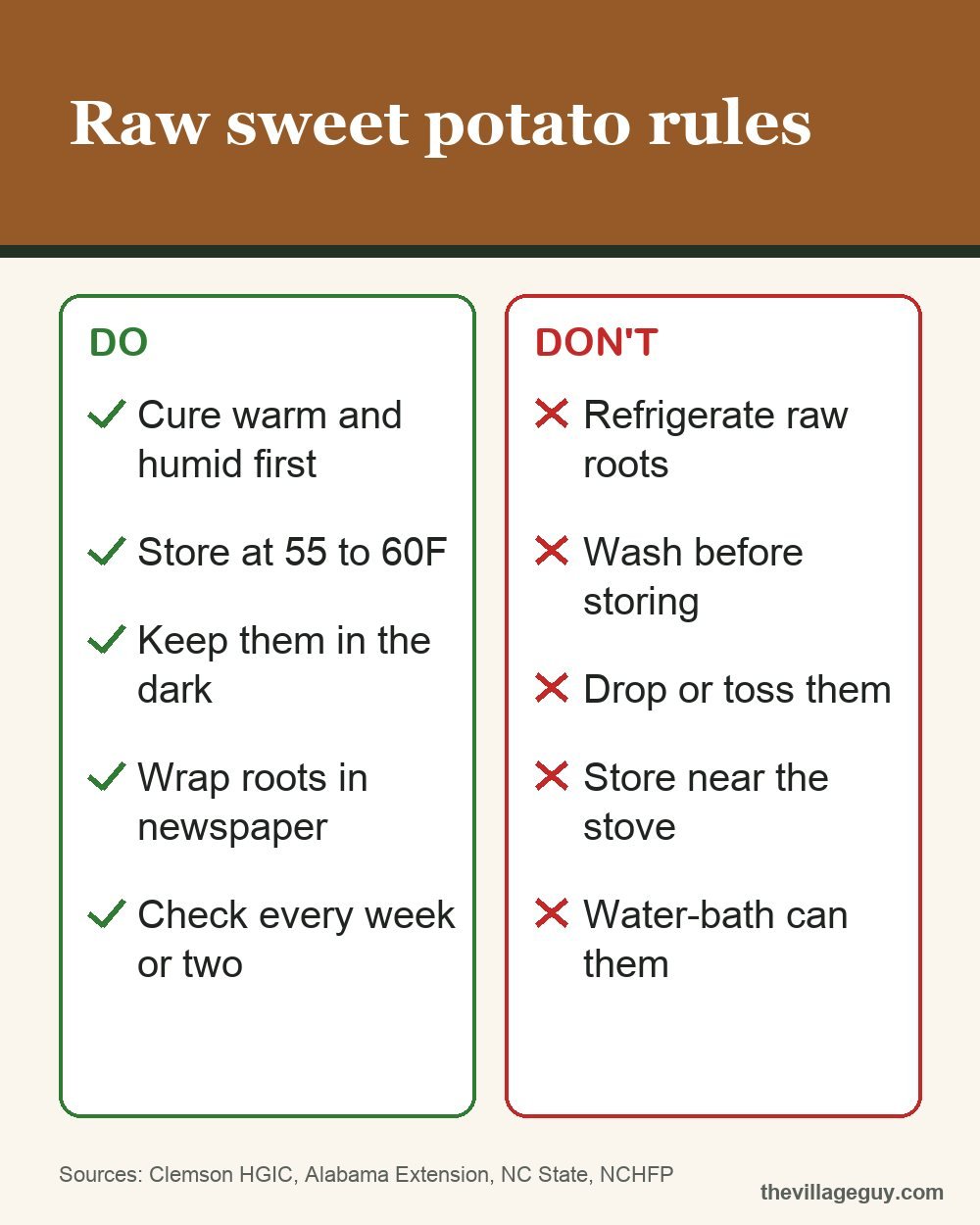
Quick answer: Cure freshly dug sweet potatoes at about 85°F and 85 to 95 percent humidity for 4 to 7 days (or in your warmest room for about two weeks), then store them in the dark at 55 to 60°F. Do not refrigerate raw roots: cold causes off-flavors, dark flesh and hard centers. Cured roots kept this way can last 4 to 7 months or more; cooked sweet potatoes freeze well.
In this guide
- How to store sweet potatoes: every method at a glance
- Dig and handle them gently
- How to cure sweet potatoes at home
- What you’ll need for curing and storage
- Where to keep cured roots (and why not the fridge)
- How long do sweet potatoes last?
- Can you freeze sweet potatoes? Yes, cooked first
- Dehydrating and pressure canning
- Sprouts, soft spots and mold: troubleshooting
- Sweet potato storage FAQ
How to store sweet potatoes: every method at a glance
Most storage failures happen because a sweet potato was treated like an Irish potato, which likes it cold. Pick your method here, then read the matching section.
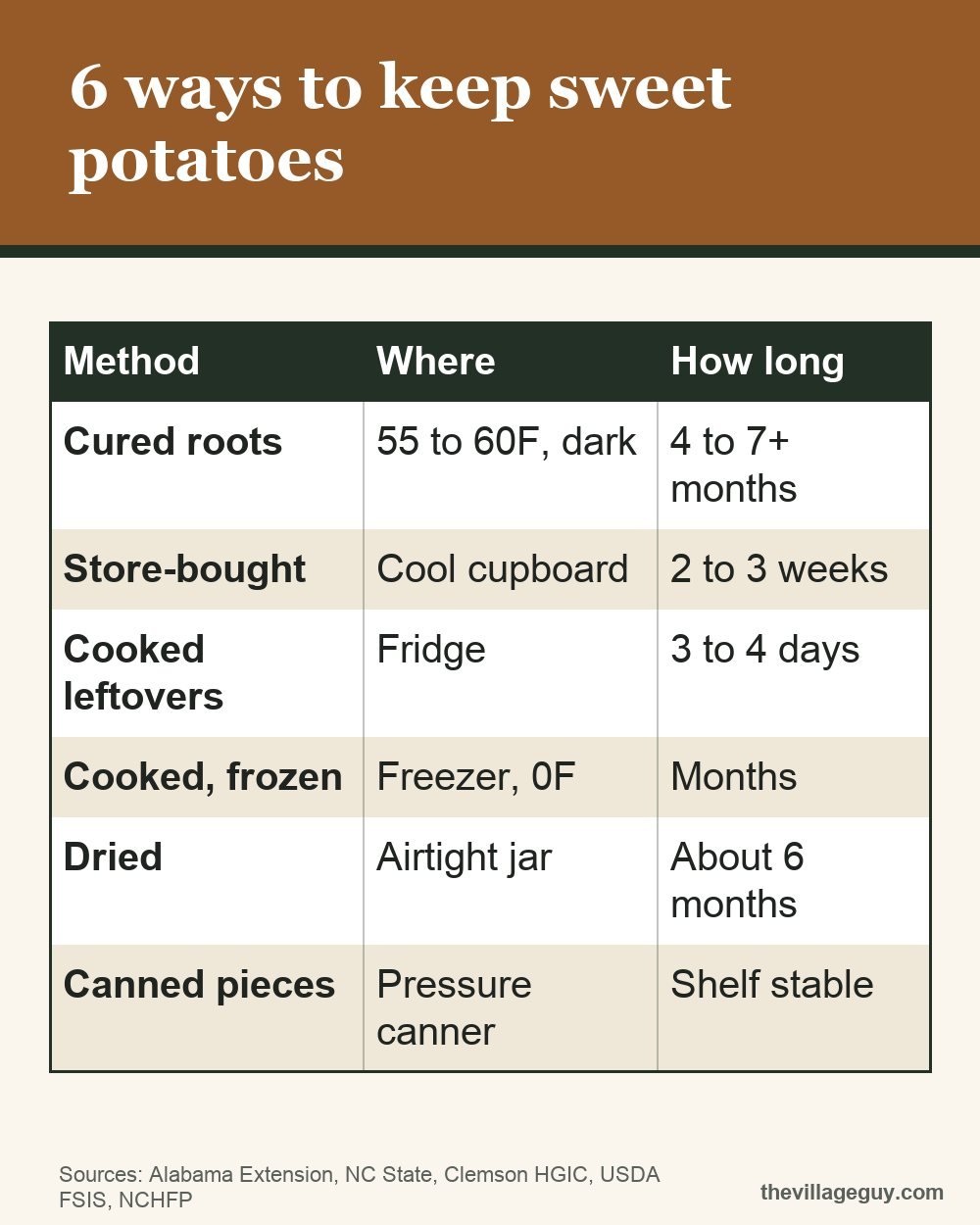
| Your sweet potatoes | Best method | Conditions | Typical keeping time |
|---|---|---|---|
| Freshly dug from the garden | Cure, then store | 85°F, high humidity, 4 to 7 days; then 55 to 60°F | 4 to 7 months, often longer |
| Bought at the store or market | Cool, dark, airy spot | Below room temperature, never the fridge | A few weeks; washed, packed roots about 2 to 3 weeks |
| Cooked leftovers | Refrigerator | 40°F or below, within 2 hours of cooking | 3 to 4 days |
| Cooked, a surplus | Freezer | 0°F, cooked and cooled first | Best quality for months; safe while frozen |
| Cooked and dried | Airtight jars, cool and dark | Dried until brittle | About 6 months at 60°F |
| Pieces in jars | Pressure canning only | Follow the NCHFP tested process | Shelf stable when processed correctly |
Curing and storage figures come from Alabama Cooperative Extension, NC State Extension and Clemson HGIC; leftover times from USDA FSIS; dried-food storage from Clemson HGIC.
Dig and handle them gently
Storage life is decided the day you dig. Sweet potato skin is thin and scrapes off at a touch, and NC State Extension notes that skinned and bruised roots shrink faster, look worse and give rot organisms a way in. Treat a crate of fresh roots the way you would treat a crate of eggs.
Beat the cold
Sweet potatoes are tropical, and cold injures them even underground. University of Maryland Extension warns that soil below 50°F can cause chilling injury, and Clemson HGIC advises digging before frost because cool soil lowers quality and storage life. If frost blackens the vines, Maryland says to dig right away; if you cannot, cut the vines and cover the rows with loose soil. NC State adds that chilling damage may not show for weeks or months.
Keep them out of the sun and off the ground overnight
NC State reports sunscald can develop after as little as 30 minutes in bright sun, and says harvested roots should never be left in the field overnight. Dig in the morning, let the roots surface-dry for a short while, and get them under cover. Do not wash them before curing, and do not rub off clinging soil: Alabama Extension and Maryland Extension both say washing and scrubbing come later, if at all.
- Check root size before frost, and dig before soil drops below 50°F
- Cut the vines off first so you can see where the roots are
- Dig wide with a fork or spade, starting well away from the crown
- Lift roots by hand and set them down; never toss them into a bucket
- Get dug roots out of bright sun within about half an hour
- Sort out cut, stabbed or crushed roots to eat first
- Leave soil on and skip washing until you are ready to cook
If you are planning next year’s patch, our guide to starting a vegetable garden covers choosing a sunny site and building beds, so this page sticks to what happens after harvest.
How to cure sweet potatoes at home
Curing does two jobs. Clemson HGIC explains that it heals cuts and scrapes, and converts some of the root’s starch to sugar. Uncured sweet potatoes taste starchy and bland straight out of the ground, and their open wounds invite rot. NC State says a delay of as little as 12 hours before curing is harmful, so set up the curing spot before you dig.
The target conditions
Extension sources agree on warm and humid, and differ a little on the details:
| Source | Temperature | Humidity | Time |
|---|---|---|---|
| NC State Extension | About 85°F | 85 to 90% | 3 to 5 days, well ventilated |
| Alabama Cooperative Extension | 85°F | 90 to 95% | 4 to 7 days |
| Clemson HGIC (ideal) | 85°F | 90% | About 1 week |
| Clemson HGIC (home kitchen) | Warmest room, above 70°F | Room air | About 14 days |
| Univ. of Maryland (home) | Porch, garage or covered spot | Outdoor air | About 1 week |
Two warnings sit underneath those numbers. Clemson says no curing happens below 70°F, and NC State says curing below 75°F increases weight loss and shortens storage life. NC State also warns that overcuring leads to sprouting and fast weight loss, so this is a set-it-and-check-it job, not a set-it-and-forget-it one.
Practical ways to hit 85°F and high humidity
Few houses have a spare tropical room, so home growers improvise. A common approach is a small room or closet with a thermostat-controlled heater, a humidifier or pans of water, and a low fan. Maryland’s simpler option: spread roots in a single layer on a mesh screen on a porch or in a garage for about a week while early fall weather is still warm, safe from rain and animals. Maryland says roots usually still store successfully even when the formal cure is skipped.
Safety: If you use a space heater to cure, choose one with tip-over and overheat shutoff, keep it well clear of cardboard, crates and curtains, plug it directly into a wall outlet, and never leave it running in a closed room with no one checking. Follow the manufacturer’s instructions on clearances.
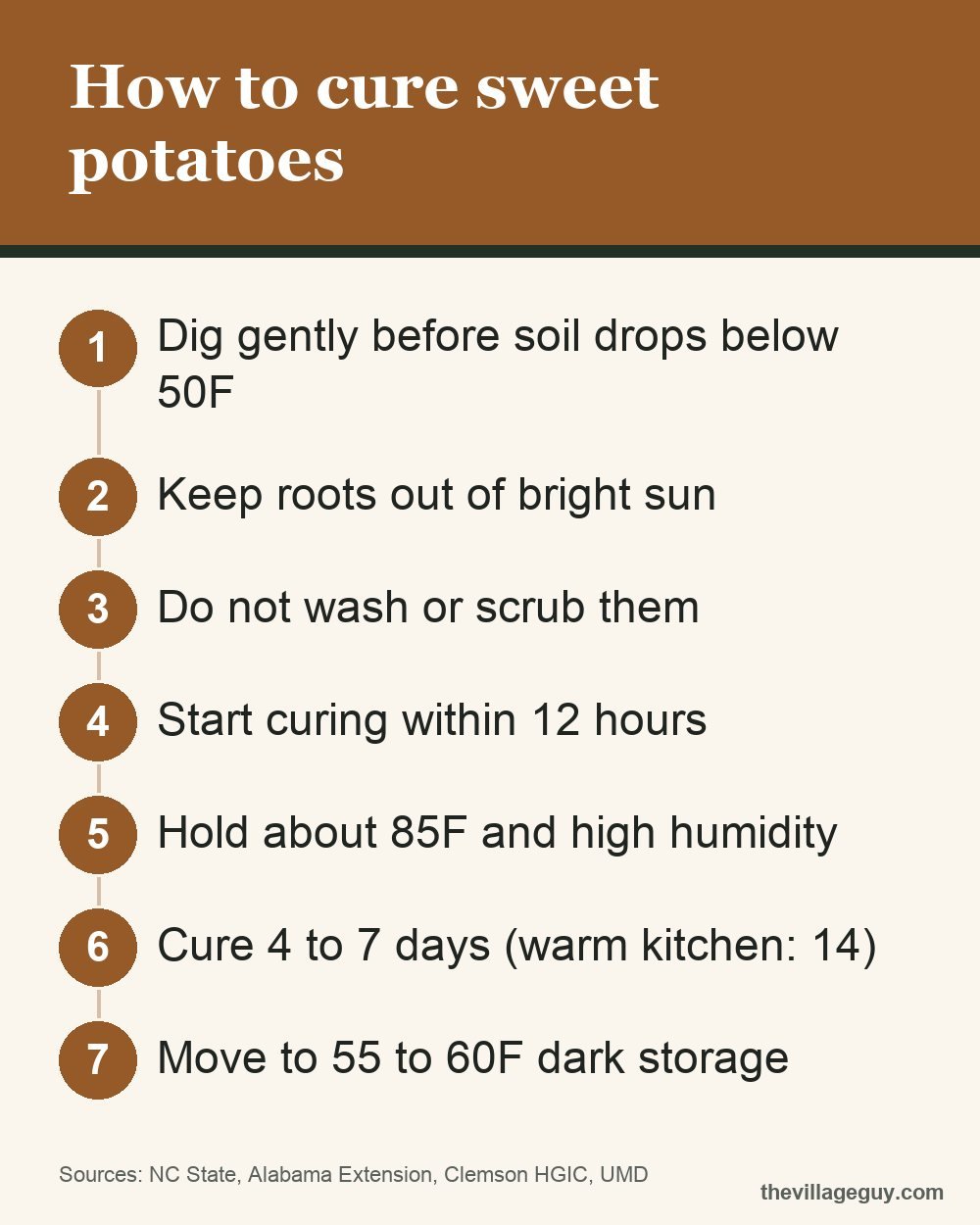
- Set up the curing spot and a thermometer-hygrometer before harvest day
- Start curing within 12 hours of digging
- Spread roots one or two layers deep in slatted crates or on screens
- Hold about 85°F and 85 to 95 percent humidity, with gentle airflow
- Check temperature and humidity twice a day
- End the cure after 4 to 7 days (about 14 days in a warm kitchen)
- Move cured roots to storage without dropping or rubbing them
What you’ll need for curing and storage
None of this is fancy, but a few items make the difference between guessing and knowing.
- Digital thermometer-hygrometer: one that reads both temperature and relative humidity, ideally with a min/max memory, so you can see whether the curing spot stayed near 85°F and whether the storage spot dipped below 55°F overnight.
- Slatted crates or ventilated bins: wooden or plastic, shallow enough to hold roots a few layers deep; Alabama Extension notes slatted crates and bins are the usual storage containers because roots need air.
- Space heater with safety shutoffs: tip-over and overheat protection and an adjustable thermostat, for holding a small curing room in the mid 80s.
- Small humidifier or water pans: to push humidity up toward the 85 to 95 percent range during the cure.
- Small circulating fan: low speed is enough; NC State stresses ventilation during curing and storage.
- Newspaper or plain paper bags: Maryland Extension suggests lining boxes or baskets with newspaper, and wrapping roots individually helps keep one rotting root from spreading trouble.
- Digging fork: a sturdy four-tine fork lets you loosen soil wide of the roots with fewer stab wounds than a narrow spade.
Where to keep cured roots (and why not the fridge)
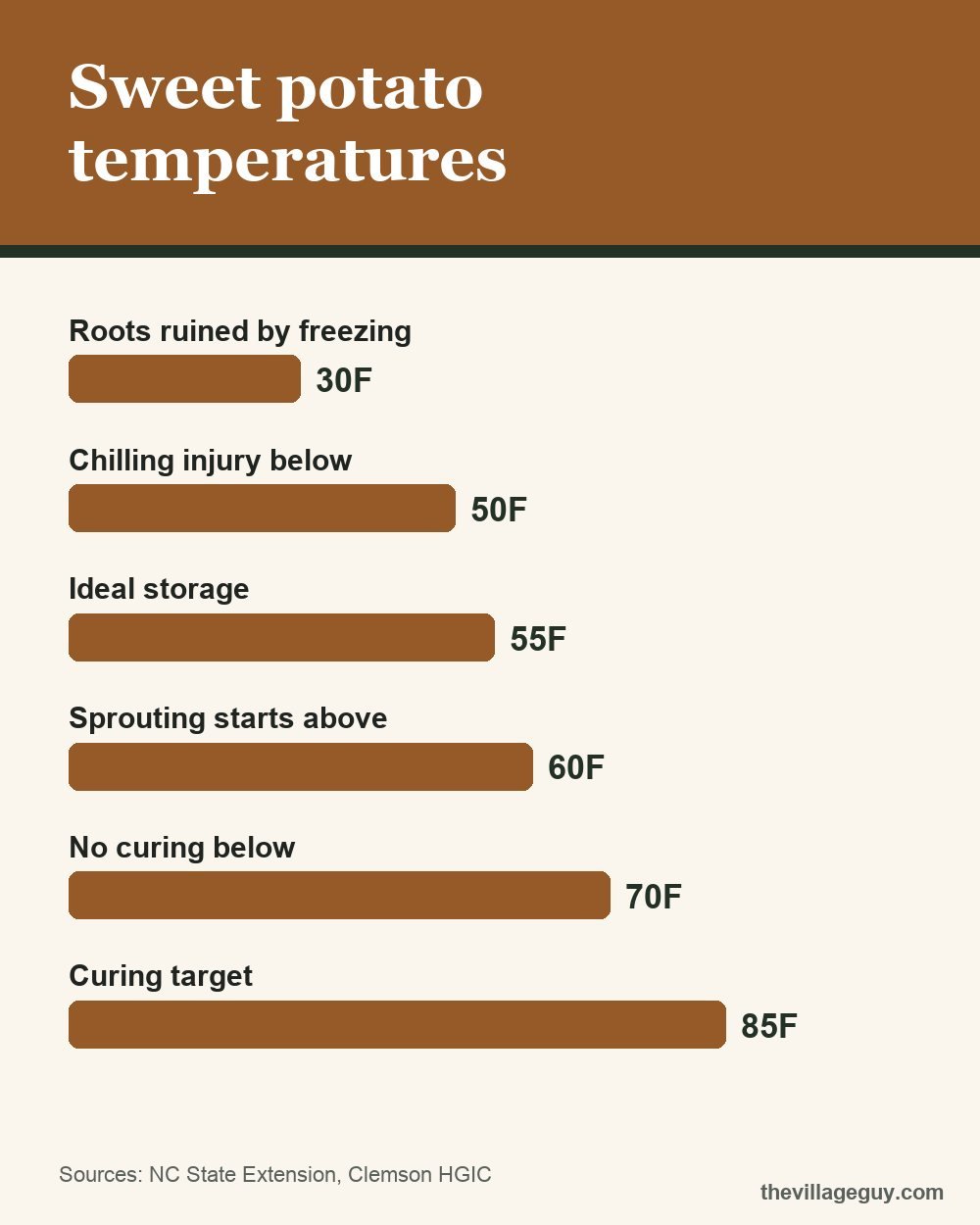
After curing, sweet potatoes want 55 to 60°F, darkness, decent humidity and steady conditions. NC State puts the ideal at 55°F and 85 to 90 percent humidity, held within 3 or 4 degrees; it warns that swings of more than 5 degrees cause early breakdown and weight loss. Alabama gives 55 to 60°F at 80 to 85 percent humidity. In a house, that usually means a basement corner, an insulated but unheated room, an interior closet against a cool wall, or an attached garage that never freezes.
Why the refrigerator ruins raw sweet potatoes
A fridge near 40°F is chilling-injury territory. Alabama Extension says roots are damaged below 54°F; a brief dip to 50°F is harmless, but a few days at 50°F, or shorter spells colder, can cause discolored flesh, internal breakdown, off-flavors, hard cores when cooked and more decay. NC State adds that chilling is cumulative: one hour at 40°F can do the same damage as five hours at 45°F. Clemson HGIC sums it up bluntly: never refrigerate them. The giveaway is a hard core: a center that stays woody however long you bake it.
Why warm storage fails too
Above 60°F, roots start to sprout. NC State says sprouts may take a month or more to appear at 65°F, but can show within a few weeks at 75°F or warmer, and sprouting burns through the root’s reserves and moisture. Alabama adds that warm storage can make roots pithy. So the kitchen counter next to the stove is a short-term spot, not a winter home.
How long do sweet potatoes last?
It depends almost entirely on whether they were cured and how cool and steady the storage is. Alabama Extension says most properly cured varieties keep about 4 to 7 months; Clemson says over six months under good conditions; commercial houses with tight control stretch high-quality roots to about a year.
Homegrown versus store-bought
Supermarket sweet potatoes were cured and stored commercially, then washed, graded and sometimes waxed or treated with a fungicide before shipping, according to Alabama Extension. That washing is the catch. Alabama Extension says washed, fungicide-treated roots in consumer packs last only about 2 to 3 weeks, and it notes perforated plastic bags lose much less weight than mesh bags. So buy what you will use in a couple of weeks, keep it in a cool, dark, airy cupboard, and do not expect store roots to behave like your own cured crop.
Cooked sweet potatoes
Once cooked, sweet potatoes follow the same rules as any leftover. USDA FSIS says to refrigerate within 2 hours and use leftovers within 3 to 4 days, or freeze them. A baked sweet potato left on the stovetop overnight belongs in the compost.
Can you freeze sweet potatoes? Yes, cooked first
Freezing is the easiest way to keep a surplus, as long as you cook the roots before they go in. The National Center for Home Food Preservation (NCHFP) method starts with medium to large sweet potatoes that have been cured for at least one week.
- Sort by size and wash.
- Cook until nearly tender by boiling, steaming, pressure cooking or baking.
- Cool at room temperature, then peel and cut into halves, slices or mash.
- To stop darkening (optional), dip whole roots or slices for 5 seconds in 1/2 cup lemon juice per quart of water, or mix 2 tablespoons of orange or lemon juice into each quart of mash.
- Pack into freezer containers, leave 1/2 inch of headspace, seal and freeze.
NCHFP also gives a baked method: heat unpeeled potatoes at 350°F until slightly soft, cool, peel, wrap each in foil, bag and freeze, then finish baking at 350°F in the foil when you want them. Clemson HGIC publishes the same steps. USDA FSIS notes that food kept constantly at 0°F stays safe, but quality slowly declines, so label bags with the date and eat the oldest first.
- Sweet potatoes, cooked and mashed, 1 quart, frozen on [date]
- Sweet potatoes, baked whole in foil, finish at 350°F, frozen on [date]
Dehydrating and pressure canning
Dehydrating
Extension drying charts generally treat root vegetables as cook or blanch first, slice thin and dry until brittle. Clemson HGIC says dried vegetables should be brittle or crisp, at about 10 percent moisture, cooled completely before packing so they do not sweat and mold, and packed in clean, dry, insect-proof jars or tins. It gives a storage guide of about six months at 60°F or three months at 80°F. Most extension drying tables have no sweet potato row, so follow your dehydrator manual and the brittle test.
Pressure canning
Sweet potatoes are a low-acid food, and the only tested home method uses a pressure canner. A boiling water bath canner cannot reach the temperature needed to destroy botulism spores in low-acid foods, so it is not an option, and neither is an oven, a steam canner or a made-up time. The NCHFP page “Potatoes, Sweet: Pieces or Whole” lays out the process, including headspace and the processing times and pressures for dial and weighted-gauge canners at different altitudes. Two of its rules surprise people: it says not to mash or puree the pieces, and it calls for small to medium roots canned within one to two months of harvest. Read the full NCHFP page and your canner’s manual before you start, and adjust for altitude exactly as the page shows.
Safety: Never water-bath can sweet potatoes, and never can mashed or pureed sweet potato at home; there is no tested process for it. Freeze mash instead. If a jar’s lid is bulging, the seal has failed, or the contents spurt, smell off or look moldy, do not taste it.
Sprouts, soft spots and mold: troubleshooting
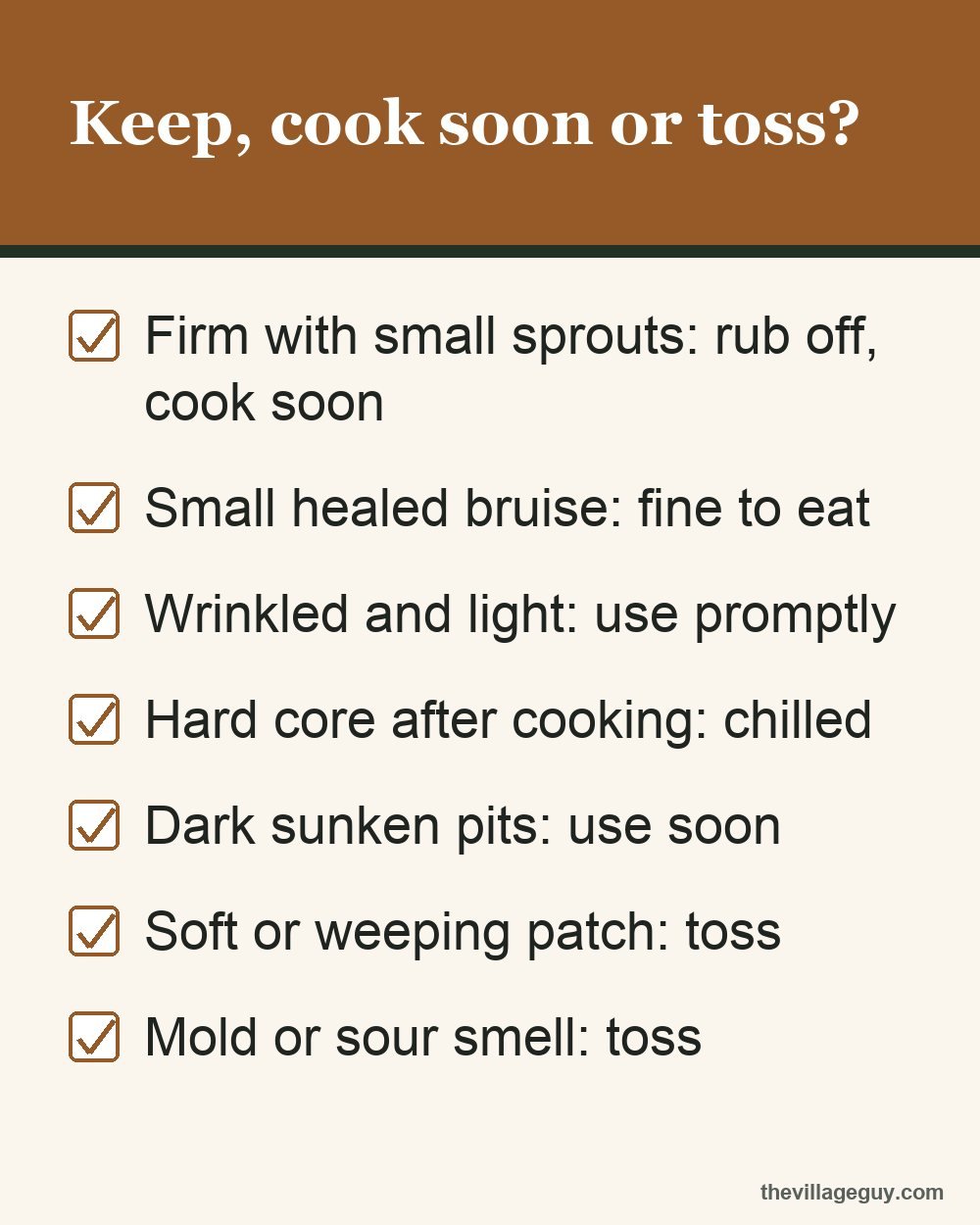
Stored roots tell you what went wrong if you know what to look for. Use this table on your weekly check.
| What you see | Likely cause | What to do |
|---|---|---|
| Small sprouts at one end | Storage above 60°F or overcuring | Rub off sprouts, cook soon, move the rest somewhere cooler |
| Hard center that never softens when cooked | Chilling injury (fridge or cold soil) | Cut away; keep roots above 55°F next time |
| Dark, sunken pits on the skin | Chilling injury | Use soon; check for rot underneath |
| Wrinkled, light, rubbery roots | Air too dry or too warm | Use promptly; raise humidity or wrap roots in paper |
| Soft, wet or weeping patches | Rot starting, often at a wound | Discard the root and check its neighbors |
| Blue-green or fuzzy mold | Decay, often after chilling or bruising | Discard; do not cut around mold on a soft root |
Chilling symptoms are from NC State and Alabama extension; sprouting and shriveling causes from NC State and Maryland extension.
For more seasonal projects, see our guides page, including how to plant garlic, which goes in during the same fall window.
Sweet potato storage FAQ
Should you refrigerate sweet potatoes?
Not raw ones. Refrigerator temperatures cause chilling injury: dark spots, off-flavors, hard centers and faster rot, per Clemson HGIC and Alabama Extension. Cooked sweet potatoes are different and do belong in the fridge, for 3 to 4 days.
Are sprouted sweet potatoes safe to eat?
A sweet potato with small sprouts is generally fine to cook once you rub or cut the sprouts off, as long as the root is still firm. NC State notes that sprouting speeds up respiration and weight loss, so a sprouting root is on the clock. If the root has gone soft or wrinkly as well, eat it soon or plant it for slips.
Can you freeze raw sweet potatoes?
The NCHFP freezing method cooks the roots until nearly tender before freezing, either by boiling, steaming, pressure cooking or baking. NCHFP does not publish a method for freezing raw sweet potatoes, so stick with the tested route: cook first, then freeze halves, slices or mash.
Do sweet potatoes need to be cured if I bought them at the store?
No. Supermarket roots were cured commercially before they were washed and packed. Just keep them cool, dark and dry, away from the fridge, and use them within a couple of weeks.
Sources
- NC State Extension: Postharvest Handling of Sweetpotatoes (chilling, sunscald, curing and storage conditions, sprouting)
- Alabama Cooperative Extension System: Harvesting and Curing Sweet Potatoes (curing and storage conditions, storage life, chilling symptoms, store-bought roots)
- Clemson Cooperative Extension HGIC 1322: Sweetpotato (home curing, no refrigeration, storage life)
- Clemson Cooperative Extension HGIC: Sweetpotatoes, selecting and storing (refrigeration causes dark spots and off-flavors, freezing steps)
- University of Maryland Extension: Growing Sweet Potatoes in a Home Garden (harvest, porch or garage curing, storage)
- National Center for Home Food Preservation: Freezing Sweet Potatoes (freezing method)
- National Center for Home Food Preservation: Potatoes, Sweet: Pieces or Whole (tested pressure canning process)
- Clemson Cooperative Extension HGIC: Drying Vegetables (dryness test and storage of dried vegetables)
- USDA FSIS: Leftovers and Food Safety (refrigerate within 2 hours, use within 3 to 4 days)
- USDA FSIS: Freezing and Food Safety (food held at 0°F stays safe; quality declines over time)