
Crack a duck egg into a pan next to a hen’s egg and the difference is obvious: a bigger, taller, deeper-orange yolk sitting in a white that holds its shape like it has somewhere to be. Duck eggs are richer than chicken eggs by the numbers, too, with noticeably more fat, cholesterol, iron and vitamin B12 per egg in USDA data. They also come with their own rules for collecting, cooking, baking and hatching, which is what this page sorts out.
Quick answer: A duck egg weighs about 70 g against 50 g for a large chicken egg, and USDA FoodData Central lists it at roughly 130 calories, 9 g protein and 9.6 g fat per egg (a large hen’s egg: about 72 calories, 6.3 g protein, 4.8 g fat). Egg-type breeds such as Khaki Campbells and Indian Runners can lay more than 230, and some over 300, eggs a year, according to Cornell. Refrigerate duck eggs at 40°F or below, cook them until the white and yolk are firm, and expect about 28 days to hatch.
In this guide
- Duck eggs vs chicken eggs: 7 differences
- Duck egg nutrition, egg for egg
- How many eggs do ducks lay? Rates by breed
- Collecting duck eggs: mornings, mud and floor nests
- Duck egg food safety: Salmonella, washing and the fridge
- Cooking duck eggs: frying, boiling and scrambling
- Baking with duck eggs: swap by weight
- Hatching duck eggs: the 28-day calendar
- Duck eggs and egg allergy
- Duck eggs FAQ
Duck eggs vs chicken eggs: 7 differences
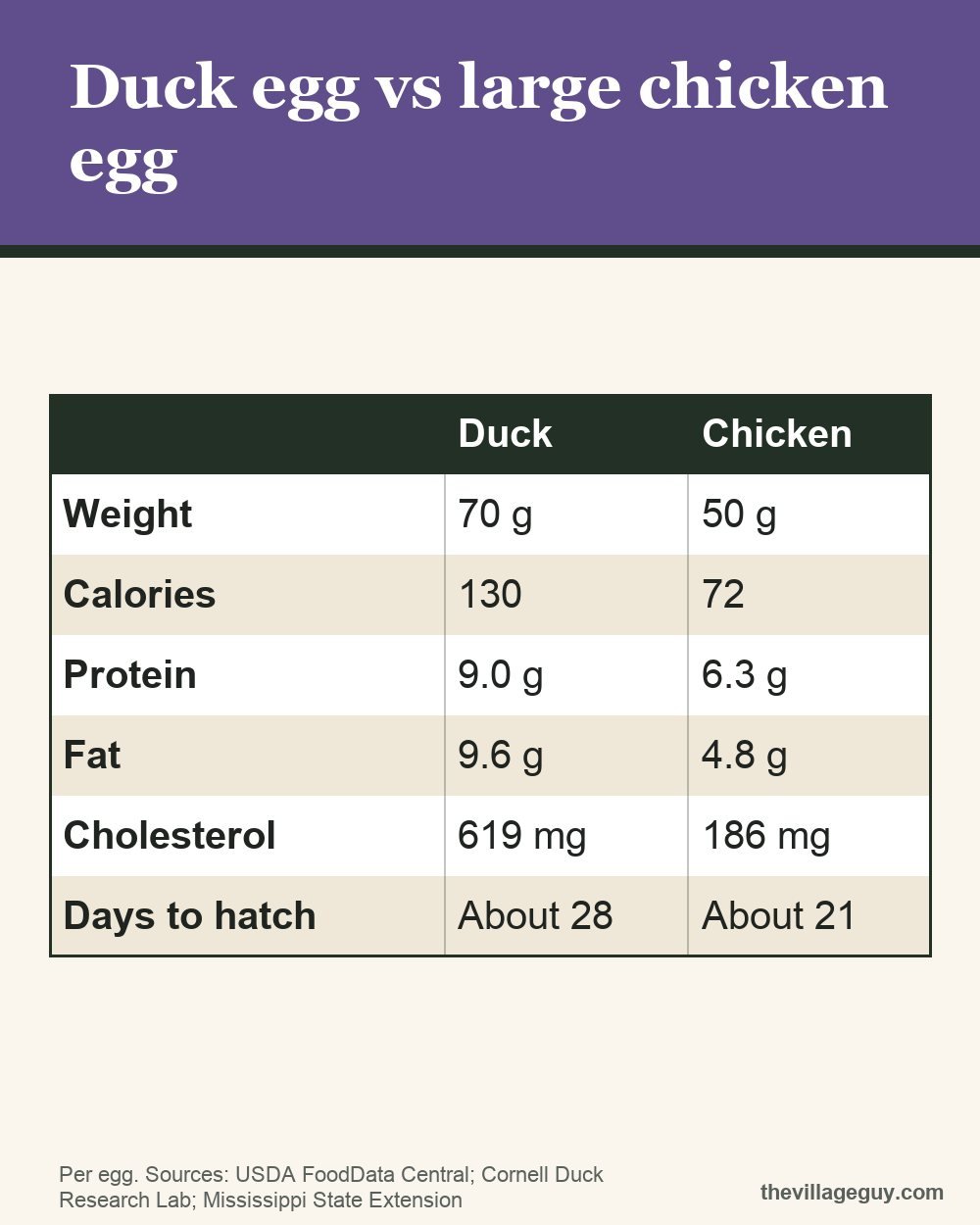
Most of what people notice about duck eggs traces back to two facts in the USDA nutrient tables: they are bigger, and they carry less water and more fat per gram. Here is how they compare with a USDA large chicken egg.
| Difference | Duck egg | Chicken egg (large) |
|---|---|---|
| 1. Weight | About 70 g (2.5 oz) each | About 50 g (1.8 oz) |
| 2. Water | 70.8 g per 100 g | 76.2 g per 100 g |
| 3. Fat | 13.8 g per 100 g | 9.5 g per 100 g |
| 4. Protein | 12.8 g per 100 g (9 g per egg) | 12.6 g per 100 g (6.3 g per egg) |
| 5. Cholesterol | About 619 mg per egg | About 186 mg per egg |
| 6. Laying time | Mostly within 3 hours of sunrise | Mostly within 5 hours of sunrise |
| 7. Days to hatch | About 28 (Muscovy about 35) | About 21 |
Weights and nutrients are from USDA FoodData Central; laying times are from University of Kentucky poultry specialist Jacquie Jacob; duck hatch times from Cornell’s Duck Research Laboratory and the chicken figure from Mississippi State University Extension. A University of Wisconsin-Madison Extension article puts production duck eggs at 32 to 34 ounces per dozen against 24 to 26 ounces for USDA Large chicken eggs, which agrees with the per-egg weights.
The shell is the difference you feel first. Duck shells and the membrane beneath them are widely described by cooks and keepers as tougher than a hen’s, so expect to tap harder and to pick a few more shell fragments out of the bowl. Shell color varies by breed: the University of Kentucky lists white shells for Pekins, off-white for Campbells and blue-tinted eggs from Rouens and darker Runner varieties.
Duck egg nutrition, egg for egg
Comparing per 100 g makes duck and chicken eggs look closer than they are on the plate, because nobody eats 100 g of egg. Per egg, the gap widens: about 1.4 times the protein, twice the fat and three times the iron of a large hen’s egg. These figures are calculated from the USDA FoodData Central SR Legacy entries (duck egg, whole, fresh, raw, 70 g; chicken egg, whole, raw, fresh, large, 50 g).
| Per egg | Duck (70 g) | Chicken, large (50 g) |
|---|---|---|
| Calories | 130 | 72 |
| Protein | 9.0 g | 6.3 g |
| Total fat | 9.6 g | 4.8 g |
| Saturated fat | 2.6 g | 1.6 g |
| Cholesterol | 619 mg | 186 mg |
| Iron | 2.7 mg | 0.9 mg |
| Vitamin B12 | 3.8 mcg | 0.4 mcg |
| Folate | 56 mcg | 24 mcg |
| Choline | 184 mg | 147 mg |
| Selenium | 25.5 mcg | 15.4 mcg |
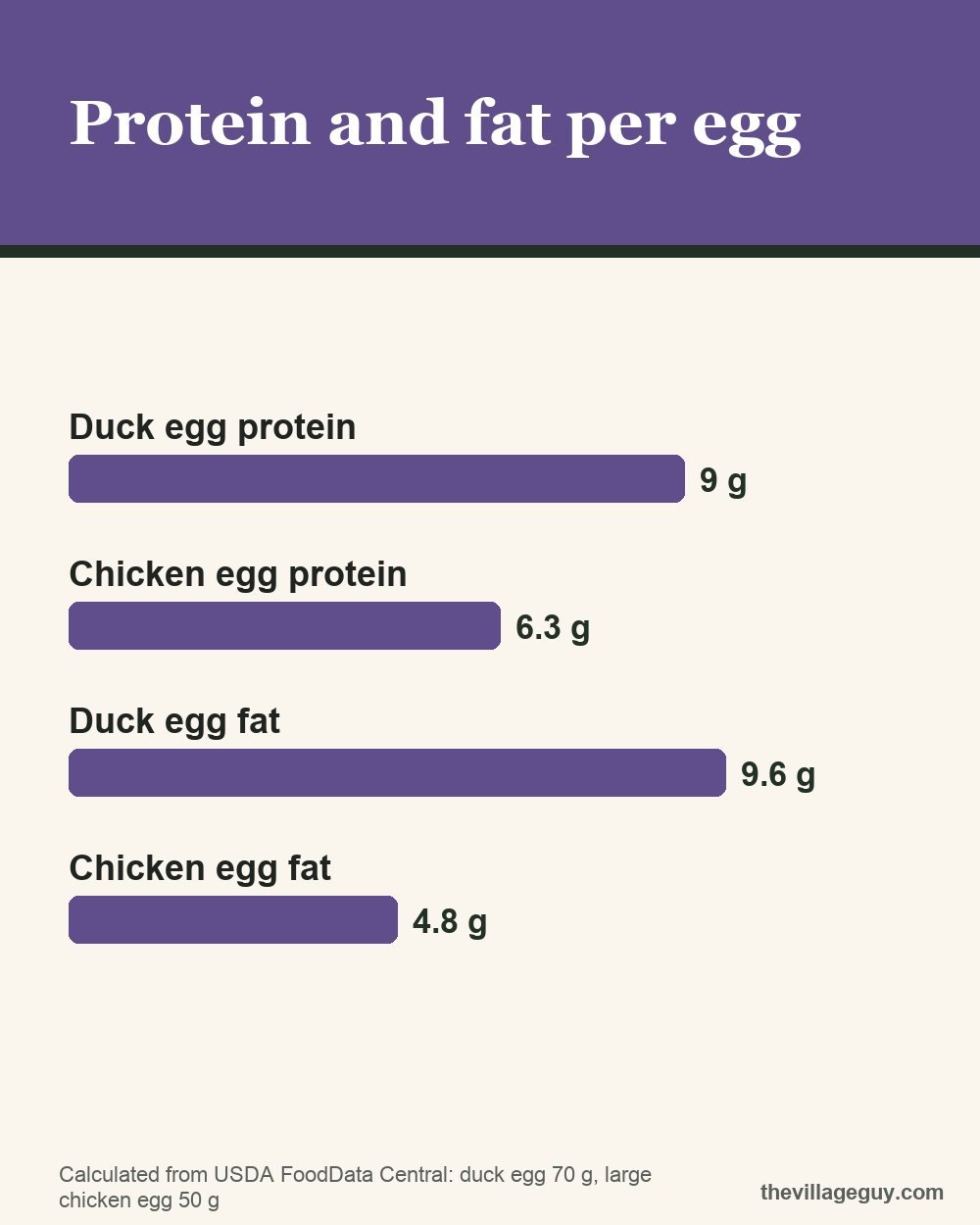
So is a duck egg “healthier”? It depends what you are counting. It delivers more protein, iron and B12 per egg, and also more calories, saturated fat and cholesterol. If your doctor has you watching cholesterol or saturated fat, one duck egg is not a like-for-like swap for one hen’s egg. These are averages; the hen’s diet, breed and age move the numbers.
How many eggs do ducks lay? Rates by breed
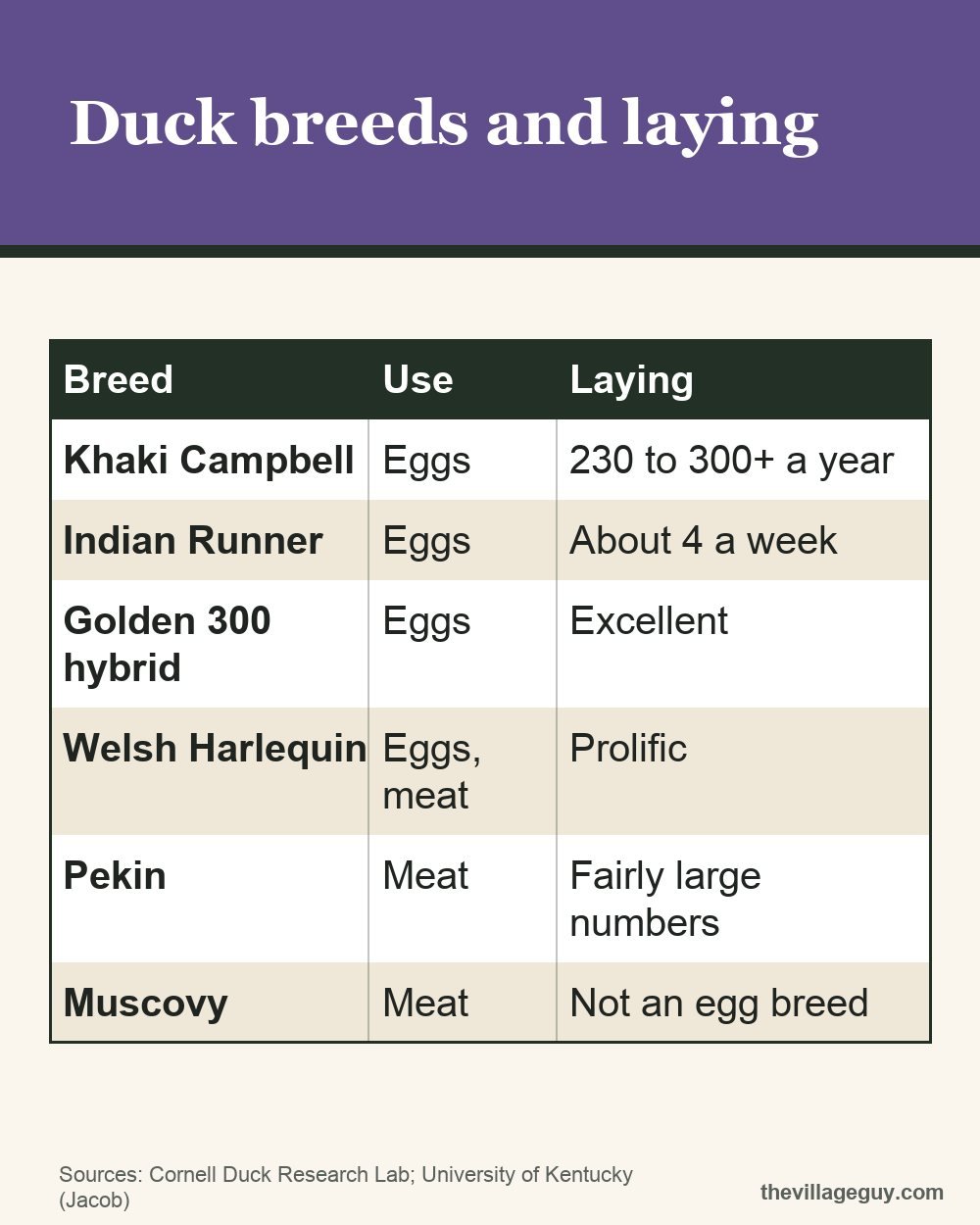
The short answer to how many eggs do ducks lay: anywhere from a modest seasonal clutch to more than 300 a year, and breed decides most of it. Cornell’s Duck Research Laboratory says the egg-type breeds (Khaki Campbell, Indian Runner and Tsaiya) can lay in excess of 230 eggs a year, and in some cases over 300. University of Wisconsin-Madison Extension puts commercial egg-producing ducks at 300 to 350 eggs a year, compared with 250 to 280 for a commercial White Leghorn hen.
| Breed | Main use | Laying, per extension sources |
|---|---|---|
| Khaki Campbell | Eggs | Over 230 a year, some over 300 (Cornell); can lay through winter with added light (Kentucky) |
| Indian Runner | Eggs | About 4 a week for about 8 months; some utility strains over 300 a year (Kentucky) |
| Golden 300 and other egg hybrids | Eggs | Described as excellent, exceptionally productive layers (Kentucky, Wisconsin) |
| Welsh Harlequin | Eggs and meat | A “prolific producer” (Kentucky); no annual figure given |
| Pekin | Meat | Lays “fairly large numbers” of white eggs (Kentucky); commercial egg strains exist |
| Rouen | Meat, ornamental | About an egg every other day in breeding season (Kentucky) |
| Muscovy | Meat | Not bred for egg numbers; no figure in these sources |
The University of Kentucky notes that Runner output depends on whether the birds come from an exhibition or a utility strain, so ask the hatchery which you are buying. Campbells reach laying age at about six months. Expect the top of any range only with good layer feed, clean water and healthy birds; production usually dips as days shorten, so winter gaps are normal.
Collecting duck eggs: mornings, mud and floor nests
Ducks are less tidy about laying than hens. Many ignore nest boxes and drop eggs in bedding, in a corner, or wherever they happen to be standing, and a duck that lays in the pond has turned breakfast into a fishing trip. Because most eggs arrive within three hours of sunrise, a common approach is to keep the flock in its house or run until mid-morning, then let them out once the eggs are in.
- Keep ducks shut in until mid-morning so eggs are laid indoors
- Give them a low, ground-level nest area with deep, dry bedding
- Collect every morning, and again later if anyone lays in the afternoon
- Check corners and under bedding for buried eggs
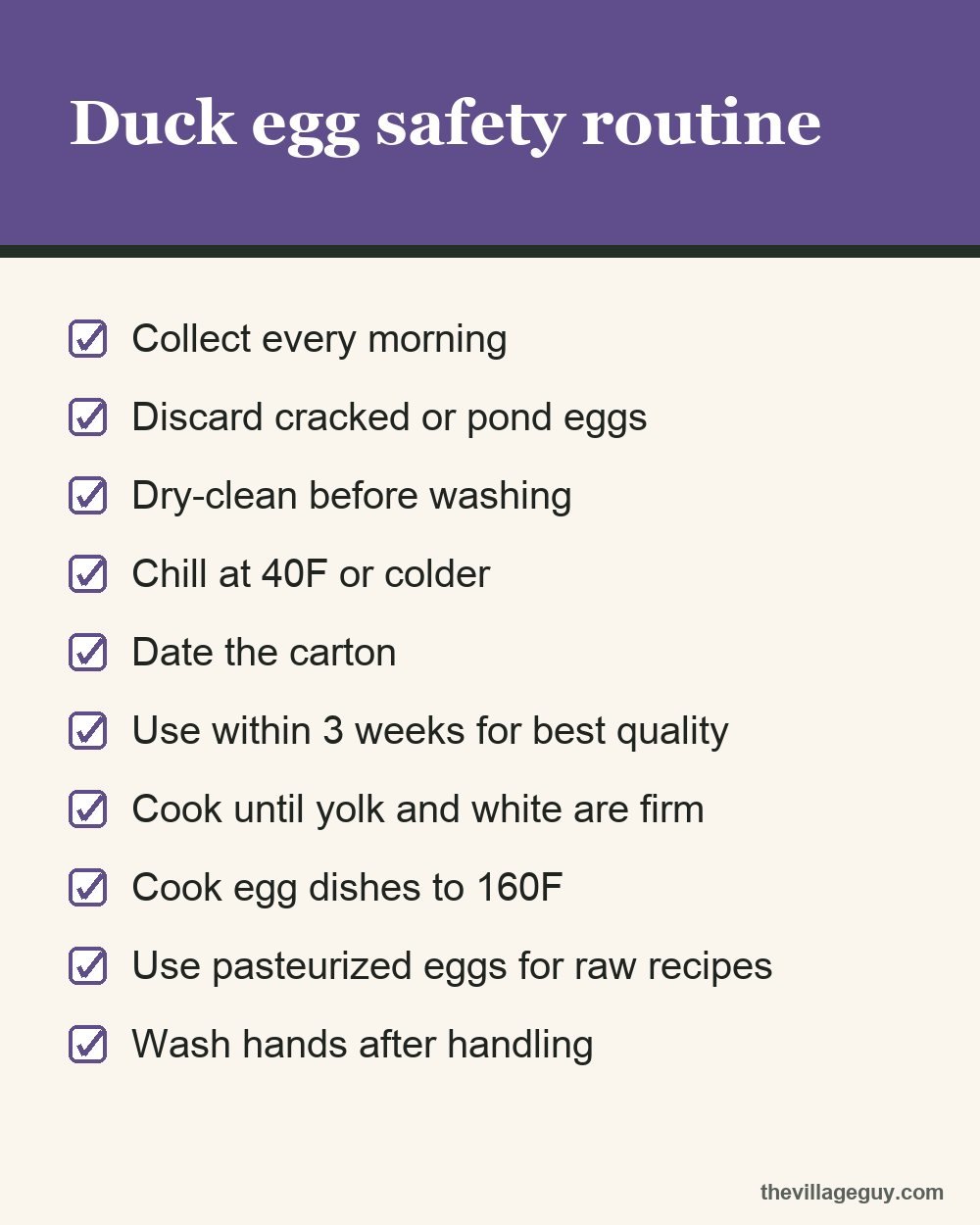
- Throw out cracked eggs; the CDC says bacteria get in more easily
- Throw out any egg you find in or beside the pond, or of unknown age
- Refresh soiled bedding often; wet bedding is the main source of muddy shells
Because ducks splash water everywhere, expect more dirty shells than from a hen house. Dry-clean light dirt first, and if you must wash, follow the warm-water method in our guide on how to wash fresh eggs safely; the same rules apply to duck eggs.
Duck egg food safety: Salmonella, washing and the fridge
Duck eggs carry the same basic risk as hen’s eggs, and some food safety agencies treat them with extra caution. The CDC warns that backyard poultry, ducks and ducklings included, can look healthy and clean and still spread germs that make people sick. Ireland’s Food Safety Authority notes that Salmonella is sometimes found in duck eggs and that undercooked duck eggs have been linked to past outbreaks there, so it advises against eating them raw or lightly cooked.
Safety: The FDA says to cook eggs until both the yolk and white are firm and to cook egg dishes to 160°F, checked with a thermometer. For anything served raw or lightly cooked (mayonnaise, mousse, eggnog), use pasteurized eggs instead of farm duck eggs. Children, older adults, pregnant women and people with weakened immune systems are most at risk of severe Salmonella illness, so be strictest when cooking for them. Keep children under 5 from handling ducklings, as the CDC advises.
US rules for refrigerating, keeping and checking eggs apply to duck eggs as well, so there is no need for a separate system. The FDA recommends storing eggs at 40°F or below in their carton and using them within 3 weeks for best quality, and not leaving cooked egg dishes out for more than 2 hours (1 hour above 90°F). For the full storage timeline, see how long fresh eggs last, and for doubtful finds from a hidden nest, use the checks in how to tell if eggs are bad.
- Chill duck eggs at 40°F or colder soon after collecting
- Store them in a carton, away from ready-to-eat food
- Write the collection date on the carton
- Wash hands and counters after handling raw duck eggs or shells
- Skip tasting raw batter or dough made with duck eggs
- Swap in pasteurized eggs for any recipe that stays raw or runny
Cooking duck eggs: frying, boiling and scrambling
Because a duck egg is larger and heavier, it needs more cooking time than a hen’s egg; Ireland’s Food Safety Authority says so directly. Start with your usual timing, add a little, and judge by the egg rather than the clock: the white fully set and opaque, the yolk thickened and firm.
Fried and scrambled
The lower water and higher fat give duck eggs a richer, denser texture. Many cooks find the whites turn rubbery if blasted on high heat, so medium heat and a lid (to set the top of the white without frying the bottom to leather) work well. Scrambled duck eggs set into larger, creamier curds; stop when no liquid egg remains.
Hard-cooked
Use the same method you use for hen’s eggs, with more time in the pot, then cool them quickly in cold water. The FDA says hard-cooked eggs should be used within 1 week.
Tip: One duck egg on toast is a solid breakfast on its own. At roughly 9 g of protein, a single duck egg carries about the protein of one and a half large hen’s eggs.
Baking with duck eggs: swap by weight
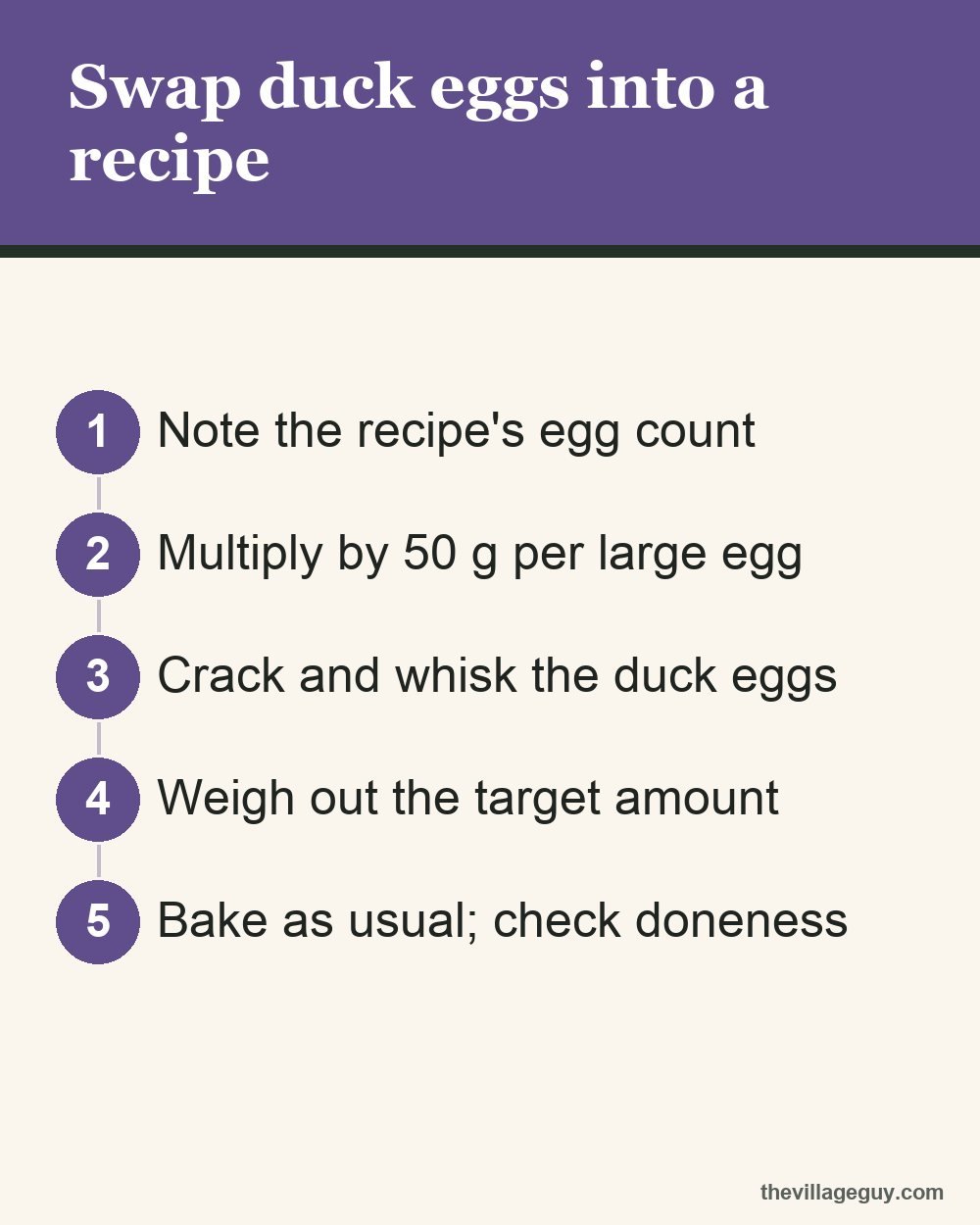
Duck eggs have a loyal following among bakers, who report richer cakes and custards, credited to the extra fat and lower water. That reputation comes mostly from cooks rather than controlled trials, so treat it as a promising tendency, not a law. What is certain is the math: a duck egg is bigger, so swapping one-for-one adds more egg than the recipe expects.
A worked example
A recipe that calls for 3 large eggs expects about 150 g of egg (3 x 50 g). Two duck eggs at about 70 g each give about 140 g, close enough for most cakes and quick breads, which is where the common “2 duck eggs for 3 hen’s eggs” rule comes from. Duck eggs vary in size more than graded store eggs, though, so for anything delicate, whisk the eggs and weigh them.
- Recipe egg weights: 1 large egg = 50 g; 2 large = 100 g; 3 large = 150 g; 4 large = 200 g
- Duck egg swap: 2 duck eggs (about 140 g) for 3 large eggs; weigh for custards and sponges
Bakers also commonly report that duck egg whites take longer to whip into stiff peaks; room-temperature whites and a spotless, grease-free bowl help. And because the batter will contain raw duck egg, resist licking the spoon; the Irish food safety agency specifically warns against tasting raw mixtures.
Hatching duck eggs: the 28-day calendar
Cornell’s Duck Research Laboratory says eggs from common ducks take about 28 days to hatch, a week longer than the 21 days Mississippi State University Extension lists for chicken eggs. Muscovy eggs, from a different species, take about 35 days (Mississippi State gives 35 to 37). That extra week matters if you are mixing breeds in one incubator.
| Stage | Cornell’s guidance |
|---|---|
| Before setting | Store at about 55°F and 75% humidity, narrow end down; set within 1 to 3 days (7 days costs about 3% hatchability, 14 days about 10%) |
| Days 1 to 25 | 99.5°F (37.5°C), 55% relative humidity, turned at least 4 times a day |
| Day 7 | Candle and remove infertile eggs and dead embryos |
| Day 25 | Candle again; move to hatcher at 99°F and 65% humidity; stop turning |
| Pipping | Raise humidity to about 80% and increase ventilation |
| Day 28 | Hatch (Pekin); Muscovy about day 35 |
These are Cornell’s settings for Pekin eggs in setter-and-hatcher machines. A small home incubator may have its own instructions, and where they differ, follow the manufacturer.
- Set only clean, uncracked, normal-shaped eggs; skip doubles and oddly sized ones
- Run the incubator a day ahead to confirm it holds 99.5°F
- Mark day 7, day 25 and day 28 on the calendar when you set the eggs
- Keep Muscovy eggs in a separate batch because they hatch about a week later
Duck eggs and egg allergy
People with a chicken egg allergy sometimes ask whether duck eggs are a safe substitute. The American Academy of Allergy, Asthma and Immunology says lab studies show cross-reactivity between hen, duck, goose and turkey egg white, but its clinical significance has not been established, and published data are thin. Its expert’s advice is that skin testing with duck egg is reasonable, a negative skin test does not rule out an allergy, and only a supervised oral challenge settles it.

Safety: If you or a child has an egg allergy, do not test duck eggs at home. Ask an allergist, who can decide whether testing or a supervised food challenge makes sense.
Duck eggs FAQ
Are duck eggs healthier than chicken eggs?
Neither wins outright. USDA data show a duck egg has more protein, iron and vitamin B12 than a large hen’s egg, but also nearly twice the calories and about three times the cholesterol. If you are counting protein, duck eggs look good; if you are limiting cholesterol or saturated fat, ask your doctor before making them a daily habit.
Can you eat duck eggs with a runny yolk?
Official advice says no. The FDA recommends cooking eggs until the yolk and white are firm, and Ireland’s food safety authority specifically advises against raw or lightly cooked duck eggs. If you love a runny yolk, pasteurized eggs are the lower-risk choice.
Do ducks lay eggs in winter?
Production usually drops as days shorten. The University of Kentucky notes that Khaki Campbells can keep laying through winter when supplemental lighting is used, while Runners typically lay for about eight months of the year.
How long do duck eggs last in the fridge?
Treat them like hen’s eggs. The FDA advises using refrigerated eggs within 3 weeks for best quality, kept at 40°F or below in the carton. Unwashed farm eggs can keep longer; the details and the evidence are in our egg storage guide linked above.
Keeping ducks alongside hens? Our guide to raising chickens for beginners covers coop and feed basics, and you can browse every Village Guy guide by topic.
Sources
- USDA FoodData Central: Egg, duck, whole, fresh, raw (SR Legacy 172189) (duck egg weight 70 g; water, fat, protein, cholesterol, iron, B12, folate, choline, selenium per 100 g)
- USDA FoodData Central: Egg, whole, raw, fresh (SR Legacy 171287) (large chicken egg 50 g and its nutrients)
- Cornell Duck Research Laboratory: Domestic Ducks (egg breeds over 230, some over 300 eggs a year; 28 and 35 days to hatch)
- Cornell University: Hatching Duck Eggs (storage before setting, incubation temperatures, humidity, turning, candling, day 25 transfer)
- Poultry Extension Collaborative (Jacquie Jacob, University of Kentucky): Selecting a Duck Breed for Small or Backyard Poultry Flocks (breed laying notes, shell colors, laying within 3 hours of sunrise, Campbell maturity, winter lighting)
- University of Wisconsin-Madison Extension (David Laatsch): The Origin of Ducks (commercial ducks 300 to 350 eggs a year vs Leghorn 250 to 280; duck eggs 32 to 34 oz per dozen)
- FDA: What You Need to Know About Egg Safety (40°F storage; 3 weeks; cook until firm; 160°F dishes; 2-hour rule; pasteurized eggs; at-risk groups; hard-cooked eggs within 1 week)
- CDC: Backyard Poultry (healthy-looking poultry can spread germs; discard cracked eggs; refrigerate; children under 5 and ducklings)
- Food Safety Authority of Ireland: Advice on Duck Eggs (Salmonella in duck eggs; outbreaks from undercooked duck eggs; longer cooking; no raw mixtures)
- Mississippi State University Extension: Incubation Duration Periods (chicken 21 days; duck 28; Muscovy 35 to 37; confirmed via search-result text)
- American Academy of Allergy, Asthma and Immunology: Cross-reactivity of hen and duck egg (cross-reactivity data, skin testing and oral challenge)