Seasoned firewood is wood that has dried to below 20 percent moisture, and the whole craft of getting it there comes down to three things: surface area, air and time. Learning how to season firewood means splitting it early, stacking it where wind and sun can reach it, keeping rain off the top, and then proving it is dry with a meter instead of a guess.
The payoff is real. Dry wood lights faster, throws more heat per armload and leaves far less creosote in the chimney. Wet wood hisses, smokes and quietly costs you money, because a big share of its energy goes into boiling off water before it ever warms the room.
Quick answer: Split the wood soon after cutting, stack it in single rows on rails off the ground in a sunny, breezy spot, cover only the top, and leave it at least 6 months (softwoods) to about 12 months or more (dense hardwoods like oak and hickory). It is ready when a moisture meter reads below 20 percent on a freshly split face.
In this guide
- What seasoned means: the 20 percent line
- How to season firewood in 6 steps
- How long firewood takes to dry
- How to stack firewood so air does the work
- A 12-month seasoning calendar
- Test it: moisture meter and quick checks
- Troubleshooting wood that will not dry
- Keep seasoned wood dry until you burn it
- Seasoning firewood FAQ
What seasoned means: the 20 percent line
EPA’s Burn Wise program, the agency’s wood-heat guidance (now kept as an archive after the program ended in 2025), sets the target plainly: wood burns best below 20 percent moisture content. University extension services from New Hampshire to Illinois use the same number.
Freshly cut wood is a long way from that. West Virginia University Extension notes that green wood can hold up to 80 percent water by weight, and that evaporating it can steal up to 15 percent of the wood’s potential heat. University of New Hampshire Extension says green wood can exceed 50 percent moisture. Either way, a fresh split is more water tank than fuel.
| Wood condition | What it does in the stove |
|---|---|
| Green, freshly split | Hard to light, hisses, smolders, heavy smoke, fast creosote buildup |
| Partly dry (roughly 20s to low 30s on a meter) | Burns, but cooler and smokier than it should; needs more air |
| Seasoned, under 20 percent | Catches quickly, burns hot and clean, less wood for the same heat |
| Rotted or moldy | Poor heat; EPA lists rotted, diseased or moldy wood as something not to burn |
The University of Maryland Extension puts the stakes simply: wet wood produces smoke with soot that coats the stovepipe, and that raises the chance of a chimney fire.
How to season firewood in 6 steps
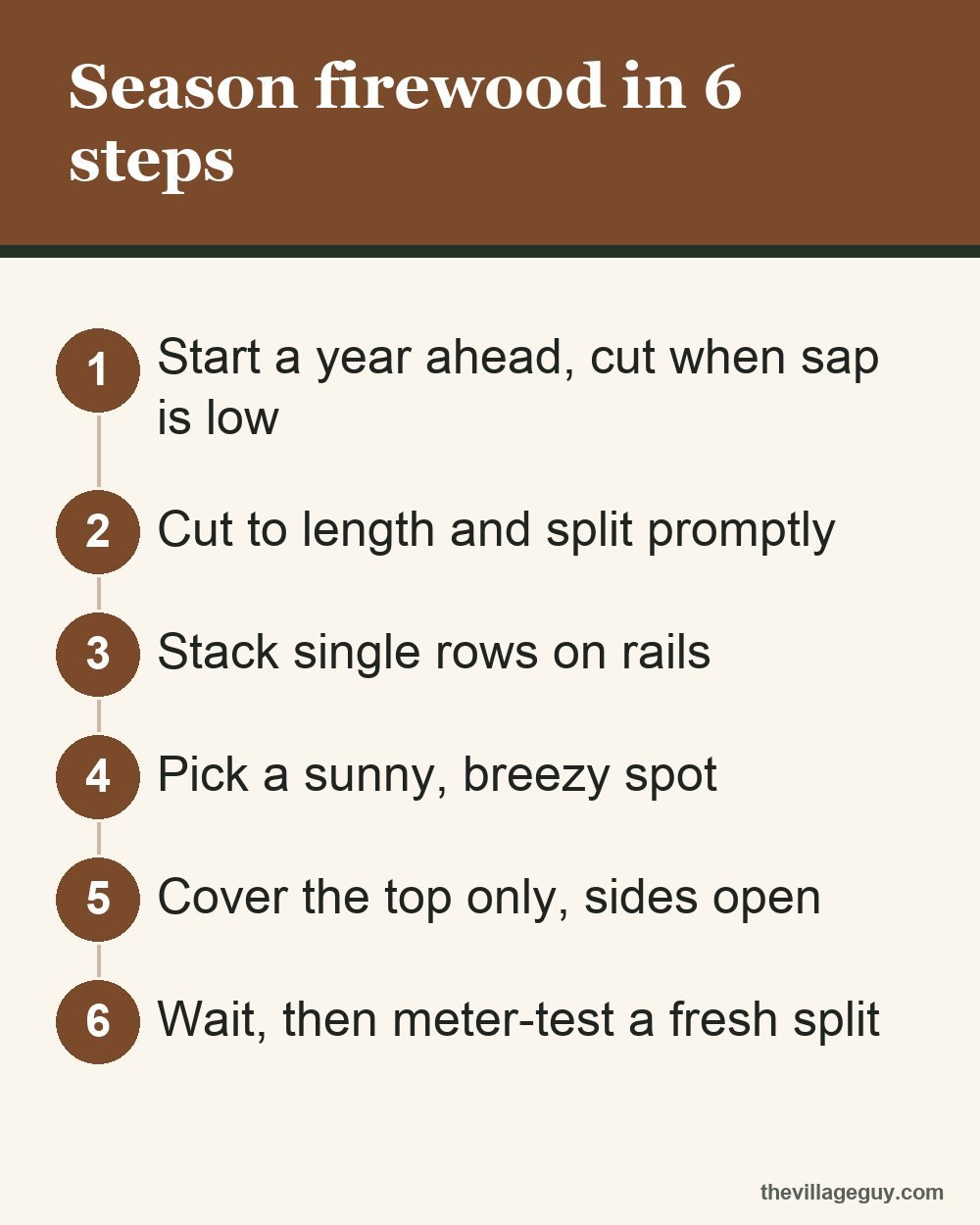
EPA sums up the method as split, stack, cover, store. The six steps below add the two pieces people skip: starting early and testing at the end.
- Start a year ahead. Maryland Extension recommends cutting wood at least one full year before you plan to burn it, and cutting in late summer, fall or winter, when above-ground sap content is lower than during spring sap flow.
- Cut to length and split promptly. Cut rounds to fit your firebox, then split them soon after cutting. EPA’s drying brochure suggests a range of sizes but no wedge wider than about 6 inches, plus a pile of small splits for kindling.
- Stack on rails in single rows. Keep wood off the ground on rails, pallets or a rack, one row deep, so air reaches every piece. EPA’s brochure suggests stacking split side down.
- Pick sun and wind. The Maine Forest Service calls a windy spot exposed to sunlight the best place. The University of Kentucky warns against perpetual shade.
- Cover the top only. Keep rain and snow off the top with a roof, sheet metal or a tarp held above the wood, and leave the sides open.
- Wait, then test. Give softwoods about 6 months and hardwoods about 12 (EPA’s guideline), then check a freshly split piece with a moisture meter before you trust it.
How long firewood takes to dry
Most answers to how long does firewood take to dry cluster around 6 to 12 months: EPA says softwoods take about 6 months and hardwoods about 12, Illinois Extension says at least six to nine months, and the University of Kentucky says six months minimum with a full year preferred. The honest version is “until the meter says so,” because species, piece size, splitting and climate all move the finish line.
What a real drying study found
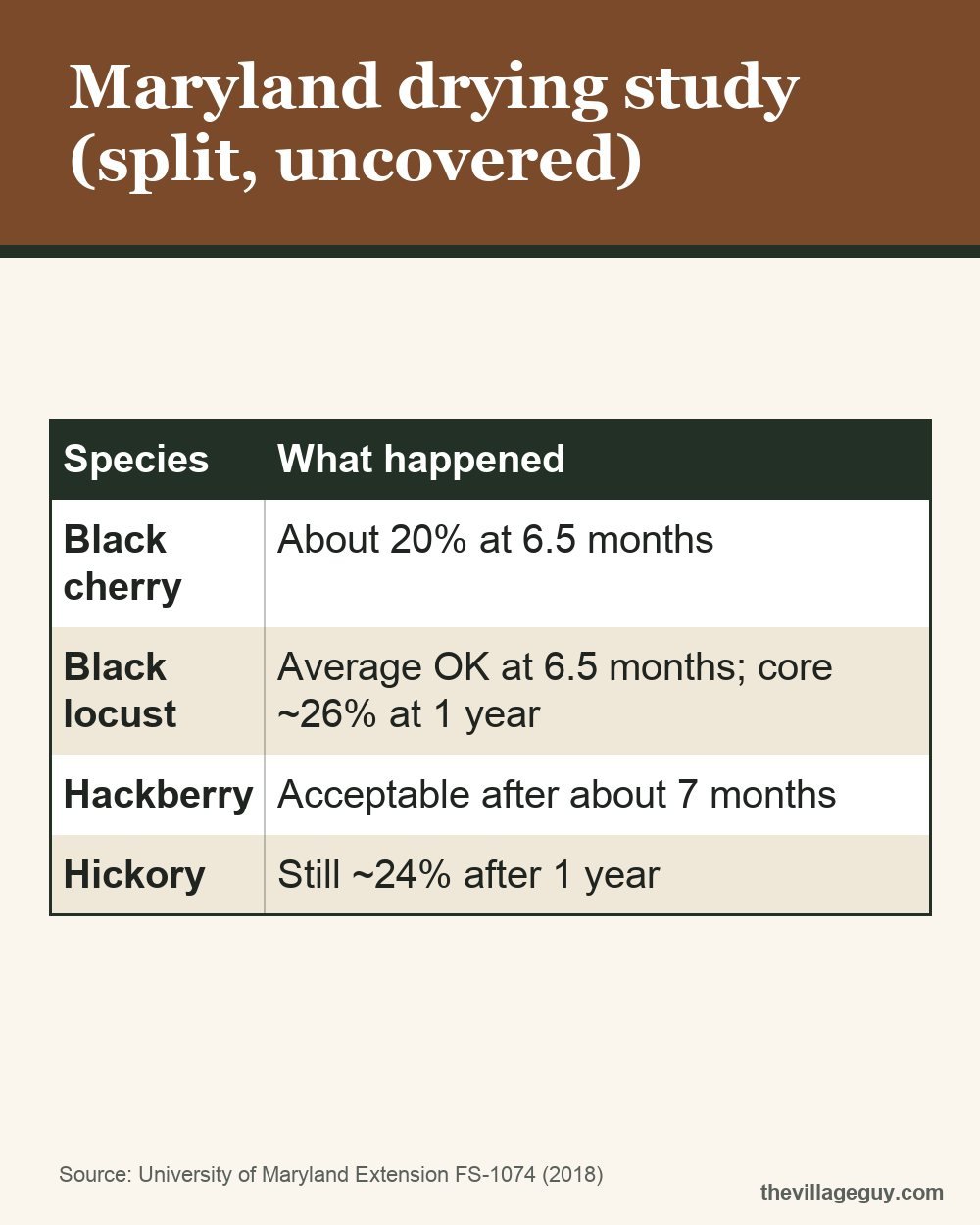
University of Maryland Extension tracked four hardwoods felled in mid-April 2016, cut into 16- to 18-inch pieces, split, stacked on pallets and left uncovered at a field edge that was shaded until mid-morning. Moisture dropped most between September and November, after the summer heat and dry fall weather had done their work.
| Species (split, uncovered) | Result |
|---|---|
| Black cherry | About 20 to 21 percent at 6.5 months; well under 20 percent about a month later |
| Black locust | Average ready at about 6.5 months, but the core still read about 26 percent at one year |
| Hackberry | Slower start; acceptable after about 7 months |
| Hickory | Still averaging about 24 percent after a full year |
Two lessons stand out. First, dense woods lag: the study’s authors expected oak, which they could not test, to behave like hickory or black locust. Second, splitting matters enormously. The same fact sheet reports that hickory left in unsplit, uncovered rounds was still above 30 percent moisture after a year.
Rules of thumb by wood type
| Wood | Plan on | Why |
|---|---|---|
| Softwoods (pine, spruce, fir) | About 6 months | EPA guideline; lighter, less dense wood |
| Medium hardwoods (cherry, hackberry and similar) | About 7 to 12 months | Maryland study results; EPA hardwood guideline |
| Dense hardwoods (oak, hickory, black locust) | 12 months or more | Maryland study: hickory and locust cores still wet at one year |
| Unsplit rounds of any species | Far longer; split them | Unsplit hickory stayed above 30 percent after a year |
Humid climates and northern states stretch every number in that table, which the Maryland authors note directly. Wood cut in spring, when it is wettest, also starts the race from behind.
How to stack firewood so air does the work
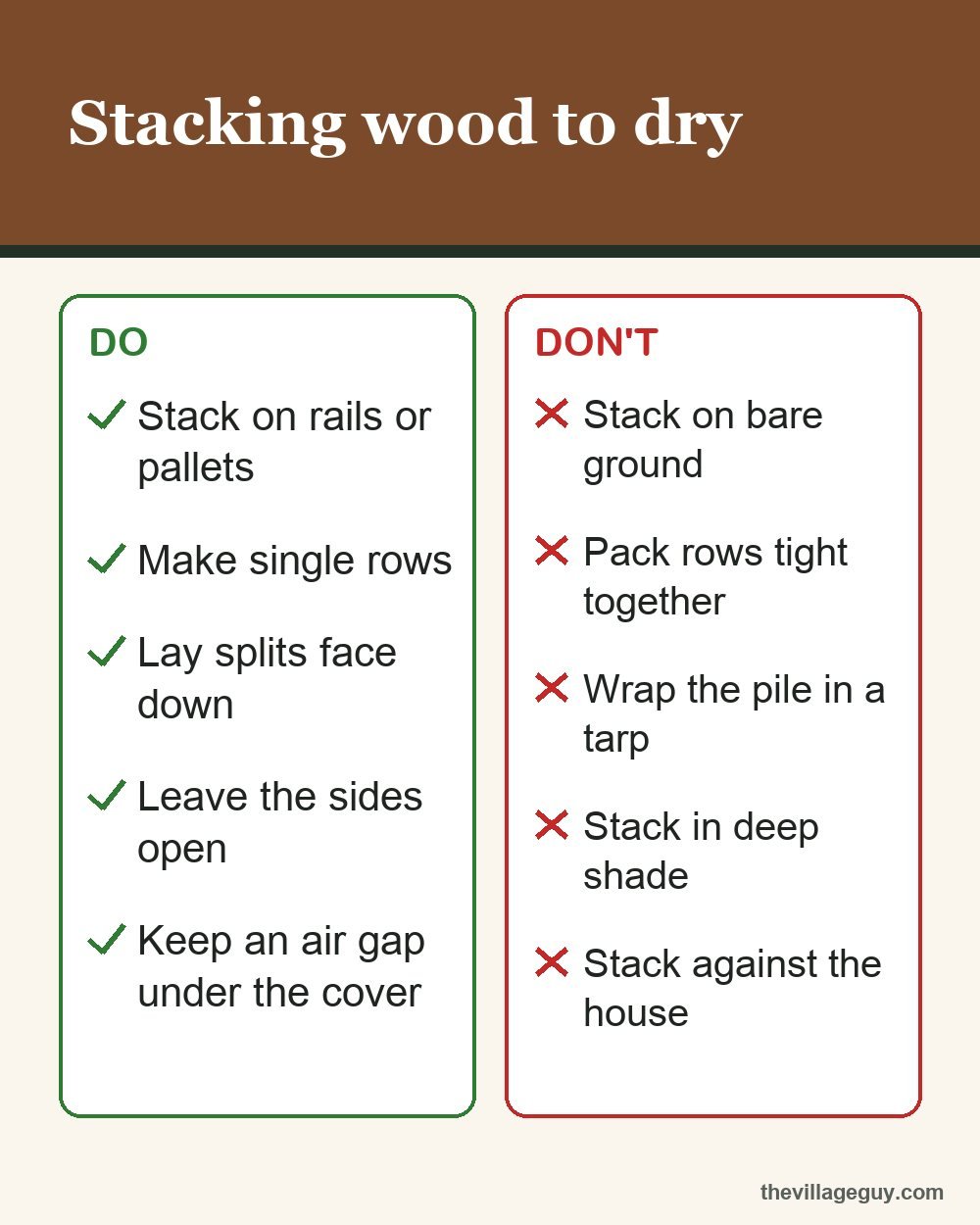
Knowing how to stack firewood is most of the battle, because a perfect split stacked badly dries like an unsplit round. The goal is a stack that lets wind move through it while the top stays dry. EPA’s guidance boils down to rails underneath, single rows, open sides and a cover with an air gap between it and the wood.
| Setup | Drying | Watch out for |
|---|---|---|
| Single row on rails, top covered | Fast: air on both faces | Tipping if stacked too high; brace the ends |
| Open-sided woodshed | Good drying and easy storage | Solid walls or doors that block airflow |
| Metal or wood rack with a top cover | Good for a face cord or two | Covers that drape down the sides |
| Double or triple rows packed tight | Slow in the middle rows | Leave a hand-width gap between rows |
| Tarp wrapped over a heap | Slowest; traps moisture | Mold and rot; EPA says to cover only the top |
Maryland Extension says a covered, well-ventilated woodshed beats a tarp for good air circulation, and points to EPA plans for a simple shed that holds about a cord. The Maine Forest Service adds that covered storage open on the ends helps prevent re-wetting, and that covering wood with clear plastic and venting it with a fan can speed drying if you are in a hurry.
Set up your seasoning yard once and it works every year:
- Pick a spot with full sun and a steady breeze, away from the house.
- Lay two rails, pallets or a rack so the bottom row sits 4 to 6 inches off the ground.
- Stack one row deep with the split faces down, leaving a hand-width gap between rows.
- Build crisscrossed end pillars or use end posts so the stack cannot roll.
- Keep freestanding stacks at roughly chest height so they stay stable.
- Fix a roof, metal sheet or tarp over the top with an air gap, leaving the sides open.
- Label each stack with the month it was split so you burn the oldest first.
A 12-month seasoning calendar
Seasoning is a calendar job more than a muscle job. This plan assumes you want to burn the wood next winter, and it follows the Maryland advice to cut when sap is low and at least a year ahead.
| When | Job |
|---|---|
| Late fall to late winter | Fell or buy log-length wood for next year while sap is low; cut and split on dry days |
| Early spring | Finish splitting; stack everything on rails before spring rains settle in |
| Late spring to summer | Leave it alone; check covers after storms and pull weeds that block airflow |
| Early fall | Meter-test samples from each stack; move the driest wood under cover near the house |
| Winter | Burn stacks that test under 20 percent; start cutting the following year’s supply |
Early fall is also a good weekend to tackle other cold-weather jobs, such as checking which pipes are at risk using our guide to the temperatures at which pipes freeze. If you are buying wood rather than cutting it, green wood bought in spring is often cheaper and has the whole summer to dry; see what a cord holds and what it costs before you order.
Test it: moisture meter and quick checks
A moisture meter takes the guessing out of seasoning, and it is cheap. EPA’s 2020 flyer priced basic meters at $15 to $40, and Maryland Extension’s 2018 fact sheet showed models around $30. Prices vary by store and season.
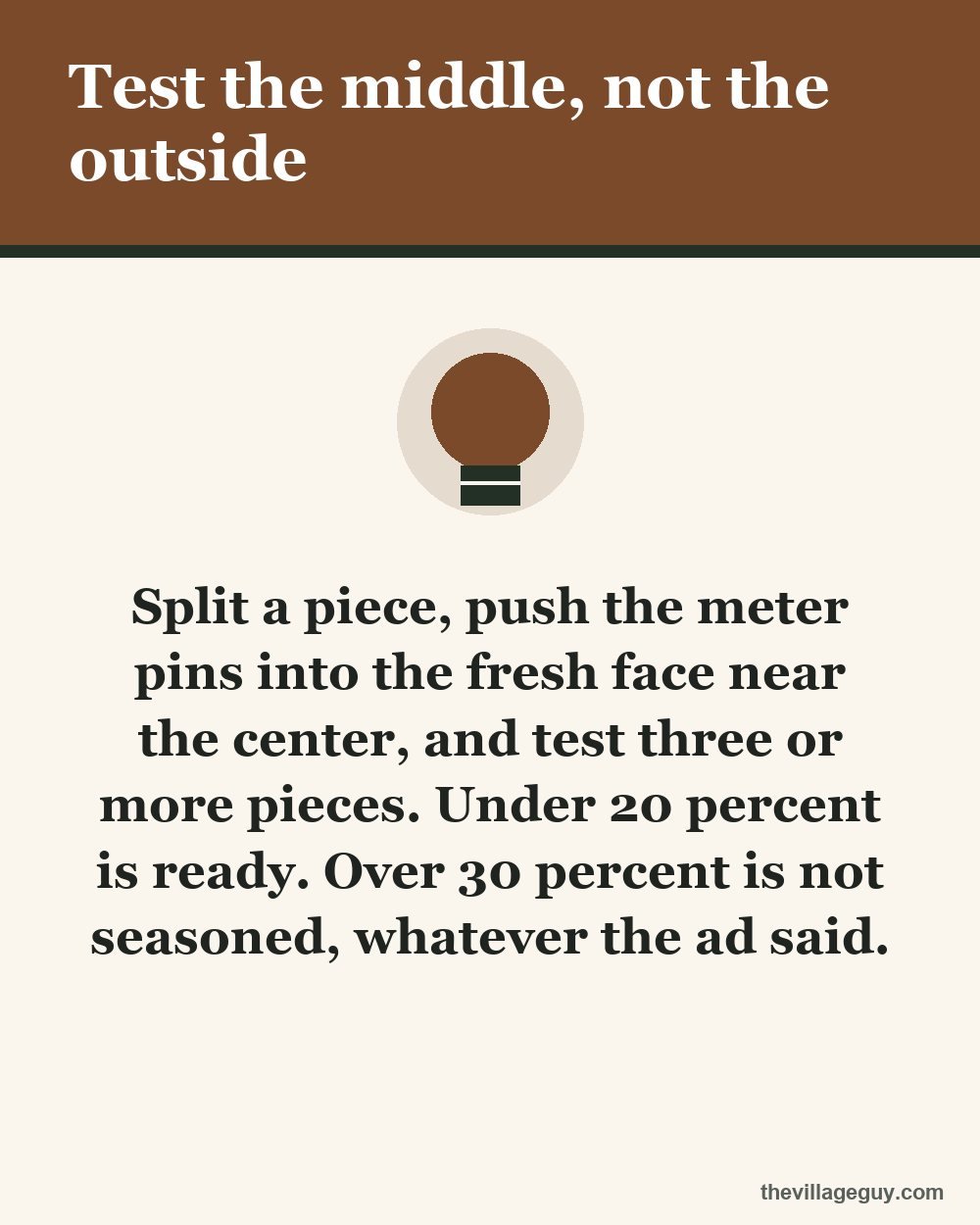
The technique matters more than the meter. The surface of a split dries first, so reading the outside, or the end grain, flatters the wood. Maryland Extension and UNH Extension both say to split a piece and push the pins into the freshly exposed wood, ideally in the middle of the piece.
- Pick three or more pieces from different parts of the stack, including the middle and the bottom.
- Split each piece in half just before testing.
- Press the meter pins into the fresh face near the center of the piece, following the meter’s instructions for pin direction.
- Write down the reading for each piece and go by the highest one, not the average.
- Treat anything over 20 percent as not ready; give it more weeks under cover and test again.
- Test a split from any delivery labeled “seasoned” before the truck is unloaded.
That last point comes straight from Maryland Extension: once the wood is dumped, it is hard to negotiate. The fact sheet says wood reading over 30 percent is not seasoned, and you may refuse delivery or negotiate a lower price.
No meter yet: the quick checks
| Check | Seasoned wood | Source |
|---|---|---|
| Ends | Deep radial cracks (checks) across the end grain | UNH, WVU, Illinois Extension |
| Sound | Two pieces knocked together ring or clink rather than thud | UNH, Illinois Extension, EPA |
| Weight | Noticeably lighter than a fresh split of the same size | EPA, UNH |
| Color | Darker than fresh wood | EPA Burn Wise |
These checks are useful filters, but checking on the ends can appear while the core is still wet. Use them to decide which stack to test, then let the meter decide.
Troubleshooting wood that will not dry
| Problem | Likely cause | Fix |
|---|---|---|
| Still reads 25 to 30 percent after a summer | Dense species, big splits, shade or tight stacking | Re-split the biggest pieces, restack in single rows in full sun, give it another season |
| Outside dry, center wet | Pieces too thick for the time allowed | Split to 6 inches or less across and retest in a month |
| Mold or soft, punky wood | Ground contact or sides wrapped in a tarp | Raise the stack on rails, uncover the sides; set rotted wood aside, not in the stove |
| Bottom row stays wet | Wicking moisture from soil or puddles | Add rails or pallets; Maryland Extension also mentions a plastic layer under the pile |
| Hissing, sizzling, dark glass in the stove | Wood above 20 percent | Burn drier wood; EPA notes dirty glass and smoke signal wet wood or too little air |
| Bought “seasoned” wood reads wet | Split only weeks or months ago | Stack and cover it for next year; buy earlier next time and meter-test on delivery |
Keep seasoned wood dry until you burn it
Dry wood can soak rain back up, so the job is not finished when the meter says 19 percent. Move tested wood into a shed or under a roofed rack for winter, keep the top covered and the sides breathing, and bring only a day or two of fuel indoors at a time.
Placement matters for safety as much as dryness. EPA’s brochure says to build stacks away from buildings, and the University of Kentucky suggests keeping drying and storage stacks at least 30 feet from any structure, both to limit fire risk and to avoid inviting wood-destroying insects up against the house. West Virginia University Extension adds a reminder to buy and burn firewood locally, because moving it spreads emerald ash borer and other forest pests.
Safety: Seasoned wood burns hotter, so keep the indoor wood box at the distance your stove manufacturer specifies and never stack wood against the stove or chimney. Never dry wood on or beside a running stove, and never burn painted, stained or pressure-treated lumber, plywood, particle board or trash to “use up” a pile. Keep working smoke and carbon monoxide alarms, and follow your stove’s manual and local codes.
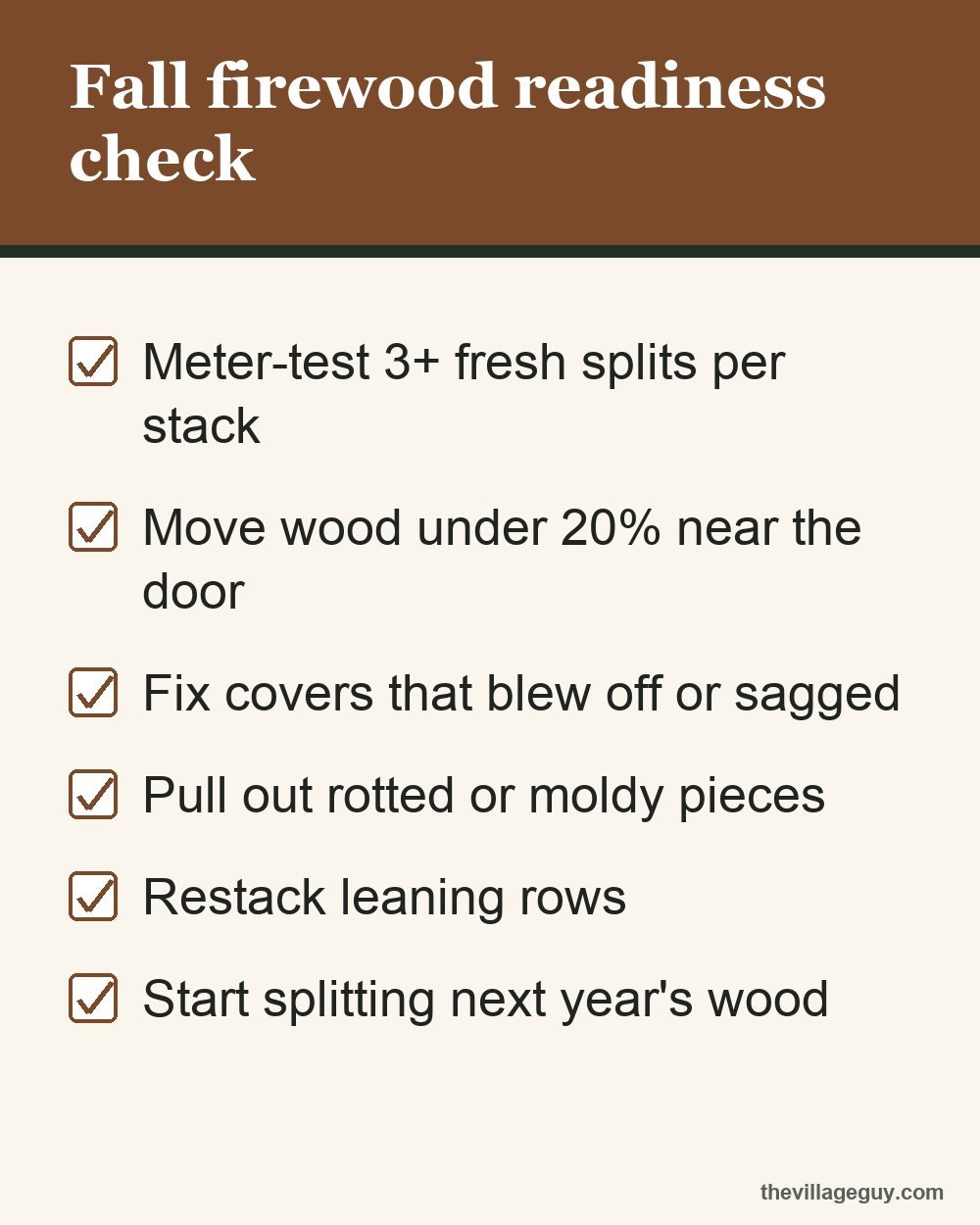
Before the first hard frost, run this quick readiness check:
- Meter-test at least three fresh splits from every stack you plan to burn this winter.
- Move the stacks that test under 20 percent under cover closest to the door.
- Re-cover any stack whose top has blown off or sagged onto the wood.
- Pull out and set aside rotted, moldy or punky pieces.
- Restack anything that has leaned or collapsed during the summer.
- Cut and split next year’s wood as soon as this year’s is under cover.
More cold-weather and country-living guides are collected on The Village Guy guides page.
Seasoning Firewood FAQ
Can you burn unseasoned firewood?
It will burn, but badly. Green wood spends much of its heat boiling off water, smolders, makes more smoke and builds creosote in the chimney faster, which raises the risk of a chimney fire. If you are stuck with damp wood, mix it with your driest splits, burn hot fires with the air open, and have the chimney checked sooner than usual.
Does firewood season in winter?
Slowly. Cold, damp air pulls moisture out of wood much less readily than a hot, breezy summer, and the Maryland study saw its biggest moisture drop after the summer and a dry fall. Winter is still the right time to cut and split, because the wood will be ready to take full advantage of spring and summer drying.
Should I cover my firewood?
Cover the top, not the sides. EPA says to cover only the top because wrapping the sides traps moisture, and to leave an air gap between the cover and the wood. A roofed, open-sided shed is the gold standard; a tarp tied down over the whole heap is the most common mistake.
Can firewood be too old to burn?
Well-stored wood stays good for years, but wood left on the ground or wrapped tight can rot. EPA lists rotted, diseased and moldy wood among the things not to burn, so if a split is soft, crumbly or fuzzy with mold, it belongs in the compost or brush pile rather than the stove.
Sources
- EPA Burn Wise: Best Wood-Burning Practices (under 20 percent moisture, six months minimum, signs of dry wood, cover top only, what not to burn)
- EPA: Wet Wood Is a Waste brochure (6-inch splits, rails, single rows split side down, cover gap, softwood 6 and hardwood 12 months)
- EPA: Test Your Wood with a Moisture Meter (2020) (test the newly split side, meter price range)
- EPA: Wood-Burning Resources for Consumers (Burn Wise archive status, drying videos)
- University of Maryland Extension: Measuring Wood Moisture and Drying Time (FS-1074) (four-species drying study, unsplit hickory, test the middle of a split, cutting season, woodsheds)
- UNH Extension: How can I tell if my firewood is seasoned? (6 to 12 months, meter technique, cracks and ringing sound)
- UNH Extension: Heating Your Home with Wood (green wood over 50 percent moisture)
- WVU Extension: Heating with Firewood (green wood up to 80 percent water, heat lost, drying time, buy local)
- Illinois Extension: Burning Safety (six to nine months, signs of dry wood, creosote)
- University of Kentucky Extension: Firewood (FORFS 17-11) (six months to a year, 30 feet from structures, off the ground, avoid shade)
- Maine Forest Service: Firewood Facts (windy sunny site, covered storage open on ends, clear plastic and fan method)