
A duck eats like a shovel with a water habit. It scoops a bill full of feed, waddles to the waterer, slurps, comes back, and leaves a trail of wet crumbs that would make a chicken keeper wince. So what do ducks eat when they are raised well? Backyard and farm ducks do best on a complete, unmedicated waterfowl feed matched to their age, with drinking water always beside it, a little foraging and greens on the side, and treats kept to a small share of the day.
Quick answer: Domestic ducks should eat a complete unmedicated duck or waterfowl feed: a starter of about 20 percent protein for the first two weeks, then a grower of about 16 to 18 percent, then a layer ration with about 16 percent protein and roughly 3 percent calcium once hens start laying. Always put drinking water next to the feed, keep treats under about 10 percent of the diet, and skip bread, moldy feed, avocado, chocolate and onions.
In this guide
- What do ducks eat: feed first, forage second
- Duck feed by age: starter, grower, layer
- What do baby ducks eat in the first weeks
- Why ducks need water with every bite
- What you’ll need to feed ducks well
- What to feed ducks as treats and forage
- 10 foods to keep away from ducks
- Oyster shell, grit and winter feeding
- Feeding wild ducks at the pond
- Copy-ready duck feeding checklists
- Duck feeding FAQ
What do ducks eat: feed first, forage second
Given space, ducks graze and dabble for green plants, insects, worms and snails. University of Kentucky poultry specialist Jacquie Jacob notes that foraging alone can meet a duck’s minimal nutritional needs, but production will be low, and the smaller the yard per bird, the more the flock depends on bagged feed. For a backyard flock that is supposed to grow well and lay, a complete feed carries the load.
Purina, which makes duck feed, uses a 90/10 split: about 90 percent of the diet from complete feed and no more than 10 percent from treats. Our guide to what chickens eat covers hens; these are the duck differences that cause trouble.
| Question | Ducks | Chickens |
|---|---|---|
| Niacin need | About 55 to 70 mg per kg of feed | At least 30 mg per kg |
| Medicated starter | Avoid; ducks eat more and can overdose | Common for chicks |
| Water at feeding time | Needed beside the feeder to swallow and avoid choking | Needed daily, not at every bite |
| Feed form | Crumbles or pellets; powdery mash can choke them | Mash, crumbles or pellets |
| Feed per dozen eggs | About 20 to 30% more than chickens | Baseline |
Niacin figures are from the Merck Veterinary Manual; the medicated-feed and feed-per-dozen points are from University of Kentucky extension; the feed-form note is from University of Wisconsin extension.
Duck feed by age: starter, grower, layer
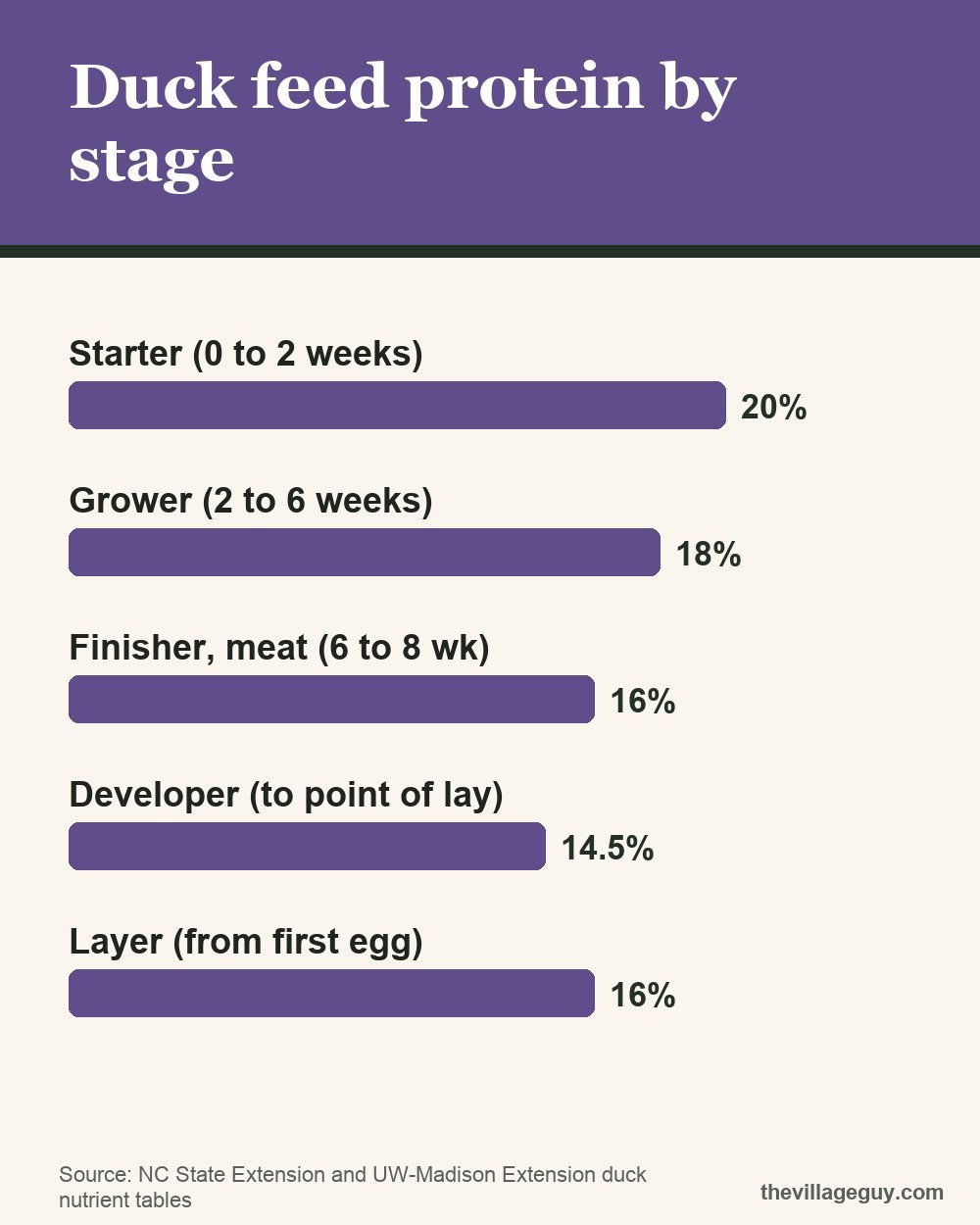
NC State Extension and University of Wisconsin extension publish the same nutrient table for ducks, and it is the clearest map of how protein steps down as ducklings grow. The finisher stage is for meat ducks headed to market at around 7 to 8 weeks; backyard egg and pet ducks move from grower to a developer or maintenance feed and then to layer feed.
| Stage | Age | Protein | Notes |
|---|---|---|---|
| Starter | Hatch to 2 weeks | 20% | 1/8-inch pellets or crumbles; niacin about 25 mg per lb of feed |
| Grower | 2 to 6 weeks | 18% | 3/16-inch pellets; niacin about 20 mg per lb |
| Finisher (meat ducks) | 6 to 8 weeks | 16% | Only for birds raised for the table |
| Developer | Grower to point of lay | 14.5% | Keeps future layers from getting fat |
| Layer | From first egg | 16% | About 2.9% calcium; free-choice oyster shell optional |
Kentucky’s Jacquie Jacob simplifies it for small flocks: about 20 percent protein for the first two weeks, and after that a balanced feed above 16 percent brings no benefit. Turkey and game bird starters carry plenty of niacin, but Kentucky warns their high protein can harm ducklings.
Pellets beat loose mash for ducks. NC State reports that mash reduces growth by about 10 percent compared with pellets and wastes more feed, and Wisconsin warns that ducks tend to choke on powdery feed. Whatever you buy, check the mill date: NC State advises using duck feed within 3 weeks of manufacture, sooner in hot, humid weather.
How much feed a duck eats
Kentucky’s small-flock figures make a handy budget. A duckling raised for eggs eats about 27.6 pounds (12.5 kg) of feed up to 20 weeks old, and a laying duck eats about a quarter pound (120 grams) a day, more or less depending on how hard she lays and how much she forages. Wisconsin puts a commercial duckling’s first week at about half a pound. Put simply, six laying ducks go through roughly a 50-pound bag a month.
What do baby ducks eat in the first weeks
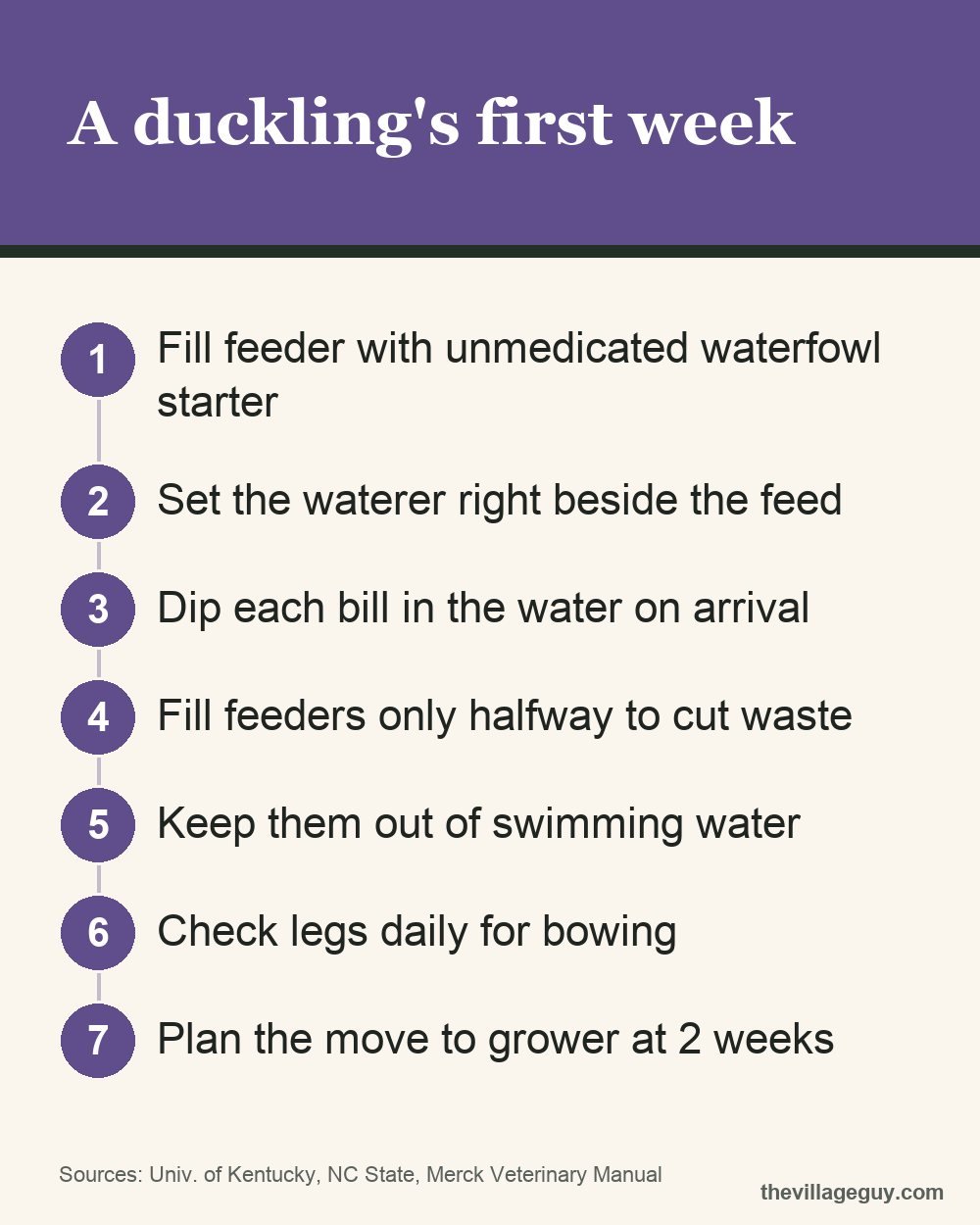
Baby ducks eat a duck or waterfowl starter, in crumbles or small pellets, with clean water right beside it from the first hour. Two things set ducklings apart from chicks: niacin and medication.
Niacin: the vitamin ducklings run short on
The Merck Veterinary Manual says turkeys, ducks, pheasants and goslings are much more severely affected by niacin (vitamin B3) deficiency than chickens are, because they convert less of it from their feed. It puts the allowance for ducks at 55 to 70 mg per kg of feed, roughly twice a chicken’s minimum. A deficient duckling shows severe bowing of the legs and enlarged hock joints.
That is why a waterfowl starter is the first choice. Kentucky extension says chick starter can stand in, but it is lower in niacin, so supplemental niacin is needed. Hatcheries such as Metzer Farms suggest brewer’s yeast or a niacin product for this; ask the hatchery, your extension office or a vet how much to use for your feed, and call a vet promptly if a duckling starts walking stiffly or its legs bow.
Skip medicated chick starter
Kentucky extension notes that medicated chicken feed can be toxic to waterfowl, because ducks eat more feed than chickens and so swallow a higher dose of the drug. Ducks also resist most of the diseases those feeds target. Buy unmedicated starter, and let a vet decide on any treatment.
Why ducks need water with every bite
Ducks swallow food whole and use water to wash it down. A University of California hatching guide says ducklings must have water to swallow, and Kentucky extension is blunt about adult birds too: never give feed without water nearby, because ducks can choke on dry feed. They also eat less when they cannot drink, so short waterer space quietly cuts growth.
The water has to be deep enough for a duck to dunk its whole head. University of Maryland Extension says to provide liquid water deep enough for the birds to dunk and wash their heads, which also keeps eyes and nostrils clean. Swimming water is a different matter: Wisconsin extension says it is not required for growing ducks, and Kentucky advises keeping ducklings out of pools for their first three weeks, before their feathers are ready.
Tip: Put the waterer close enough that a duck can walk between bites, but not right over the feed. Wisconsin extension suggests keeping some distance so splashing does not soak the feeder. A wire-covered platform under the waterer keeps the bedding drier.
NC State recommends cleaning and sanitizing waterers at least three times a week (Kentucky says daily for ducklings) and closing feed hoppers overnight if the water sits outside the pen, so birds never eat dry feed with nothing to drink.
What you’ll need to feed ducks well
Duck feeding gear is mostly about keeping feed dry and water deep, which are two jobs that fight each other.
- Unmedicated waterfowl starter and grower: crumbles or small pellets, about 18 to 20 percent protein, with niacin listed on the tag; check that the mill date is recent.
- Layer pellets for adult ducks: around 16 percent protein and roughly 3 percent calcium, fed once hens begin laying, not before.
- Deep waterer: wide and deep enough for a duck to submerge its head and bill, with a design that limits splashing.
- Trough or hanging feeder: enough length for the whole flock to eat at once, since ducks eat as a group; adjustable to back height.
- Wire or slatted waterer platform: lets spilled water drain away from bedding and feed.
- Heated waterer base: for freezing climates; look for a unit rated for outdoor use, with a guarded element and cord kept off litter.
- Small dish for oyster shell: a separate container so laying hens can take calcium as they need it.
- Insoluble grit: only if you feed whole grains such as corn or wheat; offer it in its own dish.
- Lidded metal feed bin: keeps rodents out and feed dry, which matters because mold toxins are particularly harmful to ducks.
What to feed ducks as treats and forage
Treats are where duck keeping gets fun, and where diets drift. Keep the total under about 10 percent, give treats after the birds have eaten their regular feed (veterinarian Sandra Mitchell recommends this in her PetMD guide), and offer them near water. Chopped leafy greens floated in a shallow pan get ducks dabbling the way they would in a pond.
Good options, drawn from PetMD’s veterinary guide and the forage foods Kentucky extension lists:
- Chopped lettuce, cabbage and other leafy greens (go easy on spinach, see below)
- Thawed frozen peas and corn kernels
- Cooked oats or plain cooked rice
- Halved grapes and other fruit in small pieces
- Earthworms, insects and slugs from the garden
- Weeds and lawn clippings that have not been sprayed
Keep foraging ducks off lawns or beds treated with herbicide or slug bait, and fence them away from seedlings.
Can ducks eat bread
Can ducks eat bread? A little will not hurt a well-fed backyard duck, but it is a filler, not food. Purina calls bread neither bad nor good and caps it at 10 percent of the day, which it puts at probably less than half a slice per adult duck. The problem is what bread replaces: it fills the crop without the protein, niacin and minerals a duck needs, and ducklings filled up on it grow poorly. Salty crackers and chips are worse, and Metzer Farms warns salt overload can be fatal.
10 foods to keep away from ducks
Duck-specific research on kitchen foods is thin, so this list names its source for each item: extension where it exists, hatchery or bird-vet advice where it does not.
| Food | Why to skip it | Source |
|---|---|---|
| Moldy or stale feed | Some molds make toxins particularly harmful to ducks | Cornell Duck Research Lab; NC State |
| Medicated chicken feed | Ducks eat more, so they get a higher dose | University of Kentucky |
| Bread, crackers, chips as a staple | Fills ducks up without nutrition; salt risk | Purina; Metzer Farms; state wildlife agencies |
| Avocado (flesh, skin, pit) | Persin can cause heart and breathing trouble | Metzer Farms; Illinois vet school (pet birds) |
| Chocolate | Theobromine and caffeine | Metzer Farms |
| Coffee grounds and tea | Caffeine | Metzer Farms |
| Onions and garlic | Thiosulfate can damage red blood cells | Metzer Farms |
| Citrus and lots of spinach | Said to interfere with calcium use | Metzer Farms |
| Green potatoes, unripe tomatoes, rhubarb leaves | Solanine and oxalates | Metzer Farms |
| Dog or cat food | Built for another animal; too rich in protein and fat | Metzer Farms |
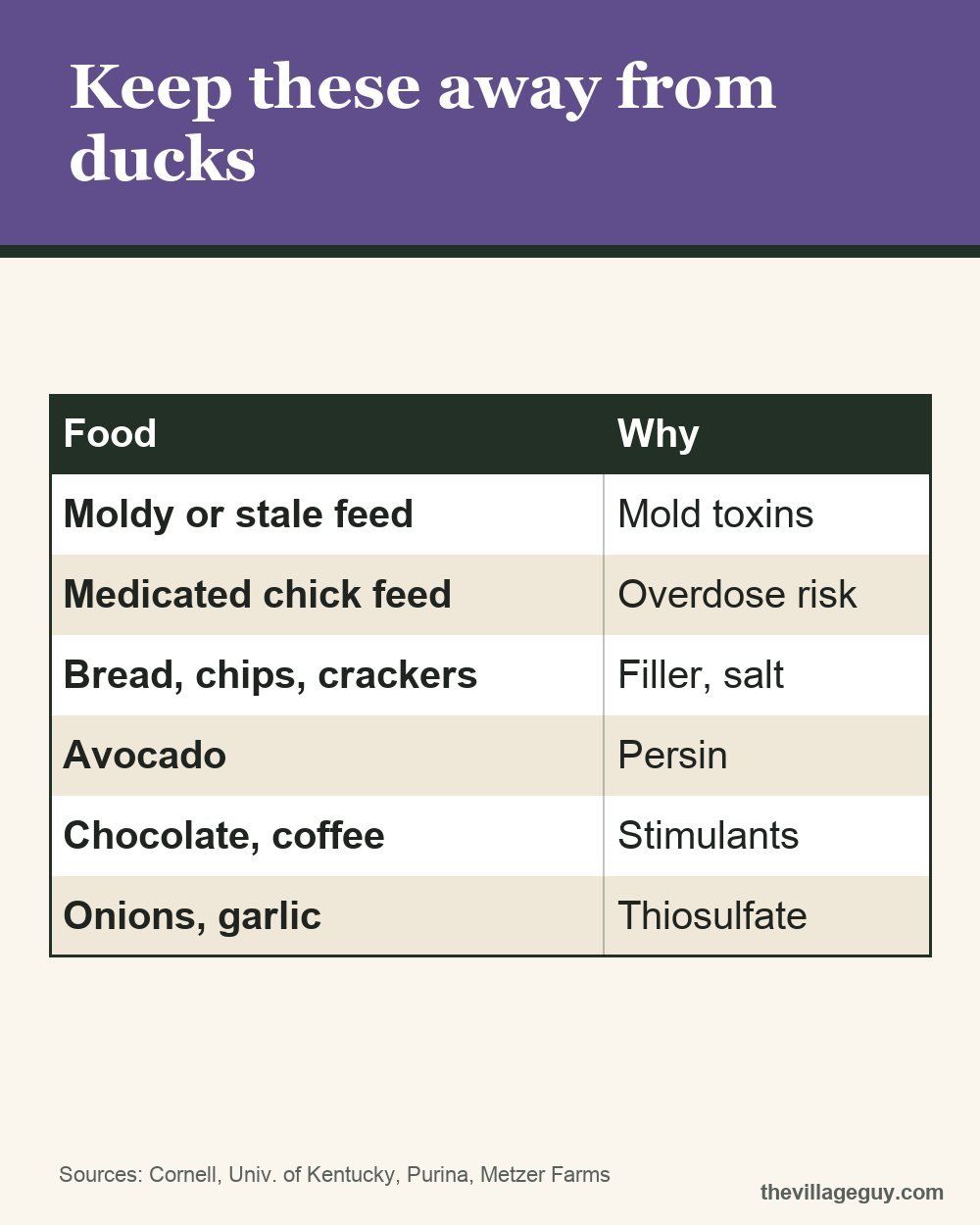
Moldy feed tops the list because it is the one most keepers serve by accident. Cornell’s Duck Research Laboratory recommends feeding only what ducks will clean up in a day, so wet leftovers never sit in the trough. Musty, clumped or discolored feed goes in the trash, and a duck that seems ill after eating something needs a vet, not a home remedy.
Oyster shell, grit and winter feeding
Calcium for laying ducks
Laying ducks spend a lot of calcium on shells. NC State’s layer ration carries about 2.9 percent calcium, and the commercial layer tables Kentucky extension reproduces sit at 3 percent. Purina suggests adding free-choice oyster shell in a separate feeder at 24 to 26 weeks, or when ducks begin laying, and notes that hens tend to stop eating it when they stop laying. Keep it out of duckling feed and off the menu for drakes on their own, since extra calcium is not something growing or non-laying birds need.
Grit: only for whole grains
Metzer Farms, a waterfowl hatchery, explains that grit is not needed when ducks eat mash, crumbles or pellets, because the mill has already ground the feed. Grit becomes necessary if you feed whole corn, milo, wheat or other whole grains, which usually starts no earlier than four to six weeks old. Offer it in its own dish, and do not confuse it with oyster shell: one grinds, the other dissolves to feed eggshells.
Winter feeding
University of Maryland Extension calls waterfowl naturally climate hardy and notes ducks seek out water even in the coldest weather. In winter, keep feed available all day for extra energy, offer a little scratch grain in the evening (with grit, since it is whole grain), and check water several times a day, because ducks cannot drink through ice and cannot eat without water. Snow also ends most foraging, so the bag carries more of the diet.
Safety: Heated bases and heat lamps start coop fires. Maryland Extension warns that even heat lamps can cause fires if not secured, that heated bases must not touch litter, and that splashed cold water can shatter a hot bulb. Ducks splash constantly, so keep any heat source well away from the waterer, use outdoor-rated equipment and follow the manufacturer’s instructions. Our winter coop guide covers safer setups that work for ducks too.
Feeding wild ducks at the pond
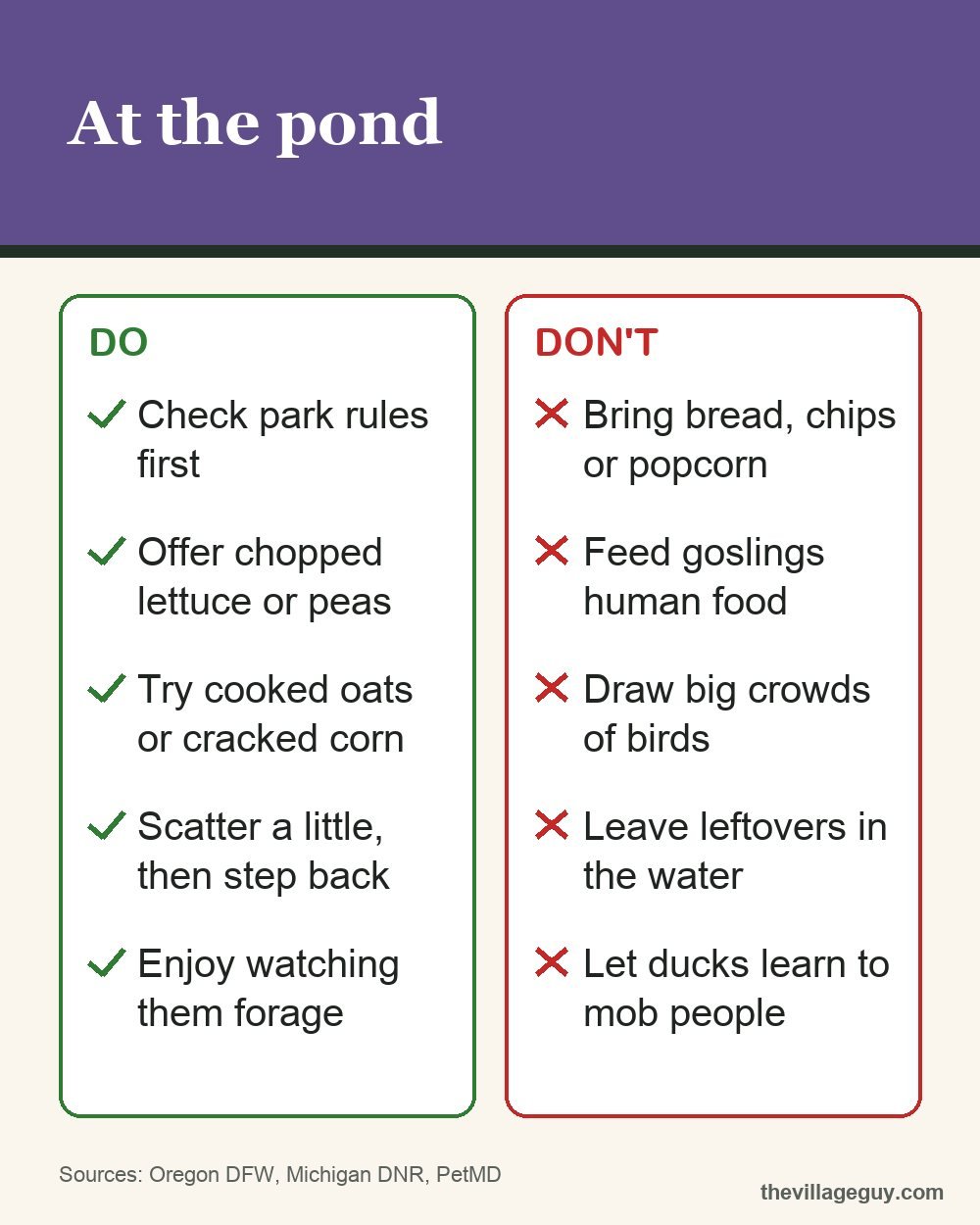
Wild ducks are a separate case, and wildlife agencies are close to unanimous: the kindest thing is usually not to feed them at all. In a 2010 release, the Oregon Department of Fish and Wildlife said bread, popcorn, French fries and other human food can cause starvation, spread disease and lead to deformities. It also pointed to sick birds and unsanitary crowding at feeding sites, and to water quality falling apart there, with algae blooms and higher bacteria.
The deformity people hear about is angel wing, where the wing tip twists outward and the bird cannot fly. Oregon’s agency ties it to artificial feeding of goslings, which grow faster than their wing bones when fed human food, and Michigan’s DNR also asks people not to feed ducks bread, citing malnutrition and deformities that hinder flight.
Many parks and towns ban feeding waterfowl, so read the signs or ask your parks department first. Where it is allowed, PetMD’s veterinary guide suggests small amounts of chopped lettuce, thawed peas, cooked oats or rice, or cracked corn. Scatter a little, then step back.
Copy-ready duck feeding checklists
Setting up for new ducklings
- Buy unmedicated waterfowl starter, or chick starter plus a niacin plan approved by your hatchery or vet
- Check the mill date on the bag and plan to use it within about 3 weeks
- Set the waterer next to the feeder so every bite has a drink nearby
- Dip each duckling’s bill in the water on arrival so it finds the drinker
- Allow about 2 inches of feeder space per duckling, doubling it after 2 weeks
- Keep ducklings out of swimming water for the first 3 weeks
- Switch to grower at about 2 weeks, mixing old and new feed for a few days
- Watch legs and gait daily and call a vet if legs bow or hocks swell
Daily and seasonal care for adult ducks
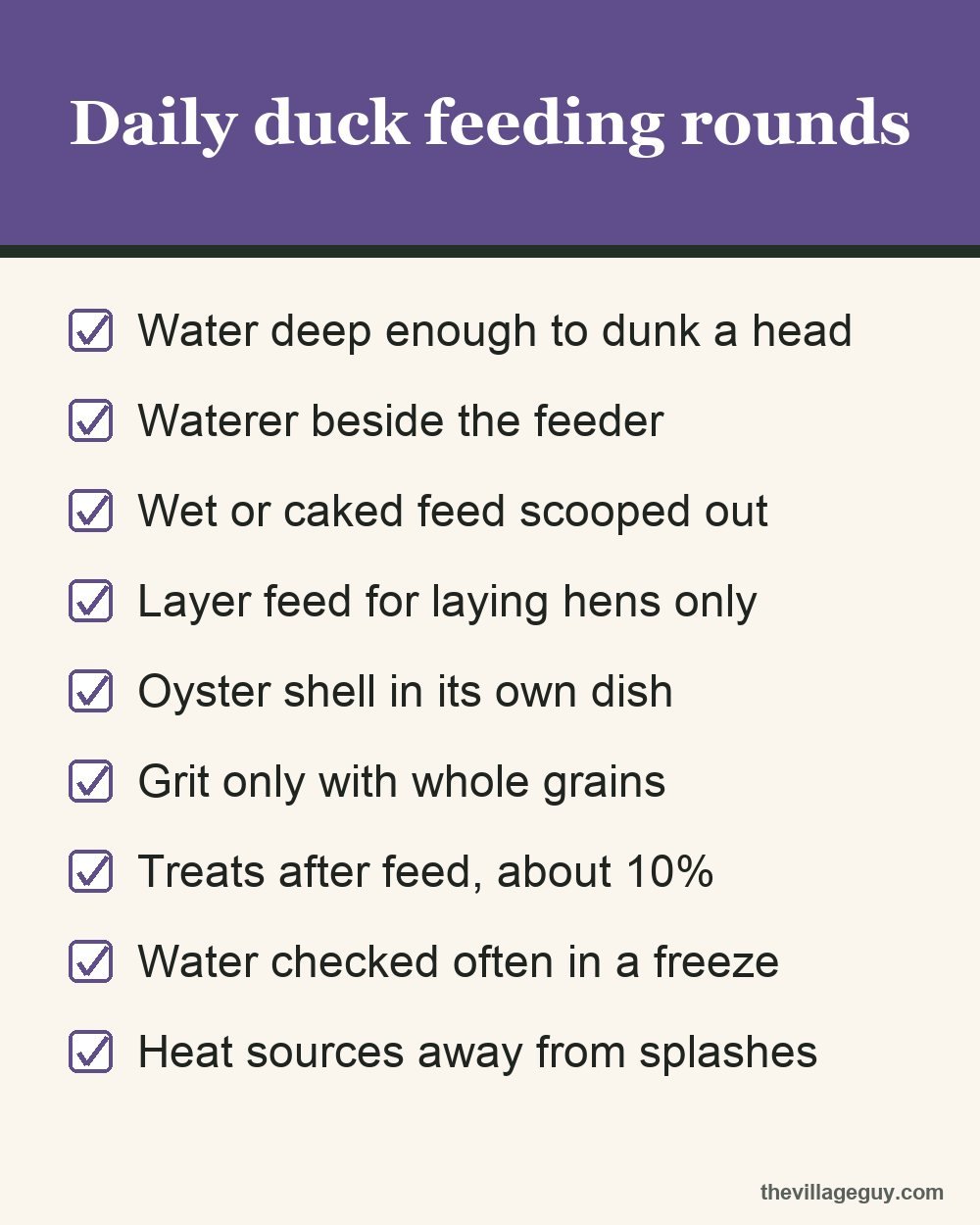
- Refill water deep enough for every duck to dunk its whole head
- Scoop out wet or caked feed before adding fresh
- Scrub and refill waterers at least three times a week
- Move hens to layer feed at first egg and set out oyster shell in its own dish
- Add grit in a separate dish only if you start feeding whole grains
- Hold treats to about a tenth of the day and serve them after regular feed
- Store feed in a sealed bin off the floor and toss anything musty
- Check water several times a day in freezing weather
- Keep heat sources away from splashing water and bedding
Duck feeding FAQ
Can ducks eat chicken feed?
Adult ducks can eat unmedicated chicken layer feed in a pinch, but it is not ideal, and ducklings are the real risk. Chick starter is lower in niacin than ducklings need, so Kentucky extension says to add niacin if you use it, and medicated chicken feed should be avoided because ducks eat enough to overdose. A waterfowl or all-flock feed with niacin on the label is the simpler choice.
What do baby ducks eat if you have no duck starter?
Unmedicated chick starter will do short term, with extra niacin (ask your hatchery or vet how much). Kentucky notes broiler starter has niacin levels close to a duck’s needs, though NC State warns broiler feeds may contain medications not approved for ducks, so read the tag.
How long can ducks go without food?
Do not test it. Kentucky extension recommends keeping feed available at all times for young ducklings, and Maryland Extension says birds need feed available all day in cold weather. Water matters even more, because a duck without water cannot swallow its feed, so a frozen or empty drinker is effectively an empty feeder.
How much water does a duck drink a day?
Purina puts an adult duck at up to half a gallon a day, and ducklings at about half a gallon each per week in their first few weeks. Ducks also waste a good deal by dunking and splashing, so size the waterer for more than they drink, and refill it before it runs low rather than once a day.
Sources
- NC State Extension: Feeding Ducks (protein, niacin and calcium by stage; feed freshness; waterers)
- University of Wisconsin-Madison Extension: Care of Ducks (feed changes, choking on powdery feed, swimming water)
- University of Kentucky (Small and Backyard Poultry): Feeding Ducks Intended for Consumption (protein levels, niacin in chick starter, foraging)
- University of Kentucky (Small and Backyard Poultry): Feeding Ducks for Egg Production in Small Flocks (medicated feed, feed amounts, water beside feed)
- University of Kentucky (Small and Backyard Poultry): Raising Meat Ducks in Small and Backyard Flocks (feeder space, no swimming for 3 weeks)
- Merck Veterinary Manual: Vitamin Deficiencies in Poultry (niacin needs and deficiency signs)
- Cornell University Duck Research Laboratory: Duck Nutrition (mold and feed moisture)
- University of California ANR: Duckling Hatching Basics (water needed to swallow)
- University of Maryland Extension: Winter Weather and Small Flocks (winter feed and water, fire risk)
- Purina Animal Nutrition: What Do Ducks Eat? (90/10 rule, bread limit, water intake, oyster shell timing)
- Metzer Farms: Foods Ducks Should Never Eat (2023) (foods to avoid)
- Metzer Farms: Grit, Do Ducks Need It or Not? (2025) (when grit is needed)
- Metzer Farms: Determining How to Supplement Your Duck’s Diet with Niacin (niacin supplement options)
- University of Illinois College of Veterinary Medicine: Bad for Birds (avocado toxicity in birds)
- PetMD (Sandra C. Mitchell, DVM, 2026): What to Feed Ducks Instead of Bread (safer foods, treats after feed)
- Oregon Department of Fish and Wildlife (2010): Don’t feed ducks and geese (why not to feed wild waterfowl, angel wing)
- Michigan DNR: Ducks (no bread or human food)
More practical guides for village and country life are on our guides page.