
A septic tank is a slow, patient machine that only asks one thing of you: get the solids out before they get out on their own. Bacteria break down some of what settles in the tank, but not all of it, so sludge piles up on the bottom and grease floats on top year after year. Working out how often to pump septic tank solids depends on three numbers you can find (tank size, the number of people in the house and how much solid waste goes down the drains), and once you know them the guesswork mostly disappears.
Quick answer: The EPA says most household septic tanks need pumping about every 3 to 5 years, with an inspection at least every 3 years. A 1,000-gallon tank serving 4 people works out to roughly every 2.6 years in the Ohio State University table; 2 people in the same tank, about 6 years. Pump sooner if a professional finds sludge and scum taking up more than a quarter of the tank, or if you use a garbage disposal.
In this guide
- How often to pump septic tank solids: the baseline
- Pumping interval by tank size and household
- Find your tank size and set your own schedule
- How sludge and scum are measured
- Signs septic tank is full (and signs of something worse)
- What should happen on pumping day
- What pumping costs depend on
- What not to flush, pour or grind
- Winter access and freeze protection
- Septic pumping FAQ
How often to pump septic tank solids: the baseline
The US Environmental Protection Agency gives the standard answer: have an average household system inspected by a septic professional at least every 3 years, and pump the tank about every 3 to 5 years. Systems with float switches, pumps or other mechanical parts (aerobic units, mound systems with dosing pumps) should be inspected about once a year, ideally under a service contract.
That 3 to 5 year range is an average, and averages hide a lot. A retired couple with a big tank can go far longer; a family of six on a small, older tank may need a truck every year or two. Pennsylvania’s Department of Environmental Protection says larger households generally need pumping every 1 to 2 years. So the honest answer to “how often should you pump a septic tank” is: as often as your tank size and household make necessary, checked against real measurements.
Local rules can also set the schedule for you. Penn State Extension notes that many Pennsylvania communities require pumping on a set cycle (often every 3 years), and some counties elsewhere require pumping reports or licensed contractors. Ask your county health department or local sewage enforcement office before you settle on a plan.
Tip: The tank is only half the system. Solids that escape the tank clog the drainfield (also called the leach field or soil treatment area), and Oregon State University Extension warns that a ruined drainfield may be impossible to replace on some lots. Pumping is the cheap insurance on the expensive part.
Pumping interval by tank size and household
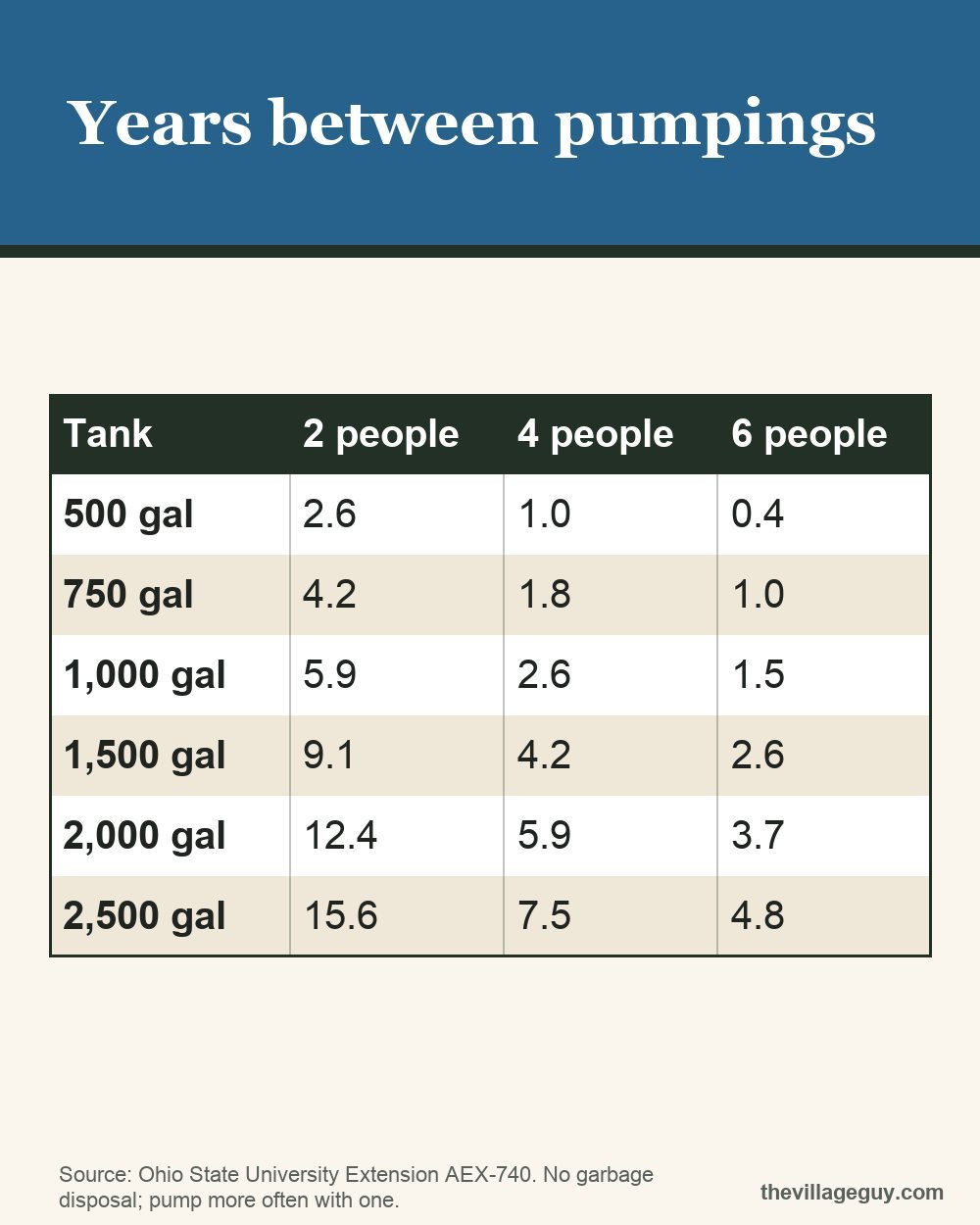
The most widely used planning table comes from Ohio State University Extension (Karen Mancl and Brian Slater, fact sheet AEX-740). Penn State, Oregon State and the University of Arizona publish the same estimates. Figures are years between pumpings for year-round residents with no garbage disposal.
| Tank size | 1 person | 2 people | 3 people | 4 people | 5 people | 6 people |
|---|---|---|---|---|---|---|
| 500 gal | 5.8 | 2.6 | 1.5 | 1.0 | 0.7 | 0.4 |
| 750 gal | 9.1 | 4.2 | 2.6 | 1.8 | 1.3 | 1.0 |
| 1,000 gal | 12.4 | 5.9 | 3.7 | 2.6 | 2.0 | 1.5 |
| 1,500 gal | 18.9 | 9.1 | 5.9 | 4.2 | 3.3 | 2.6 |
| 2,000 gal | 25.4 | 12.4 | 8.0 | 5.9 | 4.5 | 3.7 |
| 2,500 gal | 31.9 | 15.6 | 10.2 | 7.5 | 5.9 | 4.8 |
The table continues to 9 people in the original fact sheet; at that size, a 1,000-gallon tank drops below one year. Both Ohio State and the EPA say a garbage disposal means pumping more often, because ground food adds solids the bacteria cannot keep up with.
A worked example
Say you bought a 1970s farmhouse with a 1,000-gallon tank, and four people live there. The table says about 2.6 years. Add a garbage disposal and a teenager who showers for twenty minutes, and a 2-year cycle is the safer starting point. Then let the first two inspections tell you whether the tank fills faster or slower than the table guessed.

Find your tank size and set your own schedule
Plenty of owners of older places do not know their tank size. The county health department or permitting office often holds the original permit and a sketch of the system. A previous pumping receipt usually lists gallons removed, and the pumper can estimate size from the tank’s dimensions while it is open.
The University of Nebraska-Lincoln suggests a smarter method than any table: after the tank is pumped, have a professional check the scum and sludge layers every year until they reach the pump-out point. The number of years that took is your real interval. Recalculate when the household changes, such as someone moving in or out, adding a disposal, or children becoming teenagers.
- Call the county health or permitting office for your system’s permit, tank size and site sketch
- Find the last pumping receipt and note the date and gallons pumped
- Count year-round residents, plus regular long-stay guests
- Look up your starting interval in the table and subtract time for a garbage disposal
- Book an inspection if you cannot find a record from the last 3 years
- Ask for sludge and scum depths in writing at every service visit
- Set a calendar reminder for the next inspection before the truck leaves
- Recalculate the schedule when people move in or out or a disposal goes in
A one-line note for your house file or phone, to fill in after each visit:
- Septic pumped on ____ by ____; ____ gallons removed; sludge ____ in, scum ____ in; baffles OK? ____; filter cleaned? ____; next check due ____
How sludge and scum are measured
Inside a working tank there are three layers: floating scum (grease, oils, soap), a middle layer of fairly clear liquid that flows out to the drainfield, and settled sludge on the bottom. The tank needs pumping before either the scum or the sludge gets close enough to the outlet to escape.
Safety: Never enter a septic tank or lean head-first into an open one. Oregon State University Extension warns that tank gases can kill within minutes, and the University of Arizona notes the gases are explosive, so no smoking, matches or flames nearby. Do not try a rescue without breathing apparatus; call 911. Wash thoroughly after any contact with sewage, and keep children and pets well away from an open lid.
The pump-out points
| Source | Pump when |
|---|---|
| US EPA | Bottom of the scum is within 6 inches of the outlet, or top of the sludge is within 12 inches of the outlet, or sludge plus scum fill more than 25% of the liquid depth |
| Penn State Extension | Sludge and scum should never fill more than about 30% of the tank’s volume |
| University of Arizona Extension | Sludge is deeper than 24 inches, or the bottom of the scum is less than 3 inches above the bottom of the outlet |
If your county publishes its own threshold, use that. Otherwise the EPA’s 25% figure is the easiest to remember.
How a sludge reading works
Pumpers and inspectors usually use a “sludge judge,” a clear tube with a check valve that pulls up a core sample showing every layer. The extension method for homeowners is simpler. The University of Arizona describes wrapping the bottom 3 feet of an 8-foot board in a white, 100% cotton towel, lowering it until it touches bottom, holding it there several minutes, then lifting it out: the stained band shows sludge depth. Scum thickness is read with a stick that has a hinged or flat “foot” on the end, which catches on the underside of the scum layer.
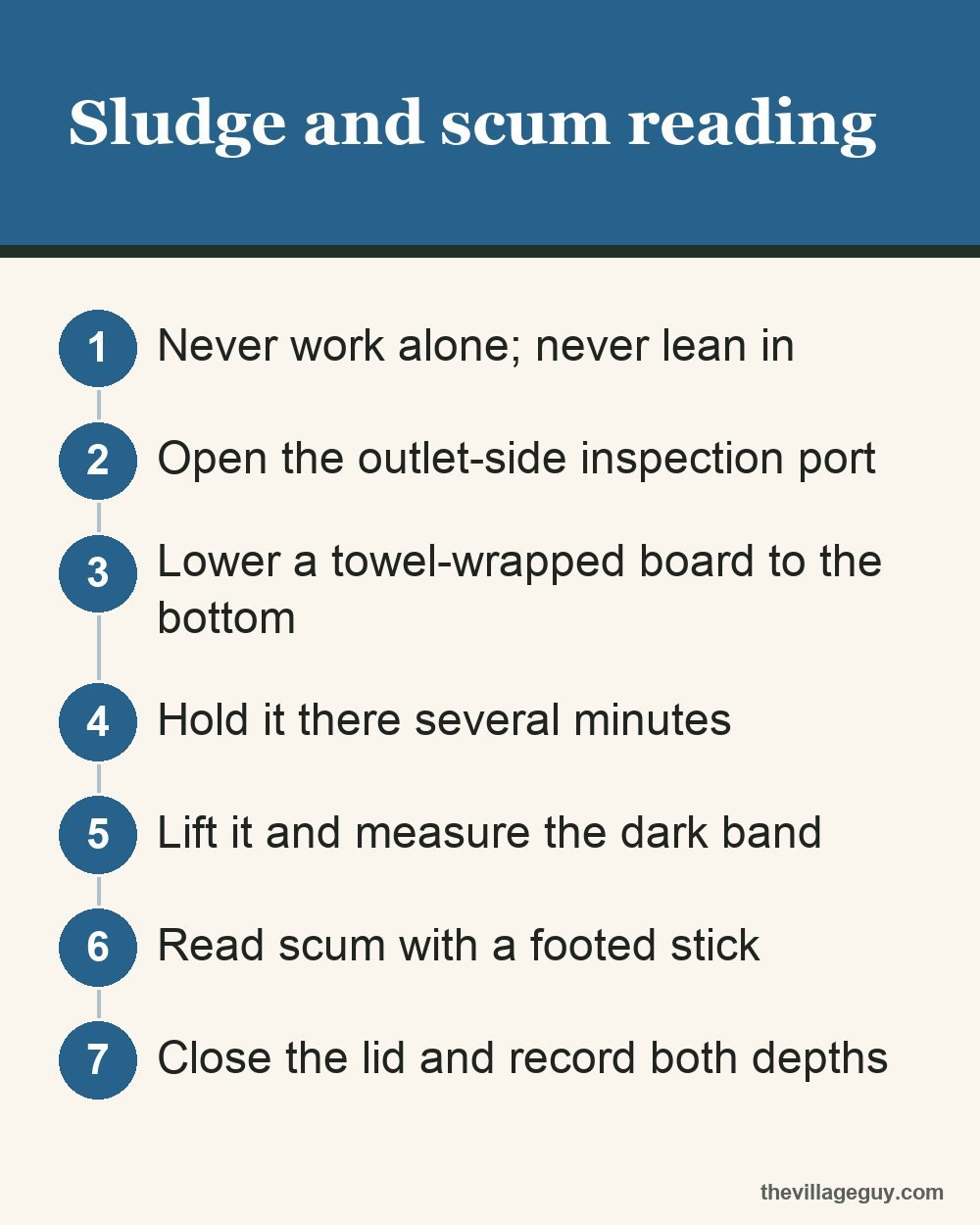
Most owners are better off letting the inspector take the reading and asking for the numbers. If you do it yourself, have a second person present and secure the lid the moment you finish. Washington State’s Department of Health links to this homeowner inspection course.
Signs septic tank is full (and signs of something worse)
Waiting for symptoms is the expensive way to schedule pumping, because by then solids may already be moving into the drainfield. The EPA and Clemson Cooperative Extension list largely the same warnings; this table sorts them by what they usually mean.
| What you notice | Often means | Do this |
|---|---|---|
| Every drain in the house is slow | Full tank or blocked outlet | Cut water use and call a pumper |
| One fixture is slow, others fine | Clog in that drain line | Snake that drain; skip chemical openers |
| Gurgling in pipes or toilets | Trapped air from a full tank or a blockage | Book an inspection soon |
| Sewage smell outdoors near the tank | Full tank, loose lid or a vent problem | Check the lid; have the vent and tank checked |
| Wet, spongy ground or standing water over the drainfield in dry weather | Effluent surfacing; drainfield overloaded or failing | Keep people and pets off; call the health department or a pro |
| Bright green, lush grass over the field in a dry spell | Wastewater reaching the surface zone | Have the system evaluated |
| Sewage backing up into a tub or floor drain | Full tank or failure | Stop using water, avoid contact, call for service |
The EPA also points out that a sewage smell can come from a blocked or frozen roof vent rather than the tank, which is common after heavy snow. Clemson adds two signs owners miss: dead patches of grass outlining the tank or field, and loose seals around toilets.
Safety: Treat any backup as raw sewage. The EPA advises avoiding contact, wearing protective gear for cleanup, and following your health department’s guidance. If you have a private well, a failing system nearby is a reason to test the water.
What should happen on pumping day
A good pump-out is more than sucking the tank dry. Oregon State University Extension recommends that owners watch the work, and lists what it should include: the scum layer broken up and the sludge stirred into the liquid (usually by pumping some liquid back into the bottom of the tank) so the solids come out with it, and everything pumped through the large central manhole, not through the small baffle inspection ports, which can damage the baffles.
Baffles or sanitary tees at the inlet and outlet keep scum and sludge from leaving the tank, and they wear out. The pumper should check them before the lid goes back on. If your tank has an effluent filter in the outlet, it should be cleaned too; University of Maryland Extension suggests a professional cleans it about once a year.
- Uncover or mark the main lid before the truck arrives
- Ask the pumper to empty the tank through the main manhole, not the baffle ports
- Watch that scum and sludge are broken up and removed, not just the liquid
- Ask to see the inlet and outlet baffles and whether either needs replacing
- Have the effluent filter cleaned if the tank has one
- Get a written receipt with gallons removed, layer depths and any defects found
- Close and secure every lid before anyone leaves the yard
Do not ask the crew to scrub or disinfect the tank. Bacteria from everyday use repopulate it on their own, and University of Maryland Extension says starter additives are unnecessary.
What pumping costs depend on
Prices vary too much by region, season and company to quote a fair national number, so get quotes from two or three licensed local pumpers. What moves the bill is fairly consistent, though.
| Factor | Why it matters | What you can do |
|---|---|---|
| Tank size | More gallons means more truck capacity and disposal volume | Know your gallons before you call |
| Buried lid | University of Maryland Extension notes a buried manhole takes time to find and uncover, adding cost | Install a riser to bring the lid to grade |
| Unknown tank location | Crews may need to probe or locate it first | Keep a site sketch with measurements from the house |
| Distance and access | Long hose runs, steep drives or soft ground slow the job | Clear a path and ask about hose length |
| Emergency timing | Weekend, holiday or backup calls are often billed differently | Pump on schedule, before symptoms |
| Extra work | Baffle replacement, filter cleaning or a full inspection may be separate line items | Ask what the quote includes |
A riser is the one upgrade that pays back every time. Oregon State recommends risers from the manhole and inspection ports to or near the surface, plus a marked location, so nobody has to dig.
- Hi, I need a septic pump-out quote for a ____-gallon tank, last pumped ____. Does the price include locating and uncovering the lid, baffle and filter checks, and a written report of sludge and scum depths?
What not to flush, pour or grind
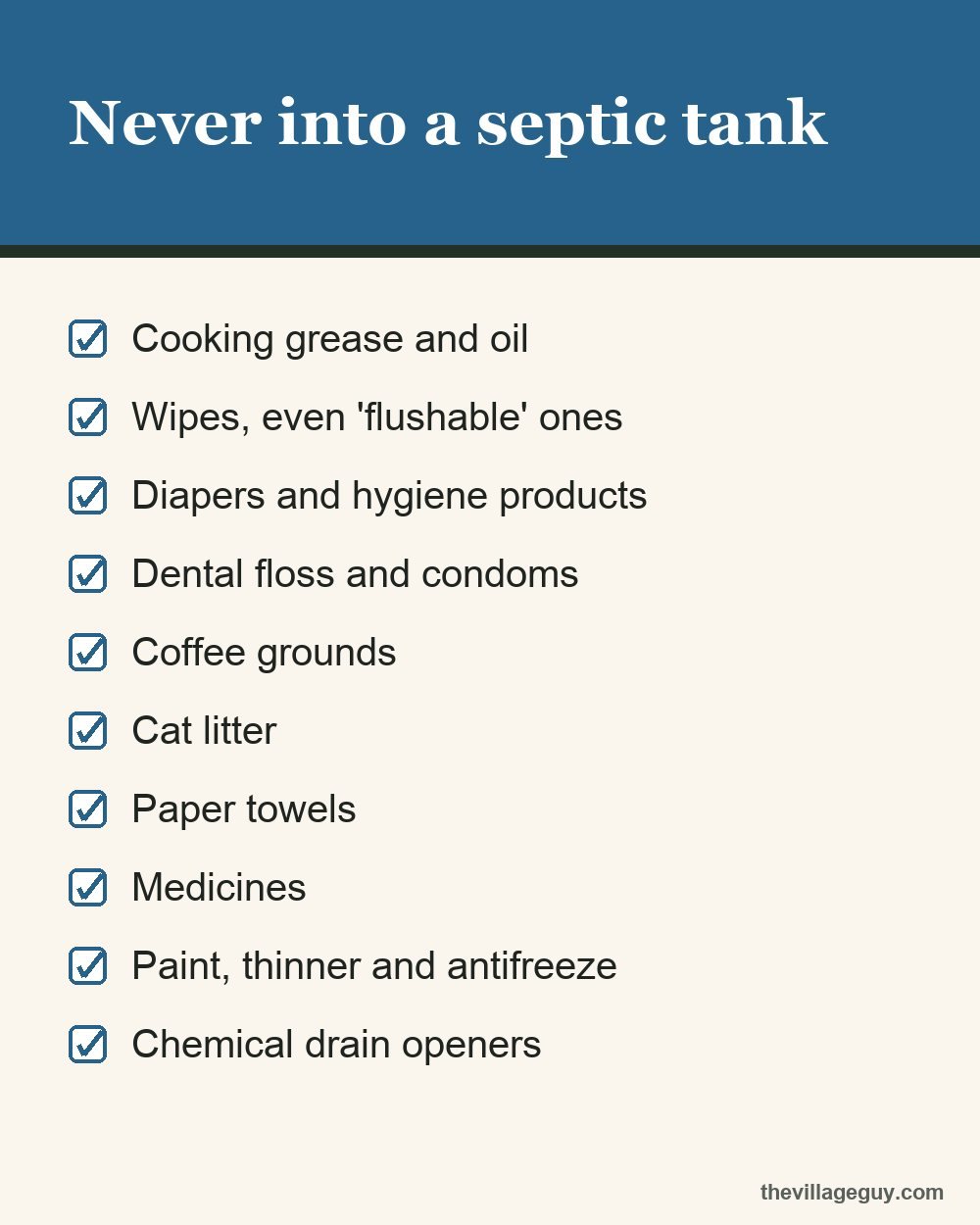
Every solid that goes down the drain and does not break down shortens your pumping interval. The EPA’s rule is short: flush only human waste and toilet paper. Its list of things that should never go in includes cooking grease and oil, wipes (even ones labeled flushable), feminine hygiene products, condoms, dental floss, diapers, cigarette butts, coffee grounds, cat litter, paper towels, medicines and household chemicals such as gasoline, oil, pesticides, antifreeze, paint and thinners.
A few habits matter just as much as the list. The EPA advises against chemical drain openers (use boiling water or a drain snake instead), spreading laundry across the week rather than running every load on Saturday, and fixing leaks: a single running toilet can send up to 200 gallons a day into the tank. More water does not fill the tank with sludge, but it pushes solids out toward the drainfield before they settle.
Septic additives are a common sales pitch. The University of Arizona says there is no conclusive evidence that starters, feeders or cleaners prevent failure or improve performance, and none of them remove the need to pump.
Winter access and freeze protection
Pumping in January is possible, but digging through frozen ground to find a lid is slow work. If your tank is due in winter, consider booking it in early fall instead, while the ground is still open and the lid is easy to find.
Snow is the system’s friend. University of Nebraska-Lincoln Extension notes that snow cover insulates the tank, that the worst freezing risk comes in extreme cold with no snow, and that bacterial activity nearly stops once tank temperatures reach about 39°F. Compacted snow insulates poorly, which is why traffic over the system matters so much in winter.
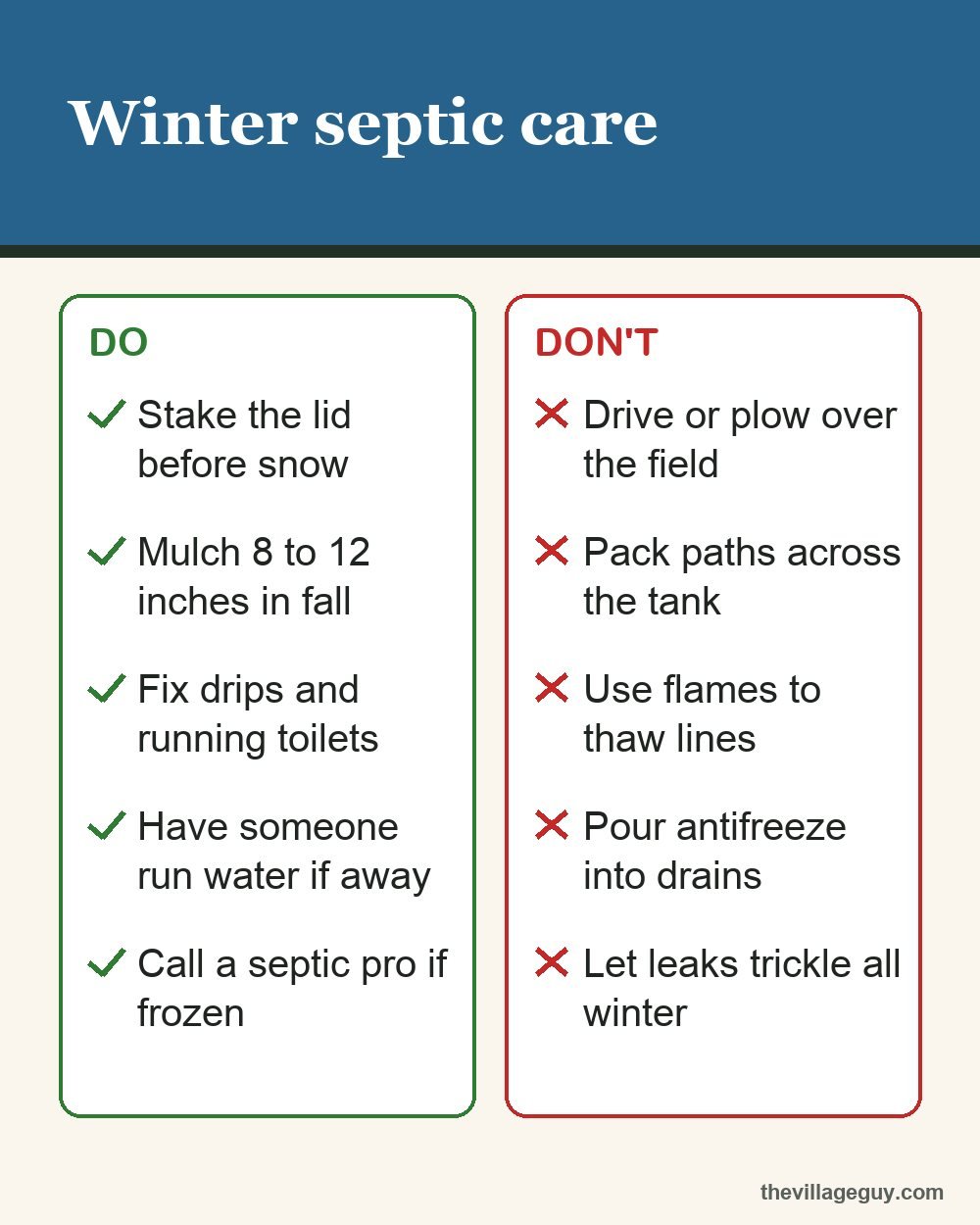
- Mark the tank lid and cleanouts with tall stakes before the first snow
- Spread 8 to 12 inches of mulch, straw or leaves over the tank and pipes in fall where winters are hard
- Keep cars, plows, snowmobiles and foot paths off the tank and drainfield so the snow stays fluffy
- Fix dripping faucets and running toilets, which send a thin, freezing trickle down the line
- Arrange for someone to run laundry or dishes regularly if the house sits empty
- Call a septic professional, not a plumber with a torch, if the system freezes
If the line freezes, the University of Minnesota’s septic program advises calling an onsite professional and fixing the cause, or the system will freeze again the next winter. Never use open flame near a tank or its vents, because the gases are flammable. The same cold snap that freezes a septic line can freeze house plumbing; our guide to the temperatures at which pipes freeze covers the indoor side. And when you plan next year’s beds, keep vegetables off the drainfield: the EPA recommends only grass or shallow ground covers there, so site a new vegetable garden well away from it.
Safety: Do not thaw septic lines, tanks or vent pipes with a torch, heat gun on the tank or any open flame. Septic gases can ignite. Do not pour antifreeze into the system to keep it running; it is on the EPA’s list of chemicals that should never go in.
Septic pumping FAQ
How long can a septic tank go without being pumped?
It depends on size and use, and a single person in a large tank can go many years by the table. The risk is not knowing: University of Maryland Extension warns that tanks left five or more years without service can build enough sludge to clog the drainfield or pollute groundwater. If you have no record, book an inspection rather than guessing.
Can you pump a septic tank too often?
The extension guides cited here worry about pumping too late, not too early, and University of Maryland Extension notes that regular use supplies all the bacteria a tank needs. The real cost of pumping early is your money, which is why the University of Nebraska-Lincoln’s yearly-measurement method is worth using to find your true interval instead of pumping on a fixed, overly cautious schedule.
Do I need to pump more often with a garbage disposal?
Yes. Ohio State University Extension advises against disposals in septic homes, and the EPA says to limit or avoid them and pump more often if you have one. Scraping plates into the trash or a compost bin does the same job without adding sludge.
Should a septic tank be pumped before selling a house?
Some counties and lenders require a septic inspection at sale, and many buyers ask for one. An inspector often needs the tank opened or pumped to see the baffles and walls. Rules vary widely, so check with your county health department and the buyer’s agent before you list.
For more practical guides on running a country property, browse all The Village Guy guides, or read how these guides are researched and sourced.
Sources
- US EPA: How to Care for Your Septic System (inspect every 3 years; pump every 3 to 5 years; yearly checks for mechanical systems; 6-inch, 12-inch and 25% pump-out rules; what not to flush; drain openers; running toilet up to 200 gallons a day; disposals; drainfield plantings)
- US EPA: Resolving Septic System Malfunctions (warning signs; blocked or frozen vent; sewage backup cleanup)
- Ohio State University Extension (Mancl and Slater): Septic System Maintenance, AEX-740 (pumping frequency table; disposals)
- Oregon State University Extension: Septic Tank Maintenance, EC 1343 (pump through the manhole; break up scum; check baffles; risers; tank gas danger; drainfield replacement risk)
- University of Arizona Cooperative Extension: Maintaining Your Septic Tank, AZ1160 (24-inch sludge and 3-inch scum rules; towel-and-board method; explosive gases; additives)
- Penn State Extension: Septic Tank Pumping (30% sludge and scum limit; local pumping requirements; confirmed via search-result text)
- Pennsylvania DEP: Septic Systems (larger households pumping every 1 to 2 years; confirmed via search-result text)
- University of Nebraska-Lincoln Water: Pump Septic Tank Regularly (yearly measurement method for setting your own interval)
- University of Maryland Extension: Maintaining Your Septic System (buried manholes and risers; effluent filter; additives unnecessary; five-year risk)
- Clemson Cooperative Extension: Be Septic Safe, Septic Failures (failure signs including dead grass and loose toilet seals)
- UNL Water: Minimizing the Impact of Winter Weather on Water and Wastewater Systems (snow insulation; 39°F bacterial slowdown; 8 to 12 inches of mulch; traffic; empty homes)
- University of Minnesota Onsite Sewage Treatment Program: Seasonal Care (call a professional for frozen systems; fix the cause; confirmed via search-result text)