Cattle are built to last about two decades, but very few get the chance. Researchers put the natural life expectancy of dairy cattle at roughly 20 years, yet most dairy cows leave the herd 3 to 4 years after their first calf, and most beef steers go to market before they turn two. So the answer to how long do cows live depends almost entirely on the job a given animal does on the farm.
Here you will find both numbers side by side: the natural cow lifespan and the working life of dairy cows, beef cows, steers, veal calves and bulls, plus how to read a cow’s age from her teeth and how to look after an older family cow.
Quick answer: Cattle have a natural life expectancy of about 20 years, and a well-kept pet or family cow can reach her late teens. On commercial farms lives are much shorter: dairy cows typically leave the herd at around 5 to 6 years old, beef cows are most productive from about 5 to 9 and few stay past 10 to 12, and grain-finished steers are usually harvested at 14 to 22 months.
In this guide
How long do cows live? Two very different answers
The first answer is biological. In a 2020 review of dairy cow longevity published in the journal animal, Albert De Vries and Marcos Marcondes put the natural life expectancy of dairy cattle at approximately 20 years. The same review notes that it is rare for dairy cows to reach even 10.
The second answer is economic. A cow on a working farm stays as long as she earns her keep: she must get pregnant, calve, raise or milk out that calf, and stay sound enough to do it again. When any part of that chain breaks, or a younger replacement is waiting, she is usually sold. Most cattle in the United States therefore live a fraction of their possible lifespan.
A third group sits in between. Family milk cows, show animals that have been retired, and cattle in sanctuaries are often kept long past their productive years, and those are the animals most likely to see their mid to late teens.
How long do cows live on a farm? Lifespan by role
On a working farm, cow lifespan is set by the animal’s role. The figures below are typical ranges from extension services, researchers and USDA, not hard limits.
| Animal and role | Typical time on the farm | Why it ends there | Source |
|---|---|---|---|
| Cow kept as a pet or family cow | Can approach the natural limit of about 20 years | Old age, teeth, feet or illness | De Vries and Marcondes (2020) |
| Dairy cow | First calf around age 2, then about 3 to 4 years of milking | Low production, fertility, mastitis, lameness, replacements | De Vries and Marcondes (2020); CDCB |
| Beef cow | Joins the herd at 2, peaks at 5 to 9, rebreeding drops after 10 | Age or bad teeth, failing to get pregnant | NDSU and Mississippi State extension |
| Grain-finished steer or heifer | 14 to 22 months | Reaches market weight | Oklahoma State Extension |
| Grass-finished steer or heifer | About 20 to 26 months | Slower growth on forage | Oklahoma State Extension |
| Veal calf | About 16 to 18 weeks | Raised for veal, up to about 450 lb | USDA FSIS |
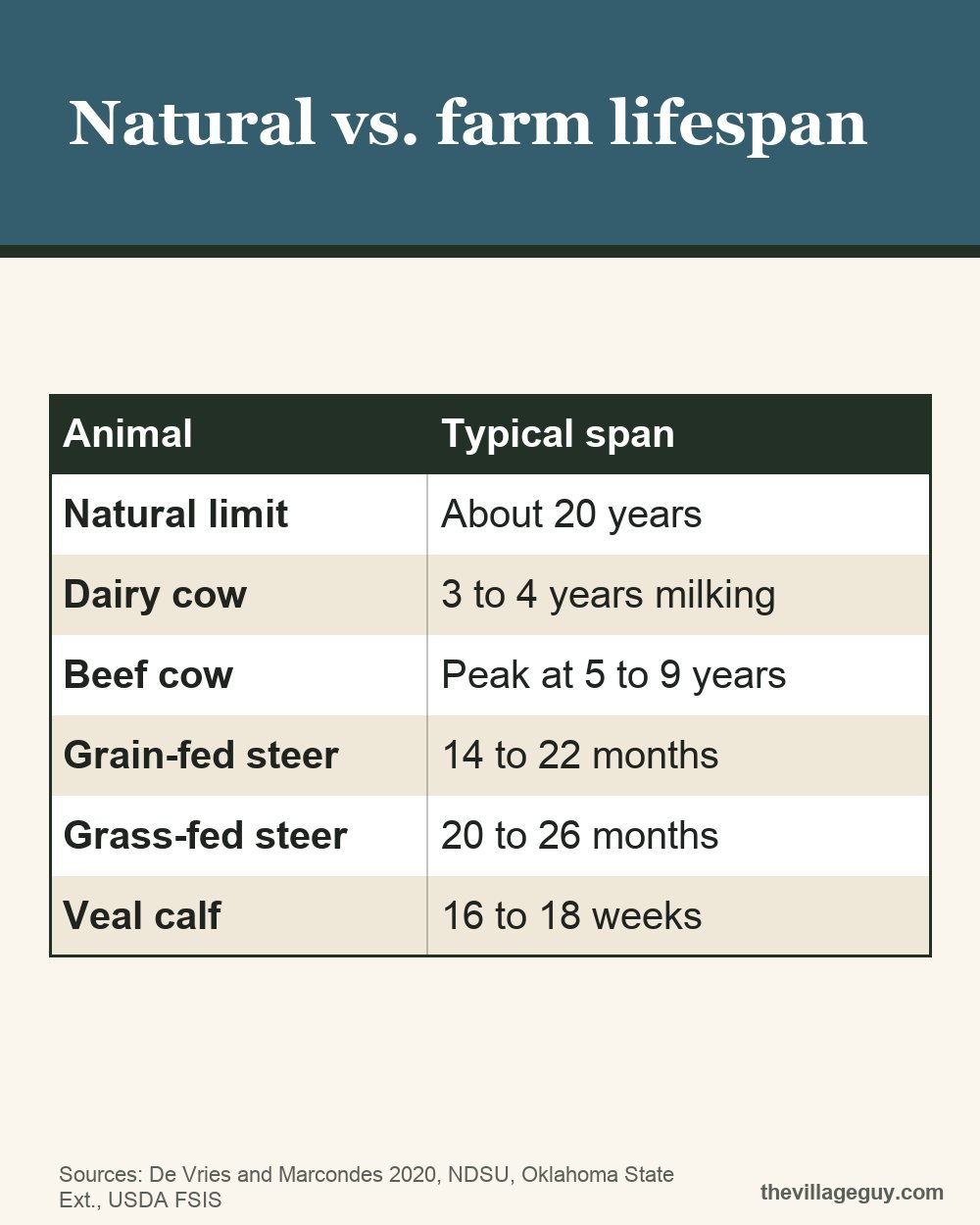
Breeding bulls do not fit neatly into a row. North Dakota State University’s Dickinson Research Extension Center says it seldom keeps bulls to 4 years old, partly because heavy mature bulls become harder to manage. Other operations keep a sound, fertile bull for several breeding seasons; there is no single standard.
Why dairy cows leave the herd young
Most dairy heifers have their first calf at about 2 years old; Virginia Tech’s dairy management goals list 22 to 24 months as the target, against a Virginia herd average of 26.4 months. Milking starts with that first calf. From there, De Vries and Marcondes report an average productive lifespan of approximately 3 to 4 years in countries with high-producing dairy cows, so a typical cow leaves at around 5 to 6 years old.
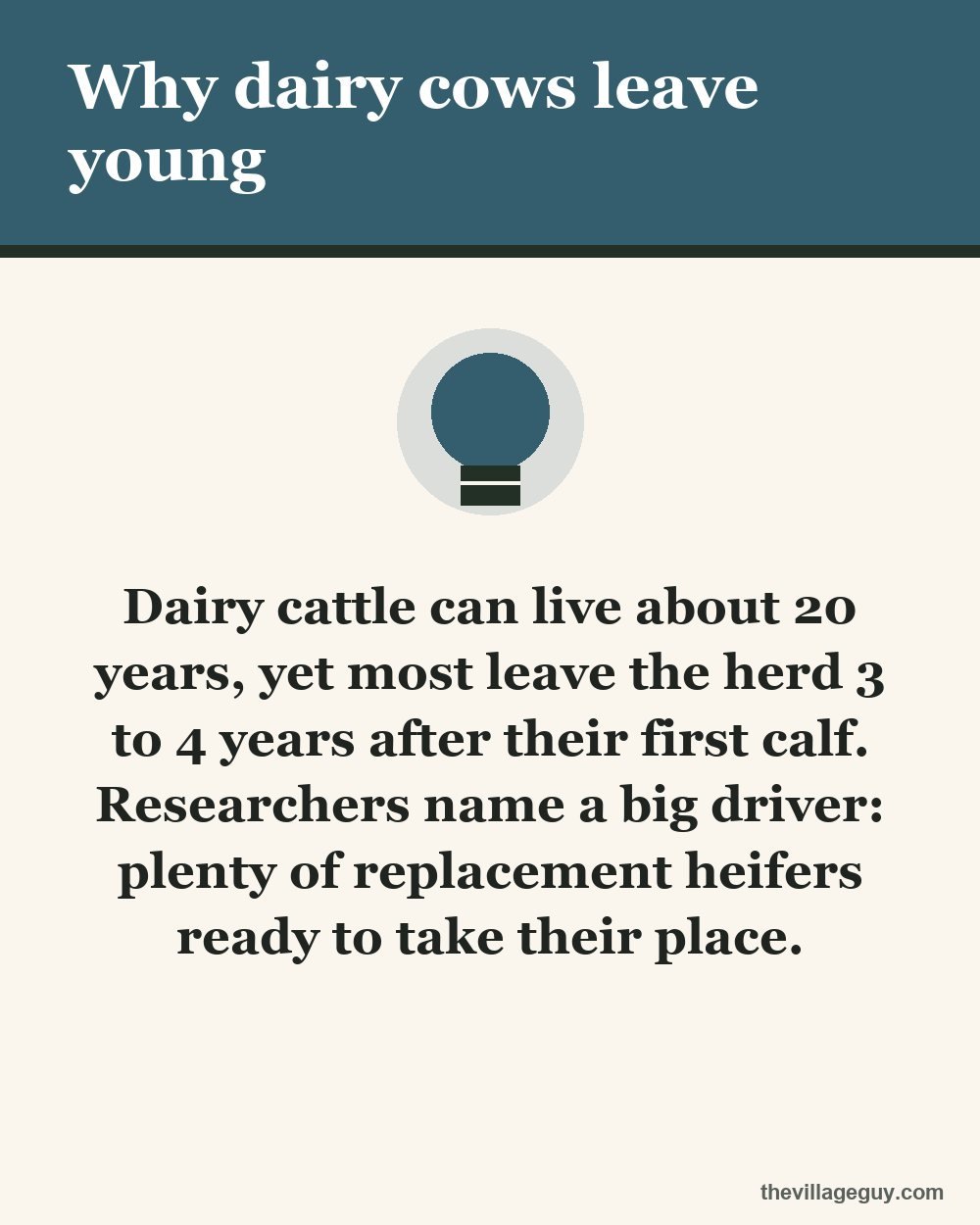
The surprising part is what drives that number. The review’s authors say a major driver of productive lifespan is the availability of replacement heifers: when plenty of young, genetically newer heifers are ready to calve, they push older cows out. They add that average productive lifespan could be extended by reducing the supply of dairy heifers.
Beef cows: a longer working life
A beef cow’s job is simpler than a dairy cow’s: raise one calf a year on mostly forage. That lets many of them work longer. NDSU Extension describes most beef cows entering the herd as 2-year-olds, reaching their greatest production from about 5 to 9 years old, and dropping off after that, with production likely well down by around age 12.
Mississippi State University Extension cites research showing consistent rebreeding through about 8 years of age, a decline after 10 and a steeper drop after 12, and advises moving cows out of the herd before that sharp decline. Survival in the herd is the limiting factor: the same NDSU article notes that by age 10, fewer than 20 percent of the cows that came in as 2-year-olds were still there in the herds it describes.
Breed and crossbreeding matter here too. NDSU reports differences of more than 30 percent between breeds and crosses in the share of cows still in the herd at age 12, and breed associations publish a “stayability” figure that predicts whether a bull’s daughters will still be in the herd at age 6.
Why cows leave the herd: the numbers
The reasons cows are sold or die differ sharply between dairy and beef herds, and they explain most of the lifespan gap between the two.
Dairy herds
The Council on Dairy Cattle Breeding analyzed cows leaving U.S. herds enrolled in Dairy Herd Improvement programs in 2015 (dairy sales excluded). Unspecified reasons were the biggest single code, so the recorded causes add up to well under 100 percent.
| Reason recorded | Share of cows leaving |
|---|---|
| Low production | 19.8% |
| Died | 16.7% |
| Reproduction problems | 14.6% |
| Mastitis or high somatic cell count | 13.8% |
| Locomotion (feet and legs) | 4.3% |
| Unspecified | 30.8% |
Beef herds
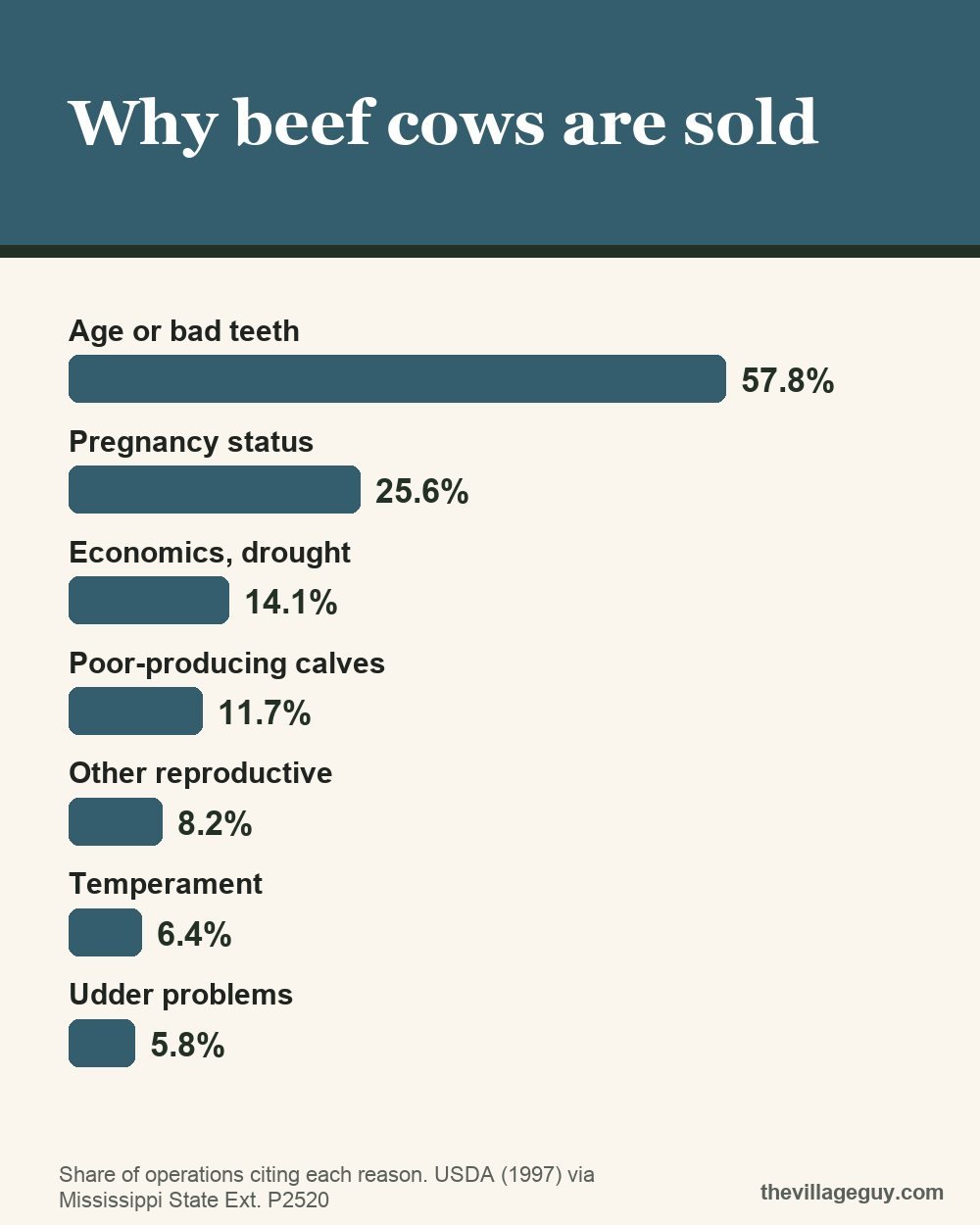
For beef cows, Mississippi State Extension reproduces USDA survey data on the reasons operations gave for marketing cows. Operations could list more than one reason, so the shares add up to more than 100 percent. Age or bad teeth led by a wide margin.
How to tell a cow’s age by her teeth
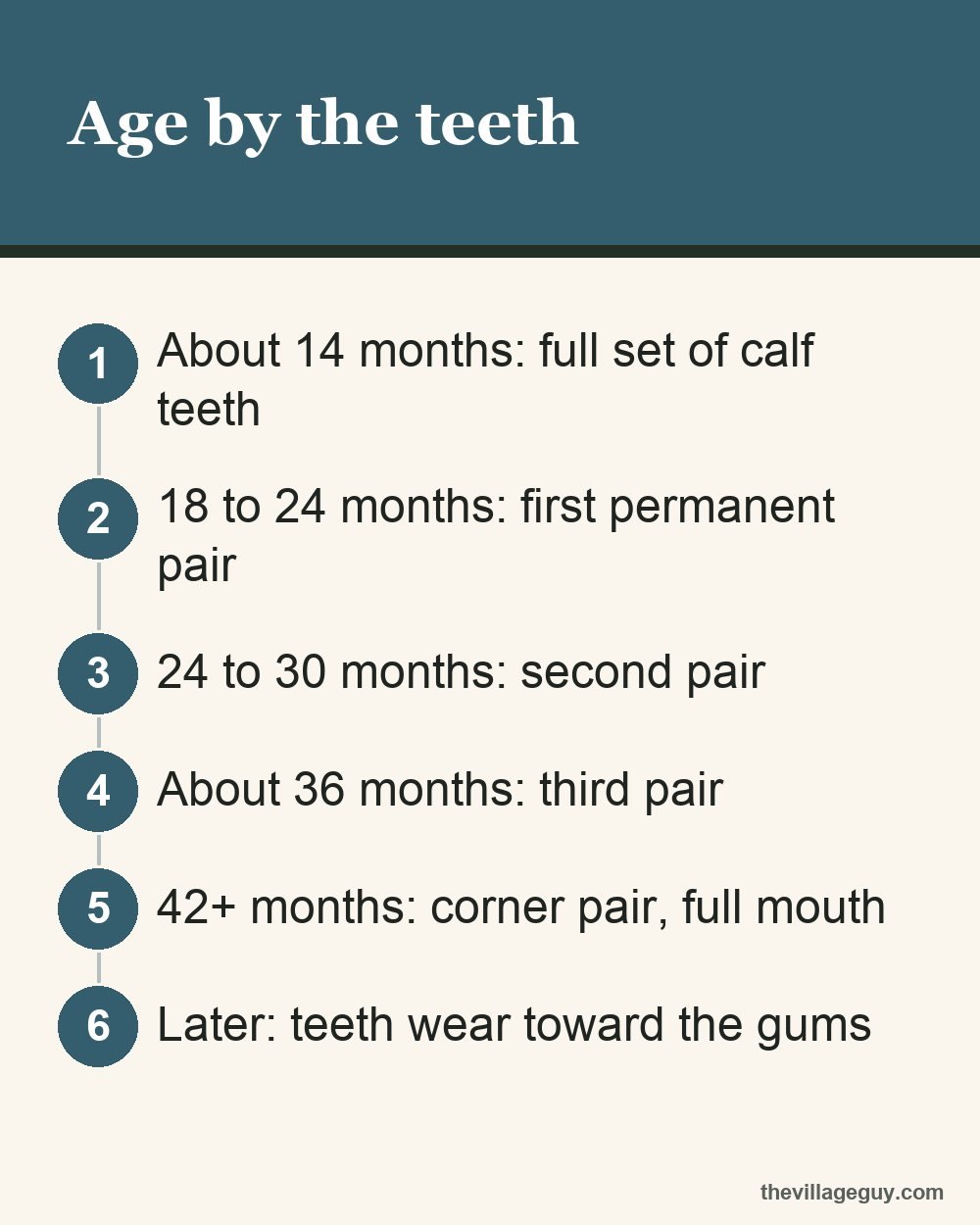
If you buy a cow without papers, her front teeth are the best clue to her age. Cattle have front incisors only on the lower jaw; as the Cornell Small Farms Program puts it, they are absent from the upper jaw. Calf (milk) teeth are replaced by permanent incisors in pairs, from the center outward, on a fairly predictable timetable.
| What you see | Approximate age |
|---|---|
| Full set of calf (temporary) incisors | About 14 months |
| First pair of permanent incisors (centrals) | 18 to 24 months |
| Second pair (middles) | 24 to 30 months; USDA treats any eruption as 30 months or older |
| Third pair (laterals) | About 36 months |
| Fourth pair (corners), a full mouth | At least 42 months |
| Teeth worn down to the gums (“smooth mouth”) | Older cows; varies with diet and grit |
Eruption ages from the Cornell Small Farms Program, following USDA FSIS guidance; mouth terms from Mississippi State Extension.
After the full mouth, aging gets vague. Mississippi State Extension describes smooth-mouthed cows as having teeth worn down to the gums, and broken-mouthed cows as having lost teeth to injury, gum disease or infection, which can happen at any age. Wear varies from cow to cow, so two 10-year-olds can have very different mouths.
Safety: Only look in a cow’s mouth when her head is held in a chute and headgate or by an experienced handler. A swinging head can break a hand or a nose.
Caring for an older family cow
An older cow that stays on a small farm needs a little more attention, mostly to her mouth, her body condition and her feet. Mississippi State Extension notes that older cows can keep performing as long as their teeth, udders, feet and legs are sound, and that worn teeth can eventually leave a cow in poor body condition even when plenty of feed is available.
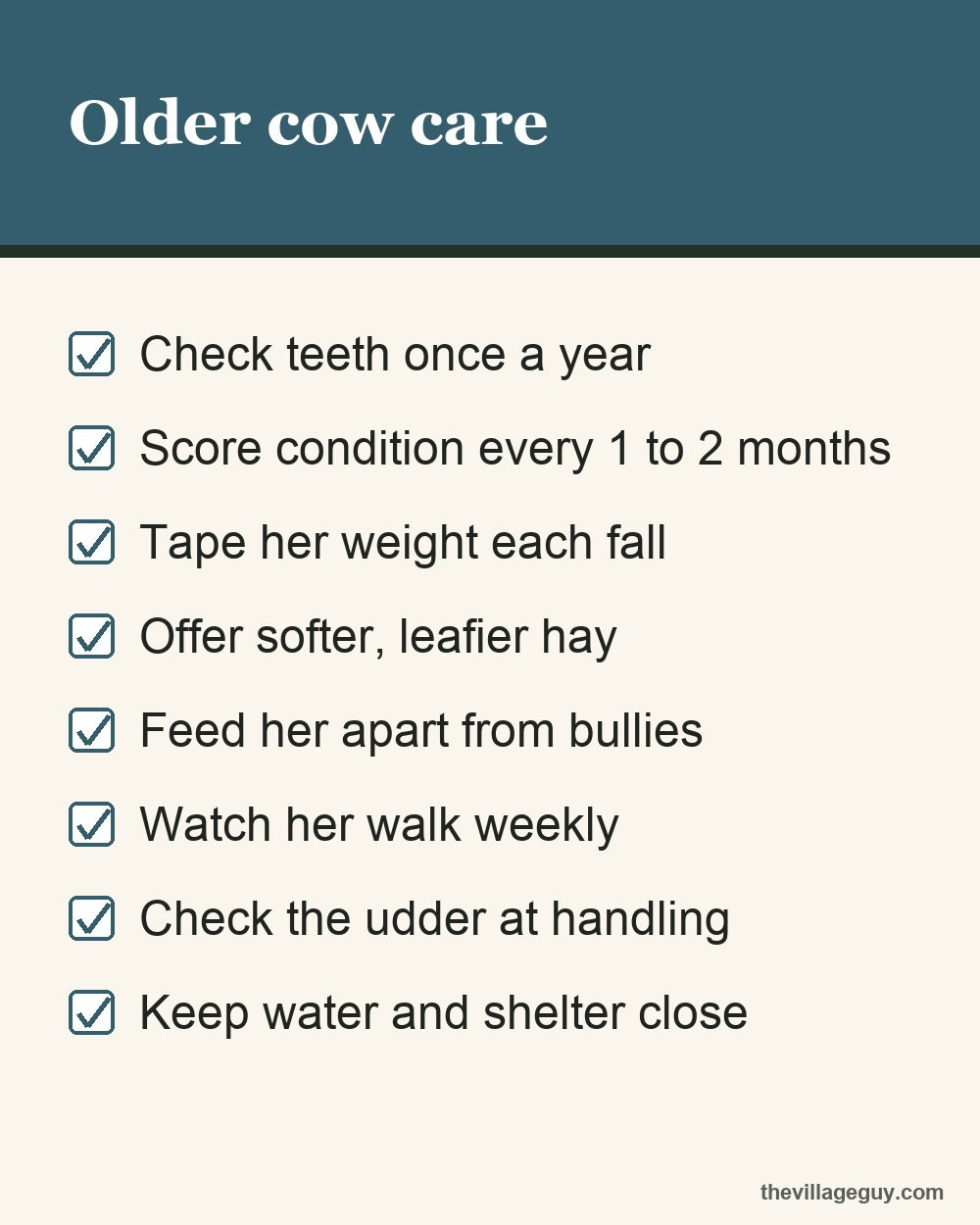
- Check teeth and mouth once a year at routine handling, as Mississippi State Extension recommends.
- Score body condition every month or two and act on any drop before she gets thin.
- Estimate her weight with a tape each fall so you can see slow losses that are easy to miss by eye.
- Offer softer, leafier hay or a ration your vet or nutritionist suggests if she struggles to chew coarse stems.
- Feed her apart from younger, pushier cattle so she gets her full share.
- Watch her walk each week and have overgrown or sore feet looked at early.
- Check the udder for lumps, heat or uneven quarters at every handling.
- Keep fresh water and shelter easy to reach, without long climbs or icy slopes.
For the weight checks, our guide to estimating a cow’s weight with a tape and body condition scores has the formula and a worked example. If an older cow keeps losing condition on good feed, her teeth or her digestion may be the problem; the warning signs in our explainer on a cow’s four-compartment stomach are worth knowing.
Plan the hard decision before you need it
Mississippi State Extension notes that cattle with a body condition score below 3 on the 9-point scale may not be fit to haul. Waiting too long can take selling off the table and leave only euthanasia. Deciding your plan while she is still in fair shape is kinder to her and easier on you.
- Decide in advance whether an old cow will be retired, sold or euthanized when she can no longer keep condition.
- Ask your vet what signs would tell them it is time, and write those signs down.
- Find out now which local services handle euthanasia and carcass removal, and what they charge.
- Check your state’s rules on burying livestock on your own land before you plan to.
- Budget for extra feed and vet visits for every year you keep a retired cow.
The oldest cow on record
The most famous long-lived cow is Big Bertha, from County Kerry, Ireland. Ireland’s national broadcaster RTÉ reports that she held two Guinness World Records, one as the oldest cow recorded and one for breeding, produced 39 calves, and died about three months short of her 49th birthday. Sources disagree slightly on her exact birth year, so treat her age as roughly 48 years.
She is an extreme outlier. For planning purposes, a well-cared-for retired cow reaching her mid or late teens is a good long life, and the 20-year figure from the research literature is a sensible upper expectation rather than a target.
Cow lifespan FAQ
How long do dairy cows live compared with beef cows?
Dairy cows usually leave the herd younger, at around 5 to 6 years old, because the standards for milk yield, fertility and udder health are demanding and young replacements are usually waiting. A beef cow’s main job, raising one calf a year on forage, lets many work until 10 or beyond. Kept as pets, both could live about 20 years.
How old is a cow when she has her first calf?
Most heifers calve for the first time at about 2 years old, which is why NDSU describes beef cows entering the herd as 2-year-olds. Dairy farms aim for 22 to 24 months, though many herds average a little older.
Do bulls live as long as cows?
Biologically, bulls can live as long as cows, but working bulls rarely do. Large mature bulls are harder to handle, so many farms replace them after a few breeding seasons. NDSU’s research center, for example, seldom keeps bulls to 4 years old.
What usually ends a beef cow’s working life?
Age and teeth. In the USDA survey data that Mississippi State Extension reproduces, 57.8 percent of operations named age or bad teeth as a reason for marketing cows, and 25.6 percent named pregnancy status, meaning cows that failed to get bred.
Browse more cattle, poultry and country-living explainers in The Village Guy guide library.
Sources
- De Vries and Marcondes (2020), animal: Review: Overview of factors affecting productive lifespan of dairy cows (natural life expectancy about 20 years; productive lifespan 3 to 4 years; rare to reach 10; replacement heifers as a driver)
- Council on Dairy Cattle Breeding: Reasons that cows in Dairy Herd Improvement programs exit the herd (2015) (dairy exit reasons and shares)
- NDSU North Central Research Extension Center: Setting Heifers up for Long Life Cows (beef cows enter at 2, peak 5 to 9, under 20 percent remain at 10, breed differences, stayability to age 6)
- Mississippi State University Extension: Market Cow and Bull Management and Marketing (P2520) (USDA reasons for marketing cows; rebreeding by age; smooth and broken mouth; annual teeth checks; condition score below 3)
- Oklahoma State University Extension: Carbon Footprint Comparison Between Grass- and Grain-Finished Beef (grain-finished cattle harvested at 14 to 22 months, grass-finished at about 20 to 26 months; confirmed from search-result text)
- USDA FSIS: Veal from Farm to Table (veal calves raised to about 16 to 18 weeks and up to 450 lb)
- Cornell Small Farms Program: Aging Cattle Without a Birth Certificate Through Dentition (incisor eruption ages; FSIS 30-month rule)
- USDA FSIS: Using Dentition to Age Cattle (official dentition guidance)
- NDSU Dickinson Research Extension Center: BeefTalk, How Much Should Bulls Weigh? (center seldom keeps bulls to 4 years; heavy bulls harder to manage)
- Virginia Tech Dairy Science: DHI and Management Goals (2022) (age at first calving goal 22 to 24 months; Virginia average 26.4 months)
- RTÉ Archives: Big Bertha (Guinness records for oldest cow and breeding; 39 calves; died three months short of 49)