A well-kept backyard hen commonly lives 6 to 8 years, according to University of Wisconsin Extension, and lays well for only about half of that. So the honest answer to how long do chickens live depends on which chicken you mean: a broiler raised for meat is usually processed before 10 weeks, a commercial layer is replaced after a few seasons, and a pampered pet hen can, very rarely, see her twenties.
Below is a lifespan table by type of chicken, the life stages of a backyard hen, the threats that cut most lives short (predators first), 6 clues for working out the age of a bird with no paperwork, and a plan for the years after the eggs slow down.
Quick answer: Backyard hens typically live 6 to 8 years, and most flocks produce eggs for about 3 to 4 of those years (University of Wisconsin Extension). Predators and disease end many lives sooner. The oldest chicken on record, according to Guinness World Records, lived to 23 years 152 days.
In this guide
How Long Do Chickens Live? Lifespan by Type
“Lifespan” means different things for a pet, a commercial layer and a meat bird, because most chickens are not allowed to die of old age. The table separates natural lifespan from the age at which each type usually leaves the flock.
| Type of chicken | Typical span | Source and notes |
|---|---|---|
| Backyard laying hen | 6 to 8 years | University of Wisconsin Extension; most flocks lay for 3 to 4 of those years. |
| Commercial laying hen | Kept 2 to 3 years | Wisconsin notes commercial layers are replaced as production falls; Virginia Tech says production hens lay efficiently for two laying cycles. |
| Broiler or fryer (meat) | Under 10 weeks at processing | USDA class definition (9 CFR 381.170). |
| Roaster (meat) | Under 12 weeks at processing | USDA class definition; carcass 5.5 pounds or more. |
| Stewing or baking hen | Over 10 months | USDA class for adult hens sold for meat, often retired layers. |
| Record holder | 23 years 152 days | Muffy, a Red Quill Muffed American Game hen (1989 to 2012), per Guinness World Records. |
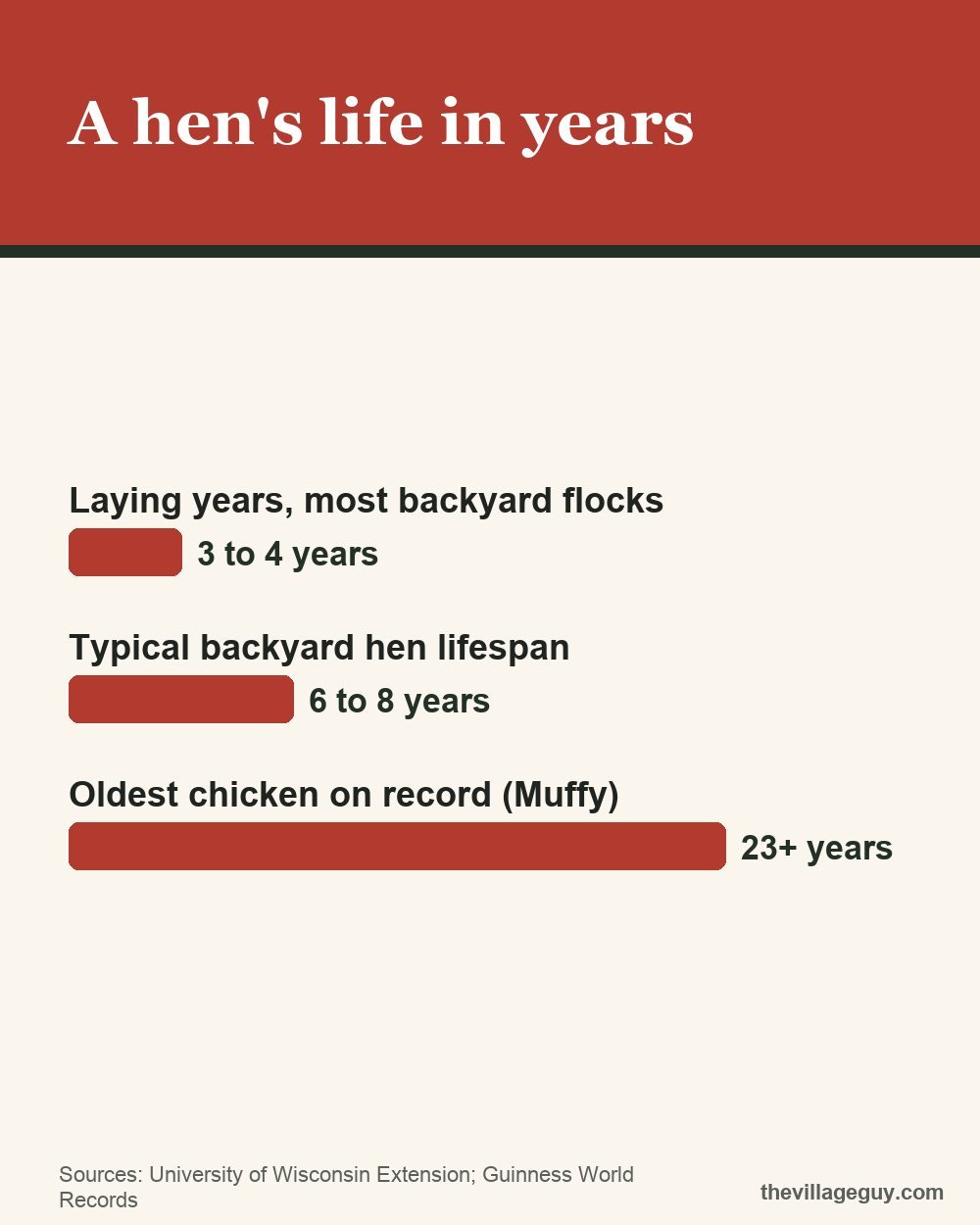
Records make good trivia but poor planning numbers. Guinness also verified Peanut, a hen from Michigan, as the world’s oldest living chicken in 2023; she died at least 21 years 238 days old, according to its January 2024 report. Birds like that are outliers with exceptional luck and care. Plan around 6 to 8 years and be pleasantly surprised.
How Long Do Backyard Chickens Live? Life Stages From Chick to Retiree
A backyard hen’s life falls into five rough stages. The exact timing shifts with breed, season and care, but the order never changes.
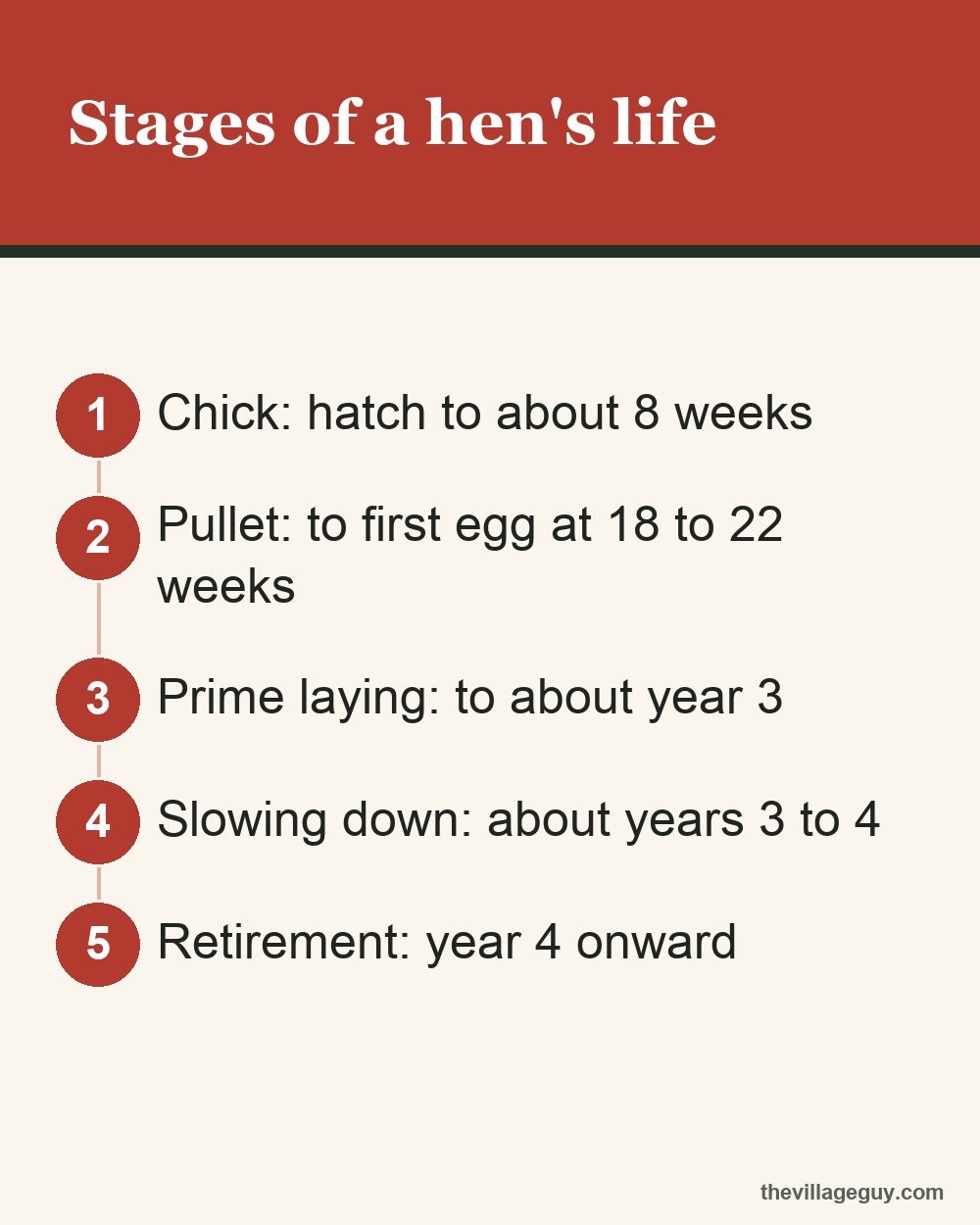
- Chick (hatch to about 8 weeks): brooder heat, starter feed, and the age when Marek’s disease vaccination matters most.
- Pullet (about 8 weeks to first egg): most start laying at 18 to 22 weeks; our guide on when chickens start laying eggs covers the signs and timeline.
- Prime laying years (first egg to about year 3): the University of Florida says many hens decline significantly after two or three years.
- Slowing down (about years 3 to 4): Wisconsin notes egg numbers, egg size and shell quality all drop each year.
- Retirement (year 4 onward): few or no eggs, but often several more years of foraging, bug patrol and personality.
Because laying fades long before life does, Wisconsin Extension recommends planning to retire old hens and add young pullets every 2 to 3 years. If eggs dwindle earlier than this timeline suggests, the cause may be seasonal or fixable; our troubleshooting guide on why chickens stop laying eggs sorts age from everything else.
What Shortens a Chicken’s Life
Few backyard chickens reach their natural limit. Predators, infectious disease, reproductive problems and parasites account for most early losses. Each has a prevention that costs far less than the bird.
| Threat | What the sources say | Best prevention |
|---|---|---|
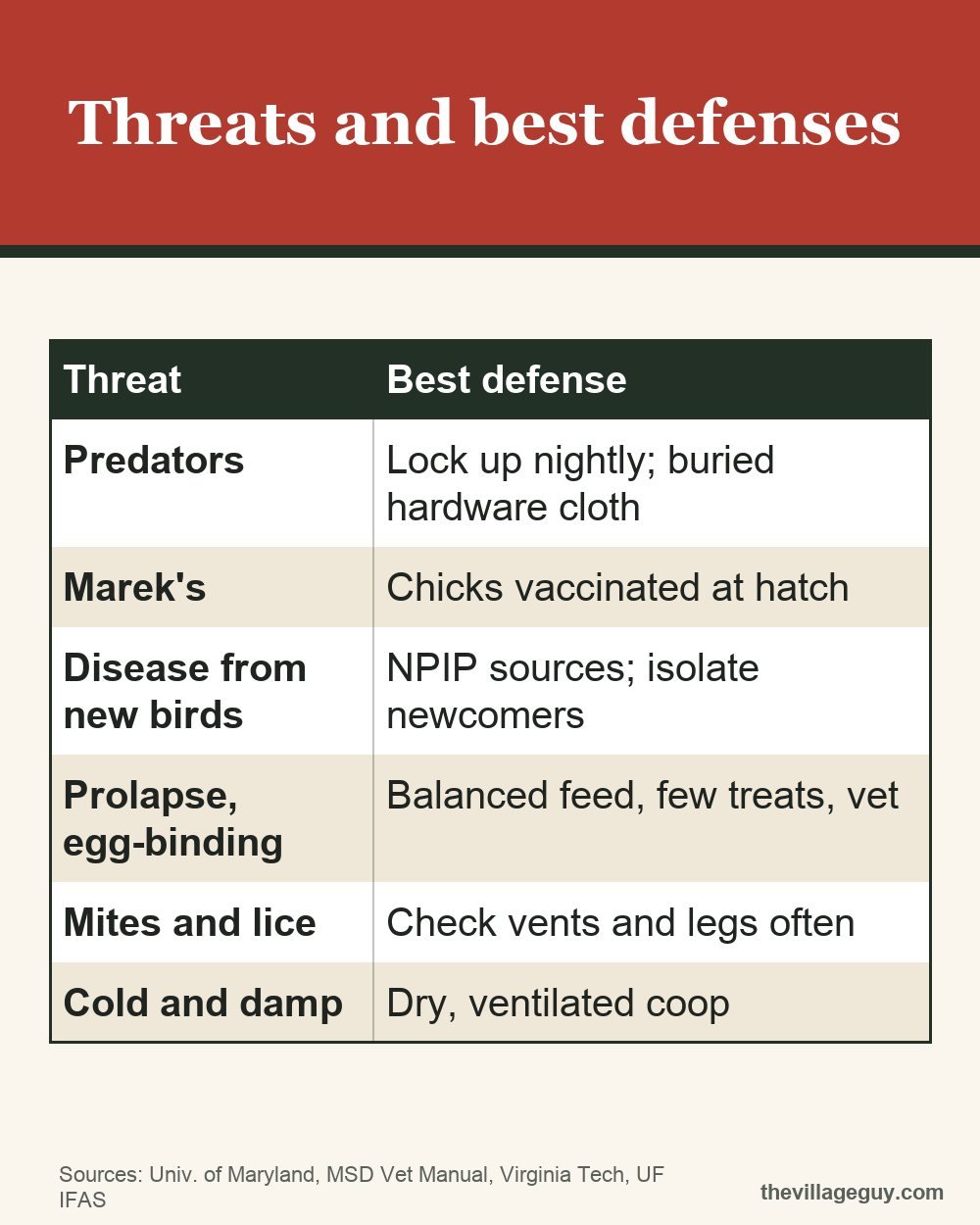
| Predators | Coyotes, dogs, foxes, hawks and owls, raccoons, opossums, skunks, rats, snakes and weasels all take poultry (University of Maryland). | Lock birds in at night; bury hardware cloth; cover the run. |
| Marek’s disease | A herpesvirus that can strike chickens as young as 3 weeks, causing leg paralysis and tumors; spread in dander and survives for months in litter and dust; no treatment (MSD Veterinary Manual). | Buy chicks vaccinated at hatch or in the egg. |
| Diseases brought in by new birds | Virginia Tech advises NPIP-certified sources and isolation; USDA’s Defend the Flock program centers on biosecurity. | Buy from NPIP-certified sources; keep new birds separate for a few weeks. |
| Reproductive problems | Egg-binding, internal laying and prolapse stop laying for good (Oregon State); prolapse is often fatal, and overweight hens are at higher risk (University of Florida). | Feed a balanced layer ration, limit treats, call a vet early. |
| Parasites | Northern fowl mites cause anemia; scaly leg mites cause thickened, crusted legs and lameness, mostly in older birds (MSD; University of Florida). | Check vents and legs regularly; ask a vet about treatment. |
| Weather extremes | Damp, drafty coops lead to frostbite and cold stress; heat stress cuts feed intake. | Dry, ventilated housing, shade and unfrozen water. |
Winter is its own topic: our guide to keeping chickens warm in winter covers ventilation, frostbite and why heat lamps are a fire risk.
Predator-Proofing: The Biggest Lifespan Lever
A hen that is locked up safely every night has already beaten the most common cause of an early end. The University of Maryland Extension’s predation guide boils it down to a few habits and one weekend of digging.
Lock up at night, every night
Maryland’s first rule is to lock birds up during the night and keep a vigilant eye. A coop door left open once can undo years of good care. An automatic door on a timer or light sensor is a common solution for owners who are not home at dusk.
Stop the diggers and the reachers
Maryland recommends digging a trench 12 inches to 1.5 feet deep around the entire coop and burying hardware cloth in it. Utah State University Extension adds heavy-gauge wire mesh beneath the floor and warns that rodents can enter through holes the size of a nickel or quarter. For snakes, Maryland suggests limiting gaps larger than 1/4 inch where chickens roost.
Cover the top
Hawks and owls hunt from above, so Maryland advises covering outdoor runs with mesh wire or netting. Hawks such as the red-tailed and Cooper’s hawk and owls such as the great horned owl are on the federal list of migratory birds protected under the Migratory Bird Treaty Act, which bars killing or capturing them without US Fish and Wildlife Service authorization. For a persistent problem, Maryland suggests asking local wildlife authorities for help.
Health Habits That Add Years
Long-lived flocks are rarely lucky flocks. They are flocks where problems get spotted early. Two minutes of hands-on checking each week catches most issues before they turn serious, and biosecurity keeps the worst diseases out in the first place.
Copy-ready flock health checklist
- Order chicks that were vaccinated for Marek’s disease at the hatchery.
- Buy birds and hatching eggs only from NPIP-certified sources.
- Keep new adult birds in a separate pen for a few weeks before mixing.
- Keep dedicated boots or boot covers for the coop and wash hands after chores.
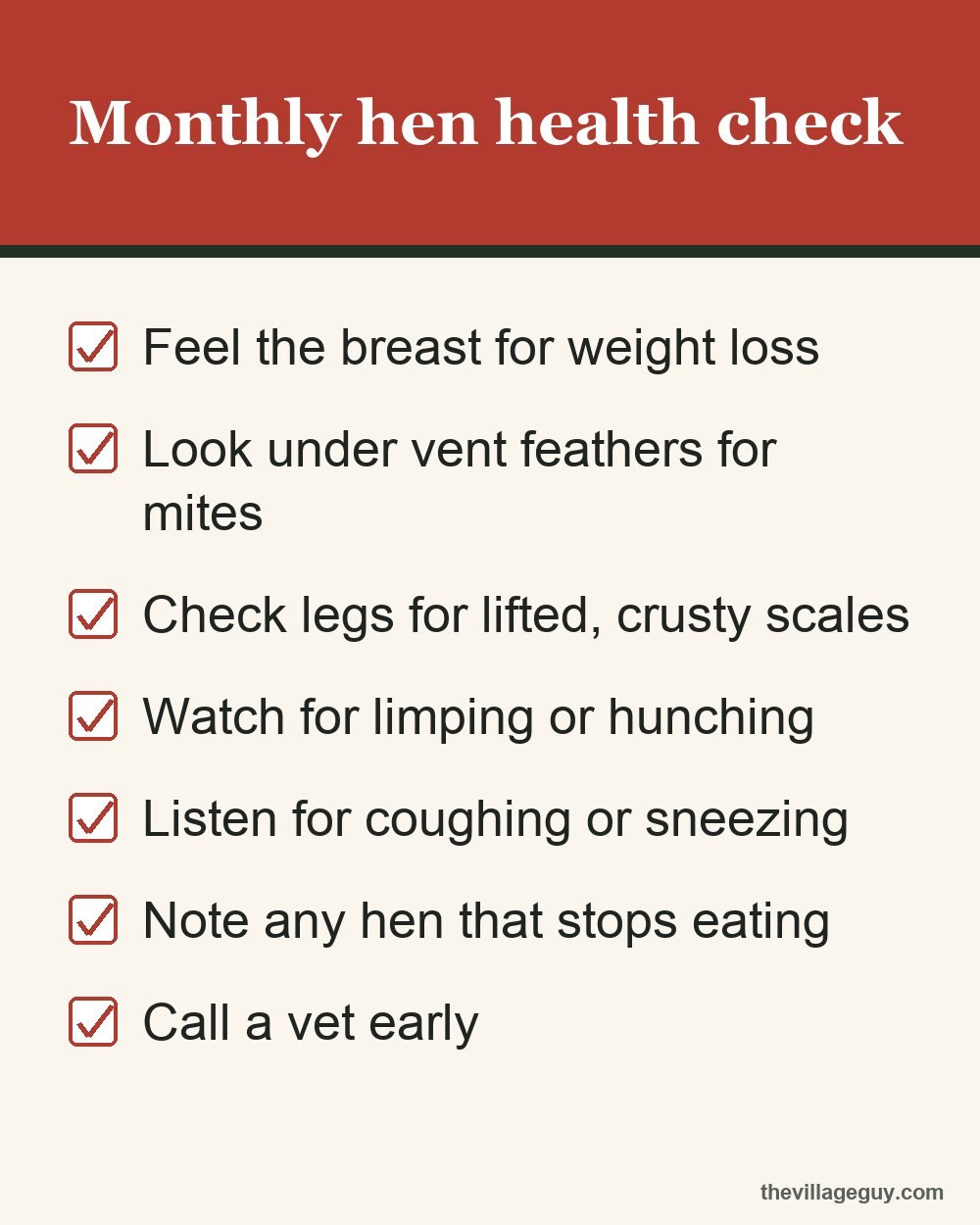
- Pick up each bird monthly and feel the breast for weight loss.
- Part the feathers around the vent to look for mites and lice.
- Look at the legs for lifted, crusty scales.
- Feed a complete layer ration and keep treats small.
- Write down any bird that is lame, hunched, coughing or off feed, and call a vet.
- Report sudden deaths or several sick birds to your vet, state veterinarian or USDA at 1-866-536-7593.
Diet matters more as hens age, because the University of Florida links obesity and oversized eggs to prolapse, which is often fatal. Our guide to what chickens eat covers balanced rations and safe treats.
Safety: Do not medicate chickens on your own. Diagnosis, drug choice and dosing belong with a veterinarian, and many poultry medications carry egg withdrawal periods. If several birds are sick or dying, USDA APHIS asks owners to report it quickly to a state veterinarian or to USDA at 1-866-536-7593.
How to Tell How Old a Chicken Is: 6 Clues
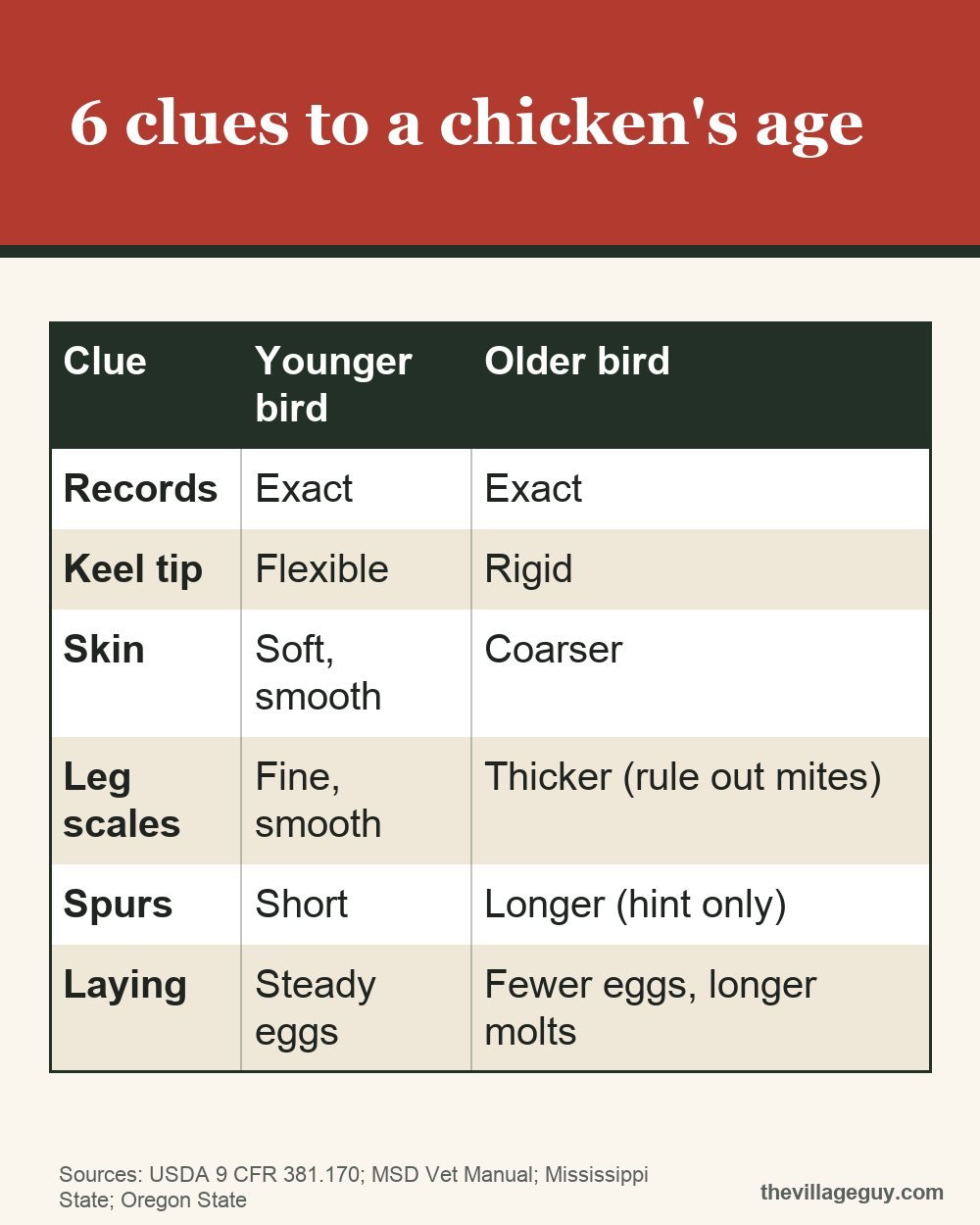
Without records, nobody can tell a chicken’s exact age. What you can do is sort birds into young, adult and probably old, which is enough to plan. These clues run from most reliable to least.
1. Paperwork and leg bands
The only exact method. Hatch receipts, a dated photo or a colored leg band added each year turns guesswork into fact. Start now with any birds you add.
2. The breastbone tip
USDA’s poultry class definitions rely on the end of the breastbone (keel). Broilers under 10 weeks have flexible breastbone cartilage, roasters under 12 weeks have cartilage that is somewhat less flexible, and adult hens over 10 months have a nonflexible breastbone tip. Gently pressing the tip separates a young bird from an adult.
3. Skin texture
The same definitions describe young birds as having soft, pliable, smooth-textured skin and an adult rooster as having coarse skin. It is a rough clue on a live bird, but noticeable once you have handled a few.
4. Leg scales
Keepers commonly find that leg scales look rougher and thicker on older birds. Be careful: the MSD Veterinary Manual notes that scaly leg mites cause thickened, encrusted legs, mostly in older birds, so a crusty leg can be a parasite rather than a birthday. Ask a vet if the scales are lifting.
5. Spurs on roosters
Roosters grow spurs on the back of the legs, and longer spurs are commonly taken as a sign of an older bird. No extension source publishes a reliable spur-length age chart, so treat this as a hint only.
6. Laying history
For yellow-skinned breeds, Mississippi State University Extension explains that pigment fades from the vent, eye ring, beak and finally the shanks as a hen lays, so a hen with bleached legs has been laying for months. Fewer eggs, longer molts and more frequent molts point to an older hen, as Oregon State and the University of Florida describe.
Planning for the Retirement Years
The arithmetic is simple and worth doing before you buy chicks. If a hen lives 7 years and lays well for about 3, she spends more than half her life as a pensioner. Ohio State puts a laying hen at about 2 pounds of feed a week, roughly 100 pounds a year, and retired hens still need to eat. The University of Maine suggests about 1.5 hybrid layers per person (or 2 heritage hens) for a steady egg supply, so a family of four keeping only productive birds would need about six hybrids, replaced every few years.
Owners handle the older birds in different ways. Many keep them for pest control, garden scratching and simple affection. Some rehome them. Others process them for the table; Wisconsin Extension notes that laying hens bred for egg production have tough meat, which is why older hens suit slow cooking. Whatever you choose, check local rules on flock size and slaughter, and if an old hen is clearly suffering, talk to a vet about humane euthanasia.
Retirement planning checklist
- Record each bird’s hatch year with a leg band or a coop logbook.
- Decide before buying chicks what will happen to hens that stop laying.
- Budget feed for every bird, laying or not.
- Plan to add a few pullets every 2 to 3 years to keep eggs coming.
- Check town or county limits on total flock size before adding birds.
For more on raising a flock from start to finish, browse the village life guides.
Chicken Lifespan FAQ
How long do roosters live?
None of the extension sources used here publishes a separate lifespan figure for roosters, and they face the same main threats as hens. Local rules often decide a rooster’s future more than biology does, because many towns limit or ban them, so check your ordinance before keeping one.
How long do free-range chickens live?
It depends almost entirely on predator protection. Free-ranging birds face every predator on the University of Maryland’s list, from foxes to hawks, so the free-range flocks that last are the ones shut into a secure coop every night and given covered areas to dash under by day.
What was the oldest chicken ever?
Guinness World Records lists Muffy, a Red Quill Muffed American Game hen from the US, who lived 23 years 152 days (1989 to 2012). Peanut from Michigan, recognised in 2023 as the oldest living chicken, died at least 21 years 238 days old, Guinness reported in January 2024.
Do hens keep laying until they die?
Usually not. Wisconsin Extension says most backyard flocks lay for 3 to 4 years of a 6 to 8 year life, with egg numbers, size and shell quality falling each year. Some older hens still lay a few eggs when days are long, while others stop entirely.
Sources
- University of Wisconsin Extension: Life Cycle of a Laying Hen (6 to 8 year backyard lifespan, 3 to 4 laying years, commercial layers kept 2 to 3 years, add pullets every 2 to 3 years, tough meat of laying breeds)
- 9 CFR 381.170 (USDA FSIS poultry classes), via Cornell Law School LII (broiler, roaster and hen ages; breastbone and skin descriptions)
- Guinness World Records: World’s oldest chicken, Peanut, dies aged 21 (Peanut’s age, Muffy’s record)
- MSD Veterinary Manual: Marek’s Disease in Poultry (age of onset, signs, spread, no treatment, vaccination)
- MSD Veterinary Manual: Mites of Poultry (scaly leg mites in older birds)
- University of Maryland Extension: Prevention of Predation (predator list, night lockup, buried hardware cloth, run cover, snake gaps)
- Utah State University Extension: Housing Backyard Chickens (wire under floors, rodent-size holes)
- University of Florida IFAS Extension: Factors Affecting Egg Production in Backyard Chicken Flocks (PS-35) (decline after 2 to 3 years, prolapse risk, mites)
- Oregon State University Extension: Why did my chickens stop laying? (PNW 565) (reproductive problems and age)
- Virginia Tech Extension: 5 Factors that Impact Egg Production (two laying cycles, NPIP, isolating new birds)
- Mississippi State University Extension: Culling Hens (pigment fading with lay)
- USDA APHIS Defend the Flock: How to Spot Sickness (reporting sick birds)
- US Fish and Wildlife Service: Migratory Bird Treaty Act of 1918 (taking protected birds requires authorization)
- 50 CFR 10.13: List of Migratory Birds, via Cornell Law School LII (red-tailed hawk, Cooper’s hawk, great horned owl listed)
- Ohio State University Extension: Winter and Your Backyard Chickens (ANR-66) (about 2 pounds of feed per laying hen per week)
- University of Maine Cooperative Extension: Bulletin 2104 (hens per person)