A cow at a Missouri sale barn in late October 2026 cost anywhere from about $1,600 for a cull cow sold by the pound to $5,400 for a top cow with a big calf at her side. That spread is the honest answer to how much does a cow cost: it depends on what kind of cow, how old, how heavy, whether she is bred, where you buy, and which week you show up. Cattle prices in 2026 are running near record highs, so numbers from a few years ago will badly undershoot.
Quick answer: In October 2026 USDA auction reports, a 500 to 550 lb feeder steer calf brought roughly $2,250 to $2,550 a head, bred cows about $3,300 to $3,550, bred heifers about $3,400 to $4,800, and cow-calf pairs about $3,500 to $4,450. The U.S. average for a replacement dairy cow was $3,260 in July 2026 (USDA NASS). Keeping a beef cow then costs roughly $800 to $2,000 a year in extension budgets, mostly feed.
In this guide
- How much does a cow cost in 2026: prices by type
- How cattle prices are quoted
- Price of a cow by type, in detail
- Cost of a cow for the freezer: quarter, half or whole
- What a cow costs to keep each year
- Worked example: three bred cows, year one
- Why cattle cost so much right now
- What you’ll need before the cattle arrive
- Buying tips and what to ask a seller
- Cow cost FAQ
How much does a cow cost in 2026: prices by type
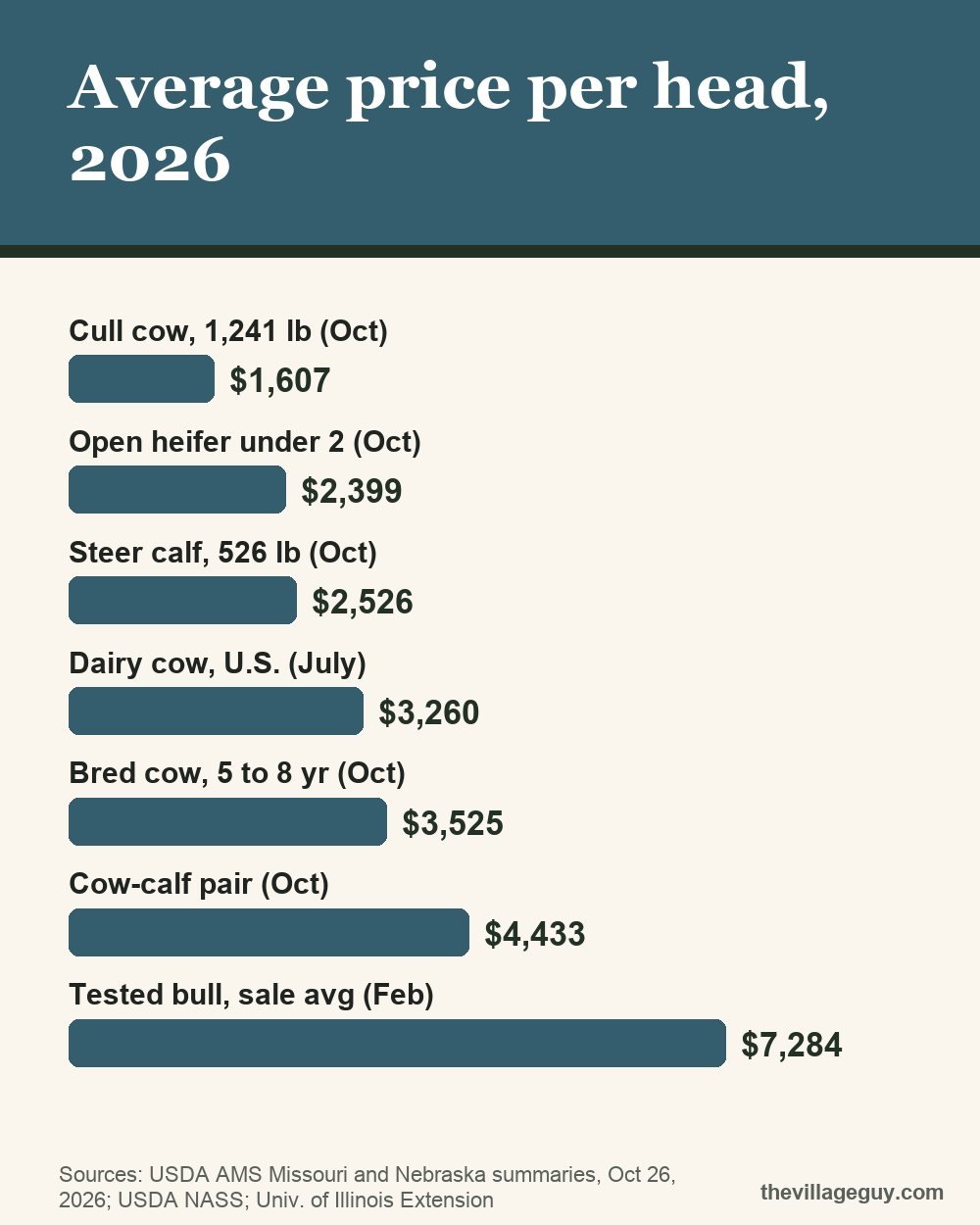
The figures below come from the USDA Agricultural Marketing Service weekly auction summaries for Missouri and Nebraska (both covering the week of October 18 to 24, 2026, released October 26), USDA NASS for dairy cows, and a University of Illinois Extension bull sale. They are averages and ranges for the most common grades (Medium and Large 1 and 1-2), so a fancy animal sells higher and a plain one lower.
| Type | Typical 2026 price | Where and when |
|---|---|---|
| Feeder steer calf, 500 to 550 lb | About $2,265 to $2,525 a head ($430 to $480 per cwt average) | Missouri and Nebraska auctions, Oct 2026 |
| Feeder heifer calf, 500 to 550 lb | About $2,200 a head ($423 per cwt average) | Nebraska auctions, Oct 2026 |
| Open heifer under 2 years | $2,250 to $2,700 (average $2,399) | Missouri auctions, Oct 2026 |
| Bred heifer | $3,000 to $4,775 (averages $3,398 to $4,775) | Missouri and Nebraska auctions, Oct 2026 |
| Bred cow, 5 to 8 years | $3,150 to $3,850 (averages $3,315 to $3,525) | Missouri and Nebraska auctions, Oct 2026 |
| Cow-calf pair | $3,000 to $4,475 (averages $3,493 to $4,433) | Missouri auctions, Oct 2026 |
| Bull under 2 years, sale barn | $2,200 to $4,800 (average $3,684) | Missouri auctions, Oct 2026 |
| Performance-tested bull | Average $7,284, top $15,000 | Illinois sale, Feb 2026 |
| Replacement dairy cow | U.S. average $3,260 (states $3,050 to $3,500) | USDA NASS, July 2026 |
| Cull (slaughter) cow, about 1,240 lb | About $1,600 ($129 per cwt average) | Missouri auctions, Oct 2026 |
So how much is a cow for someone starting small? Plan on about $3,300 to $3,900 for a sound, middle-aged bred cow at a fall 2026 sale barn, and more from a registered breeder. Prices vary by region, weight, season and the week’s market, so check a current report before you go.
How cattle prices are quoted
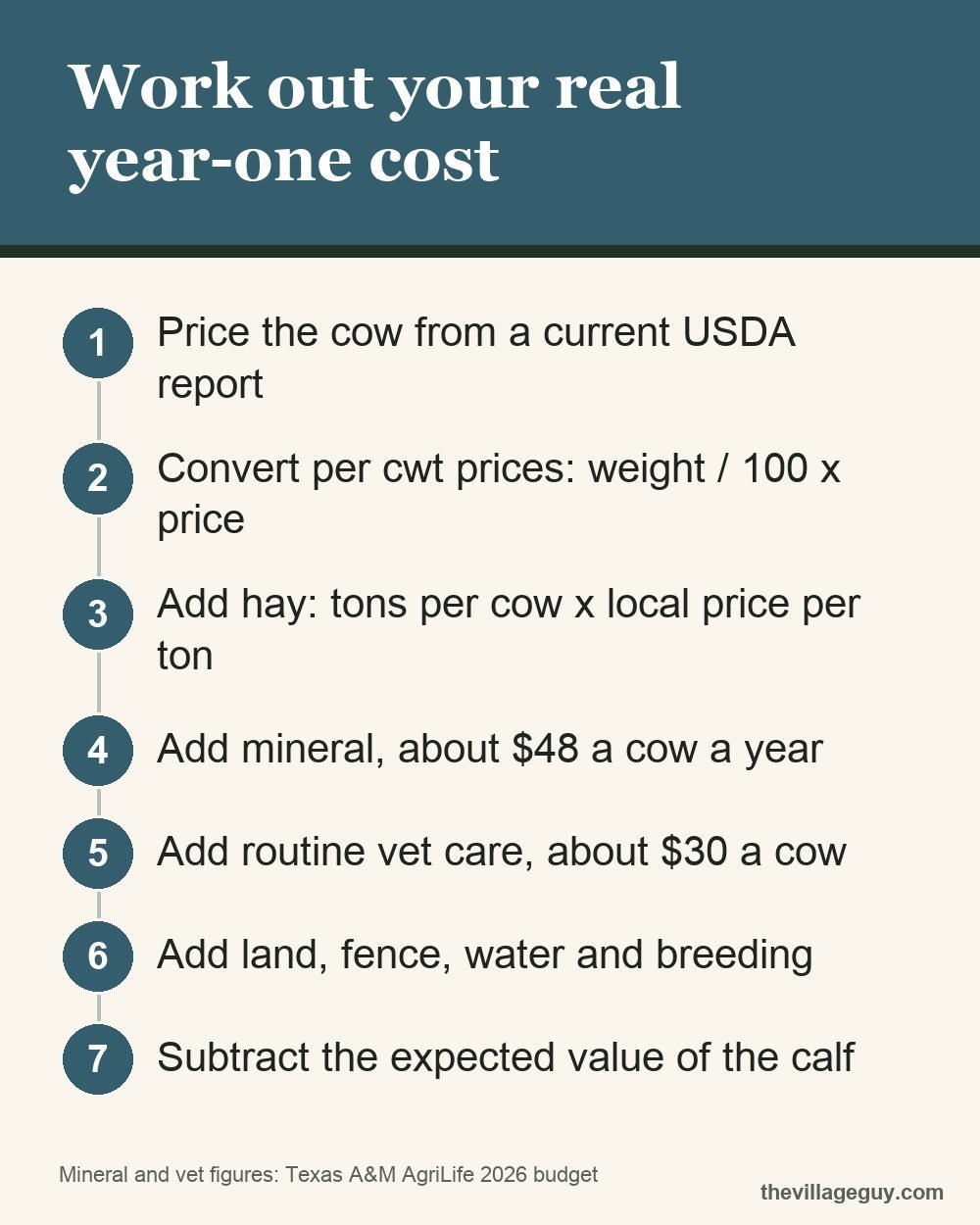
Sale barn reports price lighter cattle per hundredweight (cwt, meaning 100 pounds) and breeding cattle per head. To turn a cwt price into a check you will write, divide the weight by 100 and multiply by the price.
- 526 lb steer x $480.29 per cwt = 5.26 x 480.29 = about $2,526 a head
- 580 lb steer x $449.43 per cwt = 5.80 x 449.43 = about $2,607 a head
- 1,241 lb cull cow x $129.47 per cwt = 12.41 x 129.47 = about $1,607 a head
Those three lines use the Nebraska and Missouri averages from the week of October 18 to 24, 2026. Notice the slide: per pound, heavier calves bring less, even though each one costs more in total. In the Nebraska report, 500 to 549 lb steers averaged $480.29 per cwt while 600 to 648 lb steers averaged $430.58.
Report terms worth knowing
- Medium and Large 1, 1-2, 2: frame size and muscling grades; 1 is the heaviest-muscled, and most prices you hear quoted are for 1 or 1-2.
- T1, T2, T3: stage of pregnancy, from first trimester (1 to 3 months) to third (7 to 9 months), as defined in the USDA reports.
- O: open, meaning not pregnant.
- Broken mouth: an older cow missing teeth, usually priced well below a young cow.
- Unweaned, fleshy, thin fleshed, fancy: condition notes that move the price up or down.
Price of a cow by type, in detail
Feeder calves (to raise for beef)
A weaned steer calf is the usual way a family starts raising its own beef. In the Missouri summary for October 18 to 24, 2026, Medium and Large 1 steers weighing 500 to 548 lb averaged $429.88 per cwt; in Nebraska the same class at 501 to 549 lb averaged $480.29. The Nebraska report noted steer calves sold $6 to $12 higher than the week before, which shows how fast these numbers move. Heifer calves usually sell below steers of the same weight.
Bred heifers and bred cows
A bred heifer is a young female carrying her first calf; a bred cow has calved before. In Missouri that October week, Medium and Large 1 bred cows aged 5 to 8 in the second trimester averaged $3,524.62, and young bred heifers under 2 years in the second trimester brought $4,775. In Nebraska, bred heifers under 2 averaged $3,397.76 to $3,756.16 depending on stage, while bred cows over 8 years with broken mouths sold for about $1,900 to $2,675.
Age is the quiet price driver. An older cow is cheaper because she has fewer calves left in her; our guide to how long cows live explains how long a beef cow typically stays productive and how to age one by her teeth.
Cow-calf pairs
A pair is a cow with her calf at side, so you get two animals and skip a calving. Missouri pairs that week ranged from about $2,350 for a broken-mouth cow with a small calf to $5,400 for a pair with a calf over 300 lb that was already bred back. Medium and Large 1 cows aged 5 to 8 with a 150 to 300 lb calf averaged $4,433.
Bulls
At Missouri sale barns in late October 2026, Medium and Large 1-2 bulls under 2 years averaged $3,683.54. Bulls with performance data and a breeding soundness exam cost more: the University of Illinois Extension’s Illinois Performance Tested Bull Sale on February 19, 2026, averaged $7,284 on 37 lots, a record for that sale, with a top of $15,000. With only two or three cows, many small farms skip owning a bull and use artificial insemination or borrow a neighbor’s bull, which is worth pricing before you buy one.
Dairy cows and family milk cows
USDA NASS reports what farmers receive for cows sold as dairy herd replacements. The U.S. average was $3,260 a head in July 2026, up from $3,000 in July 2025, with states ranging from $3,050 in New Mexico to $3,500 in Arizona. A gentle, hand-milking family cow sold privately can land well outside that range, and NASS figures are commercial averages rather than a family cow quote.
Cost of a cow for the freezer: quarter, half or whole
If you only want the beef, buying a share from a local farm is the cheaper route than buying and raising an animal. Freezer beef is usually priced by hanging (carcass) weight, either with processing included or with processing billed separately by the butcher. USDA’s quarterly National Grass Fed Beef Report for July to September 2026 (released September 25, 2026) gives these direct-to-consumer figures for grass-fed beef:
| Share | Hanging weight, processing extra | Hanging weight, processing included | Per lb of packaged meat |
|---|---|---|---|
| Whole | $4.00 to $7.90 (avg $5.90) | $5.25 to $8.50 (avg $7.36) | $6.85 to $15.50 (avg $11.90) |
| Half | $4.25 to $6.95 (avg $5.76) | $5.25 to $9.75 (avg $7.71) | $8.75 to $16.50 (avg $12.39) |
| Quarter | $4.50 to $8.00 (avg $6.23) | $6.50 to $9.00 (avg $7.69) | $9.00 to $18.03 (avg $13.30) |
When processing is billed separately, the same report puts it at $0.57 to $1.25 per pound of hanging weight (average $0.94) plus a slaughter fee of $100 to $150 a head. Deposits averaged about $449 for a half and $262 for a quarter. Grain-finished beef from a local farm may price differently, so ask which kind you are getting.
The trap in freezer beef math is weight. Hanging weight is less than live weight, and the meat you bring home is less again after cutting and trimming. Our guide to how much a cow weighs walks through live weight, hanging weight and take-home beef so you can compare a farm’s quote with the price per pound at the store.
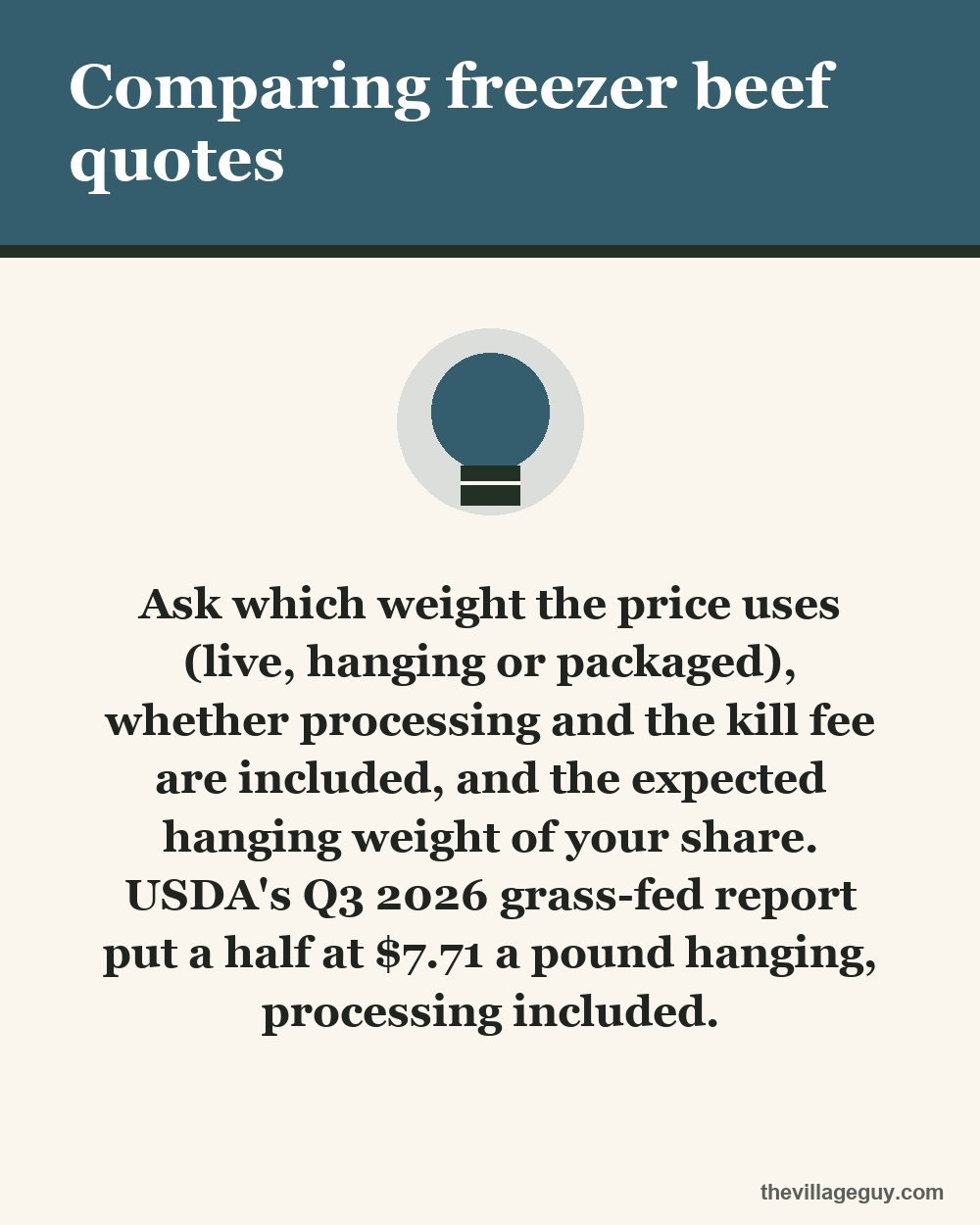
Tip: Ask every seller the same three things: the price per pound and which weight it applies to (live, hanging or packaged), whether processing and the kill fee are included, and the expected hanging weight of your share. Without all three, two quotes cannot be compared.
What a cow costs to keep each year
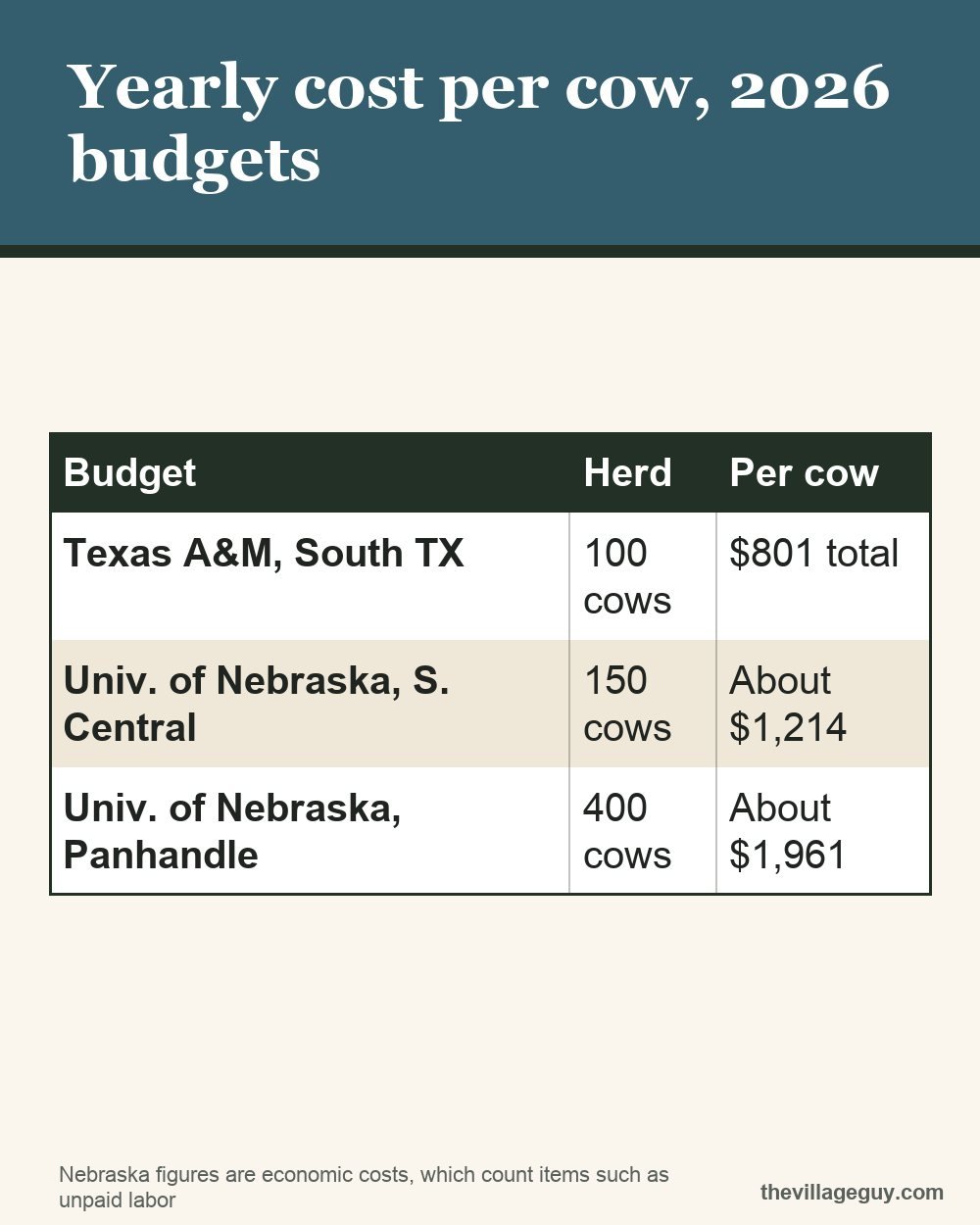
The purchase price is the smaller number over time. Extension enterprise budgets put the annual cost of keeping a beef cow in a wide band because they differ on climate, how long hay is fed, and whether land and labor are counted. Feed is always the biggest piece: a University of Nebraska analysis puts grazed and harvested feed at 40 to 70 percent of annual cow costs.
| 2026 budget | Setting | Annual cost per cow | What it includes |
|---|---|---|---|
| Texas A&M AgriLife, District 10 | 100 cows, 20 acres each, South Texas | $800.69 total ($359.94 variable) | Hay, mineral, protein cubes, vet, fuel, repairs, interest, pasture at $186 |
| University of Nebraska, South Central | 150-cow herd | About $1,214 economic cost | Includes about $30 vet and about $200 unpaid labor |
| University of Nebraska, Northern Panhandle | 400-cow herd | About $1,961 economic cost | Feed about $801, vet about $35 |
Inside the Texas A&M budget, the line items are a useful shopping list: about 1,800 lb of round-bale hay at $0.07 a pound ($127.50), about 80 lb of loose mineral at $0.60 a pound ($47.82), 3 cwt of protein cubes ($59.70) and roughly $30 of vaccines, dewormer, pregnancy checks and bull exams per cow. That is a mild-winter budget. Where snow covers the grass for months, hay is the line that grows.
Hay: the cost that sets your budget
University of Wisconsin extension’s winter example assumes 1,200 lb cows eating about 2 percent of body weight a day in dry matter, budgets 32 lb of hay per head per day after storage and feeding losses, and comes out at about 3.2 tons per cow for a 197-day feeding season (October 1 to April 15). USDA NASS put the U.S. average price of non-alfalfa (other) hay at $152 a ton in August 2026 and all hay at $190. Weigh a few of your own bales, because a bale that is lighter than you think leaves you short in March.
Small herds pay more per cow
Budgets built for 100 to 400 cows spread the bull, equipment and labor across many animals. With two or three cows, the farm call, trailer and hay feeder cost about the same as for ten, so expect to sit at or above the high end.
Worked example: three bred cows, year one
Here is what the first year looks like for someone in a cold-winter area buying three middle-aged bred cows at a fall 2026 sale and feeding hay through winter. Every number comes from a source on this page; your own will differ.
| Item | Math | Cost |
|---|---|---|
| 3 bred cows, 5 to 8 years, 2nd trimester | 3 x $3,524.62 (Missouri, Oct 2026) | $10,574 |
| Winter hay | 3 cows x 3.2 tons x $152 a ton (Wisconsin example; NASS Aug 2026) | $1,459 |
| Loose mineral | 3 x about $48 (Texas A&M 2026 budget) | $144 |
| Routine vet and vaccines | 3 x about $30 (Texas A&M and Nebraska budgets) | $90 |
| Year one total | Before land, fence, water, bull, equipment, trucking | $12,267 |
That works out to about $564 a cow in feed, mineral and routine vet care, which is in line with the variable costs in the Texas budget once heavier winter hay is added. What it leaves out matters: pasture rent or land payments, fence repairs, a farm call for a sick cow, breeding, hauling and your time. Those are exactly the items that push the Nebraska economic budgets to $1,200 to $2,000 per cow.
On the other side of the ledger, each cow should raise a calf. A 550 to 597 lb steer calf averaged $408.53 per cwt at Missouri auctions that October week, or about $2,350 for a 576 lb calf. That is why cattle can pay at today’s prices, and also why a lost calf or an open cow hurts so much.
Why cattle cost so much right now
The short answer is a small herd. USDA NASS counted 86.2 million cattle and calves on U.S. farms on January 1, 2026, down from 86.5 million a year earlier, and 27.6 million beef cows, down about 1 percent. Fewer cows means fewer calves, and buyers bid harder for each one. Our cow facts guide has more of the national numbers.
USDA NASS put calves at $455 per cwt in August 2026 and all beef cattle at $231, which was $15 below July and $5 below August 2025. Weather, feed prices and herd rebuilding all move the market, so check a current report rather than assuming today’s level will hold.
What you’ll need before the cattle arrive
Have these ready before the trailer pulls in, because a loose cow on a country road is an expensive first day.
- Perimeter fence: woven wire, barbed or multi-strand high-tensile electric suited to cattle, tight and checked along its full length before stock arrive.
- Electric fence energizer: sized in miles or joules for your fence length and vegetation load, with a proper ground rod system.
- Water tank or automatic waterer: big enough for the herd’s daily drinking, with a tank heater or frost-free waterer for freezing climates.
- Hay feeder or ring: a ring with a skirt or panel cuts waste; Wisconsin extension’s example assumed only 6 percent feeding loss with one.
- Covered mineral feeder: keeps loose mineral dry and lets cows take it free choice.
- Catch pen and headgate: a small pen and a headgate or squeeze chute so a vet can safely check, vaccinate or treat a cow.
- Livestock trailer access: your own stock trailer or a hauler lined up, sized for the heaviest animal you will move.
- Weatherproof hay storage: a shed, tarp or rock pad off the ground to limit storage loss.
Buying tips and what to ask a seller
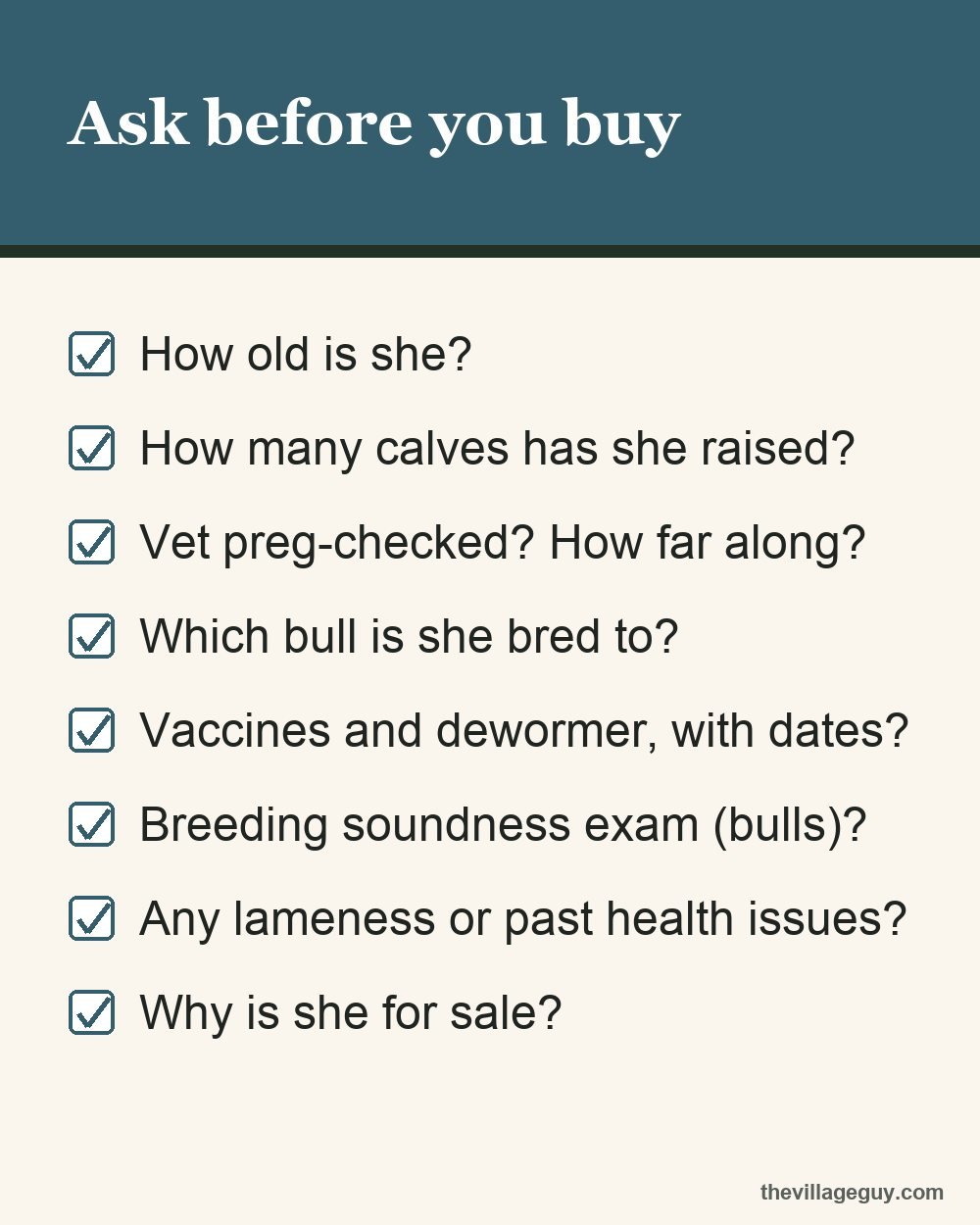
NDSU Extension’s beef specialists have long pointed out that buyers of replacement cows rarely ask even basic health questions, such as whether the cows were vaccinated and with what. Asking is free, and the answers say a lot about the seller.
Before you buy
- Look up a current USDA auction report for your state the week you plan to buy
- Price the year: hay, mineral, vet, pasture and breeding, not just the cow
- Line up a large-animal vet before you need one
- Check local zoning and any county rules on livestock for your acreage
- Ask your extension office how many acres per cow your pasture will carry
- Weigh or measure your hay supply against a full winter’s need
At the sale or the farm
- Confirm pregnancy and stage with a vet check, not a guess
- Ask for the vaccination and deworming records in writing
- Ask the cow’s age and check her teeth if you can
- Ask for a breeding soundness exam on any bull 12 months or older
- Watch each animal walk for lameness before you bid
- Keep new arrivals apart from your other cattle until your vet clears them
The University of Georgia’s bull buyer’s guide recommends a physical and semen exam on any bull 12 months or older, and SDSU Extension suggests checking calving dates against your facilities and labor. These lines can go straight into a text to a seller:
- How old is she, and how many calves has she raised?
- Was she preg-checked by a vet, and how far along is she?
- Which bull is she bred to, and is he known for easy calving?
- What vaccines and dewormer has she had, and when?
- Why are you selling her?
Cow cost FAQ
How much is a cow per pound?
Breeding cows are usually sold per head, but feeder calves and cull cows sell per hundredweight. In the Missouri report for October 18 to 24, 2026, 500 to 548 lb steers averaged $429.88 per cwt (about $4.30 a pound live), while slaughter cows of the common Boner grade averaged $129.47 per cwt (about $1.29 a pound).
What is the cheapest way to get a cow?
An older bred cow or a weaned heifer calf costs less up front than a young bred cow or a pair, but each has a catch. The older cow has fewer calves left, and the heifer calf needs a year or more of feed before she can be bred. Count the feed and waiting time before calling either one a bargain.
Is it cheaper to buy a cow or buy beef?
For most families who just want meat, buying a share is cheaper and simpler. USDA’s third-quarter 2026 grass-fed report put a half at an average of $7.71 per pound of hanging weight with processing included, with no hay, fence or vet bills. Raising your own makes more sense if you already have pasture, water and fence.
How many acres do you need for one cow?
University of Georgia Extension uses about 2 acres per animal unit as a rough figure for most pastures in its region, and drier rangeland can need many times that. Your county extension office or NRCS can give a stocking rate for your soil and grass.
Sources
- USDA AMS Market News: Missouri Weekly Cattle Auction Summary (Oct 26, 2026) (feeder, bred cow, bred heifer, pair, bull and slaughter cow prices)
- USDA AMS Market News: Nebraska Weekly Livestock Auction Summary (Oct 26, 2026) (feeder steer and heifer prices, bred cows and heifers, pregnancy stage definitions)
- USDA NASS: Agricultural Prices (Sept 29, 2026) (milk cow prices by state, calf and beef cattle prices, hay prices)
- USDA AMS: National Grass Fed Beef Report, Q3 2026 (freezer beef by whole, half and quarter; processing and slaughter fees)
- University of Illinois Extension: 2026 Illinois Performance Tested Bull Sale (bull sale average and top price)
- Texas A&M AgriLife Extension: 2026 Cow-Calf Budget, District 10 (annual costs per cow, hay, mineral and vet line items)
- University of Nebraska Center for Agricultural Profitability: 2026 South Central 150-cow budget (economic cost per cow, vet, unpaid labor)
- University of Nebraska Center for Agricultural Profitability: 2026 Northern Panhandle 400-cow budget (feed and total economic cost per cow)
- Beef Magazine: Annual cow costs higher in 2026 (University of Nebraska analysis of feed as 40-70% of cow costs)
- University of Wisconsin-Madison Extension: Thinking Ahead for Our Winter Hay Needs (hay per cow per day and per season, storage and feeding losses)
- USDA NASS: Cattle (Jan 30, 2026) (U.S. cattle and beef cow inventory)
- NDSU Extension BeefTalk: buying replacement cows (ask about vaccination and health history)
- University of Georgia Extension: Bull Buyer’s Guide (physical and semen exam for bulls 12 months or older)
- SDSU Extension: Purchasing Bred Females (2025) (check calving dates, facilities and labor)
- University of Georgia Extension: Understanding Stocking Rate in Pasture Systems (about 2 acres per animal unit)
Find more cattle, poultry and homestead guides on our guides page.